Conference – Day 2: Activism

I began the day with an early morning trek to the Philadelphia Museum of Art. It was too early to enter the museum and see the exhibits, but that is not what I was there for, anyway. Like millions of others over the years, I visited the museum to see the Rocky steps. You know, the ones Rocky tackled as part of his training for the big fight in the original Rocky film. One of the reasons that movie has inspired so many is the whole idea of one regular guy taking on a corrupt system and, through application of hard work and heart, overcoming the odds that are stacked so high against him.

Turns out, this was a fitting way to begin the second day at the NASPA Conference. The morning’s featured speaker was Emmanuel Jal, whose autobiography War Child tells the story of his turbulent youth in Sudan, where he witnessed many atrocities, at the age of eight became a child soldier, then a refugee and one of the “lost boys” of Sudan. But Jal’s path was destined to cross that of Emma McCune who saved him (along with 149 other Sudanese children). Jal now works for peace and to better the lives of those in his home country living in poverty. His goal is to change the world. I know he managed to take a bunch of college administrators and turn us into dancing fools this morning, so maybe he will succeed.

The afternoon featured speakers were Ian Cheney and Curt Ellis, the documentary filmmakers who brought us King Corn the story of how hidden corn in our diets has literally changed us. They also took on a project of farming out of the bed of an old pickup, leading to their high-profile Truck Farm.  Advocates for sustainable practices in food production, they have also started an activism project modeled on Americorps, called Food Corps. Their aim is to send young adults into communities to teach about whole foods, grow school gardens, and get communities really thinking about the startling effects of our current food consumption patterns in the United States. This is a public health crisis (1 in 3 children is on track to develop Type II Diabetes), it is a social justice concern (our poorest communities have the least access to fresh foods), and it touches everyone. After the session, I spoke briefly with Curt Ellis, who is spearheading the activism side of their ventures. He indicated that Iowa (my home state) is one of the first 10 states to which Food Corps workers will be sent. We spoke about some of the challenges in Iowa of speaking directly and truthfully to farmers and to powerful business interests about these concerns. He said he’s met with higher level management at businesses such as Cargill (to name one major industry in my community) – and he believes that by and large they want the same things he does, among them food that makes people healthy rather than sick. The ten states they’re starting Food Corps in were selected because they already have statewide organizations which will support Food Corps’ mission and purpose. In Iowa, there are a couple of campuses with strong Americorps programs, and they will also be working with the National Center for Appropriate Technology.

In addition to the two featured presentations, I went to two additional sessions. One of these also fit todays theme. The presenters, from Marquette University, discussed the development of a social justice living-learning community based on the life and work of Dorothy Day, founder of the Catholic Worker Movement. Dorothy Day, an activist whose example has inspired many to enter fully into lives of those who have little.

In all, I walked away from today’s formal events ready to take action in both my work and my own life. Inspiration is a great thing, but today’s speakers reminded me that without action, great ideas remain just that. As Emmanuel Jal, Ian Cheney, and Curt Ellis know, inspiration must lead to action in order to spark real change.  And this brings me back to Rocky. As we all know, sometimes the road to change is difficult and requires hard work. We love what Rocky stands for because he succeeded through sheer perseverance. Emmanuel Jal fasted for over 600 days to raise money to build a school in Africa because he promised the children he would do it. I don’t know about you, but I definitely call that perseverance! I’m happy to have both the fictional hero and a real life one to learn my lessons from. And the lesson I learned today is that it isn’t really a question of CAN I do it (am I good enough, strong enough, talented enough to change the world). Its more a question of WILL I do it? And the only way to answer yes to that question is…to get busy!
Conference – Day 1: Inspiration

I am currently in Philadelphia, attending the annual conference of the National Association of Student Personnel Administrators (NASPA). The theme of this year’s conference, stemming from our location in this city of our nation’s birth, is “Educating for Lives of Purpose”. I have to admit that, more than twenty years into my professional career in Student Affairs, I can be a bit cynical about meaningful titles and conferences which suggest there might be things seasoned professionals can learn from the programs being offered. Tonight’s opening session, though, may have set the tone for a transformative experience I wasn’t anticipating.

The opening session of professional conferences can be…well, boring. You hear from numerous speakers who congratulate themselves and thank everyone under the sun, give “updates” and “housekeeping notes”. And when that is done, your keynote address is from someone who might be marginally entertaining but, let’s face it, rarely actually knows anything about student affairs. Not tonight.

We began with the theme song to Rocky, which as anyone who reads my blog knows, has personal significance for me beyond the movie. The conference chair gave a gracious welcome, which was succinct and minimalist (as these things go). The NASPA President, Elizabeth Griego, from University of the Pacific, gave a stirring speech on the theme, “We are the people we have been waiting for”. She called us to personally creative leadership, lives and work of purpose, and to ask ourselves whether what we are doing is clear, focused, intentional, and systematic enough to bring about real transformation in the lives of our students and in the communities our institutions are part of.

The featured presenter for the evening was Donna Shalala, President of The University of Miami (and well-remembered as the Secretary of Health and Human Services for eight years under President Clinton). President Shalala made a few brief remarks about her career. She was engaging to listen to, and it is clear that she not only understands the student affairs profession, but sees it as essential to the work of colleges and universities.

President Shalala’s remarks were, however, brief. The majority of her session was devoted to a panel (which she moderated) of recent college graduates who are engaging in lives of purpose through community service: the Peace Corps, Teach for America, City Year, and the Clinton Global Initiative University. These young people were amazing – articulate, thoughtful, bright. And they were challenged, supported, and mentored by student affairs colleagues at each of their respective institutions. As a young woman named Sajena Erazo said, “I pour myself into my students to make them better than I was at their age. And I realize that is what you did for me when I was a student.”

Before the panel, as a way of introducing the panelists and the organizations they are working with, we watched a video. I wrote down one set of words which flashed by on the screen: raise money, raise hope, raise the bar. And while I don’t do a lot of fundraising associated with my career (except for a current pledge drive raising money throughout Lent for Kids Against Hunger), I do believe in the very real possibility of both raising hope and raising the bar in my work. And I am ready to ask myself, as President Griego suggested, “What does it mean to me to live with purpose?” Hopefully, the rest of the conference will also inspire me to ask myself this difficult question. To challenge myself to be the person I have been waiting for.

Flashback Friday

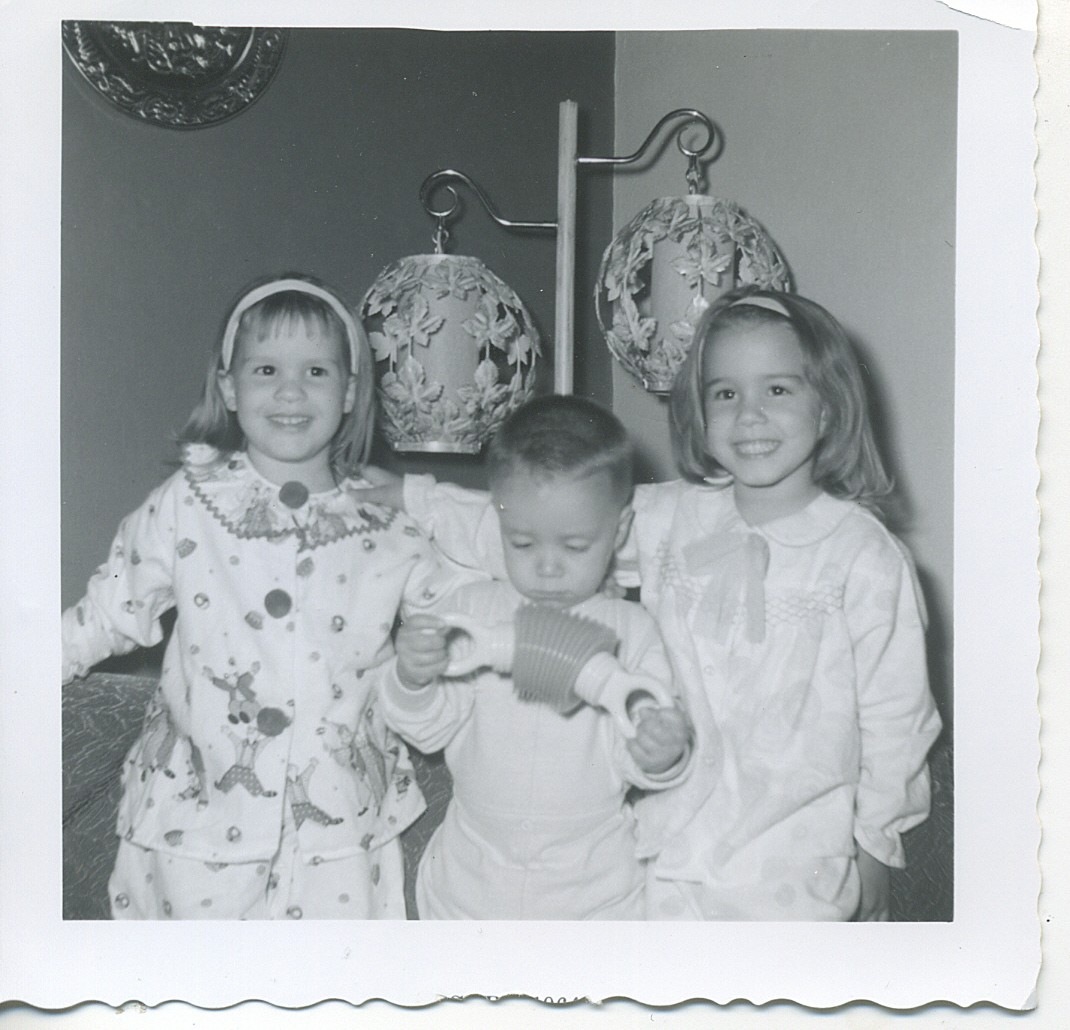
Remember that fresh-scrubbed, pj’ed-up, ready for bed feeling? The three happy children above: Me, in the festive clown pajamas; Jeff, the pensive child in the middle attempting to figure out how his new toy works; Chris on the right with the dazzling smile.

The six children in our family have been divided into two groups for most of our lives: the big kids (above) and the little kids (Gwen, Anne, Matt). Never mind that the baby is over 40 now, we maintain the groupings as verbal shorthand. We were reminiscing a couple of years ago, and one of my parents, instead of calling the three oldest the “big kids”, accidentally called us “the originals”. You can imagine the uproar that caused!

On a completely different note, I still love getting ready for bed and putting on my jammies. Visiting a friend last fall, I went into the bathroom to wash up and change. When I came out, my friend said, “Don’t you look festive!”  I used that word to describe my childhood circus clown p.j.s, and I would like to note that its a great word for a three year old clown. In my current stage of life, let’s just say I’ve decided that particular pair of p.j.s will now be reserved for home, not travel!

The “Jen Pack”

Reading a random blog the other day, I learned of a book called Bitter is the New Black : Confessions of a Condescending, Egomaniacal, Self-Centered Smartass,Or, Why You Should Never Carry A Prada Bag to the Unemployment Office, by Jen Lancaster.  I have NOT read the book, and while the review I read was favorable, I wasn’t tempted to run right out and buy it.

Anyhoo…one of the things the review mentioned about the book is a list the author calls the “Jen Commandments”, which is a list of things about her that her friends and loved ones just need to accept. As I understand it, and remember I’ve never read the book, they are the non-negotiables, the things that are just wired into her personality. This idea got me thinking. I mean, such a list would need to include the stuff that maybe you want to change about yourself but have given up on being able to. The things that you know your friends don’t like but put up with anyway because…well, they’re your friends. Or your family.

What, I wondered, would be on my list (if I created one)? It isn’t possible to set such a mental challenge for myself without quickly deciding to write it down and post it in my blog! So, here’s my list. Its not exhaustive – I am well aware there are other items I could add:

10. If I am angry or irritated about something, anything, it will sound in my vocal tone, which will become harsh and vehement. And you will think I am mad at you…but I’m not. If I am angry with you, I will normally hide it from you. To recap: If I sound mad to you, it can’t possibly be at you.

9. I will tell you every detail of my vacation, my workout, or the movie I watched last night. But if something truly meaningful has happened, or my emotions have been deeply engaged, you will have to ask probing questions if you want details.

8. I like to use the wonderful vocabulary I developed as the result of an expensive liberal arts education. If you don’t know a word, say so and I’ll define it for you. That doubles my fun!

7. I drive the way my father taught me to. I do feel bad when it terrifies my passengers.

6. I get mushy and sentimental. Often at really inappropriate times (karaoke night at the bar, while doing dishes at your house, when everyone is finally being relaxed and silly). You will know this is happening because I will kill the moment with my need to express my sentiment.

5. I have been known to bring my slippers with me to friends’ homes. When I put them on, I might imply that the inside temp at their place is not fit for warm-blooded mammals.

4. I procrastinate, then panic. I take you with me to the panic place.

3. I try to stop myself but “I told you so”, or a variation on that theme, slips out.

2. I overreact. My first thought, comment or reaction is usually suspect. My third thought or reaction is invariably better and/or more appropriate to the circumstances.

1. Out of sight is out of mind. Bills, friends who live across the country (or town), societal ills, the five items I need every morning but forget to buy when I stop at Walgreens. The public library once sent me to a collection agency for unpaid fines. I kept forgetting to return the books because they were underneath a pile of crud in my apartment. I don’t intend to be a deadbeat, it just happens.

OK, so it might be fun to think about this list, and to suggest that the items on it are unchangeable aspects of my personality. To ask my loved ones, colleagues, and in some cases strangers, to just suck it up. It is tempting to believe that these traits are inborn, that like Jessica Rabbit I can say, “I’m not bad, I’m just drawn that way.”

The unfortunate truth, though, is that these traits are not things outside myself, beyond my scope of either management or responsibility. I can impact them through conscious attention. And I do try, though I am imperfect in both conscious intent and  in the application of effort.

And so I’ve decided to let Jen Lancaster keep her “Jen Commandments” without horning in on her clever concept. I’m thinking of mine as a “Jen Pack” –  ten things I’d like to change about myself. Ten things I would like to ask my loved ones to be patient with in exchange for my promise that I’m working on them.

Respectful Dissent

This morning I was inspired by remarks made by Dr. Maryanne Stevens, President of the College of St. Mary in Omaha, Nebraska. Dr. Stevens’ comments were the final remarks on a weekend retreat exploring the theme of what it means to be a Mercy college or university (for more information on Mercy institutions of higher education, please check out the Conference for Mercy Higher Education website. I believe Dr. Stevens’ remarks will eventually be posted there.)

I cannot do justice to Dr. Stevens’ remarks by attempting to paraphrase them here. However, I do want to share my thoughts regarding one concept introduced this morning: respectful dissent. Respectful dissent, according to Dr. Stevens, involves first listening with an open heart and mind. Then, we must turn inward and reflect upon what we have heard, before determining our response. Only after deep reflection, if we feel called to dissent, by virtue of our membership in a community we would look for ways to do so respectfully. Within the context of Dr. Stevens’ remarks, the community under discussion was the Catholic Church. She was able to offer several examples of respectful dissent within that faith community.

As I’ve thought about this concept throughout the day, I see that it has application for many areas of my life, including but not limited to my rocky relationship with Catholicism. In the workplace, as we struggle to define our roles and to intentionally create policies and programs which reflect our mission and values. In our civic and political engagements, as we strive to resolve difficult and contentious differences in our visions for the society in which we live. In our families, where we hope to create safe and trusting environments which feed our souls and allow us a safe place to land if we fall in life.

We live in a world which appears to have accepted wholeheartedly an adversarial model of disagreement, with a concomitant style of discourse which espouses confrontation and disrespect for those with differing views. We spend our energy shouting each other down, or worse shooting each other down. Respectful dissent would differ in that the process would include dialogue: both deep listening and deep speaking (from the center of ourselves, rather than from the surface, our egos). Its end goal would be lasting and transformative change, as opposed to declaring the loudest voice “the winner” and disenfranchising “the loser”.

 Are there situations in which it would be inappropriate, or not be applicable, to engage in respectful dissent? I don’t know, however, I am doubtful that those who dissent from men like Moammar Gadhafi would be successfully able to take this approach. On a more personal level, do I know what it would look like if I attempted to bring it as a personal response into my daily life? Not really. But I suspect that if I am able to engage more often in respectful dissent, it will result in fewer embarrassing reflections on my hot-headed over-reactions, as well as the need for fewer apologies for steamrolling over other’s opinions. And I think I would like those changes quite a lot.

Flashback Friday

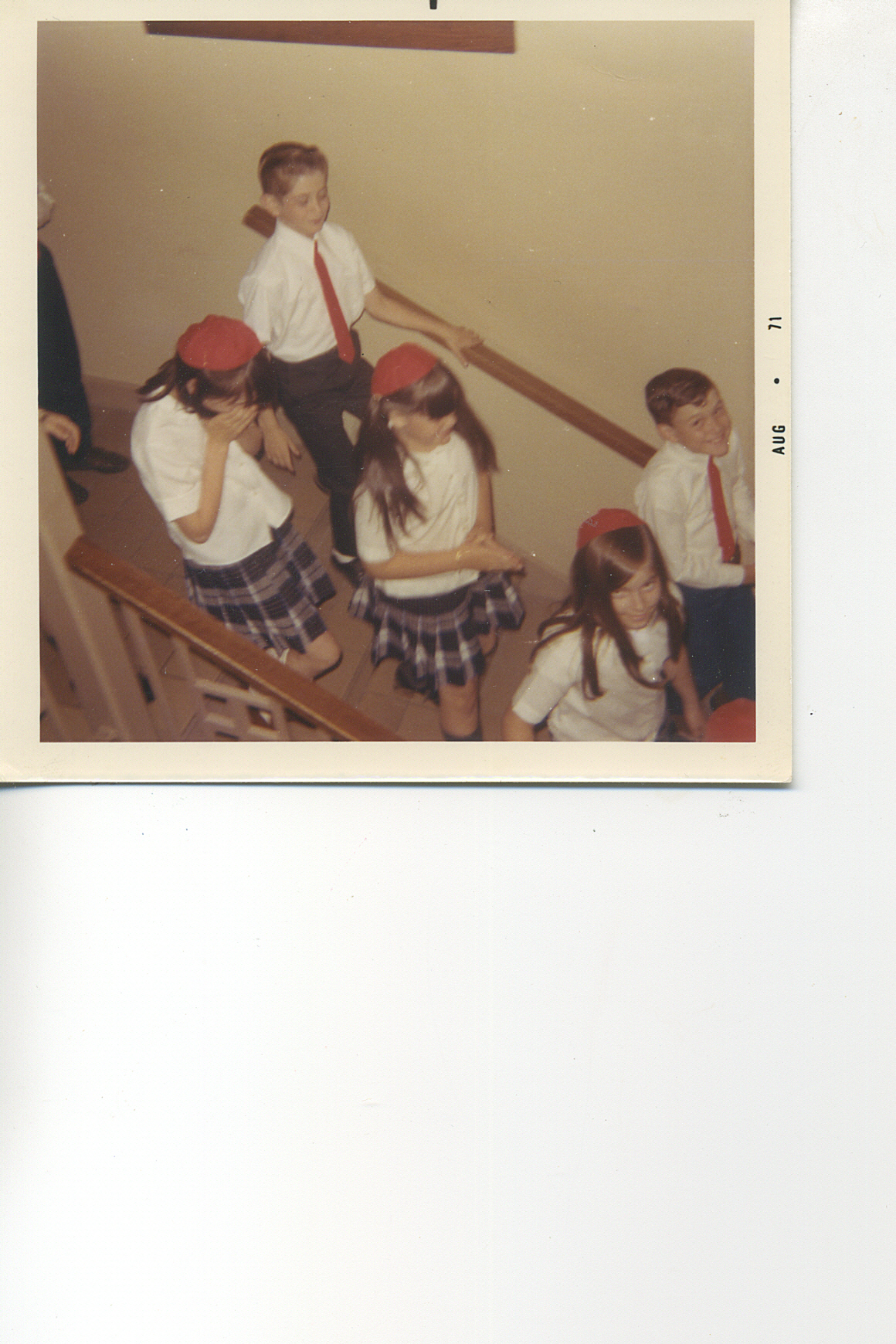
On the stairs at St. Raphael’s Cathedral following my confirmation. This was the day we were to become “adults” in the eyes of the Church…didn’t look or feel very much like an adult! However, I am the only one in the photo maintaining the prayerful attitude we were instructed by Sister Irma Mary to present all the way out of the church.

Throughout my school years, I wore four different Catholic school uniforms, but this one was the best (way better than the red and gray plaid at St. Anthony’s)! Wool, all year. No pants, no shorts, no long-sleeved blouses – no matter what the weather or temp.

What does it say about me that, of these children I went through five years of school with, I remember the names of both boys in this photo but neither girl? The boy behind me was my nemesis in classroom competition (especially Iowa Tests of Basic Skills; our scores were posted in order from highest to lowest, with names, at the front of the room). The grinning one in front was a regular in our recess games of “Batman and Robin” (I was Bat Girl. Though I longed to be Cat Woman, we all knew I couldn’t pull it off!).

An Inside Job

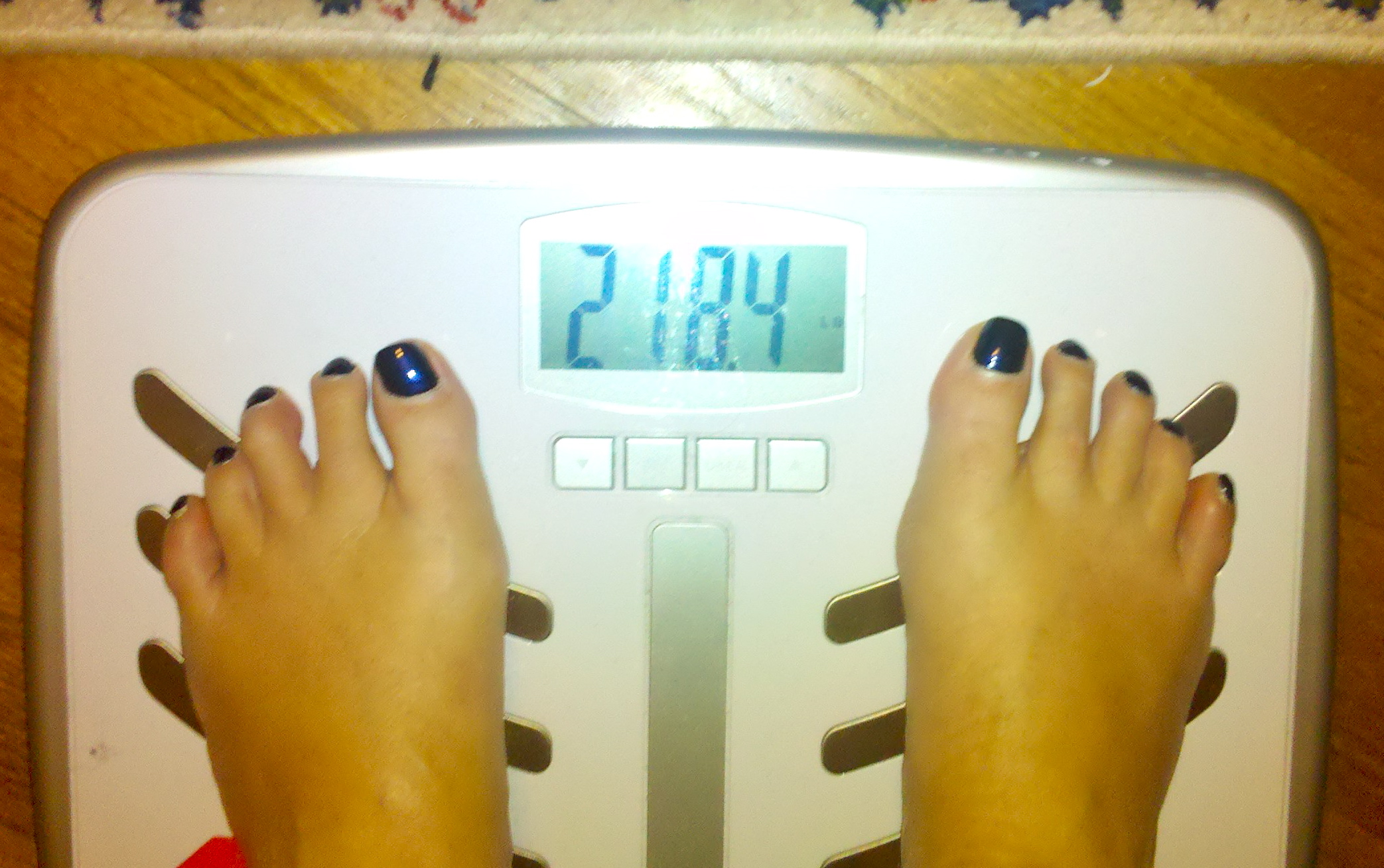
Recently, I have been lamenting, kvetching, complaining or just plain old whining about being stuck, weight-wise that is. I have recommitted to my goals, renewed my determination, and reviewed You: On a Diet to little avail. I have upped my workouts in both time and intensity and (with the exception of a little Oscar night snacking) have measured and counted calories with real discipline. There has been some incredibly slow, incremental movement on the scale, but I’ve been impatient.

Then yesterday came along, in the middle of a busy and frustrating week, and something shifted. I was sore from an incredibly demanding workout on Tuesday, but I powered through an intense early morning cardio blast. When I got dressed for work, I just felt right in both my skin and my clothes.

After work, I went clothes shopping with my friend, Sara. I looked at myself in the full-length mirror, just before trying on the massive pile of clothing I brought into the fitting room. And for what was the first time in many years, what I thought wasn’t, “Wow, look how fat you are” or, more recently, “Wow, I thought I’d lost more weight than that.” The thought I had, standing in the Von Maur fitting room under horrendous fluorescent light was, “Hmmm. I look normal.”

Normal. As in, not huge. Not outside the norm. I felt like anyone else might feel in a fitting room, preparing to try on clothes — I could see my figure “flaws”, I could see what I wanted new clothes to emphasize or detract from. But standing there, in a short-sleeved t-shirt over a long-sleeved thermal shirt, and broken-in jeans I also thought I would blend in any crowd. So what that the pants I was trying on came from the women’s section, and the shirts did not? So what if I wasn’t at my ideal weight – who in the fitting rooms was?

As I tried on clothes, Sara and I found quite a few looks to laugh at. But almost everything I tried on fit, some things just didn’t work. As I made my selections, and put my own clothes back on, I realized how happy I was at that moment (even before getting to the shoe department!).

Happy and clothes shopping. Two concepts that, for most of my life, have been diametrically opposed. And I realized that this new experience was an inside job — meaning that it really had nothing to do with the external circumstances of the reading on a scale, or how I looked in a full-length mirror, or whether manufacturers made clothes that fit my frame. Instead, it had everything to do with what I was feeling and accomplishing internally. I have really been working hard – harder than I ever have – on my fitness and diet. And I am so proud of that work, and so surprised to discover capabilities beyond my expectations. Being proud of myself for being disciplined and for being internally motivated is a very new feeling. And a very good one.

So, this morning, still sore from Tuesday, I rolled out of bed with every intention of another workout with the dreaded TRX bands. And because its Thursday, before getting into my workout clothes, I stepped on the scale. Down a pound. Cool, but not defining. Moments later, I stepped out the door, on my way to another normal day.