


“When you arise in the morning, think of what a precious privilege it is to be alive – to breathe, to think, to enjoy, to love.” Marcus Aurelius
Thursday morning. I wake up to the alarm, knowing I set it with the intent of one snooze cycle only. But I am so sleepy. Each time it sounds I can only hit snooze again. When I finally decide I am awake, I check my FitBit, which tells me that of the six hours I was “asleep” I spent roughly the exact same amount of time awake as in deep sleep: 51 minutes.
In the kitchen, as I wait for the coffee to brew, I am tempted to log in to my bank accounts. I don’t need to as I’ve spent plenty of time there in the last twenty-four hours. I have a pretty exact idea of where every penny is allocated. I have the spending of an unplanned-for small fortune on my vehicle yesterday to thank for this crystal-clear knowledge.
I think about the day ahead. So many things to do, not nearly enough time. I have this image in my head: like Jacob Marley’s ghost, I carry a chain of heavy links-each one an undone thing I ought to have already attended to. An unreturned phone call, an incomplete task, a disappointed colleague or friend.
I sit at my kitchen table, sipping the coffee that finally finished brewing. At the start of this new day, I feel tired, broke, discouraged.
It starts to rain.
I try very hard to focus on abundance, but I cannot get the three lacks out of my mind: I lack resolve; I lack funds; I lack time. They are the three lacks I always seem to battle. Maybe everyone does? Brene Brown says, “For me, the opposite of scarcity is not abundance. It’s enough. I’m enough.” But even lowering the bar to enough, I fall short many days.
I fall short today.
It isn’t even 8:00 a.m. and I have decided that the day is a bust. Already, my day is defined by what is lacking rather than by what is present.
I get dressed and drive to work – yelling at the other drivers for imagined transgressions. (It only helps a little.) Once there, before I can take the three lacks out on everyone else, sucking the abundance from their days, a colleague shares a poem that seems selected with my martyrdom of scarcity in mind:
Everything Is Waiting for You
Your great mistake is to act the drama
as if you are alone. As if life
were a progressive and cunning crime
with no witness to the tiny hidden
transgressions. To feel abandoned is to deny
the intimacy of your surroundings. Surely,
even you, at times, have felt the grand array;
the swelling presence, and the chorus, crowding
out your solo voice. You must note
the way the soap dish enables you,
or the window latch grants you freedom.
Alertness is the hidden discipline of familiarity.
The stairs are your mento of things
to come, the doors have always been there
to frighten you and invite you,
and the tiny speaker in the phone
is your dream-ladder to divinity.
Put down the weight of your aloneness and ease into
the conversation. The kettle is singing
even as it pours you a drink, the cooking pots
have left their arrogant aloofness and
seen the good in you at last. All the birds
and creatures of the world are unutterably
themselves. Everything is waiting for you.
–David Whyte
And it helps. More than a little.
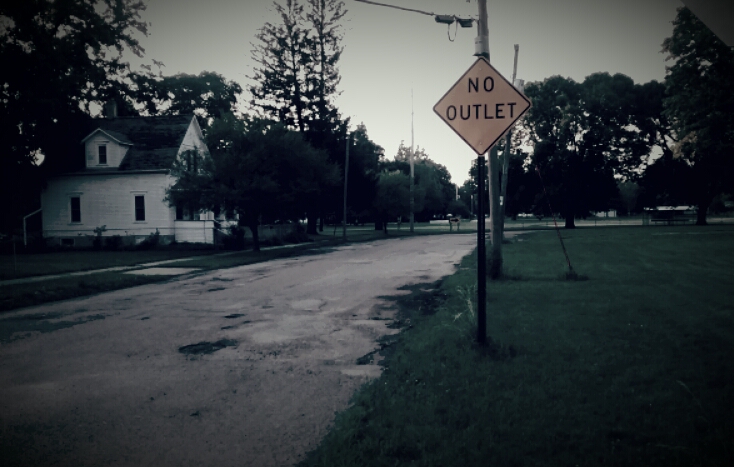
The past couple of years, I’ve been struggling with midlife anxiety. Worrying about things that haven’t happened yet (and may never), fearing the future and whether I will have the wherewithal to survive comfortably, terrified that some amorphous but horrible tragedy will strike. I’ve sometimes felt like the busy thoroughfare of life I started down became a dead-end street when I was, somehow, not looking.
I’ve finally had enough of that.
I can’t stop bad things from happening through sheer force of preemptive fear. They will either happen or they won’t – and I’ve decided to be miserable when I have to be rather than volunteer for it in advance.
Here are a few other things I’ve decided:
Speaking of singing, I discovered a wonderful Swedish proverb earlier this week.“Those who wish to sing always find a song”. Fear and anxiety often encourage silence. The longer we are silent the greater the power our fears hold over us. I’m not entirely sure what reminded me that I am someone who wishes to sing. I’m just grateful to finally be finding a song again. I recommend taking my list of “decisions” with a grain of salt. But if you suddenly hear someone singing “Ready to Take a Chance Again”, you can bet your hard-earned money its me.
When, exactly, do reasons become excuses?
I’ve been wondering.
I was having coffee on Sunday with three dear friends whom I don’t see as often as I’d like these days. At first, we talked about normal life stuff: food, our crazy schedules, the difficulty of maintaining perfectly groomed toenails. When you haven’t been together in a while, it takes some “warm up” talk before you get comfortable and start sharing what’s really going on in your life – how you feel, not just what you’ve been up to.
When we got to the real stuff, I listened with compassion to my friends’ concerns, as they did to mine. But afterwards, thinking about what I’d shared, I couldn’t help but wonder: was I holding onto reasons so tightly because I was, in fact, using them as excuses?
Many of the things that trouble us in life are not of our own choosing, and even the things that initially are choices often turn into things that are beyond our control. One example: you choose to have a child, but once they pop out you are basically SOL in the control department. Another example: I chose my job, but that doesn’t mean that, in any real sense, I get to choose how each day in that job unfolds. Mostly, I try to manage the chaos and hope for the best.
There are reasons, often good ones, for why things turn out the way they do. Which is fine – end of story – if the way things turn out is copacetic. But when it isn’t? When we’re unhappy or uncomfortable with where things are (where we are)?
How long do reasons remain reasons in that unhappy or uncomfortable space? When do they morph into excuses? I haven’t exactly figured that timing out yet.
But I do know that change has happened for me.
If I’m honest, I realized it when talking with my friends on Sunday. As I told them the reasons for my 80-pound weight gain and loss of physical fitness, I heard it in my own voice. “Menopause,” I said. “Medications,” I added. “Mobility challenges!” And that’s when I heard it: the false, tinny note of self-excusation.
What might have been reasons to begin with are not any more. Now, they’re just the excuses I use to justify inaction. Realizing this totally sucks. Now, I have to stop making excuses and make changes instead. And the fact is, making changes is hard. There’s also no guarantee that the outcome of these changes will be everything I want it to be.
But the eventual outcome isn’t the most important reason to change. A much more important reason is to be able to say, without reasons or excuses, “I’ve done the best I could do.” No matter what else happens, I’ll be really glad when I can say that again.
 Jenion