Gallery

My 2022 in pictures…

Dear family and friends:

I don’t usually send holiday cards or letters, but so many of you have asked about the many changes in my life this past year, I thought I’d break my “tradition” of being lazy. I had a hard time deciding how I might share about this year in an interesting way, but eventually decided to select one photo from each month that might be representative of that point in the year. This proved a difficult task. I took a lot of photos this year, many of incredible scenery and of the two cats who live here, Poco and Loco. Unfortunately, as is often the case, I took too few photos of the most important events and the people who shared them with me.

Now that I’ve gotten all the caveats out of the way, here’s my 2022 in review:

Colorado Visitor’s Center, Julesburg CO, January 2022 Driving home to Iowa, having been delayed in New Mexico after Christmas by a winter storm, I stopped here primarily for the restroom. I was feeling very emotional when this lone tree captured my attention. I wasn’t sure if it was a metaphor for how alone I felt, or for resilience despite adversity, or if my years at Prairiewoods had just increased my attention to and love for trees. In any case, this was the first picture I took in 2022, and in hindsight, it feels like a foreshadowing!
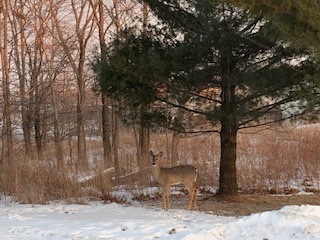
Prairiewoods, Hiawatha IA, February 2022 Winter of 2022 was a pretty dark time for me. One of the few things that truly gave light to my days was being on the land at Prairiewoods. On this particular early evening I was leaving the office and about eight deer were hanging around both sides of the drive. I stopped my car and watched them with the windows down (and they watched me right back) despite the bitter cold.
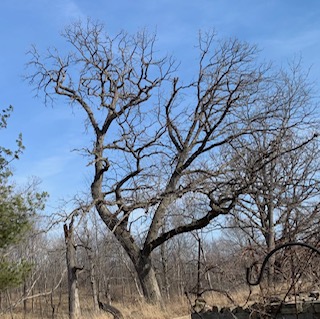
Prairiewoods, Hiawatha IA, March 2022 In March my sisters and my dear friend Wendy Dennis held the equivalent of long distance interventions with me, expressing their concerns for my well-being and insisting that I take steps to change my life. I felt a lot like this tree, scarred by the derecho but still standing, surrounded by the debris of what had been in the “before times”. I decided to listen to the advice of loved ones and to take Wendy up on her offer of a place to recalibrate.
Ellis Park, Cedar Rapids IA, April 2022. Deciding to change my life and actually doing it were very different – though equally hard – things. This photo (more trees!) perfectly captures the spot along the Cedar River at Ellis Park where I would stop for some breathing room between work and home, both places where my to-do lists were long and overwhelming.
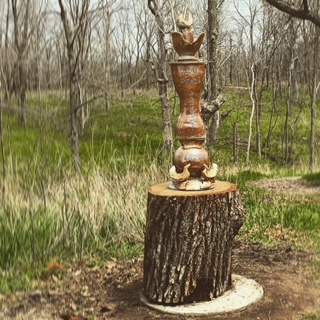
Peace Sculpture, Prairiewoods, Hiawatha IA, May 2022 One of my favorite moments at Prairiewoods was the installation, followed by the dedication, of this beautiful peace sculpture designed by local Cedar Rapids artist Lisa Williams as part of our 25th Jubilee celebration at Prairiewoods. The celebration and the sculpture had both been pushed back due to the omicron surge, so it was a joyous occasion. Sr. Betty Daugherty, the visionary who founded and led Prairiewoods with the other Franciscan Sisters of Perpetual Adoration, passed away just before Christmas in 2019. We were all still reeling from her loss when the pandemic hit, followed quickly by the death of our beloved chef, Tara King. Then came the derecho, which profoundly changed the landscape of Linn County and, of course, the 70 acres of Prairiewoods. Before her death, Sr. Betty had asked that we replace the old peace pole, which was weathered and worn (it met its ultimate end in the derecho), and we talked of commissioning an original piece that would carry our commitment to peace in a form more commensurate with the forms, materials and presence of Prairiewoods. It felt wonderful to finally see the completion of that vision. I know Sr. Betty would never have held it against me that it wasn’t finished before she left us, but it felt like the fulfillment of a promise.
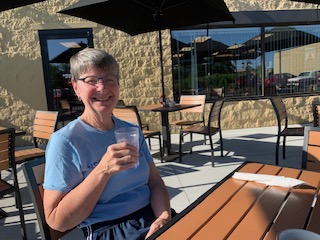
Sue Stork, Tommy’s Family Restaurant, June 2022 June was the shortest month in the history of my life. There was so much to do at home to prepare for the move to Colorado. And there were special people I needed to spend time with before I left. Honestly, none of the work would have been finished if it weren’t for the woman in this photo. Sue and I have been friends since 1986 and I often think I hit the friendship jackpot with her and she drew the short straw with me. Sue helped me go through and pack or dispose of or sell LITERALLY. EVERY. THING. I owned. She used vacation time to work her butt off on my behalf – thank God there was a lot of laughter and very little defensiveness between us! Physically, I was in terrible shape. Luckily, Sue is strong and indefatigable. Speaking of strong, I am also indebted to Rick Atkins, whose mom Colette coerced him into helping one day – he single-handedly carried every heavy thing (including furniture) down the stairs. On the morning of June 25, Sue and I picked up the moving van in Coralville, I grabbed Wendy at the airport, and by noon Colette and Sarah Botkin had arrived to help us load what was left of my stuff. Tammy and Curtis Hansen stopped by for a quick farewell and ended up staying and working – thankfully helping Tetris everything into the U-Haul. The sight of Sarah Botkin sweeping up the random popcorn kernels scattered all over my upstairs living room will be an image of friendship I hold onto forever in my memory (because, of course, I didn’t think to take a photo). The whole shebang took about two hours thanks to Sue’s prep and Colette’s cleaning. After a brief lunch at Cedar River Landing, Wendy and I hit the road – she with the hard task of driving the U-Haul.

Wendy and I spent the night at a casino hotel in Council Bluffs, lucky to get a room anywhere in the Omaha area due to the College World Series being in full swing there. Still, we had a lovely room and a beautiful sunset to admire. After we left Council Bluffs the following morning, I don’t think I saw Wendy again until she arrived at her home about an hour after me. The whole trip I worried about where she was and how the drive was going, only to discover that she was tracking me on her phone so she always knew my whereabouts while I was clueless of hers. Still, my arrival at the Dennis home was definitely memorable. I went to the front door, expecting to be greeted with hugs and laughter. Instead, after I rang the bell twice, the front door swung open with no one in view. As I hesitantly crossed the threshold, I heard someone yell, “Now!” and four nerf machine guns targeted me with a barrage of hundreds of tiny nerf balls. The Sheckels, who had thought they might avoid helping me move for once, were visiting and were responsible for the warm yet warlike welcome! They soon found themselves unloading my things from the U-Haul! It was the first time in my adult life that moving somewhere felt like coming home.

Mom and Pops, Toast, Albuquerque NM, July 2022 July was an amazing month! When she showed me to my room upon my arrival, Katie Dennis asked me if I liked it – I said, “I love it! Can I stay forever?” and her response was, “I thought that was the point.” I can’t speak for the Dennis family, but being here felt excellent right from the beginning. There was a 4th of July gathering, my sister Gwen came, I met several of the Dennises friends, and Colette and her daughter Skyla even dropped by!

I mentioned that I was in pretty bad physical shape. The packing and moving process had created a very painful and self-perpetuating issue with my knees and achilles tendons (exacerbated by excess weight and lack of exercise). Wendy began her campaign to improve my health, cutting my medications and getting me moving. I bought a swimsuit and went to the neighborhood pool most mornings all summer for pool walking during the lap swim times. Early mornings at the pool became my happy place – yes, I was as shocked to experience it as you are to read it! Also, I began the slow process of getting in shape to walk outside the pool as well. Gravity sucks.

The reason I chose a photo of my parents for this month is that I was able to visit them with an easy drive straight down I-25 from Denver to Albuquerque. It feels good to be so much closer to them and to my sisters Gwen and Chris (their husbands Kirk and Dave) and my nieces Hallie and Atalie. I’ve seen them all multiple times since moving here. Being surrounded by my family of origin and my family of choice feels incredible and healing!
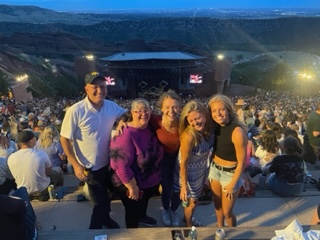
Dave, Katie, Wendy and Dani Dennis (and me), The Chicks concert, Redrocks CO, August 2022 There is always something interesting happening at the Dennis house. One morning in early August we were cleaning the kitchen and music was blaring. A song by The (Dixie) Chicks came on and Dani and I sang along. Wendy commented that we both knew every word, and we were both sharing our life-long love for The Chicks when it was casually mentioned that they had two shows at Redrocks that night and the next. Wendy said, “Let’s go!” and…we did! What an amazing experience! Highlight of the summer!

Also in August, Wendy learned about a place called The Stretch Zone, where one can go for personal stretching sessions. She thought it might help with my pain, so I went for a consultation. To say that the free stretch provided during the consultation was life-changing would be accurate. I signed up then and there for regular sessions. That very night the change in my gait was visibly apparent. My knees still give me some grief, but the pain in my calves and achilles tendons is virtually gone. The stretch sessions have made it possible to be on my feet and to walk for much longer periods of time – which is wonderful because I now live in the mountains! The elevation where we live is 5910 and in about 10-15 minutes of driving we can be in the mountains proper. I’ve never wanted to hike so badly in my life!

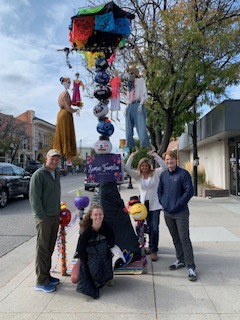
Anne Hanson and me, Snohomish Falls WA, September 2022 In September I was able to use an airline credit to visit my sister Anne in Seattle. We spent two days on Lopez Island in the San Juans and the rest of the week sightseeing in the city. I’ve never managed to visit Anne in Seattle or when she lived in Maine, so this was a long overdue trip. I finally met the infamous Lucy, Annie’s beloved elderly cat. She’s a querulous old thing and Annie takes precious care of her! I was also blessed to visit with Betsey Winter and my high school friend, Debbie Ross. Debbie and I hadn’t seen one another in decades! The only down side to the visit was there was so much smoke from Canadian wildfires that, despite Seattle being surrounded by mountain ranges, I never saw them. Even Mt. Ranier was obscurred from view the whole time.
Dave, Katie and Wendy Dennis, Spencer (Katie’s boyfriend), CO, October 2022 Many people suggested that there would be no “real” autumn in Colorado. I can categorically deny that – my sister Gwen and I spent a weekend in Breckenridge in October and it was incredibly beautiful with the fall colors. In the photo above, we were exploring Littleton where the Halloween decorations were totally on-point and where there is a restaurant called Bacon Social House – what could be better on a crisp fall day?!
Mom and Chris Finnegan, Thanksgiving, Los Alamos NM, November 2022 Early November saw Sue visiting from Iowa. We hiked at El Dorado, hot tubbed during the first snowfall, and visited a number of vintage shops (Sue’s interest!) After Sue left, I started doing bead embroidery, and it has been great to engage my creative side – I had forgotten how much I loved working with beads. Dave’s parents, Dean and Karen, visited and his brother Matt came to stay for several weeks – which means my Gin Rummy skills are sharp! I celebrated Thanksgiving with my parents at my sister Chris’ house in Los Alamos. It was a quiet and very fun holiday, which may have included the completion of a fairly difficult jigsaw puzzle and the weirdest dominoes games ever.
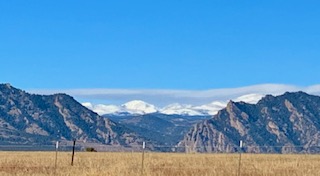
The View from Happy Road, December 2022 Which brings us to December. I don’t actually know the name of the road that takes me to this spot, but the Dennises call it Happy Road, and now I do too. I’ve been in Colorado for six months. I have learned that I was always meant to live in/near the mountains. I feel like I’ve found my place. I don’t know what the future holds, or where I will eventually settle, but I hope I am never far from mountains or views like this one.

I will begin a job in January as a K-3rd grade literacy tutor in an elementary school that is part of the Denver PS. I’m not certain how I will get used to being in place at 8:30 a.m. Monday-Friday, but I’m looking forward to working with the children.

I am beyond grateful to the Dennis family for adopting a 61-year-old woman and giving me people and cats to love and laugh with every day. Many others – too numerous to name – made it possible for me to change my life in 2022. I am humbled by the support. I am not good at staying in touch, which is a fault of character I’ve never been able to break. But please believe that you are often in my thoughts and always in my heart.

Happy holidays and many wishes for a very happy new year!

Love,

Jen/Jeni/Jenifer (whichever you know me by!)

Thanksgiving, and David Whyte On Honesty

On this Thanksgiving morning, I am feeling both grateful and troubled. Grateful for the many gifts and graces that fill my personal life; troubled for the state of the world we share. I’ve often been at a loss for words these last few weeks. Watching the news has alternately filled me with anger, despair, and righteousness – emotions so strong that I’ve been afraid to speak for fear of my own intemperance.

As is so often the case, this morning I sought insight and solace from another person’s words, and am so thankful to have come upon the following from David Whyte, who manages to tease out extraordinary meaning from ordinary words. In this national moment of daily accusations and revelations, in thinking especially of what it means that so many people have been trying to stand in the painful truth about their experiences with those whose power has so often granted immunity, these words have offered me insight. And so I share them with you, and hope you find something in them as well.


“HONESTY

is reached through the doorway of grief and loss. Where we cannot go in our mind, our memory, or our body is where we cannot be straight with another, with the world, or with our self. The fear of loss, in one form or another, is the motivator behind all conscious and unconscious dishonesties: all of us are afraid of loss, in all its forms, all of us, at times, are haunted or overwhelmed by the possibility of a disappearance, and all of us therefore, are one short step away from dishonesty. Every human being dwells intimately close to a door of revelation they are afraid to pass through. Honesty lies in understanding our close and necessary relationship with not wanting to hear the truth.

The ability to speak the truth is as much the ability to describe what it is like to stand in trepidation at this door, as it is to actually go through it and become that beautifully honest spiritual warrior, equal to all circumstances, we would like to become. Honesty is not the revealing of some foundational truth that gives us power over life or another or even the self, but a robust incarnation into the unknown unfolding vulnerability of existence, where we acknowledge how powerless we feel, how little we actually know, how afraid we are of not knowing and how astonished we are by the generous measure of grief that is conferred upon even the most average life.

Honesty is grounded in humility and indeed in humiliation, and in admitting exactly where we are powerless. Honesty is not found in revealing the truth, but in understanding how deeply afraid of it we are. To become honest is in effect to become fully and robustly incarnated into powerlessness. Honesty allows us to live with not knowing. We do not know the full story, we do not know where we are in the story; we do not know who is at fault or who will carry the blame in the end. Honesty is not a weapon to keep loss and heartbreak at bay, honesty is the outer diagnostic of our ability to come to ground in reality, the hardest attainable ground of all, the place where we actually dwell, the living, breathing frontier where there is no realistic choice between gain or loss.”
–David Whyte, ‘HONESTY’ Excerpted From CONSOLATIONS: The Solace, Nourishment and Underlying Meaning of Everyday Words© 2015 David Whyte and Many Rivers Press


The Eternal City

The Colisseum

Everyone who visits Rome tells some version of the same story. Here’s mine:

We spent the morning touring St. Peter’s Basilica. It was grand and vast, almost more to take in than one could grasp. We celebrated mass at a side altar where Pope John XXIII is interred, his uncorrupted body encased in glass. The morning was overwhelming, to say the least.

After four hours in the Basilica, Mom and I were free to find our way in Rome. Footsore, jet-lagged, and dehydrated, we grabbed a table at the first sidewalk cafe we saw, still inside the security perimeter of the Vatican. Lunch was perfect! Afterwards, we literally grabbed a taxi back to Casa Tra Noi, the driver swearing a steady (but quiet) stream under his breath as he made his way up the narrow hill, every few yards maneuvering around obstacles not envisioned when this street was first cobbled: buses, delivery trucks, SUVs.

Statue of St. Francis

We rested for a while on the patio, and I swallowed another miniscule cappuccino, before meeting our tour bus for the drive to the Cathedral of St. John Lateran. At first, I was unexcited to tour another cathedral, but then I realized that this bus trip would show us much of the city we might not otherwise see in our brief time in Rome. And it did: the Colosseum, the Forum, the Circus; we crossed the Tiber River; we saw the balcony where Mussolini harangued the crowds. Our group piled off the bus at a statue of St. Francis that stands across the piazza from St. John Lateran. We posed for a group photo,then made our weary way toward the church. Like most sites in Rome, there was security to go through – though there was no guard in sight here, just a conveyor belt that we all dutifully placed our bags on, walking through metal detectors before retrieving them.

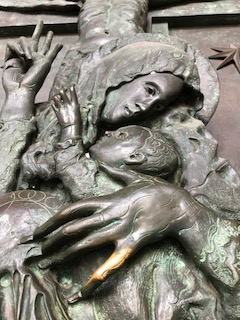
Detail from the Jubilee Doors

Our guide, Father Andre, in his brown Franciscan robe and sandals, introduced us to the cathedral. I remember bits and pieces of the history he recited, though I wouldn’t be able to reconstruct it without assistance. We looked at the beautiful papal door, opened only in jubilee years (bricked shut at other times). Then we wandered over to the giant front doors. By this time in the day, our group lacked its earlier spry energy, so we waited for the stragglers to gather close enough to Father Andre to hear his next words.

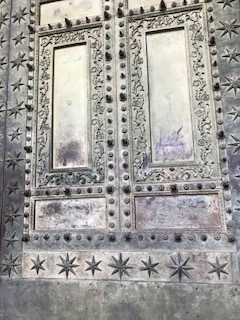
Doors originally from the Roman Senate

“These doors,” he said, “Were originally on the Roman Senate. Think about that for a minute! That means that Cicero walked through these doors. Augustus Caesar walked through them…everyone you remember from early Roman history likely touched these doors.”

And that was it: my goosebump moment.

Like I said, everyone who has been to Rome has this story. They tell about the exact moment it hit them that they were in a spot where ancient history still lives. I couldn’t have anticipated that my moment would occur at a cathedral I’d never heard of before – but it was an electrifying moment. For me, it was my heart’s true first step on the pilgrimage I had come to Italy to make.

Darkness and Thoughts on Two Continents

It is 11:27 p.m. in Iowa, which makes it 6:27 a.m. in Rome.

It is dark in Italy, as it is here – I don’t imagine this. I can watch the early morning unfold in darkness there via webcam broadcasting from the Campo dei Fiori just as easily as I can see the night outside my own window.

It is so quiet in both places. I feel like I am alone with my thoughts on two continents at once.

When I first click on the campo’s camera feed, the market square appears empty. Then I see a solitary person, like me, wander into view. All in white, he or she walks silently along the market stalls, then disappears underneath an awning. I am suddenly alone again.

Alone but for a figure in the very center of the market square – a statue of Giordano Bruno, last convicted heretic to be burned alive by the Roman Inquisition in 1600, here in the Campo dei Fiori. He looms over the square. In the dark, I cannot tell if he looks my way or has his back to me.

As I watch, the day begins to break: trucks and handcarts arrive, people appear with them to unload merchandise. I see flats of produce (tomatoes? eggplants?), and a man passes through my view with heavy, oblong bags slung over both shoulders. More stalls are erected, I begin to hear people calling to one another, glass bottles clink loudly one against another. Birds caw out raucously.

By 6:47 a rosy sunrise is just visible over the roofs of buildings that enclose the square, slowly revealing a skyline that is both foreign and, somehow, familiar. Once I read a book in which Giordano Bruno was a character. The day after I finished this novel, I browsed a local bookstore, discovering a book containing a cycle of poems about his life. I thought that was an interesting coincidence, until later that same day, I picked up a thick volume of poetry by the Polish writer, Czeslaw Milosz. I opened the volume to a random page and the title staring up at me was “Campo dei Fiori”.

This string of coincidences has stuck with me. Tonight, I wonder if it holds a message. Giordano Bruno: scientist, heretic, believer in an infinite universe, burned alive for his convictions. I told a priest friend this story and he said, “I won’t discuss him and I heartily encourage you to stay away from him.” As if we still live in a time when ideas are worth dying for; are worth killing for.

In his poem, Milosz imagines Campo dei Fiori on the day of Bruno’s death. A bustling marketplace, full of people engaged in their daily business. A pause as the pyre is lit. “Before the flames had died, the taverns were full again.” Bruno’s burning is juxtaposed with Milosz’ own time, where a carnival delights while the Warsaw ghetto burns. In both scenes, the people “of Rome or Warsaw/haggle, laugh, make love/as they pass by the martyrs’ pyres.” He imagines the loneliness of those dying, aware that the world and the living simply go about their days, barely noticing. The poem ends with a vision of the future:

Those dying here, the lonely
forgotten by the world,
our tongue becomes for them
the language of an ancient planet.
Until, when all is legend
and many years have passed,
on a new Campo dei Fiori
rage will kindle at a poet’s word.

Try as I might, I can’t quite get there – to this new Campo dei Fiori. It feels like we are living in the same old marketplace, a carnival to distract us from the fires in which people are dying. Some days we pause to notice ashes from the burning float past us, but most days we just keep keeping on. We might think “this isn’t right”; maybe we’d like to stop the world and get off this sicko ride, but the ferris wheel keeps relentlessly turning and our choice is ride or jump. We fear the free-fall that follows the jump more than we fear the impact of the ground (though, to be honest, we don’t relish the thought of either). So we ride, around and around mumbling the same argument, the same complaints.

As night deepens where I am sitting, day is already moving on in Rome. I check the webcam and note that there are shoppers beginning to drop by the market stalls. I hear the murmur of their voices, though I cannot make out any words. My eyes follow a bird that swoops in above the awnings, flying straight toward the towering figure of Giordano Bruno. Just in time, the bird rises, avoiding a collision.

That is when I notice it is bright enough to see that Bruno is facing me. Even though his face is shadowed by the hood of his robe, I imagine that our eyes meet. Behind his shines the light of a thousand thousand stars. Right or wrong, he stood his ground; is standing there still.

Campo dei Fiori by Czeslaw Milosz

In Rome on the Campo dei Fiori
baskets of olives and lemons,
cobbles spattered with wine
and the wreckage of flowers.
Vendors cover the trestles
with rose-pink fish;
armfuls of dark grapes
heaped on peach-down.

On this same square
they burned Giordano Bruno.
Henchmen kindled the pyre
close-pressed by the mob.
Before the flames had died
the taverns were full again,
baskets of olives and lemons
again on the vendors’ shoulders.

I thought of the Campo dei Fiori
in Warsaw by the sky-carousel
one clear spring evening
to the strains of a carnival tune.
The bright melody drowned
the salvos from the ghetto wall,
and couples were flying
high in the cloudless sky.

At times wind from the burning
would drift dark kites along
and riders on the carousel
caught petals in midair.
That same hot wind
blew open the skirts of the girls
and the crowds were laughing
on that beautiful Warsaw Sunday.

Someone will read as moral
that the people of Rome or Warsaw
haggle, laugh, make love
as they pass by the martyrs’ pyres.
Someone else will read
of the passing of things human,
of the oblivion
born before the flames have died.

But that day I thought only
of the loneliness of the dying,
of how, when Giordano
climbed to his burning
he could not find
in any human tongue
words for mankind,
mankind who live on.

Already they were back at their wine
or peddled their white starfish,
baskets of olives and lemons
they had shouldered to the fair,
and he already distanced
as if centuries had passed
while they paused just a moment
for his flying in the fire.

Those dying here, the lonely
forgotten by the world,
our tongue becomes for them
the language of an ancient planet.
“Until, when all is legend
and many years have passed,
on a new Campo dei Fiori
rage will kindle at a poet’s word.”

Warsaw, 1943

Webcam feed:”https://www.skylinewebcams.com/en/webcam/italia/lazio/roma/campo-de-fiori.html”>https://www.skylinewebcams.com/en/webcam/italia/lazio/roma/campo-de-fiori.html

The Wisdom to Know

God grant me the serenity to accept the things I cannot change, the courage to change the things I can, and the wisdom to know the difference.
–Reinhold Niebuhr

Here’s a disclaimer, right up front: serenity is not a quality I have generally understood, nor have I actively sought serenity in my daily life. I offer this truth, not as a self-criticism or as some kind of humble brag. I just wish to make it clear at the outset that I don’t know much about serenity.

That said, I’ve been thinking about the serenity prayer quite a bit lately. Not so much the serenity part, but the acceptance, courage, and wisdom parts. Each of us may decide for ourselves whether we are blessed or cursed to be living in these “interesting times”; for my part, it feels important to wonder if I am responding as my best self. Acceptance, courage and wisdom play a huge role in that assessment.

God grant me the serenity to accept the things I cannot change…

I am an Idealist. Even as a child, adults were often hurling this word at me as if it were an epithet: “You’re such an idealist!” It became a phrase I hated. Once I understood what the term meant, I was confused about why people seemed to think it was a bad thing. It came as no surprise when, in graduate school, I studied the Meyers-Briggs Type Indicator and found myself to be an INFP – the Idealist. All of this is background so you will understand when I say I have trouble with this line of the serenity prayer. My brain looks at the world and struggles to find things that I cannot change. So far the list is minimal: weather, in the short-run (over the long run, climate change suggests that I can have, for good or ill, an impact on weather); someone else’s choices (though I can impact the circumstances, opinions, feelings that may guide those choices)…Ok, let’s face it – I just don’t think there are things I cannot change!

This goes deeper than a personality preference. If I believe (and I do) that we are all connected, then it behooves me to take a long view of  change. The ripples I send out into the world (my actions, my thoughts, my being) effect change – whether I see or comprehend their impact is almost irrelevant. Of course, I take the most pride and pleasure in having a visible, measurable impact for the good. (In the interest of full disclosure, I’m aware that sometimes I have a negative impact as well. This does not make me proud.)

Acceptance of the things I cannot change, then, becomes more about accepting that I will never single-handedly change society or culture in a manner that is immediately operational. Institutional racism, for example, will only change if many people like me act in concert and with good will to create change then continue to act in ways that support and institutionalize equality. Learning to accept that change is both possible and occurring, even when it is imperceptible to me, is as close to finding serenity within the context of this line as I am likely to get.

…the courage to change the things I can…

I admire courage. Whether it is evidenced by someone acting on their convictions, taking a chance on the untried/unknown, or putting themselves between another person and harm I try to recognize and support courage when I see it in action. But I, myself, am a bit on the cowardly side. For most of us, courage is not a response we can plan in advance; it is too easy to reason ourselves off the hook. When we do act with courage, more often than not we are moved to act by immediate circumstances unfolding around us.

But the serenity prayer isn’t speaking to that kind of “in the heat of the moment” courage. It is talking about the courage to face our own weaknesses; the courage to stand in our truth day after day, even if/when no one stands with us; the courage of our convictions that “there is a right thing I must do” regardless of the cost. I am sometimes called to speak truth to power, but often find it difficult to do the speaking – much like being unable to scream in the midst of a nightmare, fear of the possible repercussions interferes with my courageous expression. This line of the serenity prayer calls me to find my voice and make it be heard anyway.

Speaking of finding my voice, there is also the courage required to be a broken record in service to justice. To consistently call on the “better angels” (as Lincoln put it) of our nature to heal and to forgive and to forge new understanding requires tenacity and commitment. At a time when it is fashionable to use the phrase “social just warrior (SJW)” as a pejorative, the courage to walk this path daily is often unrecognized or unwelcome – yet absolutely necessary for change.

And so I pray for courage.

…and the wisdom to know the difference.

“By three methods we may learn wisdom,” says Confucius. “First, by reflection, which is noblest; second, by imitation, which is easiest; and third by experience, which is the bitterest.” Whatever of actual wisdom we gain via these methods is precious. Like the proverbial pearl of great price, not only have we paid dearly for it, but it can be lost to us if we do not treasure it and if we do not use it.

Proverbs (4:6-7) tells us: “Do not forsake wisdom, and she will protect you; love her, and she will watch over you. The beginning of wisdom is this: Get wisdom. Though it cost all you have, get understanding.” Wow. That bears repeating:

“Though it cost all you have, get understanding.”

So wisdom is more than self-knowledge, deeper than experience. It is nothing less than gaining understanding – which requires these things, but also empathy and compassion. There is no wisdom that is merely self-referenced. No wonder wisdom feels both so important and so difficult to attain.

Given all of these musings, is it any wonder I’ve been unable to get this darn prayer off my mind? So much for serenity!

Look, I’m not the kind of idealist who expects perfection; but I am an idealist who believes that whatever better future we imagine is possible. I’m not sure I need to find serenity at the cost of choosing which change is possible, because what is possible is always changing. I am willing to concede that there are limitations to my ability to change the world, to change systems, to change minds or hearts. But these limitations are not limitations of possibility but of imagination and they are made less possible when I cower rather than act with courage. I believe that courage is a muscle that can be made stronger through repetitive use – whether I stand, speak or take a knee to express what I hold as truth, what I value.

All of it, always, returns to wisdom. Knowing how and when to act, whether speech or silence is most needed, how to exercise your courage so that it is strong when you – and the world – need it most…wisdom is the generator of true discernment. And if in gaining wisdom any of us find a modicum of serenity as well, may we be blessed by it.

“We are not enemies, but friends. We must not be enemies. Though passion may have strained, it must not break our bonds of affection. The mystic chords of memory will swell when again touched, as surely they will be, by the better angels of our nature.”                                         –Abraham Lincoln


September Skies

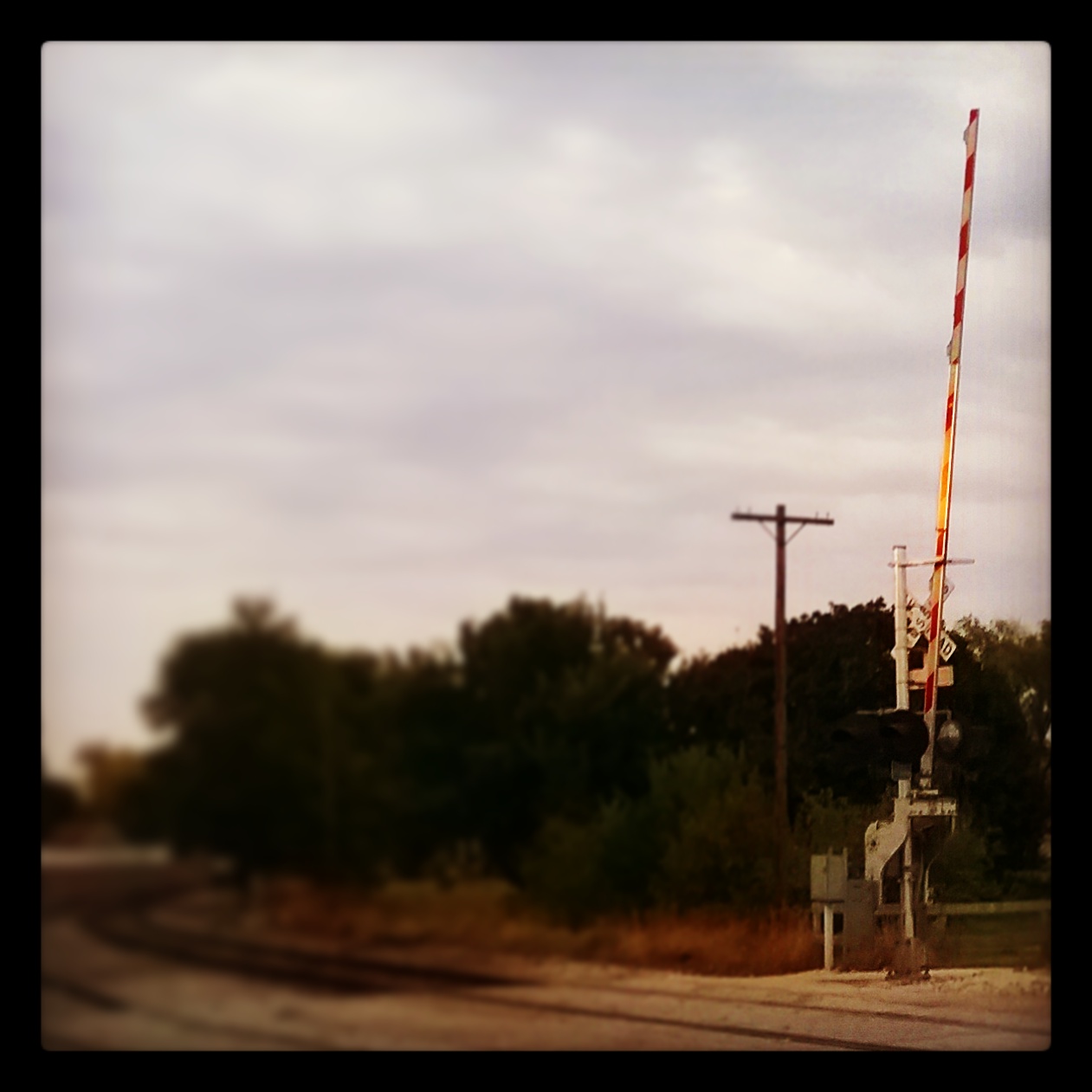
                  The last ray of sunshine illuminates a railroad crossing arm.


Last night I went for a walk. There were storm clouds massing overhead, but the sunset was still pushing through every opening in the cloud cover it could find. Consequently, the urban farm down the street was enveloped in shadowed twilight, while the factory across the street was lit dramatically, looking like a shining city of legend.

It has been a dry September, despite the clouds that have regularly gathered. There have been spectacular sunsets due to both the clouds and smoke haze in the atmosphere from the fires out west. One Sunday a few weeks ago, our skies took on a greenish tinge and a strange opacity  despite weather instruments reading “mostly sunny”. I couldn’t help but think how frightening it must be in places closer to the flames.

Last September was the opposite – so wet that this week in 2016 we were on flood watch, followed by the evacuation of parts of town at the end of the month (including my neighborhood). A Herculean effort by residents and city workers prevented a massive disaster, though my apartment has never quite returned to its pre-evacuation state. (Due to my lack of initiative, not to any flooding – the place remained dry throughout!)

I’ve been thinking about the ways this September mirrors so many other Septembers in my life. Always, after the rush of August, I look toward September with a hopefulness that is rarely born out – I think September will usher in a slower pace, an expanse of time to enjoy a brief pause between late summer and the start of fall. But it never works that way. September is always a frantic blur. This year has been no exception.

The one consistency I’ve enjoyed from year to year is the changeable skies September brings. The blue-est blues, the most colorful clouds, the most dramatic sky-scapes. Often, September skies are the only natural phenomenon I get to experience fully in this month of effort and hurry.

Sometimes, that is enough.

Of Being

I know this happiness

is provisional:

the looming presences —

great suffering, great fear

withdraw only

into peripheral vision:

but ineluctible this shimmering

of wind in the blue leaves:

this flood of stillness

widening the lake of sky:

this need to dance,

this need to kneel:

this mystery:

—Denise Levertov


An Awakening

“An awake heart is like a sky that pours light.”  –Hafiz


I have this memory from when I was around six years old. It is early summer, and I have awoken very early in the morning. My siblings and my parents are sleeping but the sun, just up, is shining and its warmth is beginning to lift the dew from the grass, forming a hazy ground fog over the yard. I am still in my bed, but the top half of my body is actually wedged onto the window sill, my face pressed against the screen. The yard, the bluff across from the one we live on, the trees I can see on hills across the Mississippi – all of it – is kissed by the sun and beautiful.

I can smell the fresh morning air, with its commingling of flowers in bloom, the river, grass and a darker scent I always associate with air emanating from the old lead mine tunnels bored through the limestone bedrock of my hometown. I hear a door close, keys in a lock, and whistling. My grandfather comes into view, leaving his basement apartment and walking along the narrow sidewalk through our yard, up the cement stairs and to the car park, on his way to work at the meat packing plant. He disappears from my view as suddenly as he appeared. It feels strange that he has no knowledge of my gaze or the love I feel for him.

I stay like this, laying in the window for several minutes. I am aware of my sleeping family in their own beds in the dark interior of the house not knowing that I am awake and watching the world. I am self-contained yet connected to everyone and everything. This feels illicit, somehow – this awareness of a world that is not aware of me.

This luminous memory has remained fresh for fifty years. I’ve thought about why often over the years. Nothing in particular happened. There have certainly been other mornings when I was awake while others slept; many mornings that I enjoyed quiet before the rest of the world got busy and choked the place up with noise. And while it may have been the only time I was awake early enough to watch my grandpa go to his very early shift at the plant, I doubt that is why the experience struck me so deeply.

Perhaps it was the first time I felt connected to everything I was looking at without being the center of it.

I looked up children’s stages of self-awareness and found the following stage-theory, in which a child’s response to a mirror is used to describe each stage:

“That, right there, is self-awareness in a nutshell: that’s a mirror (Level 1), there’s a person in it (Level 2), that person is me (Level 3), that person is going to be me forever (Level 4), and everyone else can see it (Level 5).

Queue your five-year-old’s first existential crisis.”   

https://www.fatherly.com/health-science/children-five-stages-self-awareness-mirror-tests/

I was definitely a kid who had a difficult time with that level 5 self-awareness. Being “seen” was excruciating for me. In photos I am often contorting my face in an effort to avoid looking directly at the camera, as if this would somehow make me less visible to the lens.

At the same time, I had a child’s lack of awareness that everything wasn’t about me. If my parents fought, if my sister was cranky, if it rained on the day I wanted a picnic – these all seemed to be about me. And, if I’m honest, there have been many times throughout my adult life I’ve had to shake myself out of this kind of self-referencing. (Just yesterday, a colleague’s demeanor changed dramatically during a meeting and several of us sought her out, afterwards, thinking we must have said something to upset her – she was suffering from a sudden-onset migraine. I guess this is a human tendency, not just mine.)

Back to that long-ago morning, that sense of connection without direct attention (or even awareness) was definitely part of it. There was my grandfather, clearly in a good mood as he whistled off to work. He had no idea I was watching him. He had no idea that, at that very moment, I was feeling love for him. And there was the rest of my sleeping family, to whom I felt connected, also – all with only my awareness. Was this one of the first times I was aware of feeling non-transactional love? Love for my family that was just love – not a response to some behavior or input from them? I don’t doubt I felt it before that moment, but how often was I consciously aware of that love emanating from me?

Then there was the land – the trees, our yard, the hills, the river, the limestone – I was filled with wonder and love for it, too. The sun, the light, all of the beauty in that early morning: had I ever felt such an outpouring of love?

I remember feeling a tingly, buzzy, sensation in my fingers and toes – I was full of some energy I couldn’t name. In fact, there were no words to articulate the experience. This was one of the few times in my childhood that I didn’t follow my mother around the house blabbing every detail of something to her. Later, when everyone was up, I held my tongue. I knew those few minutes of experience had been mine in a way that was deeply personal.

Many years later, I had a discussion/philosophical argument with my brother about chaos theory and the butterfly effect (can a butterfly flapping its wings in New Mexico cause a hurricane in China?) He wasn’t buying it. But I argued that everything was connected. I remember saying, “I believe it. I believe it is all connected – we are all connected.” He suggested that was magical thinking for which there was no “real” evidence  – and I told him I “just knew it”. (Of course, science has proven spooky action from a distance now, so I feel vindicated on the evidence front.) But I was convinced long ago on the level of personal experience – I had felt that connection.

Is that why this one childhood memory has remained so cherished and luminous? Was this the moment I first had the felt, lived, experience that all is connected? I don’t know. All I can say for sure is that even after years of taking this memory out and turning it over and over in my hands, it has never lost its shine – and that’s how I know it is important.

This morning, I woke just as the sun was casting a pink glow over everything. The green trees outside my window were lovely against that pink sky. I felt both gratitude and a sense of well-being, waking up to so much beauty. But it wasn’t an “awakening”.

 You can have the other words-chance, luck, coincidence, serendipity. I’ll take grace. I don’t know what it is exactly, but I’ll take it. –Mary Oliver

Let Go…and sleep

My mother says that, as a child, I could – and did – fall asleep anywhere. Once while shopping downtown, she stopped to chat with an acquaintance for a few minutes. When she was ready to move on with our errands, she looked around for me – and discovered me, sound asleep, on the sidewalk.

I wish sleep came as easily now.

Oh, I can still fall asleep (sometimes) with the rapidity and grace of a fainting goat. But the depth and duration of my sleep is often not impressive. I am becoming more well acquainted with the hours between 2 and 5 a.m. than I ever wished.

On my good nights, I sleep for a couple of hours before waking up. On the bad nights, I am keenly aware of each tick of the clock.

My thoughts have been casting a shadow on the moon of my heart.

Some nights the shadow looks suspiciously like Donald Trump, or the clashing of angry crowds, or a family waiting to be rescued from their roof. Sometimes it is just a blobby shadow with no distinctive shape. I think and I worry about politics, about what is happening to the earth, about all of us.

I must remember how to let go of thinking.


School Days and Transitions

This week is the beginning of the school year for children in our community. Even though I don’t have children myself, there is no way to not know this fact – my Facebook feed is wall-to-wall first day of school pictures (and that includes teacher friends, who post their own first day photos). Also, for a surprising number of my friends’ kids, this year marks a transition – from kindergarten to first grade, or from grade school to junior high, or junior to senior high. The kids seem to be taking these transitions in stride, but a number of their parents are emotional wrecks.

As a kid, I experienced more than the normal number of transitions in school. Kindergarten wasn’t offered at parochial schools, so first grade saw me transitioning to a new school, with all new kids. In fifth grade, we moved across town in October. In my new school district, I went “shared time”, meaning I spent half a day at the public school and half at St. Anthony’s, my new Catholic school. Then in January, we moved to Minnesota. School number four that year was the Catholic school. That summer we moved from our temporary rental home into a house my parents had bought, and I started 6th grade at another new school. 7th grade saw my entry into the consolidated junior high in town, where overcrowding had us students attending in split shifts (I didn’t start school until noon). In 8th grade we moved to Ohio, where I finished junior high and, the following fall, began high school. After my junior year, we moved back to Iowa, where I finished by senior year and graduated from high school. My K-12 years were followed by college at a small Catholic university, then graduate school at a major public research institution. If I’ve counted correctly, that is 12 new starts – new schools, new rules, new peers.

Looking back, there are several observations I can make: it wasn’t always easy to find my way, either physically or metaphorically; as an introvert, I struggled at times to make friends; occasionally, the differences in protocols, methods, or subject matter pacing caused confusion and required extra time to catch up (or boredom if I was far ahead on a subject).

More important, though, is this universal truth: in every educational setting I met incredible people who cared about me. And eventually, I made friends with other students. But the first people to care about me were always and invariably employed by the school: teachers, librarians, lunch ladies. They noticed me, even when I was trying to shrink and blend into the drab institutional walls. Sr. Joseph Mary in the St. Raphael’s library was always setting aside books for me to read. Mr. Nelson invited me and others to have “rap sessions” at the end of the day (it was the 1970s after all). Sr. Pat Nolan took me in as a bewildered high school senior and helped me believe in my own way of seeing the world.

Here’s a true story, one of many which have left me feeling that school librarians are the unsung heroes of the world. When I was in high school, there was a gas explosion and I happened to be at the epicenter of it. The school evacuated, while I, dazed and bewildered by the concussive force of the explosion, wandered slowly in the empty halls, my chemistry goggles still on. Mrs. Slusher, the librarian, was outside the open doors, and happened to glimpse me at the far end of a hallway. Against orders, this tiny little woman ran into the building, put her arms around me, and guided me out into the sunlight.

Yesterday, as I was enjoying the first-day postings on Facebook, I suddenly received several instant messages simultaneously. They were from college friends who wanted to let me know that Sr. Mary Ellen Caldwell passed away. Sr. Mary Ellen was an amazing religious studies professor. I can remember people asking me, as I was registering for every single course she taught, what possible use these classes were for my future. The only answer I could give was that Sr. Mary Ellen was an incredible teacher, and my mind came alive in her classes. Interestingly, thirty years later, I’m using what Sr. Mary Ellen taught me every single day, both personally and professionally.

To all the parents out there who are worrying about your kids: I can’t say you don’t need to worry. I can’t promise that the school year will turn out the way you or your child hopes it will. I’m aware that this world is a different place than it was when I was young. But I still believe that most teachers, counselors, social workers and other staff in our schools care about the children entrusted to them. I encourage you to keep breathing, and allow some time to pass before you judge how well it is going. Kids and teachers are a resilient bunch; together they can accomplish things no one would anticipate.

“One looks back with appreciation to the brilliant teachers, but with gratitude to those who touched our human feelings. The curriculum is so much necessary raw material, but warmth is the vital element for the growing plant and for the soul of the child.” (Carl Jung)


Making Waves

“Woman Killed in Road Rage Incident was a Fat, Childless 32-Year-Old Slut.”

You may wonder what possessed me to read the Daily Stormer article with this title. After all, I knew that the website was a neo-nazi “news” and commentary site. Part of me didn’t want to believe that, hours after Heather Heyer had been killed in Charlottesville, anyone would be vile enough to write such a headline referring to her. Part of me felt compelled to know for myself what they said, rather than just rely on commentary from others. It is hard for me, after the fact, to reconstruct my thought process prior to clicking on the article because reading it changed something in me.

The gist of the piece was that women are always a drain on men’s resources and, as such, have only one redeeming purpose on this earth: procreation. Women who are not mothers should be exterminated to reduce the drag on men. This, the article assured me, was doubly true for fat women who are not mothers. What possible purpose could such individuals have? Following this line of reasoning, the commentator went on to say that, therefore, Heather Heyer – and by extension any woman without children or past their child-bearing “usefulness” – deserved to be murdered.

The article was vile. Truly, unequivocably, vile.

But, truth be told, it felt a little familiar. It was definitely more direct, more intentionally hurtful, and less sanitized than a lot of messages our culture sends to women. But it was, underneath the nazi rhetoric, not that different from what women are told repeatedly in this culture: We are worth less than men; We don’t deserve (nor do we receive) the same care/benefits from society as men; We should be grateful for the attention of men, even when it is expressed as harrassment and/or violence. I don’t want to spend this post arguing that these assertions are true: if you want convincing that women are treated as less-than and systematically discriminated against, you can do the Google search as easily as I can. Try “women and healthcare” or “women and wages” or “women and violence”.

Reading the Daily Stormer piece flipped a switch inside my brain. I could feel, at the deepest level of my being, the ways that I’ve both received and internalized cultural messages about my own worth and power (and also about the worth and power of a variety of other folks, whether people of color, LGTB+, those living in poverty, etc.) At the core of who I am, a word formed:

ENOUGH.

As in, “I/we have had enough.”

As in, “I AM/We ARE enough.”

As in, “There is enough.”

While there are definitely people who know where I stand, I have mostly tried to play by rules that I now see more clearly than ever were intended to keep me quiet: don’t ruffle feathers; don’t lose relationships over differences of opinion; be likeable; don’t be forceful; don’t assume you know anything (or that what you know means something). Sometimes, I have lived my life as if the greatest good that could come of my choices would be my own invisibility. I have allowed myself to make occasional small ripples, but I have avoided ever making waves.

I’ve believed the myth of my own powerlessness for far too long; I’ve finally had enough of that bullshit lie. I am powerful enough to change this world. Despite the scarcity narrative so prominent in white supremacist and nazi chants, there is enough to sustain each of us in this world if we will only use our power to shift dominant paradigms. We are – each and every one of us – so much more than just a drain on resources.

Today, I find myself wondering about Heather Heyer. Her friends say she was afraid there would be violence, but that she felt she needed to protest on Saturday anyway. What was she thinking when she left home that morning? Was she hoping to send a ripple of love or justice into the waters of racism, misogyny and hate? I feel certain she wasn’t seeking death. Whatever her hopes and dreams, Heather understood that she had the power to effect change and she chose to use that power.  Heather definitely made more than ripples: when she chose to stand in her power on Saturday, she unleashed a wave containing all the force of a tsunami. May each us discover our power and courage to do the same.

“The waves broke and spread their waters swiftly over the shore. One after another they massed themselves and fell; the spray tossed itself back with the energy of their fall. The waves were steeped deep-blue save for a pattern of diamond-pointed light on their backs which rippled as the backs of great horses ripple with muscles as they move. The waves fell; withdrew and fell again, like the thud of a great beast stamping.” — Virginia Woolf