I was wide awake from 3-4 a.m. this morning. I’m not sure what woke me, but once I was awake I was very conscious of my stomach growling. I couldn’t stop thinking about how hungry I was. I was H-U-N-G-R-Y! The more I told myself to stop thinking about it and go to sleep, the less sleepy I felt. My brain was in overdrive, thinking about food, then thinking about the fact that I will be weighing in tomorrow morning, worrying about what the scale would say. After a while, I told myself that I could choose to get up, take a handful of steps to the kitchen, and eat something to stop the stomach pangs. And that thought is what brought home to me the whole point of this challenge — I CAN choose. And what a gift that is — to have abundance when others do not. To be able to choose whether I eat now or eat later or eat at all. These thoughts are what allowed me to relax into the moment and, finally, drift back to sleep. Gratitude, the new sleep aid!  —excerpt from my first Hunger Challenge Reflection on Jenion, 2009  

Today marks the five year anniversary of Jenion.

While I played a bit with the blog format before Thanksgiving 2009, it became a serious undertaking for me when I began The Hunger Challenge – my effort to lose weight while raising money for hunger relief. Every Thursday, beginning that Thanksgiving Day, I uploaded a photo of myself standing on the scale (that first day, the scale read 280 pounds).

I have said before that, in undertaking the challenge, I anticipated losing some weight and raising some money for a good cause. Both of those goals were successfully achieved. What I didn’t anticipate, what I never even considered, was that the project would end up materially altering every facet of my life. Five years on, and everything has changed.

I was recently looking for grammar info online, and came across a post by Grammar Girl that said, “Thanksgiving is a time to give thanks, and it’s also a gerund” : a verb to which -ing has been added, thereby making it a noun. In my word-geek heart, it makes perfect sense on this Thanksgiving, on this five-year anniversary, to share five gerunds that exemplify the amazing changes I’m so very grateful for today.

Offering

At a conference several years ago, I heard a young professional say that he is often misunderstood, doesn’t feel listened to, is rarely noticed as having something special to contribute. For most of my life, I would have completely commiserated with him: it isn’t easy for those of us who are introverts, shy or reticent to share our feelings, to experience the sensation that others “get” us. What I’ve discovered through Jenion and the experiences that have flowed from it is that whether others get us or not depends, in great part, on how much of ourselves we have offered for them to see, hear, know.

Friendship, respect, intimacy, connection – how often and how deeply we experience these is in direct correlation to how much of ourselves we offer to those around us. Yes, it is difficult. Yes, we feel vulnerable. Yes, we can be hurt. But oh, yes, it is SO worth it. When I open my heart to you – my friends, my family, my readers – you respond to my vulnerability with kindness, compassion, support and love.

Allowing

Offering and allowing are two parts of an energy exchange – each most powerful when experienced in flow with the other. Early on in this journey, I drew an image in my journal of a stone tower. Each block of stone was a defense mechanism I used to protect myself from hurt. My heart was locked inside the tower. Other people were outside, wanting to get in. But the tower was unbreakable. I envisioned the besieging forces attempting to fight their way in, then, eventually, giving up.

The only way to breach the tower was from within – I had to open the gate.

Letting down the drawbridge was hard. It was scary. It meant I wasn’t in control of everything, it meant others might actually see that I had needs or desires I couldn’t fulfill for myself.  But learning to allow also meant that I could receive kindness, love, and the myriad other gifts that are exchanged in social communion. Learning to allow (and letting go of attachment to manipulating outcomes) has been a revelation to me. Allowing others to be and express themselves, allowing things to unfold, allowing life to unfurl without undue prodding and poking on my part – these are all ways to keep the energy between self and others, between self and community, flowing.

Connecting

I’ve written a lot about connecting – and I still believe that people want to connect with one another. We just don’t always make use of the opportunities that present themselves. I’m so grateful to have learned to do this more frequently in my own life – it has brought some amazing people into my world and offered some incredible experiences I wouldn’t have otherwise had. So go out there and, like me, “talk to people you don’t have to”. Follow-up on those conversations. Offer and allow.

Challenging

One life lesson it took me a very long time to learn – and which I need to relearn over and over again – is that my happiness and satisfaction with my life (and with each day along the way) is absolutely connected to how much I challenge myself to keep learning and growing. For so long, I allowed myself to be a piece of flotsam on the river of life – the current pushing or pulling me in whatever direction it chose. It was the period of my life in which I describe myself as “sleepwalking” rather than “living”.

And while challenging myself has been important, I am also grateful for the challenges that others have presented me with – for the suggestions, the invitations, the gauntlets thrown down by so many of you. (A perfect example: when my friend Colette insisted on a deadline for resigning my job – we were both tired of years of hemming and hawing on that one!)

Thanksgiving

Which brings me to the final gerund: thanksgiving.

There are so many people to thank – too many to do so individually in this post. So many of you who took the time to offer encouragement, who participated in The Hunger Challenge then stuck around to go on this journey with me, who sent cards and gifts when I felt alone or when my flagging courage needed a boost, who responded in agreement or disagreement with things I posted.

In my career in college residential life, I talked about community constantly – what real community is, how to be a contributing member of one, why we need a community perspective. For the past five years, I have felt this so deeply in my own life and in the life of the community you’ve helped Jenion to be.

I can never thank you all enough. What you’ve taught me about being a genuine, loving presence in my own life and in the lives of others is more than I’ve learned from the five gerunds above put together.

Happy Thanksgiving.


Traveling Hopefully

On my day off, I planned a treat for myself as a way to off-set the need to productively tackle a long “must do” list: a rare mid-week lunch with my friend Mike. He selected a location near his office where we were able to order yummy Asian food. I was so hungry that I helped myself to two fortune cookies from a giant bin – one for before lunch and one for after.

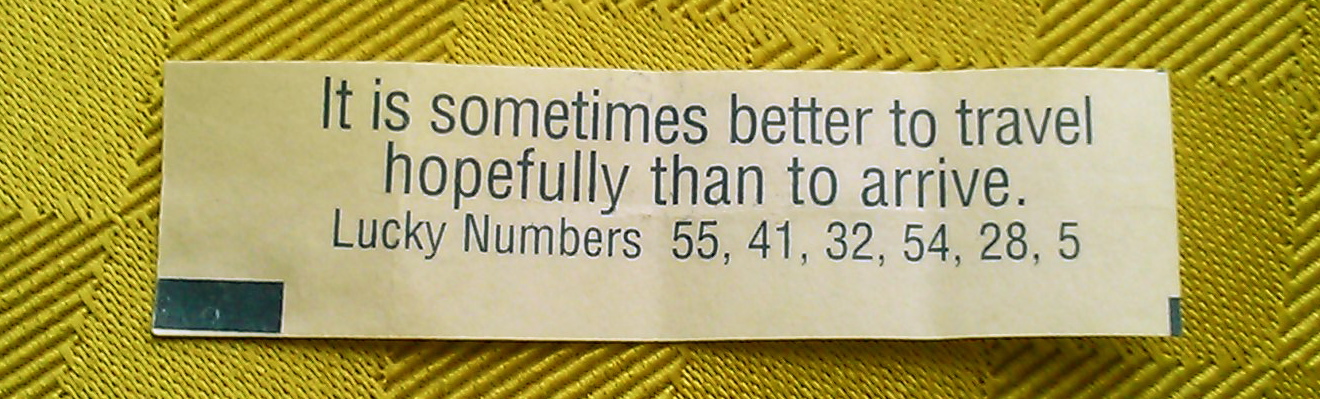
Our fortunes were not so much fortunes as they were aphorisms. My first cookie yielded this one:

Image


The sentiment struck me forcefully, and I half-laughed, half-grunted. Mike raised an eyebrow at me, so I handed him the slip of paper, saying, “This describes my whole life for the past year.”

As so often happens, my flip comment (and the fortune which precipitated it) came back to me later. Long after I had returned Mike to his office, long after I reached max capacity on my “must-dos”  and long after hunger was again gnawing at my belly (despite feeling so full at lunch), I found myself thinking about the concept of “traveling hopefully”.

When I embarked on the journey that brought me here, to Minneapolis and to today, I had a fuzzy vision for my life’s path, but no map or set itinerary.  The lack of these has meant that it  hasn’t always been an easy trip. Or maybe it’s the nature of even a well-planned trip: there have been delays (finding a professional position, connecting with people), break-downs (physical ones such as dead batteries and emotional ones like loneliness), sudden course corrections that have left me feeling disoriented. There have been days when my heart has been travel-weary, when all I really wanted to do was go home…wherever that seemed to be.

Traveling hopefully means remaining open to possibilities even when possibilities seem scarce. It means measuring options against your fuzzy vision and choosing the ones that seem to offer the most promise of clarity in the long run.

Recently, friends urged me to apply for a job back in Iowa – one which they hoped their influence could help me successfully retain. It was tempting: the idea of finally arriving at a destination made me a little weak in the knees. But every time I sat down to complete my application, I became emotional. It just didn’t feel right in my heart. What I eventually realized is that, no matter how difficult the journey has been, it has also been rewarding in ways I’m not willing to give up yet in exchange for an arrival.

There’s a fierce gladness that comes from listening to that small voice inside, especially after a lifetime of shushing it. It may not always be enjoyable to learn both what you are capable of and what you are made of, but it is a deeply moving experience. Traveling hopefully, even if the journey continues further/longer than anticipated, extends one’s ability to see multiple positive outcomes rather than remaining fixated on one preferred destination.

It’s important to note that the fortune says, “It is sometimes better…” Because there are times when arriving may be the better thing. The problem is, until we get really good at traveling hopefully, we don’t know how to differentiate which, in a given set of circumstances, is the better of the two. Like everything in life, we improve our ability to discern the better option the more we actually do it, the more we actually face new options and choose. I wasn’t a good “life traveler” because I stayed safely ensconced in one place for so long. But I’m getting better (imagine me saying that a la Monty Python!).

It might be good to point out that traveling hopefully is not the same as traveling joyfully, happily into the bright blue yonder. When you travel hopefully, you are reaching beyond today’s circumstances toward something perhaps only you can see – a destination worth working (and hoping) for. There are days when joy is the last emotion you feel, way at the bottom of a list that begins with emotions like grief, anger, dejection, fear. Or worse, days when joy is buried beneath a pile of whines and whinges and complaints. But a hopeful traveler isn’t sidetracked by these for too long. The internal victory is won by hope, and we travel on.

I must also say I’ve got nothing against arriving. Arriving is a great opportunity to stop for gratitude, to take time to enjoy the moment, the place, the state you have achieved. But “arriving”, I’m learning through this life experience of traveling hopefully, is only a way station on the path. Arriving is temporary, it turns out. Traveling is more our natural condition, the way we learn and grow and become. The journey needs, therefore, to continue. In spite of everything, it has grown more clear to me with each passing week that there’s no reason to travel with anything less than a hopeful heart.

A good traveler has no fixed plans, and is not intent on arriving. -Lao Tzu
One’s destination is never a place but rather a new way of looking at things. – Henry Miller

Image 1


Choose Your Own Jenion

I’m actually not feeling very well today, Wednesday, November 12, 2014.

As usual, I have pushed off writing my blog entry for Thursday (tomorrow) until it is so late that I should be headed to bed (especially as I have an opening shift in the morning). And did I mention that I am sick? Minneapolis’ sudden jump into mid-winter has left me with a bad enough cold that I’ve lost my voice. I’m achy and, last night, tweeted that I wanted my mommy (which is a true, if a silly admission).

Therefore, today’s post is “Choose Your Own Jenion”. I’ve given you links, below, along with brief descriptors of what you’ll find at each link. Simply click on the link(s) that piques your interest. (If none of the links interests you, then you’re almost finished reading my blather for this week!)

Think of this as my first foray into “choose your own adventure” blogging! And, in case I haven’t said this as often as I should, thank you so much for continuing to follow me on this meandering path!

  • #dailypicofmpls : For those of you who don’t follow me on Instagram, this link takes you to my instagram site. The #dailypicofmpls hashtag was born on September 3, 2013 as a project to keep me productive and creative while trying to find my place in Minneapolis as a new resident. The winter of 2013-14 was brutal, and I’m not just talking the weather – it was perhaps the hardest season of my life to date. To say that my Instagram project, born of a desire to become intimately acquainted with my new city, may have saved my life in the depths of that winter is in no way an exaggeration. It kept me interested, active, and braving the outdoors throughout the worst winter could throw my way – and it helped me to fall deeply in love with this city I now call home. When I browse through the pictures, I remember virtually every moment. Photographically, there is a huge variation in quality. But even the worst of these photos is meaningful to me. I hope you enjoy clicking through them – if you’re curious to know more about any of them, just ask!


  • Stealing Joy  In addition to this blog, I have written several pieces for the MSP Biking blog. Stealing Joy is my bike-love story. If you enjoy this piece – which involves thievery, weight-loss, and rediscovery – feel free to browse the site for my other pieces (on my first alley-cat race and on the ways I’ve changed as a cyclist in my first year in the Twin Cities).


  • Soul-Restoring Soup  A few years ago, I made this apple-parsnip soup during a howling rampage of an ice storm. I trudged through snow drifts and up treacherously slippery sidewalks in the dark of night to leave some on my friend Layne’s doorstep: it was so good, I just had to share it with someone I loved! So, here’s the recipe – just in time for another winter’s worth of dark, cold nights!


  • Say Voldemort  OR  Don’t Rain on My Parade  These are both classic posts from the first year of Jenion. I didn’t select them after careful consideration of all the posts, but they are both pieces I remember well from a time when I was learning many profound lessons on managing a reawakening emotional life!


  • Bad Faith And lest you think there is nothing new or original in today’s post, I give you this fragment. Written for my Rider Writers’ Group, on this month’s assigned theme of “bad”, this is the beginning of a longer personal essay. It is also a first draft with lots of issues to be resolved.

So, there you have it – a smorgasbord of Jenion from which to choose. I’ll be back next Thursday, hopefully well and with an all new post. At least…that’s the plan!


What happened to you?

A regular customer came into the store the other day and, while waiting for his order to be finished, said (referring to one of my coworkers), “I can’t believe she was a homecoming queen.” I smiled, and said, “She is a lot more rad than you’re giving her credit for.” He didn’t let it go at that, saying “In what way? Tell me.” So I responded with a few really cool facts about her and her life.

That’s when the customer said, “So, what happened to her?!”

What I wanted to say (a partial list, in no particular order):

  • She got stuck in a service industry job being judged by pricks like you;
  • A really crappy ex-husband;
  • It’s tough making a living as an artist, despite being incredibly talented;
  • Anxiety about how to feed her kids and keep a roof over their heads.

What I actually said: “Life.”

And it’s true. Life happens. Among other things, it brings challenges and disappointments, dangers and hurts of the kind that drain us of energy, tarnish our sparkle or steal our mojo: leaving us shell-shocked or bewildered as we shamble on through each day.

And yes, many of us end up shambling through our lives like sleepwalking bears – clumsy, unfocused, breaking things. Even if we believe that we create our own destiny by making our own choices. Even though we know that our own attitude and “positude” can be major determinants of how fulfilled or happy we are each day, not to mention in the long-haul. Even if we believe in inspiration and motivation and all the quotes and memes we post to remind us that we believe these things. Even then, life happens and it can bring us down.

When other people judge us or find us lacking, it hurts. But the truly hard moments are when we stop shambling and wake up enough to look at our lives and judge ourselves as lacking. We ask, “What happened to me?,” and the answer is both “Everything” and “Nothing”.

“Everything”, because if we take the time to tease them out, we can follow the threads of experience that lead to each moment when we felt ourselves fail, discovered we were not up to the task, were diminished by hurt or the actions of others. Mostly, the everything that happened which drained us of inspiration, motivation and resolve just feels like an amorphous blob that blotted out our inner spark.

But that’s only half of the answer. “Nothing” is also part of the answer, and it is the hopeful part. Because despite the things that have happened to us, the talents, gifts, experiences – the spark that is our true self – is still there. Obscured by the grime of daily living, perhaps, but capable of sparkling again.

I’ve seen the truth of this in the lives of some pretty incredible people who managed to turn their inner lights back on after they were dimmed by life’s “everythings”. And I have the proof of my own reawakening to life after years of shambling along (where do you think I got the image of the sleepwalking bear? That was totally me!).

If there’s one thing I’ve learned through both observation and personal experience, it’s that not one of us gets back to our true self without the help of others: friends who become our cheerleaders; personal trainers who address our wholeness, not just our bodies; loved ones who set aside their own fear of change in order to help us realize the changes we hope to make. Synchronicity and serendipity get involved too, bringing us into contact with virtual strangers whose guidance and support touch us at the very moment they are most needed.

When our customer asked “So, what happened to her?”, I felt defensive on my co-worker’s behalf. And I realized in that moment just how important it is to look for ways to support the spark in those around me. To dig deep and find a well of compassion for the “everything” that has happened to them – and, when appropriate, to use that compassion to help the other person breathe new life into that spark. To help them remember that “nothing” has also happened…they are still talented, gifted, and have a wealth of life experience to draw from.

I also intend to use that same compassion with myself. When I look in the mirror and ask, “What happened to you?”, I intend to acknowledge both the “everything” AND the “nothing”. And then nurture the heck out of the intact talents, gifts and experiences that are the stuff of my own inner spark.

Free Your Inner Turkey

A couple of weeks ago, as my friends and I biked through a state park nearby, we happened to see a wild turkey. He had somehow gotten inside a fenced enclosure, and was running back and forth along the fence line in a state of obvious panic, unable to find a way out. At first, I felt terrible for the poor thing. The few times I’ve felt that kind of feverish panic have been really awful, and I immediately identified with his distress. And then my friend, Victoria, said something simple yet incredibly profound. She said, “Hey, you dumb bird! You can fly!”

Wait. What?

Yep, despite rumors to the contrary, turkeys are capable of flight. In fact, they roost in trees, so they not only can fly, they do fly. Regularly. (It’s true – I googled it!)

As we rode on, I felt reasonably certain my feathered friend would figure it out. But the encounter got me thinking. I said that Victoria’s statement was simple yet profound. Simple, because she merely pointed out the obvious – the turkey could easily fly out of his predicament. Profound, because each of us experiences moments of panic, fear, anxiety in which we mimic the turkey’s pointless, frantic energy drain. So often at these times we overlook the simple truth that we already possess the skills, talent, or self-knowledge to extricate ourselves from, or to materially alter, the situation.

Why do we do this?

As I’ve asked myself this question, I’ve identified three possible reasons that make sense to me:

1. We’ve told ourselves a story that isn’t true. I wasn’t there for more than a few minutes, but I’m certain the panicked gobbler we came upon had not yet tried flying over the fence. Instead, he was running around looking for any other way out. Like the erroneous story that turkeys can’t fly, we’ve all told ourselves stories about what we are, and are not, capable of doing. Quite often, we are certain we can’t fly (or take risks, or attempt something new, or do what we see others routinely do). We say, “I could never do that” when, in fact, we’ve never even tried. It would be more appropriate to say, “I don’t know if I can do that.”

I was talking with friends about creativity recently, and I said, “I’ve never really been disciplined as a writer.” The first response to my comment was, “That’s not true. You publish your blog every Thursday. How many years have you done that? Seems like discipline to me.” How might it affect my creativity if I began to think of myself as capable of a disciplined approach?

There are other, more insidious stories, we tell ourselves. How about the one that says, “I not only can’t fly, I’m not worthy of flying?” Or the one that goes, “I’ve never flown before, so it’s obvious I never will.” As long as we keep telling these versions of our stories – the versions that say we can’t, that underestimate us, that bully us into keeping our lives smaller than they need be – that is how long we’ll be wasting our energy running around in circles but getting nowhere.

2. We’re afraid of what we don’t know/can’t see. As I watched the turkey running back and forth along the chain link after Victoria pointed out that he could fly out of the enclosure, I realized something. He was so close to the fence, and so much shorter than it, he couldn’t see that the fence ended a few feet up. Perhaps he wasn’t attempting to fly out because he didn’t realize that there was open sky above him.

We are so close to our own fears we bump up against them day in and day out. Living in such close quarters with them, our fears begin to feel both familiar and insurmountable.

As a personal example, I’d like to share how I stopped being afraid of the dark. For much of my life, being alone in the dark was a debilitating fear. One of the ways I dealt with that fear was to have living arrangements that made me feel as if I wasn’t alone – I either had roommates or lived in multi-unit buildings (a career in college housing helped immensely, as I spent two decades living amongst my students). Then I had the opportunity to move into a little cottage by myself. I was feeling burned-out from living in my workplace, and the house was adorable. The first few nights, I couldn’t sleep – I left the lights on, I started at every noise I heard. Finally, about a week after moving in, I was exhausted. I clearly remember having a “come to Jesus” talk with myself. “Jen,” I said, “you can either keep this up and live exhausted all the time, or you can stop being afraid of the dark.” And so I made a different choice.

Holy crap! The most surprising thing about this change was that it worked! I simply chose differently. For example, w hen I heard an unidentifiable noise, I chose to think it was nothing – instead of thinking it was someone trying to break in. At first, this was a very deliberate process. I had to engage in a lot of self-talk. Eventually, though, I didn’t need that anymore. This process taught me that my fears might be familiar, may even sometimes be understandable, but they are rarely insurmountable.

3. We feel overwhelmed by what it would take to change our situation. So poor Mr. Tom Turkey may have forgotten, due to erroneous information, that he could fly. He may not have been able to see that the fence was not, in fact, endless and insurmountable. Or he may have panicked because he was simply overwhelmed by the effort he would have to make to escape his accidental cage. For many of us humans, this feeling of being overwhelmed by the effort of change is a very real phenomenon that prevents us from effecting real changes in our lives.

Of course, we blame ourselves whenever we stop to think about it. But the truth is, we also live in a culture that is continuously encouraging us to accept the status quo. Select comfort and ease over discomfort and hard work. Today’s obsession with inspirational quotes and daily feel-good memes is like my past penchant for gardening shows on PBS. Watching an hour of someone else gardening fulfilled any need I had to do so myself! Why make something happen today when, “It is never to late to be what you might have been” (as the oft-repeated saying goes)?

Perhaps one of the most frequent questions I am asked when people learn I’ve lost half my body weight is, “What was your ‘aha’ moment – what was the trigger that forced you to actually do it this time?” Thanks to popular culture, we’ve gotten used to thinking that only realizations or experiences of seismic proportions will move us enough to make real change happen in our lives. The truth for me? I stopped thinking I needed some big reason to change AND I stopped thinking that only BIG changes mattered. Instead, I allowed myself to make one decision/choice at a time. Right this minute, am I hungry? If yes, am going to eat a brownie or am I going to eat a Greek yogurt? If no, am I going to eat anyway or not? Simple choices. Not overwhelming at all when made one at a time, rather than the kind of all-or-nothing thinking that leads us so often to experience failure.

It turns out that, quite often, change overwhelms us because we simply psych ourselves out.

“You can fly,” Victoria told the turkey. Why didn’t he realize that for himself? Perhaps he just forgot he could fly, suffering from a turkey-version of memory loss. Whatever the turkey’s reasons, it seems certain they are less complicated than the reasons we humans forget or willfully ignore what we are capable of. One of the things I appreciate about observing animal behaviors – which are mainly, I believe, instinctual, – is what it teaches me about my own behaviors. And it helps me to differentiate between instinctual behavior and choice behavior; between reactivity and proactivity. Freeing ourselves from our own fenced-in places requires that we seek this kind of clarity, and that we act on it once we’ve found it. When it comes to what we’re capable of achieving, let’s agree to stop being turkeys and remember that we can fly, too!


Natural Magic

Image 2

“It is not down in any map; true places never are.”
— Herman Melville

Image 3


“In every walk with nature one receives far more than he seeks.”
— John Muir

I remember, as a child, laying down in a patch of lilies-of-the-valley on a warm spring afternoon. I was searching for fairies or pixies among the tiny bell-shaped blossoms; I fell asleep waiting patiently for the magical creatures to appear and woke drenched in the flowers’ perfume. I never saw pixies, but the memory of that afternoon has remained with me, a moment of magic nonetheless.

**************************************************

On the previous downhill, I had cut a corner too tightly, preventing a nasty fall by grabbing a tree trunk and hugging it as if my life depended on it. That moment had left adrenaline coursing through my veins – a good thing considering the rocky, twisting, dusty climb that next had me standing on my pedals, breath wheezing out of my labored lungs, muscles screaming at me to quit torturing them. Then, at the top, I did stop: breathless now because of the breath-taking view. Alone in the woods, every sense alert and heightened, I understood to the depths of my being why my friends call Sunday mountain biking “Church On Two Wheels”.

**************************************************

My childhood was spent, to a large extent, outdoors – early on, mostly in manicured and cultivated spaces but later, in junior high and high school, there were woods and ravines to be discovered. I explored winding paths, gloried in views from river bluffs, searched a creek-bed for agates among the other, ordinary, stones. As I grew older, though, I grew away from nature. By the time I was fully into adulthood, I was mostly an indoor creature. Instead of reveling in nature, I saw it as something to be occasionally endured – comprised of temperature extremes, requiring physical activity I was incapable of comfortably engaging in, leading to mosquito bites and chafing and poison ivy. Not to mention my conviction that, should I go into the woods alone, I was vulnerable to attack by any random opportunistic rapist or axe-wielding murderer. I became a person who ventured forth in my imagination, rarely in my reality.

One of the lasting joys of making the change to healthier habits in diet and exercise has been the opportunity to reconnect with the world in a physical sense. Slowly, the conviction has been growing in me that being outdoors and communing with the natural world is something basic and necessary to my happiness, to my spiritual and emotional fulfillment.

October 2014 has been a spectacular month for learning the truth of this. First, I visited the North Shore of Lake Superior. Mike and I hiked in the woods at Split Rock, spent hours climbing around Gooseberry Falls, walking in the misty rain on the beach and at Canal Park in Duluth. Kate, Victoria and I spent a Sunday afternoon biking in Fort Snelling State Park, at the confluence of the Mississippi and Minnesota Rivers. We saw wildlife in its own habitat: coyote, turkey, bald eagle. And last Sunday, I spent the better part of four hours alone in the woods on the singletrack at Elm Creek park. Each of these days offered me a mixed bag of regret and euphoria. Regret that I came so late to understand the need to be out in, and a witness to, the natural environment. Joy that I have finally come to the mountain, so to speak. It is a measure of the importance of this lesson that inner peace and euphoria far outweigh the regret.

It was easy to fall into the trap of indoor living, of moving from one controlled environment to another. It is comfortable, entertainment is readily available via television or online, food and water always at hand. I now know, though, that we lose something of ourselves, fail to live in a grounded way, when we do not create both space and time in our lives to be outdoors. We breathe in shallow breaths, when we are meant to take in huge lungfulls of oxygen. We make ourselves small, when we are meant to be expansive.

**************************************************

On a sad summer afternoon in the mid-1960s, several stately elm trees that had lived in our yard were cut down, victims of Dutch elm disease. I remember going to the largest stump, breathing in the scent of freshly cut wood and sawdust, and placing the palms of my hands on the splintery, damp surface. Young as I was, I felt myself connected to that stump, to the tree it had been, to the life not-quite extinguished inside it. And through that trunk, I felt roots – the trees and my own – reaching down, into the deep black soil of Iowa, and further, into the limestone bluff, into the water beneath it.

“Now I see the secret of the making of the best persons: It is to grow in the open air and to eat and sleep with the earth.”
— Walt Whitman

Image 1


Treading Water: A Zoo Story

Image


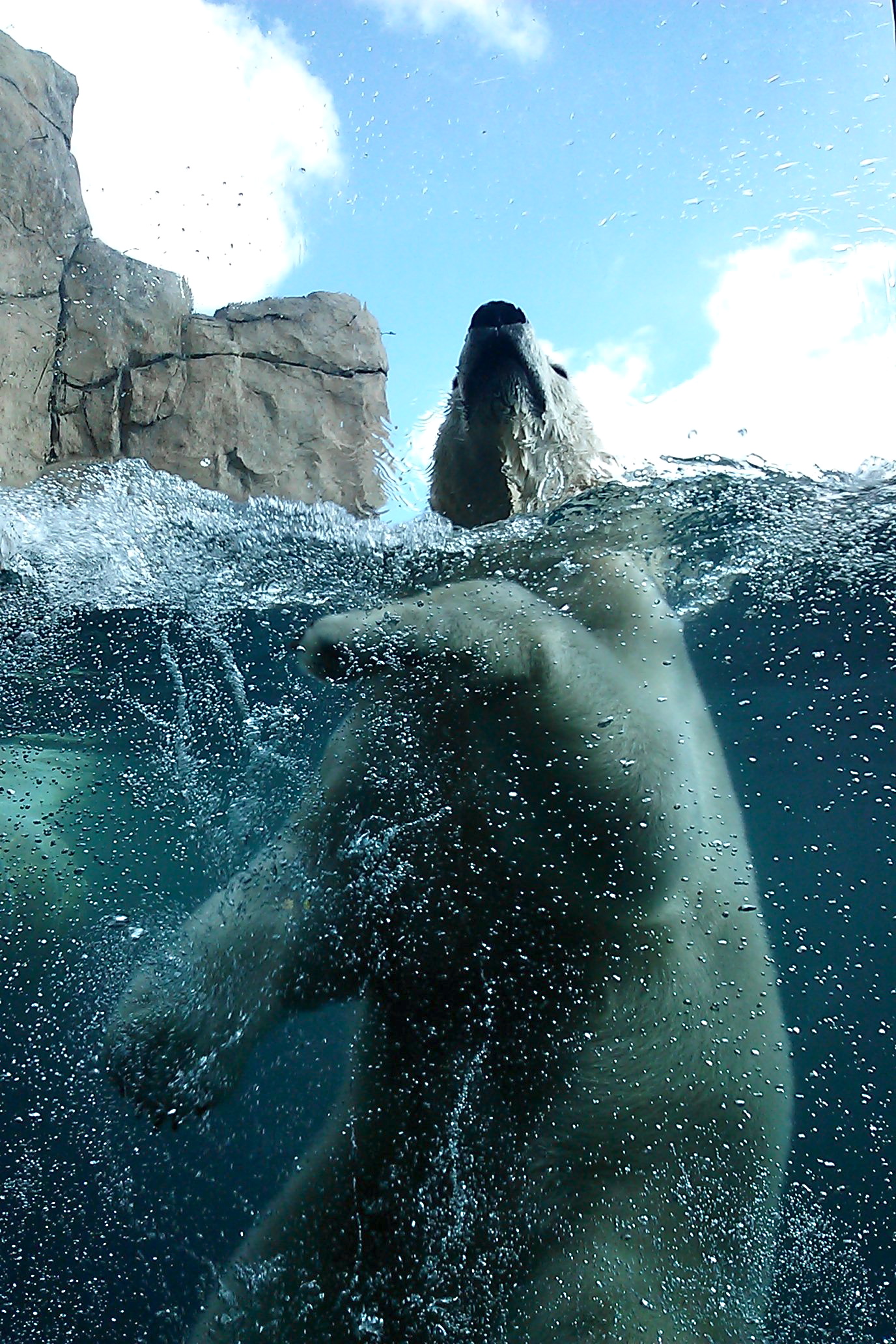
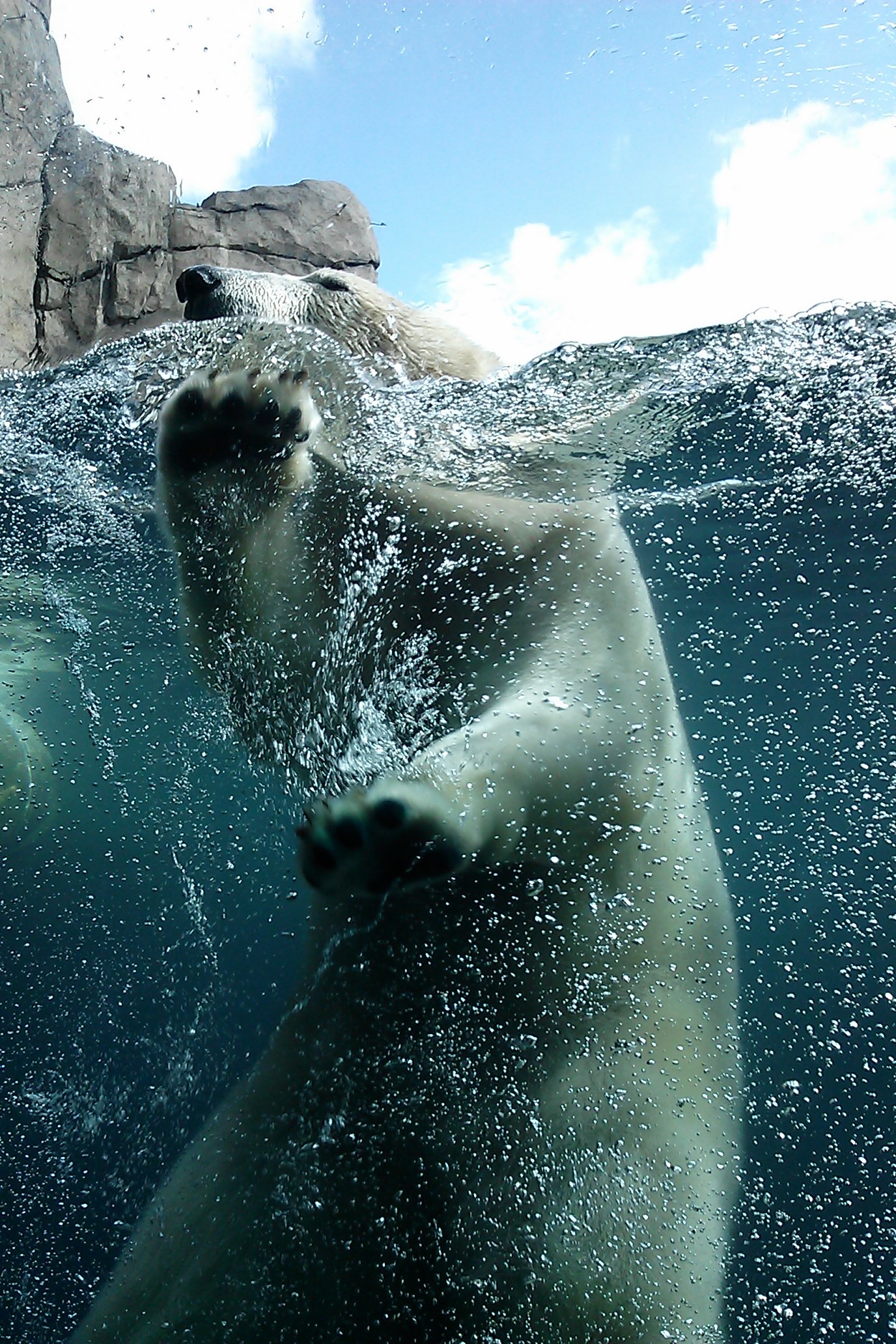
The moment we entered the polar bear exhibit, I saw him. A giant of a bear, up against the glass wall of his habitat’s pool, treading water. His powerful front paws paddled at a frantic pace, constantly working to keep him afloat. I was fascinated by his size, his concentration and his seeming oblivion to the spectators crowding the glass in front of him.

As we stood there, other visitors began commenting on the energy and exertion required to keep him afloat. The human tendency to project our own experience onto other beings asserted itself quickly. I heard comments such as, “Poor thing, he looks scared!” or “He looks so tired! Why doesn’t he just stop?” Most people in the room were enthralled by the bear treading water, myself included. I snapped several quick photos to capture the moment. However, there was a growing concern among the humans that something might be wrong. We knew nothing about polar bears, really. But if it were one of us in that pool, the activity we were witnessing would indicate a problem. So we engaged in blatant anthropomorphising, worried about the poor bear.

Image 1


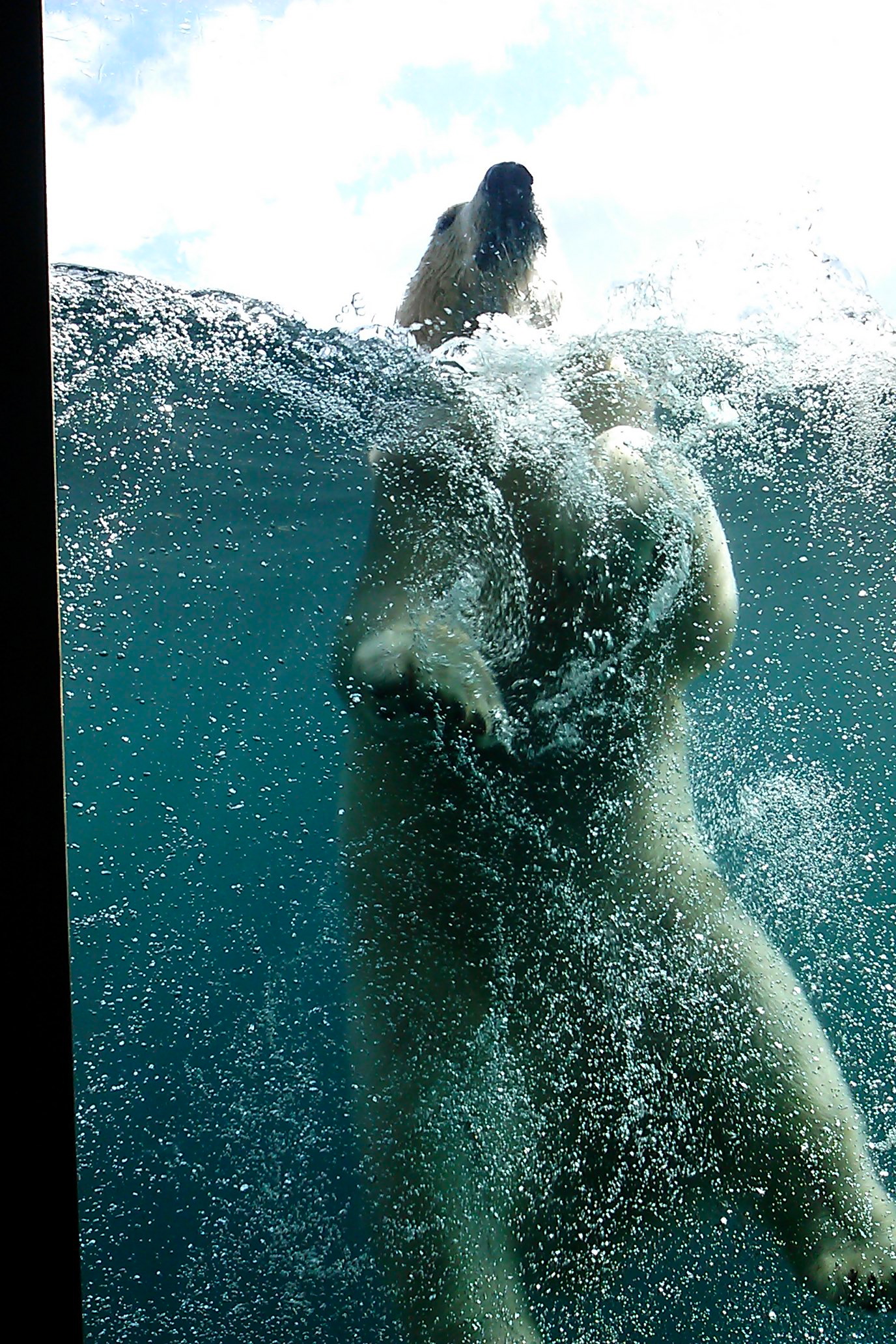
Then I noticed a small child with her face pressed against a panel of glass several feet away. She giggled, then looked at her adult companion with awe-filled eyes. I moved over a step, and saw a second polar bear. This one was swimming laps, backstroking across the pool. On the far side, he executed a perfect turn (one even Michael Phelps would be jealous of), then swam low across the bottom of the pool, facing the glass. When he arrived at the glass panel, he practically rammed it with his nose, coming face-to-face with the child before swimming vertically up the glass to the pool’s surface. Once there, he put his powerful hind paws against the glass and pushed off.

Most of the spectators in the room remained fixated on the bear treading water. However, my friend Kate and I moved into the child’s spot when she and her adult moved on. This lap-swimming bear swam with a steady rhythm, each rotation exactly the same as the previous rotation. However, he appeared happy, playful, even joyful by comparison to the bear who shared his habitat.

Image 2

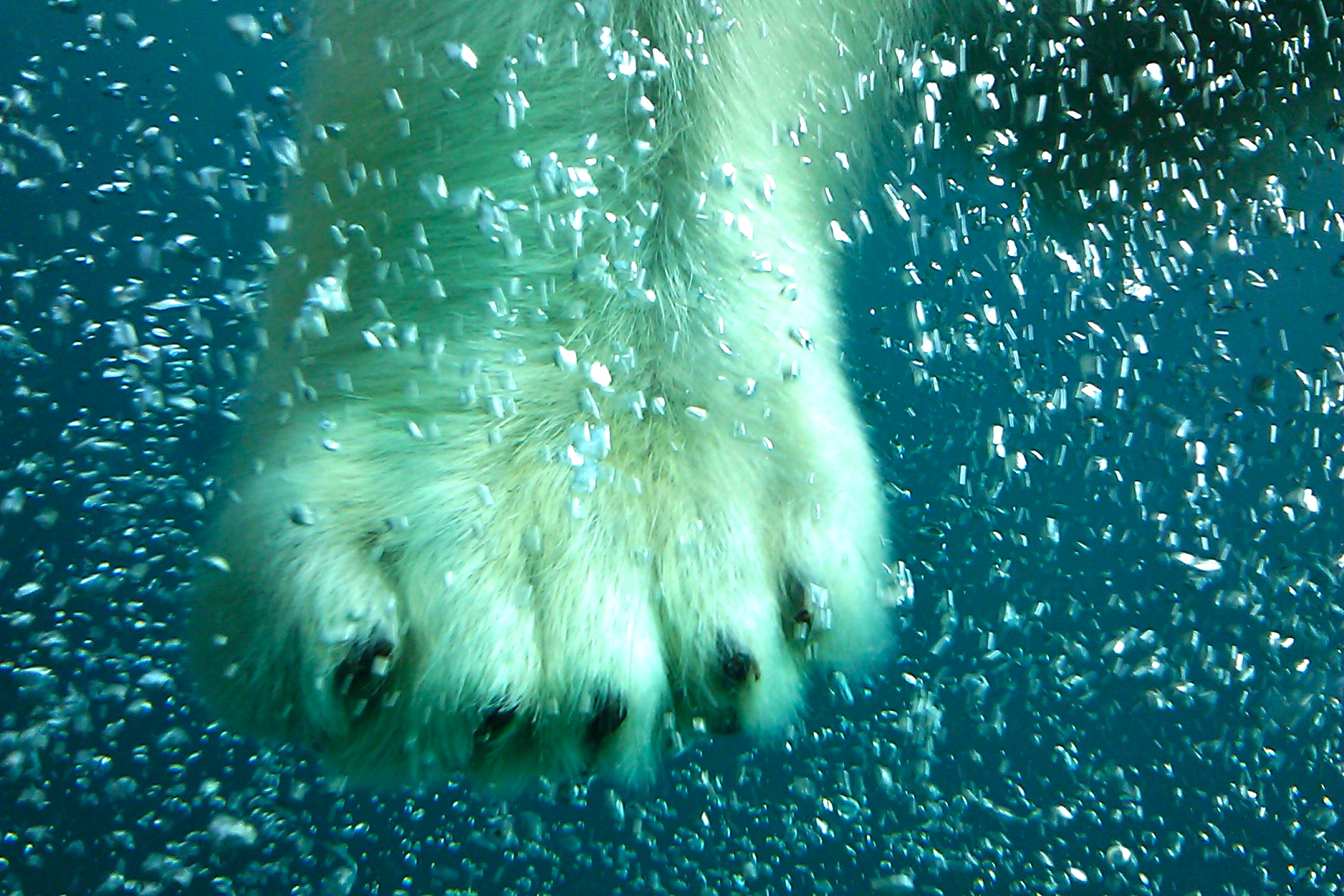
I put my forehead against the glass in order to come face-to-face with the bear as he arrived at the glass. We made eye contact, and I found myself giggling almost exactly as the child had previously. On another lap, I placed my hand on the glass so that it met his hind paw as it pushed off – the massive paw was more than double the size of my hand.

I was so fascinated I forgot to take any photos of the second bear. When Kate and I finally left the polar bear enclosure, I felt happy, infected by the positive energy we imagined flowing from the backstroking bear.

Image 4

All told, we spent maybe ten or fifteen minutes observing the polar bears that morning. But I’ve found myself thinking about them frequently and have, I think, discovered a meaningful allegory for myself in the swimming bears.

Like the first bear, I have spent a lot of time treading water – maintaining the status quo, remaining in the same place, holding steady. At times, treading water is a good thing – it allows us to conserve energy in the midst of turbulent times, can act as a respite from exhaustive or strenuous activity. But treading water can also be about fear – of the unknown, of change, of moving into the open water that signifies life’s many possibilities. The equivalent of treading water in our lives requires the same kind of frantic paddling we witnessed in the polar bear, as we avoid people, dodge opportunities, make excuses to remain the same. To remain unchanged and unchallenged – even if that also means we remain unhappy or unfulfilled.

The lap swimming bear, by contrast, was striking out boldly in a direction. On each circuit, there were similar actions, though each time he came along the pool’s floor toward the glass, there was the possibility of discovering something/someone new! His whole energy spoke of play, joy and willingness. In our lives, we have to accept that we don’t get to know everything in order to move forward. In order to experience the wide range of life and experiences we wish for and want.

As I’ve ruminated on these two polar bears, I’ve realized that each of them was working hard as they engaged in their different activities. They were likely burning similar calories, using similar reserves of energy. Yet their demeanors and the meaningfulness of what they were doing was experienced by those watching very differently. For us humans, treading water is an activity that outlives its usefulness fairly quickly. If we want our lives to have meaning, a sense of purpose, of growth, we have to swim. We have to strike out into unknown and uncharted waters. We must learn to do so with our eyes open and with a readiness to see whatever is waiting for us on the next turn.

I can’t speak for polar bears.  But for me, if staying in the same place or moving forward require roughly the same amount – though different kinds – of work, why not move? In the future, when I find myself treading water in life instead of proceeding in the direction of my dreams, I hope the images of those polar bears will come to mind. I hope they’ll remind me to pick a direction and go. I won’t know for sure where I’ll end up, but I’m certain that I’ll come face to face with something new – and in the process, become someone new.


To My Post-Weight Loss Body

I have been told I should love you.

I have been asked why I hate you.

Love and hate: the extremities of emotion. What I feel toward you is neither, yet both: extreme in its measure of complexity rather than its static position on an axis.

When it comes to their bodies, even poets vacillate between love:

Clifton swinging her jazzy hips;
Piercy belly bumping her lover;
Whitman singing the body electric…

And hate:

Roethke’s “rags of anatomy”,
Amichai betrayed by hair’s sprouting and Corso by it’s routing;
countless unnamed others using their words to reach an armistice on this war’s very personal front…

If much of humanity swings on that pendulum, loving you and hating you, how am I to reconcile my own internal tug of war?

I am proud of you:

The vigor of muscle and bone, their strength;
The tenacity of heart and lungs, their endurance;
The willingness to rise to the occasion when I mistreated you and, again, when I needed you to recover myself.

Am I also ashamed of you?

I keep you covered from the eyes of others;
I avert my own gaze in bath and dressing rooms;
I refuse the sleeveless and eschew summer beaches.

Or is what seems to be shame, instead, a self-protective instinct? A desire to hold safe and sacred “this skin, this sac of dung and joy” described by yet another poet*? Am I afraid that eyes will see not the triumph,but the scarred aftermath of the battle we waged to regain wholeness?

Will see not your death-defying resilience, but the false, sagging appearance of its opposite?

I am not touting this ambivalence as either good or bad. I’m attempting to come to terms with the “what is”

As opposed to the “what I wish it was”.

It’s one of the things you, my own body, have taught me:
What IS is always infinitely greater than we anticipate,
While also often less than we hope for.

If I need a reason to hate you, that might be enough.

In the end, though, we’re in this together. Wherever we go, however I feel about you.

If I need a reason to love you, that ought to suffice.

***********************************************************

Note: This piece was written as an exercise for my writer’s group – our assignment: to “write a toast to someone or something important to you”. Thanks to the Rider Writers for the inspiration, and the encouragement to experiment.

* The poem quoted, above (“…this skin, this sac of dung & joy”) is Yusef Komunyakaa. Here’s a link to his poem, “Anodyne” – a must-read exploration of body-love! I love his closing, which I quote here in case you don’t go to the poem in its entirety:

I love this body, this
solo & ragtime jubilee
behind the left nipple,
because I know I was born
to wear out at least
one hundred angels.

Hold It – Let It Out

 Image

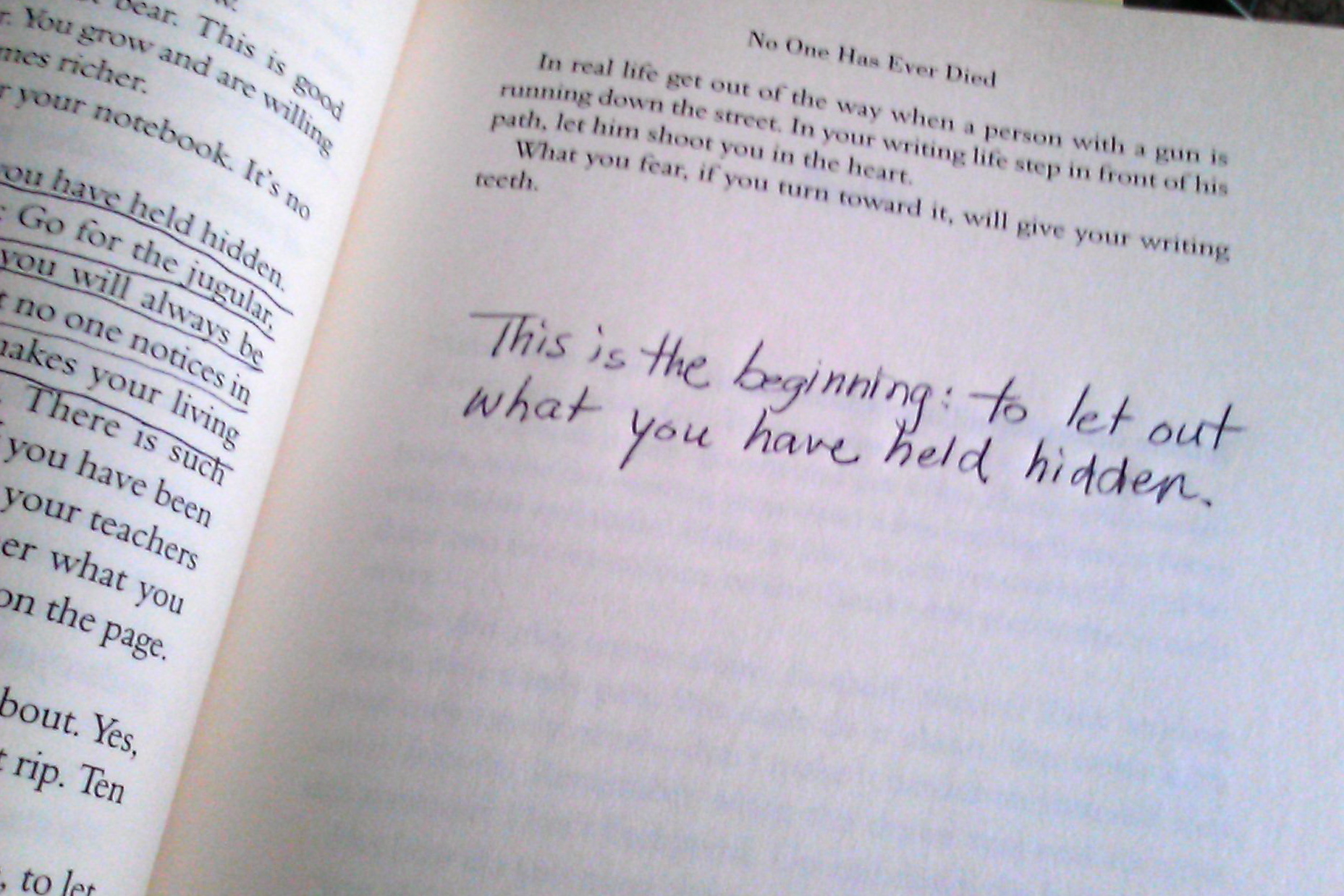
“This is the beginning: to let out what you have held hidden.”   —Natalie Goldberg

I am just plain sick of it. Sick of holding back, holding things in, holding my tongue.

I know there are some of you who think I blab about everything. After all, in the history of this blog, I’ve shared about eating binges, flatulence, passion, moments of grace, even anger at the All Knowing. And in real life, I sometimes say things that the more circumspect among you might not publicly utter. Even so.

The reality of my life has been that I worry about everyone else and how they will feel, react, respond to what I might say. I worry, and I fear – fear that if I say the truth, share my feelings, let out the things that have been kept secret that love will be withheld or withdrawn from me. Fear that, like Helen Hunt’s character in the movie “What Women Want” my reality will be that “…the price you pay for being you is that you don’t get love.”

Newsflash, folks. We pay the price whether we are ourselves or not. Because people can’t truly, authentically love someone they don’t know. It turns out, then, that the only person harmed by keeping yourself a secret is…you. Others will or will not love you, but if you keep your truth inside in an effort to be palatable to others you won’t love yourself. And this self-abuse will slowly destroy you.

You may wonder where this rant came from. After all, last week I was all about being kind, and how to respond with generosity of spirit when others hurt you or take advantage or don’t even notice your efforts on their behalf. To be clear, I don’t believe one has to be unkind to be truthful. But to share your own truth, no matter how carefully, is to risk. You can control what you say and the manner in which you say it – you cannot control how someone else responds or feels about it. (Good thing too, because they are responsible for their own crap. We all have more than enough to handle just managing our own loads.) So this rant actually follows somewhat logically on the heels of that kindness post. Because finding my way through the Land-of-Sharing-How-I-Really-Feel while treading the Path of Kindness isn’t always easy, my friends.

So why try?

I received a gift this week that has helped me begin to gel into a coherent whole my far-flung thoughts on this. An old friend from far away sent me a book by that title (Old Friend From Far Away: The Practice of Writing Memoir by Natalie Goldberg). Goldberg’s advice is for writing authentic and meaningful memoir, but it is also good advice for living authentically. She says, “Go for the jugular, for what makes you nervous. Otherwise, you will always be writing around your secrets, like the elephant no one notices in the living room. It’s that large animal that makes your living room unique and interesting. Write about it.”

This is true for writing memoir, and it is also true for speaking up for our own lives. It is our perceptions, feelings, unique perspectives that make us who we are – that make us interesting and that allow others to connect with us. When we edge nervously around our feelings – the ones we are afraid of, those we are ashamed of, the feelings that are petty or that are expansive and wise – we do avoid conflict. But the cost of avoiding that conflict is high – we teach others that we will accept anything, any behavior or treatment at their hands; we teach ourselves that we are not worth fighting for, not worth engaging in conflict over.

And I am just plain sick of it. Sick of holding back, holding things in, holding my tongue – sick of betraying myself in order to maintain the status quo, to get through another day without conflict. I’m not looking for a fight – no cruising  for a bruising here! Even so.

This is the beginning: to let out what I have held hidden.


Thoughts on Thoughtfulness

Does thoughtfulness pay?

This question was recently posed on social media by a friend of mine. I responded with the answer that occurred to me at the time – generally, that being thoughtful or kind towards others pays biggest dividends in the areas of self-respect and empowerment. When we are kind we are our best selves. When we are kind regardless of outcome or response from the recipient of our thoughtfulness, we remain centered and strong in that best self.

Since then, I’ve been thinking a lot about thoughtfulness and kindness – about what it means to be a truly kind person; about what we are supposed to do with our feelings of disappointment or hurt when our kindness or thoughtfulness is met with…less…from others; about whether there are times when the impulse toward kindness or generosity or thoughtfulness ought to be ignored or set aside.

I don’t have any definitive answers. But I’d like to share a story related to each of the three questions posed above. Perhaps my stories, as I’ve tried to parse out an answer to the original question, “Does thoughtfulness pay?”, will be useful to you, should you find yourself pondering similar thoughts.

What does it mean to be a truly kind person?

The other day, I was at work as a barista in the coffee kiosk. I chanced to look up at the store entrance just as a regular “customer” walked into the building. I say “customer” in quotation marks, because this particular woman comes by every day and requests a free sample of brewed coffee.

I confess to having uncharitable thoughts about this freeloader as she approached the kiosk that afternoon. However, I do try to interact with each person in a respectful manner so, when she asked for her free sample, I willingly filled the sample cup to the brim, saying, “Enjoy!” as I handed it off. But instead of murmuring thanks and moving on, as she usually does, the woman stopped and made direct eye contact with me. She said, “Thank you for your kindness and generosity. I hope it comes back to you many times over.”

Her facial expression was inscrutable – she neither smiled nor appeared stern; rather, she seemed to be responding to a clairvoyant knowledge that, only moments before, I had been thinking uncharitably about her. I was left wondering whether she intended to heap good fortune or its opposite upon me. Were her words a blessing or a curse?!

I think I (mostly) manage to behave in a manner which is outwardly kind. But I am coming to believe that truly kind people are kind in thought as well as deed. The kindness I most appreciate from others is the type offered in lieu of judgement or criticism, silent or otherwise.

What we are supposed to do with our feelings of disappointment or hurt when our kindness or thoughtfulness is met with…less…from others?

A friend told me about planning for weeks to surprise her sister with a perfect weekend. She worked on every detail of the time they would spend together, from meals to pedicures, to attending a show. When the weekend came, the sister’s response was unenthusiastic. In fact, she kept suggesting they call friends to join them, indicating that the whole thing would be more fun if there were more people involved. While my friend tried to adjust her plans and accommodate her sister’s wish for a more exciting time, the final blow fell when the sister casually remarked that she was very excited for the following weekend, when she had really exciting plans. My friend was hurt and felt greatly unappreciated. Her question to me: “Why did I bother?” A slightly different question than, “Does thoughtfulness pay”, but one coming from the same place of disappointment.

I’m beginning to understand that this is the wrong question for me – because there is no good or right answer. Is it worth it? Obviously not, because there you stand feeling hurt and unappreciated. Or, the answer could be Yes, because you have been altruistic, done something for another without regard for rewards – even though it still doesn’t feel very good.

For me, the path to take at this juncture is one of truthfulness with myself. Time to fess up and be clear with myself about my own motivations and desires. Instead of indulging in the myth of martyrdom, take a hard look to see whether I have made an emotional contract with another person and forgotten to tell them about it; or if I am somehow expecting that the thoughtfulness I’ve expended will ensure that the other person will love me.

Some spiritual traditions encourage us to let go of expectations. In fact, I often think the biggest reason we are hurt in these instances is that we have our hearts secretly set on a specific outcome. Kindness and thoughtfulness become manipulation when achieving a specific outcome outweighs the simple joy of putting another person’s pleasure, needs, or wants ahead of our own.

Are there times when the impulse toward kindness or generosity or thoughtfulness ought to be ignored or set aside?

There’s an older dude who hangs out around my apartment: he sits on our front steps smoking and drinking gas station coffee, then leaves his trash (butts and empty styrofoam) lying there in order to walk across our parking area to drop trou and pee into the alley. Most days, as I walk past him to get to my car or to run errands, he says, “Hey, would you happen to have a quarter you can give me? I just want to buy a cup of coffee.” I learned through experience that a yes to that question elicits a follow-up, “What about a dollar? Then I could eat something too.”  I’m never sure what the right thing to do in this situation is. The guy lives in a care facility up the street, so he isn’t homeless or completely destitute. But he also clearly doesn’t have many resources.

When kindness offered becomes, instead, a chore; when a person’s instinctual reflex toward generosity is manipulated or used to take advantage of that person, it may be time to stop being so giving.

The difficulty is in knowing when that line has been crossed. Often, our friends will tell us that we’ve been suckered or abused long before we are willing to concede to such an assertion. They do this because they love us and hate to see us feeling hurt. Our feelings of hurt, themselves, will whisper to us that we are being taken for granted – a defense mechanism attempting to protect the vulnerability that comes with being open enough to be giving to another. Yet, there ARE people who are skilled manipulators and users.

In the end, we can choose to answer the question, “Does thoughtfulness pay?” in any number of ways. And the reality is, the only answer resides within our innermost hearts. Today, I stand with the idea that kindness and thoughtfulness are worth the vulnerability they open me up to. My job is to learn to take kindness to the next level – kind in thought, as well as word and deed. And then to remember that thoughtfulness is about me paying out in energy and care and compassion – not about me earning dividends in love and respect and friendship. I expect to fail miserably at this sometimes. I expect to have my share of feeling betrayed when others are indifferent toward (or nefarious in exploiting) the care I’ve expended. That’s what makes being a truly kind person hard, and also what makes it worthwhile and powerful.