“Above all, be the heroine of your life, not the victim.”
― Nora Ephron
Dear Kristen:
You walked into my life wearing the most preposterous shoes. The heels were taller than any I’ve attempted to wear as an adult, the gap between your foot and the back of the shoe just noticeable enough to be reminiscent of a child wearing her mother’s pumps during a game of dress-up. Your eyes were wider than a newborn’s. I could see you thought yourself sophisticated and worldly – yet I thought you were terminally young.
And because of this first impression, I initially made the mistake that I think people often do with you: I assumed your youthful demeanor and optimistic naiveté signaled innocence, softness, inexperience. I could not have been more wrong.
Sometimes in life we are lucky enough to have golden moments – times when the stars seem to align and all is right with the world. In my life, the family of colleagues and friends we created – complete with love and respect and occasional bickering – was one such golden moment. In that family, I know you sometimes felt like the second child: a little less love, a little less attention, and little less appreciation of your gifts.
There are a lot of us out here who know what that feels like. So, while what I want to say is definitely meant for you, it is also meant for all of us who have felt as if we don’t come in first; who feel like our best efforts, our best offerings, our best selves, are somehow not lauded or welcomed as quite enough.
I want you to know that your character and integrity are loved. These are not shiny things that immediately draw the world’s attention. But they are strong and lovely, and they draw forth the kind of lasting respect that comes quietly and without fanfare.
I want you to know that the things that are unique to you (the way you tell stories, the tiny bites you take when you eat, the way your eyes grow large but your mouth stays closed when something upsets or infuriates you) may bring some teasing or comment from others. But they are also the things that endear you to others because they are yours alone. Don’t ever give them up because others are thoughtless enough to make you feel self-conscious about them.
I want you to know that words like loyal, dependable, thoughtful are mostly considered boring by those who easily lose concentration, whose promises are not always to be trusted. Wear these labels proudly, because you’ve earned them for being exactly those things at times when others shrugged, quit, or stopped caring.
I want you to know that it’s o.k. to ask for what you want from life and from the people in your life. Ask that the respect and the kindness and the generosity that you so freely give to others to be given to you in turn. You deserve that. And while life has taught you to accept that you won’t always get what you want, this does not mean that people who seem to are more deserving than you. If life were fair, you’d be beyond wealthy in attention and love!
What I hope for you is everything your heart truly desires.
May your dimpled smile be seen more frequently than not.
May your voice be loved and appreciated for its wisdom.
Regardless of what anyone else thinks, or how anyone else behaves toward you, may you never think of yourself as second-best. There are bound to be others who, like me, need time to appreciate the fullness of your gifts. But don’t let that stop you from knowing how gifted you are. Or cause you to hide your light in deference to anyone else. People can be slow, but the important ones will figure it out, will treasure your presence in their lives.
For my part, I miss having your beautiful light and energy in my life every day. But I believe in all the things you can do and are doing, all the love you can (and are) expressing, and the many ways you being here makes the world a better place.
“I do believe in an everyday sort of magic — the inexplicable connectedness we sometimes experience with places, people, works of art and the like; the eerie appropriateness of moments of synchronicity; the whispered voice, the hidden presence, when we think we’re alone.” — Charles De Lint
“Memory”, Meinrad Craighead
I read a statement by a cyclist somewhere, recently, that claimed one of the best reasons for riding was that while doing so the mind has free range to wander where it will. And sometimes, in that wandering, it takes one someplace wholly unexpected. One beautiful afternoon last week, as I rode along the bike lane on Portland Avenue, just as I crossed the heavily trafficked Lake Street, I became aware of my own wandering thoughts. Aware that I had been in an almost meditative state, allowing thoughts and images to float into and back out of my mind without comment, without judgement.
Oftentimes, once you become aware of that semi-meditative or flow state, it’s over. Your very attention to it brings you out of that moment, carries you back into self-consciousness. Occasionally, though, something different happens and you, instead, find yourself in a state of heightened awareness. I felt myself entering that state of hyper-awareness – I felt my tires connecting with the road, the warmth of sun on shoulders, the scent of freshly mown grass in my nostrils. The traffic noises receded, and I could hear only the blood in my veins and my own breath.
That’s when Meinrad Craighead popped into my thoughts.
At a time in my life when I was open to new ways of thinking, I happened to pick up a book called “Seekers of Wisdom: Women Mystics of the 20th Century” by Anne Bancroft. The book profiled a number of spiritual seekers; their lives and words had a profound effect on my own thinking and worldview. The chapter about Meinrad Craighead struck me as particularly powerful. In it, Craighead shared a story about experiencing (as a child) something very like what I felt that afternoon on my bike. ” I held the dog’s head, stroking her into sleep. But she held my gaze. As I looked into her eyes I realized that I would never travel further than into this animal’s eyes. At this particular moment I was allowed to see infinity through my dog’s eyes, and I was old enough to know that.”
As I read Craighead’s story, punctuated with long quotations from her own writings, I found myself drawn to her discussion of the feminine face of God, to her view of our lives. “Life,” she said, “is radically more than the experiences of a lifetime, it is an invitation to a journey back to our origin in God, and our own personal memories form the unique stuff of that quest.” An artist, Craighead became known for her dreamlike imagery and mystical themes of the Divine Feminine. At one point in the chapter, it was mentioned that she had attended an all-women’s Catholic college. I had attended a previously all-women’s Catholic college and remember having the passing thought that it would be cool if we shared an alma mater. It was a fleeting thought, and it soon passed out of my consciousness, though Craighead’s words remained with me.
A few weeks later, I received an invitation to a special series of events on my college’s campus celebrating the anniversary of its founding. Headline billing was given to world-renown artist and alumna, Meinrad Craighead. I was stunned – I’d never even heard of this woman until that spring. And once I had, I certainly did not expect the possibility of meeting her to arise. I was beyond excited, and I made plans to attend her guest lecture and the opening of her retrospective art exhibit on the campus in my hometown. I had never seen any of her paintings – this all took place early in the development of the internet, and a great deal of information was simply not yet available to the world. Meinrad Craighead’s lecture – part explication of her theological and mystical beliefs and part treatise on how these informed her work as an artist, was truly mind-blowing. Slides of her work appeared on huge screens as she discussed each piece. Each one was beautiful, deeply symbolic, and epic in scale.
My head swimming with the ideas she presented, I left the lecture hall and went immediately to the gallery where her work was on display. There I discovered, much to my surprise, that most of Craighead’s paintings were quite small. Their amazing use of color and the degree of detail took on new significance as I realized the discipline exercised in working on such a diminutive scale when the subject matter was infinity itself.
That there was more than mere chance involved in the timing of these events I have never doubted. The encounter with Craighead, through her words, her work and her presence, has continued to inform my own beliefs and perspectives. This was synchronicity in its truest sense – meaningful coincidence, rather than random happenstance.
As I rode my bike, I looked in front of my tire and saw the white painted lines which delineated the bike lane stretching straight ahead of me to the horizon. And in that moment, I realized that I was riding not only toward the Minnehaha Creek path but also into my own future. Every experience I’ve had has propelled me toward this moment – just as this moment adds strength to the forward momentum of my life. I haven’t yet become the person I am meant to be precisely because that person is the culmination of a life’s activities and experiences. As surely as Craighead saw infinity in the eyes of her dog, I saw it stretching before me in the bike lane.
“At the source of our deepest self is a mysterious unknown ever eluding our grasp. We can never possess it except as that mystery which keeps at a distance. The heart’s quest is toward this unknown. There is no respite in the task of getting beyond the point we have already reached because the Spirit stands further on. She stands at the end of every road we may wish to travel by…We never ‘catch up with’ who we fundamentally are.” — Meinrad Craighead
NOTE: Please check out Craighead’s website http://www.meinradcraighead.com so you can see her work. Adding to the touch points between us, I learned that Craighead is a resident of the bosque in Albuquerque, New Mexico – one of my favorite places and certainly influential to her work and both our lives!
The image above appeared in my Facebook feed repeatedly this week. During the same time frame, I was watching a movie called “The Way”:
I hope you caught the line, repeated throughout the movie, “You don’t choose a life, you live one.”
Two widely different views on choosing in life. The first addressing the daily choices we all make, the “micro” viewpoint; the second, the sweeping (or “macro”) view. Upon first exposure to each, I found nothing to disagree with or argue. Both statements have validity. It is often the case, however, that confronting the same idea multiple times leads to deeper consideration.
At face value, the first statement is specifically a short treatise on personal responsibility. I’m down with that – not blaming my life on others or on extenuating circumstances. I make my own choices, big and small, throughout each and every day. The more I read it, though, the more I find myself arguing with its scolding tone and oversimplified declaratives. Because the truth is, you can only make choices within the scope of what is available or possible for you – which differs among individuals/groups of individuals AND which is partially dependent upon what you believe is possible. What is possible for a child born and living in a refugee camp in the Sudan is, logically, not the same as what is possible for a child born in the midwestern United States. Even when those children are adults and, presumably the primary choice-makers in their own lives, the realities of geography, circumstance, finance make their possibilities and the choices available quite different. Layer over that the efficacy of belief and the filters through which we view the world, the realities of sexism and racism and classism…and it becomes somewhat harder to take this admonition at face value.
The second statement, “You don’t choose a life, you live one” also appealed to me at first. Jumping into your life, toes of both feet pointed to immerse you quickly and smoothly into the stream of experience, sounds about right. Don’t over think it, just do and feel it. What’s not to love about that idea? Just this: sometimes when we are all about living rather than choosing, we just keep moving from experience to experience without ever going/getting anywhere.
Just a few of the thoughts I’ve had while reflecting on these two quotes. I can always wax philosophical about such ideas. It is one of my defense mechanisms – you know, those things that conveniently keep us from thinking too honestly or feeling too deeply when something threatens to make us? Once I realize that my defenses are engaged, it’s usually a good idea to look more deeply, to figure out why.
“You and only you are responsible for every decision and choice you make.” This is the line that strikes me most deeply. It is true, if scary. However, my life isn’t constructed by my decisions only. Ask anyone in the midst of a protracted job search, and they’ll likely say what they hate the most is the lack of personal control over what happens. Your fate, your future, feels like it is in the hands of strangers. In the arena of personal relationships, as well, there are others involved in the way that relationship takes shape or doesn’t. Considering the proliferation of this post on the pages of my politically conservative friends, I find myself thinking the subtext is intended to point the finger at those lazy freeloaders deemed to be benefitting from the hard word and earnings of ‘honest” folks/taxpayers. I’m not whining or hiding from my fiscal responsibilities – but I am working full-time, on my feet for 8-hour shifts, no two-days-in-a-row off, no paid sick leave – and for the first time in my life receiving public assistance. Given all of this, its no wonder this post has me feeling a bit defensive.
“You don’t choose a life, you live one.” Well, this idea would seem to offer me relief from the “I make all my own choices” piece because it skips right over the whole question of responsibility. Live. Breathe. Experience. Om. Except this pesky voice in my head keeps suggesting that it isn’t the whole story. Am I living my life? You bet – to the best of my ability to see my choices on a daily basis. But there is also the need to feel like my life has a story, follows an arc of meaning. An over-focus on living each day as it comes can prevent one from investing energy in that long-term life plot. My defensiveness on this count is genuine. Each day seems to be so full of activities and choices and experiences, I fall into bed utterly exhausted each night. But in those brief moments before I lose consciousness to sleep I find myself asking, “What did I do today? Why didn’t I get more done? How can I do this differently?”
Twenty years ago, my colleagues at The University of Iowa and I created a substance abuse prevention campaign for the campus titled “Choices: You’ve Got ‘Em”. We then went on to share our take on how to make “good” choices in the context of substance use on a college campus. For me (and I suspect many others), this is the difficult sticking point: not that we have choices, or that we’re responsible for our own; rather, how do we know we’re making good choices. The best choices. Choices that communicate our values, that support our best selves, and that help us to create that meaningful life story each of us hopes to author?
I would love to tie up these ruminations with some really good answers for discerning how to make choices in our lives. I’m fresh out of strong answers to life’s abiding questions today, however. Instead, I’d like to share a story from Gregg Levoy’s book, Callings: Finding and Following an Authentic Life. In the excerpt, Levoy recounts asking a question of M. Scott Peck, author of The Road Less Travelled:
…asked how, in struggling with an important personal decision, I would know i was doing the right thing. Dr. Peck said the question is the single most common one he is asked and that “there is no such formula. The unconscious is always one step ahead of the conscious mind – the one that knows things – so it’s impossible to know for sure. But if you’re willing to sit with ambiguity, to accept uncertainties and contradictory meanings, then your unconscious will always be a step ahead of your conscious mind in the right directions. You’ll therefore do the right thing, although you won’t know it at the time.”
Uncertainty normally drives us daft, but although knowledge is power, not knowing also has its own power. There is the power in trusting ourselves, relying on our intuitions, being able to act even in the face of uncertainty, rather than drone on for sometimes years with yes-no-yes-no-yes-no-yes-no, the very onomatopoeia of indecision. It can be more heroic to be willing to act in the absence of certainty than to refuse to act without absolute certainty.
So, choices. We’ve got ’em. Here’s to accepting the challenge of making and taking responsibility for our daily choices. But more especially, here’s to living the life we mean to – anchored by choosing to act, rather than being paralyzed by indecision or limitations. It’s my life; it’s your life – choose it AND live it!
Atticus Finch. That’s who I want to be when I grow up. He’s the greatest guy ever – a good dad, a good lawyer, doing the right thing. And he knows he’s not supposed to win, but he’s doing it anyway. —Sean Patrick Maloney
All my life, I’ve been easily inspired by characters in books. Fiction (I should say good fiction) illuminates any number of character traits, helping the reader not only to see but to connect viscerally with both those traits they wish to emulate and those they know (to their chagrin) they already possess.
And so I have emotionally connected with passionate, dramatic, loyal Jo March in Little Women. But also with Amy March, her vain and jealous little sister. With girl detective Nancy Drew, but also her less-perfect counterpart, Trixie Belden.
Then there are characters like Atticus Finch, or Aragorn or Jane Eyre whose goodness and courage are legendary. These characters teach us about integrity. And while they may wrestle internally with doubt, the reality is that we know they will unerringly choose to do the right thing. That’s why we love them.
And that is one of the beauties of fiction.
In real life, I can find examples of many people who inspire me with their enthusiasm, their activism, their passion. Or, conversely, who allow me to be forgiving of my own humanity, by reflecting my own foibles and failings back at me. It is much harder to find examples of people in my daily life who choose to do the right thing when doing the right thing is truly hard to do: when it requires personal sacrifice; when to do so one has to put away feelings of righteousness or bitterness; when there is nothing remotely rewarding about taking that path. Much as I might wish to, I am not likely to serve as this kind of example for others.
One of the reasons it may be difficult to discover such individuals in our daily lives is that they are masquerading as ordinary friends and neighbors. They don’t appear to be starring in their very own epic tale. Instead, they appear to be schlepping through life like the rest of us. Now and then, though, the scales fall from our eyes and we can see the paragon shining through someone else’ mask of ordinary. When this happens, it can be breathtaking. Awe-inspiring. Moving.
I had one such experience last week.
A dear friend recently lost a parent. I could attempt, here, to describe my friend’s relationship with her parent in detail, but that isn’t my story to tell. Suffice it to say, there were many valid reasons for my friend to have broken off contact with this person. But she never did, as much as others argued (myself included) for her to do so.
Several years ago, the parent’s health began to decline. As it did so, it became clear that other members of the family intended to either avert their eyes or to take advantage in a grab for money. So my friend stepped up to the plate, showing both compassion and resolve to do the right thing for a person who neither appreciated nor, arguably, deserved such consideration.
For years my friend worked with her parent and with the parent’s healthcare providers. Due in part to personality, and in part to the ravages of Alzheimers, the parent was manipulative, verbally abusive, and regularly leveled false complaints against my friend. But day after day, week after week, my friend did whatever she could to provide care, comfort and presence. Some days, my friend could hardly hold herself intact emotionally. It was never easy.
She didn’t have to, there was no one policing her choices. My friend could have put her parent in a care facility and felt justified in staying away. God knows, it would have been so much easier to do this. But she took the harder course. At the end, when the parent took a final breath, my friend was there. Only one unpaid hand touched that parent and attempted to ease suffering. My friend: hero, exemplar, and shining example masquerading as ordinary.
Grace is a gift given when least expected – unearned, yet generous. Further, grace expects nothing in return. By this definition, my friend offered grace (repeatedly) to her parent. Being an instrument of grace in that parent’s life took determination, integrity, the discipline to continue digging deep in service to deeply held inner values. Dare I say it – against all odds, it took love.
I can think of a number of fictional characters who might have the wherewithal to accomplish what my friend did. For them, it would be easy – their author need just envision it, then write it. Voila. For the rest of us ordinary human beings, it is never so simple. Despite our best intentions, we have difficulty staying the course. The harder it is to do the right thing, the longer we must commit, the less likely it is we will. Doing the right thing without thanks, accolades or public pressure – that takes something special.
They say that truth is stranger than fiction. I would add that, no matter how poignant and lovely a story (and its characters) may be, truth is way more beautiful for being real. I am so grateful to have a friends’ example of grace to inspire me.
And whatever your beliefs, honor your creator, not by passively waiting for grace to come down from upon high, but by doing what you can to make grace happen… yourself, right now, right down here on Earth. — Bradley Whitford
Do not be your dorky self. Do not make a scene. Do not call attention to yourself. Do not show your feelings. Do not, under any circumstances, act as if you matter.
I don’t believe in any of these dictates.
I don’t believe in living life as if I don’t count.
I don’t believe in accepting whatever anyone else wants to dump on me.
But I sometimes find myself living as if I do believe those messages and dictates. As if I have no choice but to take whatever is being handed to me. When I feel insecure, when I feel alone, when I am anxious for people to like or love me, I revert to behaviors which, instead of making me more lovable just make me easier to take advantage of. To disregard. To hurt.
The other night, I was on a social ride sponsored by a local bike shop. We were riding to St. Paul for ice cream at Izzy’s, second-best ice cream in the cities (sorry, but Sebastian Joe’s remains number one in my heart!). We were a large group, and were asked to ride in pairs. I fell into place alongside my friend, Kate. As we rode, we got on the subject of body image and how it can impact every part of our lives. If we let it. If we choose to accept all of the cultural messages we receive. Kate told me that she had a “come to Jesus” moment in her own life.
“I realized, this is what I’ve got. Short of surgery, I can’t buy a new face or body. So I’ve got to be down with the ones I have. And anybody who tries to make me feel bad about that will just get the five fingers of death!” (she brandished her fist in the air to emphasize this point).
As we crossed into St. Paul, we faced the dreaded Marshall Avenue hill. I’d never ridden it before, but those who had warned that it was a tough one. I was feeling good, had been enjoying the ride and conversation, and I’m good at riding hills thanks to RAGBRAI. So while Kate waited to take the hill with her partner, Victoria, I forged ahead. I charged up the hill, passing friends and fellow riders. When I reached the top, I was winded but felt great – for about thirty seconds. And then…horrible, unbelievable pain whapped me in the head. I have never felt anything like it. My head felt both as if it was being squeezed in a vice and as if it were coming completely apart at the same time. I didn’t know what to do. Several friends rode up and, as they passed, asked if I was ok. At first, my indistinct answer was, “I don’t know”. But as the pain continued without abating, it became “I don’t think so” then, “NO”. I wasn’t ok.
As I stayed put, trying to breathe through the pain, the ride sponsor stopped beside me. He sat quietly and patiently while I tried to figure out what I might need. Kate and Victoria rode up and stopped, their faces full of concern. Then two other friends rode back from further ahead to see what was wrong. I was frightened. And I didn’t have a clue if the appropriate response was to shake it off or ask for an ambulance to be called. But what I focused on, what I was worried about, was that my “emergency” was interrupting everyone else’ good time. I didn’t want them to miss their ice cream, or have to stop having fun on my account.
So I insisted we move on to Izzy’s. I got off my bike and locked it up, and realized that Kate and Victoria were planning to stick with me. Victoria said, “If we’re bothering you and you’d prefer us to give you your space, just let us know.” But the last thing I wanted or needed at that moment was space. I don’t really remember waiting in line for ice cream or what we talked about. I was just doing my best to appear completely normal while feeling nauseated, in pain, and scared. Every time I made eye contact with Victoria, I knew she knew that’s what I was doing. As we got our ice cream and tried to exit the shop, our way was blocked by a bunch of guys who were just coming in the door (the line snaked halfway down the block outside). I stood there wondering how to make my way out, when Kate stepped up and just calmly said, “Gotta get through here, dude!” and the crowd parted with ease, apologizing for blocking the way.
Such a simple thing. The three of us burst out laughing on the sidewalk. Kate proudly repeated her line, “Gotta get through here, dude” several times, enjoying our response to her directness. And then she said, “Jen, you have to be more like that. You have to stop caring and develop an attitude. ‘Hey, I’m sorry if my health crisis interrupts your trip for ice cream, I can’t care about that right now – deal with it, dude!’ That’s what you need to say. And if anyone has a problem with that, you know what to do…”
In unison, we both lifted our fists and said, “Give ’em the five fingers of death!”
The Mary Lambert song, Secrets, is posted for two reasons. As a dedication to Kate and the great conversation/life lesson, and as my new theme song! My past theme songs, Flo Rida’s “Club Can’t Handle Me” and Sara Bareilles’ “Brave” were also aspirational. I love the message of Secrets: namely, that you shouldn’t hide yourself inside – be who you are, without apology or shame.
“A map does not just chart, it unlocks and formulates meaning; it forms bridges between here and there, between disparate ideas that we did not know were previously connected.” ― Reif Larsen, The Selected Works of T.S. Spivet
On a Saturday evening in early August, we stopped at the visitor center overlooking Duluth. Despite the haze in the air, and storm clouds rapidly approaching, the view was spectacular. I snapped a few photos, located Spirit Island with the assistance of the picture-graphic helpfully displayed below the plate glass windows, and used the restroom. Then, before we left the center, I wandered over to the literature display. Jackpot!
Back at the car, I happily stuffed a handful of new maps into my bag, anticipating an opportunity to pour over them in the near future. I’ve always liked maps. I’ve often thought this dates back for me, not to a love of history, but to a love of fantasy novels. Since Tolkein, fantasy novels have included obligatory maps and charts. I even own a volume of “Maps of Imaginary Places” – Middle Earth, Osten Ard, The Beklan Empire, Earthsea and many more – are places I’ve loved and visited in my imagination many times.
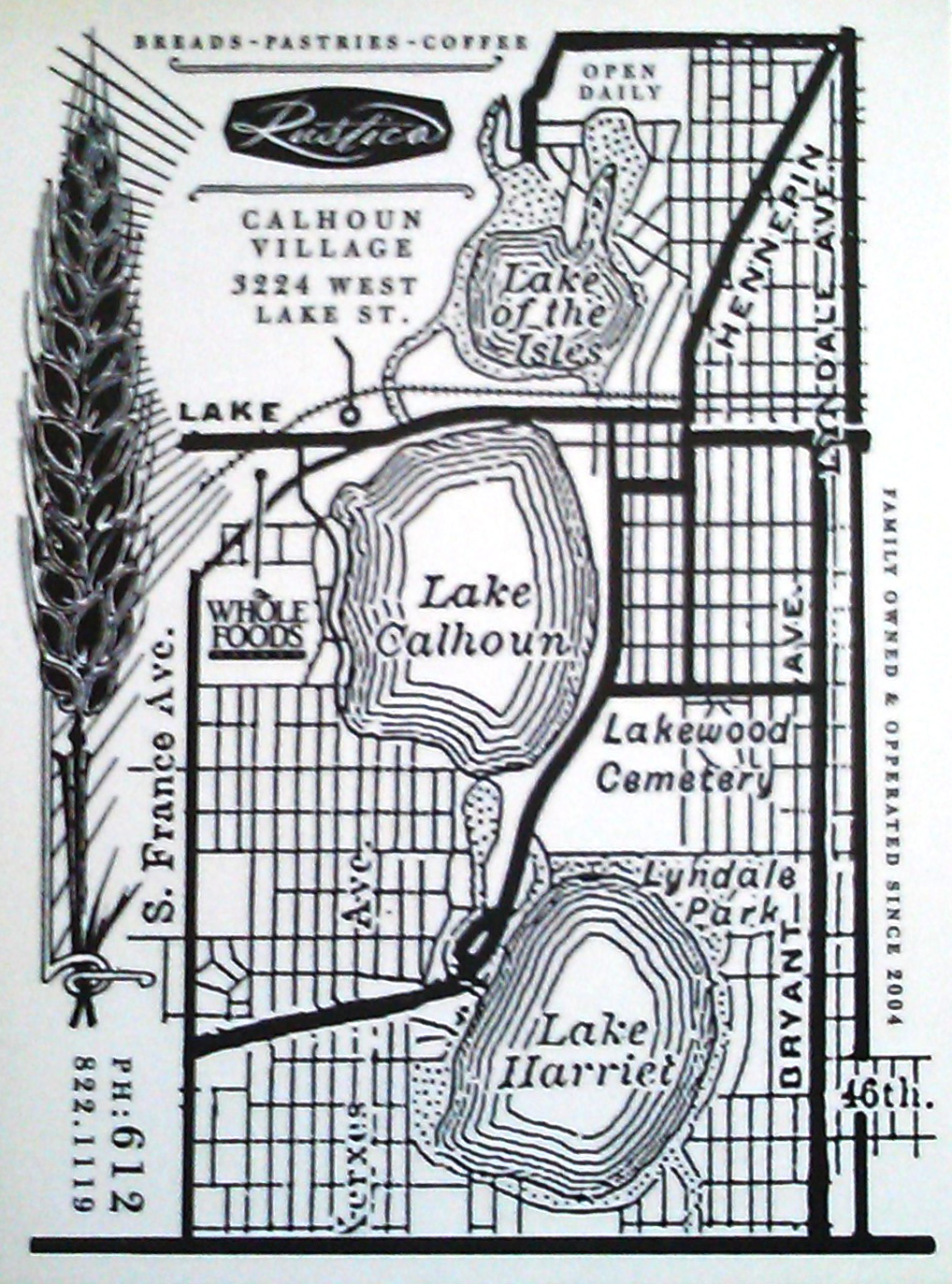
My past liking of maps has been eclipsed, however, by my current obsession with them. I have been collecting them since last fall – not collector’s items or costly maps, mind you; I collect free maps. They can be folded, multicolored road maps, such as the state map and state-wide bike trail map I nabbed in Duluth. They might also be small, black and white maps like this business card I picked up at Rustica:
Maps I love don’t need to be geographical in nature, either. I’ve discovered I’m not alone in this passion for maps and cartography; in fact, it is something of a trend the past couple of years. Maps lend themselves as pictorial markers for life’s journeys, whether through physical space or through interior, emotional and psychological space. There are publications and online sites devoted to this style of mapping. In an article on Brain Pickings, Maria Popova discusses this saying that the new cartography “places people rather than geography at the heart of the compass to construct a provocative new conception of cartography as wayfinding for the soul, not the body…expand the conception of a map as a flat reflection of geography and reclaim it, instead, as a living, breathing, dimensional expression of the human spirit.”
I find this particularly interesting, for several reasons. First, I drew such a map in my journal a number of years ago (and wrote about it, here). Second, I’ve begun to wonder exactly what this latest frenzy for maps indicates about me and/or my life – is all of this curiosity and obsession a disguised attempt at “way finding” for my soul?
In my wondering, I’ve discovered a pattern that stretches throughout my own personal history: I tend to get hopelessly lost.
I have moments (days, months, even years) of extreme lucidity when I know who I am and feel that I am where I need to be – or am facing/moving the right direction. And then that sense of direction evaporates. On the map of my life, I have difficulty finding the “You Are Here” dot, much less the “X” denoting a destination. In the middle of a path, it disappears. I stop journaling, which serves as both my sextant and my telescope – what I use to see ahead, to measure my inner distances. I forget to have faith, substituting anxiety and fear for hope and trust. Without my instruments, I drift. Tacking one way then another without aim or direction.
Is it any wonder that, at such times, I find maps so appealing? Just give me something straightforward to follow, something that allows me to rest in my decision-fatigue: a winning lottery ticket, a how-to-manual, an owner’s guide, a girl-scout handbook. The problem with a new cartography that is “wayfinding for the soul” is that one must create the map as they go along, rather than having the compass points neatly delineated ahead of time.
Perhaps everyone feels this way. Perhaps adult life is exactly this sailing into uncharted waters, underprepared and hesitant. Perhaps this is why we create tools to chart our progress (set goals, make bucket and to-do lists). I don’t know, really. I only know that, for me, the process of making my way through this life is one of starts and stops. Of backtracking and moving circuitously. If I am my own cartographer, I am creating the map of my life one blind step at a time, hoping that what is revealed is a life of purpose, a life that has been well-lived.
“When you’re a cartographer, having to make maps sort of comes with the territory. ” ― Jarod Kintz, A Zebra is the Piano of the Animal Kingdom
I don’t know about anyone else, but for me, mirrors are mostly utilitarian objects. I look into them to a) make sure the toothbrush actually goes into my pie-hole instead of poking me in the eye; b) to double-check that my buttons are properly lined up with my button-holes; c) to ascertain that no glaringly horrible stains mar the clothing I probably picked up off the floor to put on. Sure, there are times when I’m getting ready for something special and taking care with my appearance – mirrors come in handy then, too.
I don’t avoid mirrors. In fact, in my apartment there are two whole walls of mirrors in exactly the places you’d most want them: the kitchen and the bathroom (luckily, unlike my friend Mike’s place, my bathroom “wall o’mirrors” is behind me when using the toilet). Because of this, avoidance is hardly practical. On the other hand, I also don’t go out of my way to gaze into these mirrors. On the whole, I’d say my relationship with mirrors is pretty healthy.
Except when its not.
For example, one evening, as we toured out-of-town friends around the city, we found ourselves at the Guthrie Theater. The lobby leading to The Endless Bridge has deep-set windows with mirrored window surrounds. Usually, I have fun with these mirrors, as they reflect the sky and surrounding landscape in interesting ways and from unusual angles. But on this particular evening, I made a horrible discovery: Women my age, who have lost more than half their body weight, should not look down into a mirror. Gravity was not my friend. It conspired against me to throw every wrinkle and every bit of loose skin into stark relief. I was immediately plunged into a depression born of sheer horror. I wanted, nay, needed, a facelift – STAT! For the next twenty-four hours, I was obsessively checking my status in mirrors: a little old? a lot old? Just where did I fall on the spectrum between Meryl Streep in “The Devil Wears Prada” and Meryl Streep in “Into the Woods”? Every mirror I glanced at made me feel haggard and flabby.
Mirrors are nothing but bits of reflective glass, though. Despite our reactions, they don’t exist for the purpose of self-judgment or recriminations. As inanimate objects, mirrors cannot “make” us see or feel these things. Rather, the self-criticism and self-loathing we sometimes feel are coming from sources more hidden and more insidious. We’ve drunk in our culture’s singular version of perfect beauty since birth, and we have internalized it to the point at which we can’t even see that it is unattainable for everyone – even for those held up as models of it. They’ve been digitally or surgically remastered to look that way.
I’m proud to have lost so much weight, and even more so to have kept it off (some days it seems almost miraculous). My body is so much stronger and healthier than it once was. I feel so much more physically free than I once did. Much of the time I happily celebrate my body and its accomplishments. Yet, I am also often sad, embarrassed, shame filled when I think of my body. It lacks symmetry, it lacks flatness, it lacks tautness. I have an excess of skin where I would prefer not to. There are rolls and lumps and overflows where there ideally should be none. The existence of mirrors will not let me forget this, though mirrors are hardly to blame.
The poet, Marge Piercy, laments our cultural desire for body perfection in several of her poems. In “Belly Good”, she speaks to her belly, saying:
…You’re not supposed to exist
at all this decade. You’re to be flat
as a kitchen table, so children with
roller skates can speed over you
like those sidewalks of my childhood
that each gave a different roar under
my wheels. You’re required to show
muscle striations like the ocean
sand at ebb tide, but brick hard…
In the poem, Piercy goes on to celebrate her belly, tracing it through her grandmother and mother, claiming its softness and spread as comforting, its presence as a strength. I was reminded of this poem as a friend complained about her belly getting in the way of tasks she was attempting. Her partner gently reframed this, saying that her belly was perfectly lovely and more useful than problematic. It was a sweet, fleeting moment. What if we could love our own bodies like that? Shouldn’t we extend the same amount of compassion to ourselves as we so often do toward others?
Imagine how differently we might feel if we did so? And not just about our fleshy bits. What if our compassion extended to things like gray hair and wrinkles, balding heads and chin hair and crooked teeth? What if we took the highly un-American stance that all bodies belong on the beach (because it feels good and is good for the soul)? What if we celebrated the body electric, like Whitman and the kids from Fame? Beginning with my imperfect body. Beginning with yours?
One evening a few years ago I stopped by Panera Bread for dinner. I gave my order, and was asked my name so they could announce it when my food was ready. I said, “Jenifer”. The teenager behind the register asked, “Did you say Shirley?”
Ummmmmm, no. I did not – and to this day I am at a loss to understand how she heard “Shirley” when I clearly stated a name decidedly unlike Shirley. The really creepy part of the exchange? Shirley is my mother’s name.
Flash forward to this week. A friend and I were riding our bikes on the Midtown Greenway and came up behind a mother and her two children – one child on his own bike, the second on an extension of her mom’s. This kid was a little girl wearing a dress made up of purple sequins and a pink tutu. As we approached, I couldn’t help but notice both the costume and the child’s demeanor – listless, bored, and dragging her toes on the pavement. As I passed her, I turned toward her and said, “What a pretty dress! I love the sparkles!” Both the child and her mother smiled and murmured polite thank yous, and I passed on.
When we were side-by-side again after passing the family, I turned to my friend and said, “That little girl is going to break an ankle, dragging her feet that way.” To which he replied, “Do you have any idea how much you sounded like Shirley just then?!” I reached over to whap him on the arm, misjudged the distance and almost lost my balance. Wouldn’t that have been great – crashing, then explaining to people (my mother in particular) the reason!
Though it feels like a very natural thing, I don’t know why we react this way when people say we’re like our mothers. After all, most of us love our moms. And while it’s true that the majority of mothers are not perfect (and some are spectacularly awful), many are incredibly giving and exceptional parents.
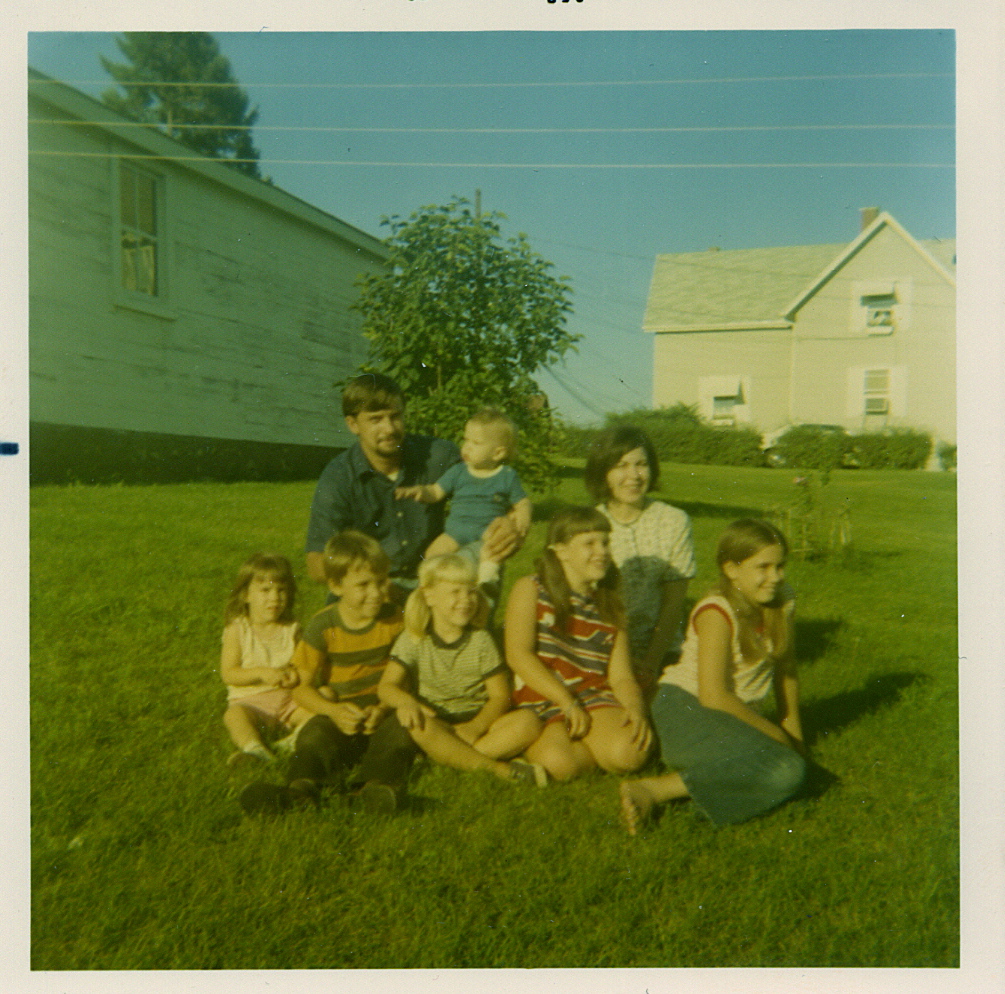
The eight groovy Hansons
My mom, Shirley, gave birth to six kids in nine years. As a child, I didn’t understand the first thing about her life: stuck at home, no vehicle, six kids, and no money (not really a surprise, with six kids). I knew she was busy, frazzled, always cooking, cleaning, sewing, or scolding. I knew she expected to receive some help from us and from our dad. Help that, I am ashamed to say, was never quite as forthcoming as it ought to have been. As an adult, I’ve learned to see my childhood with a broader focus and stand in awe that Shirley, much less all six kids, even survived those years. I’m guessing that was dicey at times.
So, as I thought about why we react negatively to the suggestion that we sound or act like our mothers, I began to think of reasons it might be o.k. to say I’m like Shirley. In the future, don’t call me Shirley UNLESS…
…you’re saying I’m incredibly observant. My mom always knew what was going on with us. Without turning around to see us, she’d call us by name and tell us to stop doing whatever sneaky thing we were trying to get away with. More than that, she always knew when we were hurt, had a crush on someone, or were about to do something we’d regret. When my brother, Jeff, fell in love with my sister-in-law Marsha, my mom knew it right away. The rest of us told her she was crazy – each of us was certain Jeff would end up with someone else. More than thirty years later, Jeff and Marsha are STILL very much in love.
…you’re saying I have a generous and forgiving heart. Shirley can always access empathy for others. I can remember many times when I confronted her with a “How could you…” style accusation, only to learn that my mother’s underlying reasons were compassion and understanding. She had many reasons, for example. to be angry with my Nana (her mother-in-law). Nana’s mental health issues led to manic spending sprees and her alcoholism was not often in check. Yet my mom saw her way to allowing Nana and I to spend quality time together, with the understanding that if anything harmful happened to me, these times would unequivocally end. The upshot was that, before Nana died, she and I created some warm and happy memories that I’ve been lucky enough to cherish my whole life. Again, when I was a teenager, I spouted off about a family friend getting back together with her cheating husband. My mom stopped me mid-sentence, asking me to back off the judgements and try to understand that people’s lives and relationships are complex and impenetrable from the outside.
…you’re saying that I embrace and celebrate diversity. Several times in my life, my father has been recognized by community, church, or political organizations for his work. During a particularly turbulent time in my hometown, he was recognized as Man of the Year by the local NAACP chapter for his leadership in efforts to end institutional racism. But my dad will tell you that Shirley is the person who taught him to let go of his racist upbringing and to appreciate human diversity and dignity. She is also the person who brought six kids up believing that all people are worthy of love and respect. These are deeply ingrained values in our family – and they are bearing fruit two generations down from Shirley, as my niece Hallie has engaged in social activism and human rights organizations throughout high school and plans to do so throughout her life.
…you’re saying that I am fully capable of unconditional love. Like many parents, my mom has had no reason other than love to tolerate me – her child – throughout my life. I’ve behaved badly when I ought to have been kind; I have been arrogant and dismissive of her wisdom and experience – especially in my youth; I have often been singularly self-focused when I ought to have seen with broader clarity and compassion. But Shirley has loved me, sometimes with exasperation but always with open hands, ears and doors.
To my friends who are mothers (and fathers), I hope that reading this helps you to believe that the day will come – though it may be far off in the future – when your children will have at least an inkling of all you do and feel, have done and felt, for them and with them throughout their lives. Will your children react badly when someone tells them they look or act like you? Yes, inevitably. But not always, at least not in their hearts. Some day they will likely see this differently, as I have begun to. These days, I say, “Don’t call me Shirley…
The text from Lank said, simply: “MTB back on. You game? Say yes!”
The Park
Lebanon Hills Regional Park in Dakota County appears to be a huge and multifaceted recreational destination – however, we were focused on the Mountain Bike Trails, maintained by the Minnesota Off-Road Cyclists. The mountain biking area is extensive, comprised of a skills park as well as beginner, intermediate, and expert trails.
We began and ended our day in the skills park. We began there to both warm-up and to learn the basics of the kinds of challenges we might encounter on the trail. As a beginner, or “noob”, I was slightly intimidated – but also eager to hit the trail. I can’t say how this park and its trail system compares with others (not having mountain-biked elsewhere), but at Lebanon Hills I found the trail map a little confusing. The markers were easy to follow once on the trails themselves, though, which allowed me to relax – I did not need to fear accidentally following the expert trail!
The Trail
My companions on this adventure, Lank and Cap (their mtb nicknames, not their real names; my mtb name is Cheeks), aren’t experts though they have more experience than me. All three of us set off on the beginner trail, me bringing up the rear. The guys thoughtfully stopped and waited for me at several points along the way, each time greeting me with expectant grins: they knew what I was only just discovering. Namely, how easily a person can become hooked on this experience!
The first time through, I only had room in my head for one thought – “Don’t fall”. And I didn’t. However, I felt like I was careening through the woods at breakneck pace with no control (in reality, I was taking it pretty slow and cautiously). The second round, I began to notice that there were many small choices to make that would affect the quality of the ride – go around or over obstructions in the path? brake or not heading into a banked turn? Still, on the first two passes, all of my attention was directed toward the ground in front of my wheel.
Midway through the course is a downhill section with side-by-side tabletop jumps for each skill level. The first and second time through, I missed the beginner path and took the narrow dirt trail which was actually a return path for those who wanted to go back to the start of the jumps section and take them again. The second time I nearly ran down Cap, who was on his way back to the top of the hill! Needless to say, I took the return and tried the ACTUAL downhill for beginners. Easy-peasy!
On our third, and final, pass I was no longer concerned about losing my way and I felt confident in my knowledge of what was ahead of me on the trail. This allowed me to enjoy being in the woods, essentially alone. I found myself laughing as I took banked turns and barreled up and down snaking hills. Like a gift, a memory came to me from my childhood – I was on my brother Jeff’s little red bike riding through the wooded ravine across the street from our house. The bike was small, and the seat stripped to its metal base (which pinched my butt in its springs every time I hit a bump). I had forgotten how much I loved racing that little bike over tree roots and along the path clinging to the high end of the ravine (I still bear scars on my leg from misjudging once and sliding, entangled in the bike, through the brush and down to the creek at the bottom).
This last time, I took the tabletops intended for the intermediate rider. While Cap achieved good air on these, I attempted no such thing. I did stand going over the jumps, though – imagining a day when I might try for a moment of air-born zen.
The Skills Park
The skills park is to mountain biking what a putting green is to golf – except you practice multiple skills, not just one, and it is actually fun and exciting. (Apologies to my golfing buddies-you know who you are).
The beginner skills seemed pretty tame, although the obstacle you were supposed to practice getting over was jarring – three logs nailed together in a triangular form. Ride over them, jump them – just get over them. No problem. In fact, I moved on to the intermediate practice trail pretty quickly, taking it easy and slow. I managed most of it, but the Lex Luthor to my day, the enemy of my composure, was a plank.
The intent is for bikers to ride up onto the plank and cross it, descending to the ground on the other side. The plank was likely 8 inches wide or so (maybe more) and appeared to be barely even an obstacle. The first time through, I panicked at the last minute and fearfully reduced my speed to almost nothing. Consequently, I tipped over, falling to the grass. As I fell, I heard Lank yell, “And she’s down!”, which made me laugh at myself even harder than I already had been. I had been going so slow, there was no possibility of actual injury.
On subsequent attempts, I successfully completed the plank exactly once. There were several last-minute launch cancellations (I swerved and rode past) or intentional side-ditches. These were most perplexing – I was already on the plank but for some reason, decided partway across that I wouldn’t make it and I drove right off the side.
After a little over four hours, we were tired and hungry (ravenous, actually). Still, even after deciding to leave, we had a difficult time loading up the bikes and heading out. So we tried riding each others’ bikes – ok, neither Cap nor Lank tried my unsexy ladies hybrid – and continued talking over the top of each other about the day’s fun. Nearly forty minutes after deciding to call it quits and find some victuals, we left Lebanon Hills.
Finally, the Lessons
I have often needed reminders to keep trying new things, even things that are scary. Mountain biking has both attracted and frightened me for a while now – so Sunday served as an important lesson to move toward the things that call me, even if it means moving through fear. Other lessons from a day at the mountain biking park:
Stop thinking you need to be an expert at everything in order to do it. I had no thought that I would show up on the singletrack and astound everyone with my expertise. And for once, that was ok with me. In actuality, others rarely expect expertise right out of the starting gate. I often expect it of myself, though. And if I can’t meet that unrealistic expectation, I have a tendency to avoid the starting gate altogether. How sad is that – to shut out new experiences beforehand to preemptively save face?
You get better with practice. Those who have had the discipline to become artists, musicians, great athletes or chemists have all had the experience of practicing what they do until they do it well. In keeping with the unrealistic idea that I need to be an expert BEFORE I try a new thing, I’ve often given up on accomplishments which required practice and discipline. So maybe this isn’t a subtle lesson – but in riding the same trail over and over, there was an immediacy to seeing improvement through practice. Each time, I was better at one or more of the skills I needed to successfully navigate the trail.
Success is as much in your head as in your skills. I can ride across the plank. I know this, and I did this. But only once. All of my other attempts were failures. Not because I couldn’t, and not because I didn’t want to. I failed on the other attempts because I told myself to fail. In other words, I psyched myself out. I choked. I clutched. This is a tendency of mine in so many areas/instances of my life. For example, I was up for a dream job this past spring – I could not believe my good fortune at making it to the final round of interviews, even though I truly believed that that job in that organization was meant to be mine. In prepping for the big day, which included a presentation and a simulation of a planning meeting with specific objectives – I drew a blank. I became paralyzed – it was worse than writer’s block. I had a complete “coherent thought block” for the entire week leading up to the final interview. The day itself proved to be energizing and exciting – exactly my scene. But I knew as I stood to present, and as I participated in the meeting simulation, that I hadn’t brought my A-game. It doesn’t really matter why THEY think they didn’t hire me. I know they didn’t hire me because I choked.
So here’s the big lesson in all that: it hurts worse when you psych yourself out than it does when you fall down giving it your all.
I could go on. I’ve thought of other lessons and parallels I can draw between Sunday’s experience and life in general. But I think I’ll end here because, like mountain biking itself, there’s still so much to discover – and the best, really the only, way to truly take it in is to experience it for yourself! So here’s my challenge to you: get out there and put your butt on the line in some way. Move toward what calls you, even if it also scares you. What you’ll learn – especially about yourself – is totally worth it.
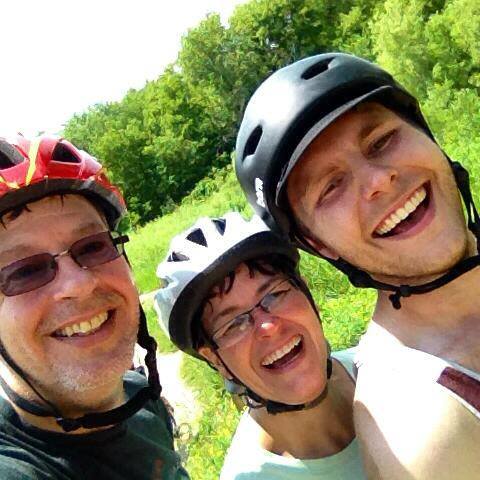
Lank, Cheeks, Cap all smiles at the mountain biking park
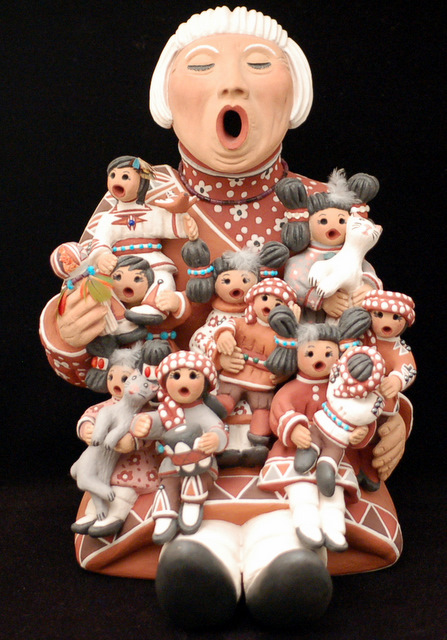
On my first trip to New Mexico, I discovered storyteller dolls. These pottery figurines represent storytellers surrounded by children (and occasionally other beings) who are literally hanging on the storyteller’s every word. Knowing nothing about the history of these pieces, and not bothering to ask at the time, I thought they were images of women with way too many children and pets to care for. In my mind, I equated them with the nursery rhyme of “The Old Woman in the Shoe” (after all, she had so many children, she didn’t know what to do).
This misunderstanding on my part led to a powerful dream not long after that trip. I dreamed that I was the woman depicted in the pottery. I was a giant, sitting in a featureless room naked (sorry, folks, dream imagery doesn’t follow our conventions). A long line of people, some of whom I recognized as friends or family members of my waking self, were waiting impatiently to breast feed. My breasts were bloated and painful, so full of milk that at first it was a relief that there were so many hungry mouths to feed. As the dream wore on, the milk kept pouring forth but I was dwindling. I became exhausted and emaciated. Yet the hungry kept coming to be fed.
When I woke from the dream, I immediately grasped its implications. At that point in my life, I felt like I was surrounded by people who were emotionally needy – friends, students, family. I tried to be nurturing toward them all. But I wasn’t finding ways to replenish the source of that energy, so while I continued to (figuratively) feed others, I was starving myself. And while I was pretty quick to understand the problem, solutions were in short supply. I had never been taught that there were limits to a person’s ability to nurture others. Scratch that – I was taught that one gave everything she had until it was gone. Then, depleted, she would self-isolate in a dark place until forced to return to the light. I didn’t want to perpetuate that cycle, but I had no tools for gently disengaging long enough to replenish my own energy. That, AND I lacked the basic understanding of reciprocity: that I could expect to rely on others to nurture me sometimes, if need be.
Allow Others to Nurture YOU
I’ve been thinking about this idea of reciprocity between friends for two reasons. First, we don’t all have the same skills or personalities, so what we have to give won’t necessarily be an exact exchange for what we got. A friend told me recently that she isn’t much help to people having emotional crises. “I’m good at practical advice. I jump right to how we can fix it.” Yet, this same friend freely admitted to appreciating her friends who could be right there with her during emotional melt-downs.
Second, on the receiving end, we each have our own interpretation of the ways others relate to us. For example, an old friend of mine became concerned that he might have offended me when I didn’t respond to an email from him in what he considered a reasonable time frame. When I said no offense had been taken, he told me, “Email is my love language. When I don’t hear from someone I assume something is wrong.”
Regardless of the potential miscues and misunderstandings that result from individual differences, allowing ourselves to accept love, understanding and nurturing from others in the manner in which it is offered is important to maintaining your own reserves.
Watch out for cognitive distortions
Sometimes the way we think about what is taking place has as much (or more) to do with how depleted we feel as the actual energy being exerted. If you fall prey to any of these cognitive distortions, you are more likely to feel burnt out as a “caring other” than if you are able to maintain a distortion-free viewpoint:
Personalization: when you start to think that the issues at hand are all about you, rather than about the person you are attempting to care for, things can get crazy pretty quickly. With this distortion, you either feel you are responsible (blame yourself) for the other person’s issues OR you begin to experience the paranoia that your friend blames you. Tell yourself, “This isn’t about me.” Repeat as necessary.
Jumping to conclusions: if you decide, without deep listening or empathy, that you know what your friend is thinking, feeling, or is in need of, you will find yourself experiencing a great deal of frustration as you attempt to offer care or comfort. After all, they would feel better (be more successful, be happier, etc.) if they just listened to you, right?
Should-ing: How often have you felt you “should” be more available to a friend, even when you didn’t feel emotionally ready to do so? If you are overtired, overstretched, burnt out, stop should-ing on yourself. You’re already depleted, and likely to be less than helpful – perhaps even cross over into actively harmful instead.
Boundaries
You, too, can have personal boundaries my friends! Set parameters – especially if someone is so needy he or she has become an emotional vampire (“Come closer, I vant to suck up your energy!”). A little secret: we are all bad at setting boundaries – until we actually practice setting and keeping them.
Look for ways to fill YOURSELF back up
Sometimes, we get in the habit of looking to others to fill our emotional buckets. We not only allow them to nurture us, we demand that they be available to us for that purpose. But each of us has inner resources – even if we’ve gotten rusty at exercising them. Prayer, journalling, yoga, bike riding – any activity that puts you into a semi-meditative state is great for refilling your own decimated reserves. Be aware that, for most of us, a semi-comatose vegetative state in front of the television does not produce the desired results. Couching-it, while it has its uses, is not the same as actively reinvigorating our emotional and psychological energy.
For most of us, being available, helpful and generous toward those we love is second nature. We want to be there for them; we hope to be a positive light in their lives – especially on their darker days. We can’t do that if we have lost our own will to live and give – if we have allowed an endless parade of others (and their neediness) to suck us dry.
Ever since my original dream of myself as the breast-feeding storyteller who literally dried and shriveled up before my eyes, I’ve practiced re-imagining the story. In the updated version, I welcome all who wish to join me in a place of warmth and supportive energy. However, it isn’t a 24/7/365 feeding frenzy. I imagine myself posting a schedule: I say who, when, how much. Not because there is a finite amount of love or caring within me – but because my energy IS limited. When I offer support, I want to be TRULY present – it is, after all, the only real gift I have to offer others.


 Jenion