Mayday

may

verb
1.
expressing possibility.
2.
expressing permission.

It hit me suddenly, full-force, like a punch to the gut. It’s May already.

My reaction, too, was very much like the reel that happens when you’ve been punched – doubled over, retreating from the fist pushing with such velocity into your midsection. My reactionary thoughts were quick, too, and packed their own punch: its been almost a year, how can you still be so unsettled, why have you been wasting your time, why did you…blah after self-defeating blah.

But that was just an emotional reaction. I don’t know why my default is set to catastrophizing (well, I have suspicions, but let’s not drag them into today’s post). It always has been. Back in the day (almost a year ago), I used to warn the people I supervised: “My first reaction is never my best. Give it a little time, and I’ll have a better one.” And while I haven’t been able to change that about myself, I have picked up some skills to hasten things along.

The first, and most important, is to talk back to that reactionary thug in my head. The second is to move along, as if there’s nothing to see here. Just another first reaction. So when I took that blow to the gut, I told my thoughts to shut the hell up. Then I grabbed my jacket and headed out for a walk.

I was moving pretty quickly as I rounded the corner, as if I could outrun my own thoughts. First stop was for coffee – I wanted the comfort of a cup in my hand. But by the time I reached Washburn-Fair Oaks Park, I was already past the worst of my panic over the swift passage of time. The beautiful evening began to make itself known to my conscious mind. There were families in the park, enjoying the soft spring evening. Some of them had puppies. I defy anyone to sustain a panic attack while watching children play with puppies in a park.

I slowed down and made my way, leisurely, onto Nicollet. I had made a spur-of-the-moment decision to get take out from one of the restaurants on Eat Street, so I stopped three people who had obviously just picked something up and asked what they had. One had Thai, one Chinese, and the last actually had leftovers cleverly disguised as take out. The Asian-influenced culinary choices helped me decide – I went to the Mexican place whose name I can never remember.

I ordered two tacos, hard shells, and a side of beans. When my order was ready, I headed out the door, but stopped to rearrange the items in my sack. That’s when I discovered that my order came with a side of chips and salsa. I took one chip, savoring it’s salty, earthy corn flavor. It was so delicious! I stopped the next pedestrian coming toward me on the sidewalk and offered him the bag of chips and salsa. From his reaction, it was a good impulse.

And just like that, my second – better – reaction arrived. I began to think about the word “may”, and it’s multiple meanings. Suddenly, I remembered riding in a group bike ride on Saturday night when the bike mechanic-cum-poet riding beside me said, “I always love this time of year. Everything seems full of possibility.” One meaning of may – expressing possibility.

What if, I wondered, I gave myself permission to stop worrying about everything and just continue exploring the possibilitties that present themselves? Another meaning of may – expressing permission.

Possibility and permission. If nothing else, this year has been teaching me to dwell within these two concepts. To look beyond fear and find the possibility inherent in each day’s activities. To give myself permission to explore, to try on, to fail. To hold myself in this place for as long as is necessary without giving up or giving in to defeatism.

At that moment (and I’m not making this up) the sun broke through some lingering clouds for a truly spectacular sunset. I stopped thinking so much, and just let myself feel May wash over me.


“Yes, Yes”, Zachariah Schaap’s Flipagram

Note: If you haven’t already watched this on my FB page, I LOVE this flipagram from Saturday’s ride. Even though I am only in it very briefly, I look joyfully in the moment – as do all of my ride companions. It completely captures what it’s like to give yourself permission to be open to possibilities in the moment!
 

My Dedication to Dedication*

So say it like you mean it boy
Be the seed in soil
Toil and reap
Keep the spoils
The road is steep
The pavement coils…

-from “Like You Mean It” by Sims/Doomtree Records

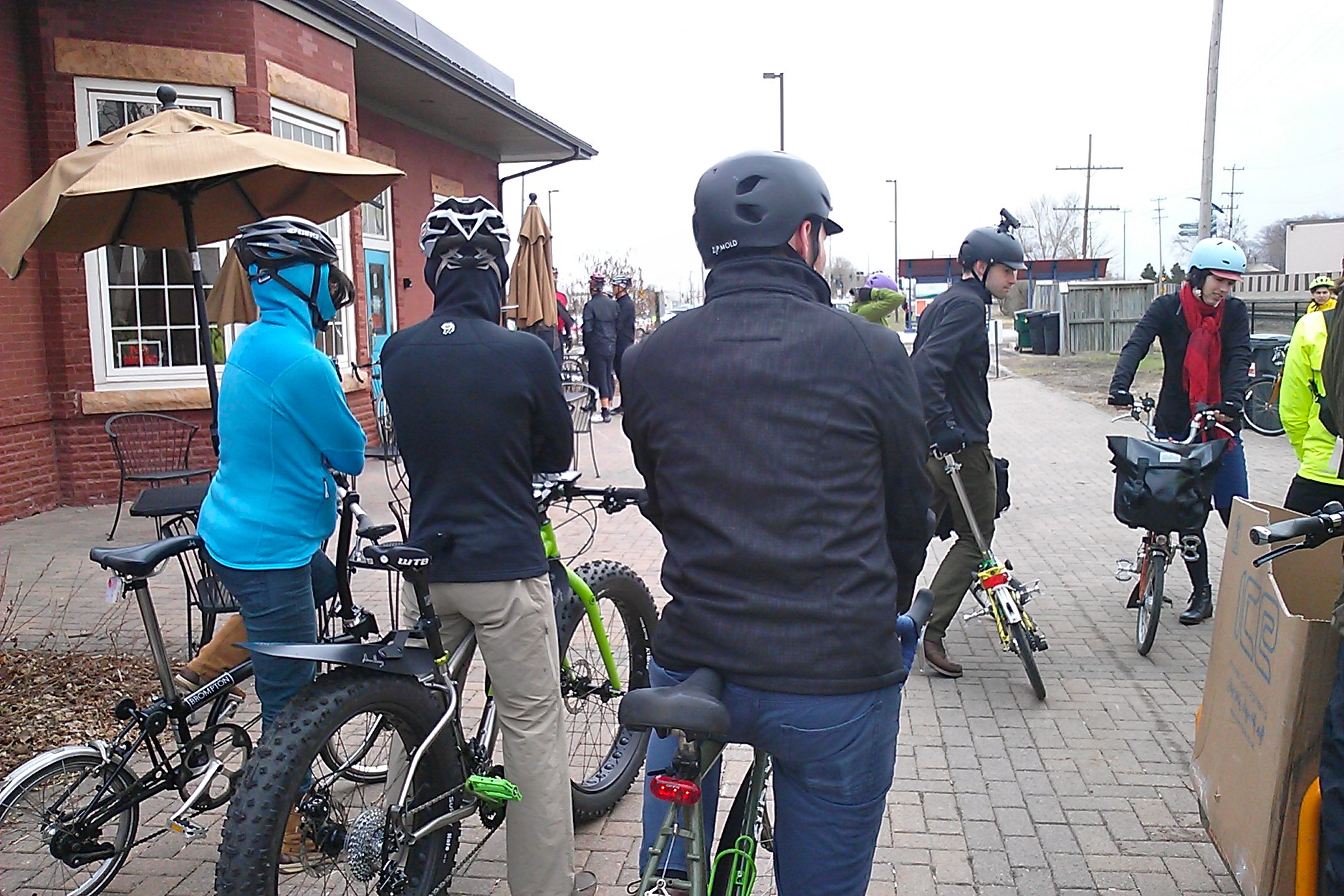
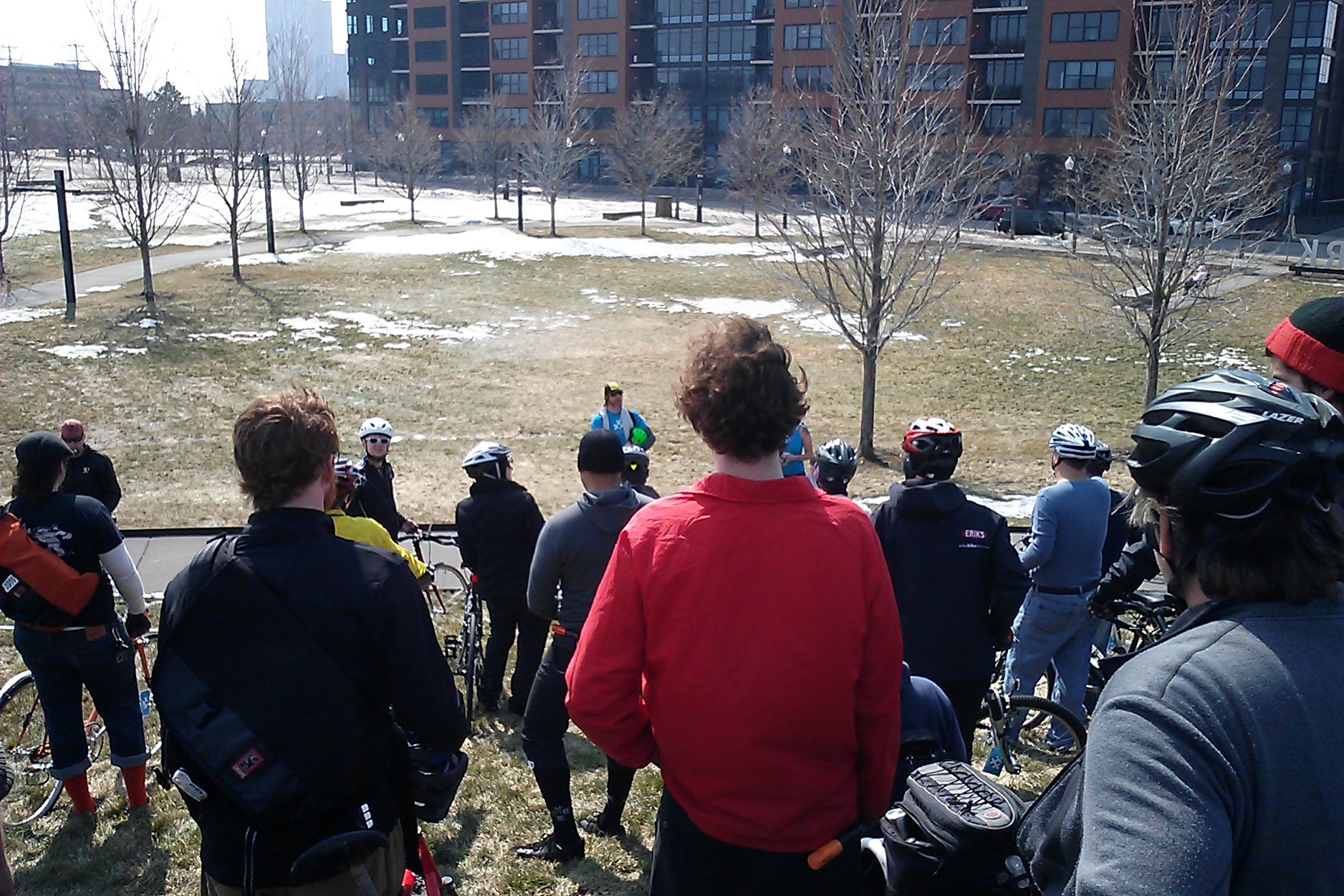
30 Days of Biking Kick-Off Ride: taking our places for the group photo

The hissing of sand dislodged from between pavement and rubber tires. Ka-thunk (my bike hits a crack)/ka-ching (my u-lock, dangling from the handlebars, jumps and falls back into place). Ka-thunk, ka-ching. The tink-tink-tink of the computer sensor counting every revolution of my front wheel. Always the rush of wind in my ears.

For April’s 30 Days of Biking, these were the sounds of dedication.

It is never easy to commit to a daily practice, whether that practice is meditation, yoga, taking a multivitamin or getting to work on time. April, famously the cruelest of months, makes the commitment to daily cycling particularly troublesome here in Minnesota. Our weather runs the gamut: winds from breezy to tornadic; temps from temperate to freezing-ass-cold; humidity from slightly damp to deluge-level rain with a little snow and a few “icy pellets of death” thrown in. Given these factors, I am proud to say I persevered, riding my bike with a deep willingness that conquered momentary weakness.

We biked through snow...
We biked through snow…
…basked in sunshine...
…we basked in sunshine…
…we layered up for cold and wet conditions!

…This is how we pull ourselves up
Overlook luck
Run til the tank spits dust
Cuz aint no spark thats bright like us
We do what we say say what we mean …

One of the main reasons I was able to maintain my dedication to 30 Days of Biking was community. Mike’s friend, Patrick Stephenson, whose warmth and joie de vivre are contagious, led us to 30 Days. Patrick, (aka @patiomensch on Twitter), co-founder, -creator and all-around-guru of 30 Days embodies the 30 Days tagline “community of joyful cyclists”. Through 30 Days, I’ve not only had the pleasure of getting to know Patrick, but also of meeting some other interesting, diverse, and genuinely amazing members of the local cycling community. Daily social media posts kept me apprised of what everyone was doing, where they were riding, and how they were meeting the challenge of April on two wheels. Knowing I was part of something bigger than myself injected the daily commitment with both more joy and a greater sense of obligation – not to the pledge I’d taken but to myself as an extension of that community.

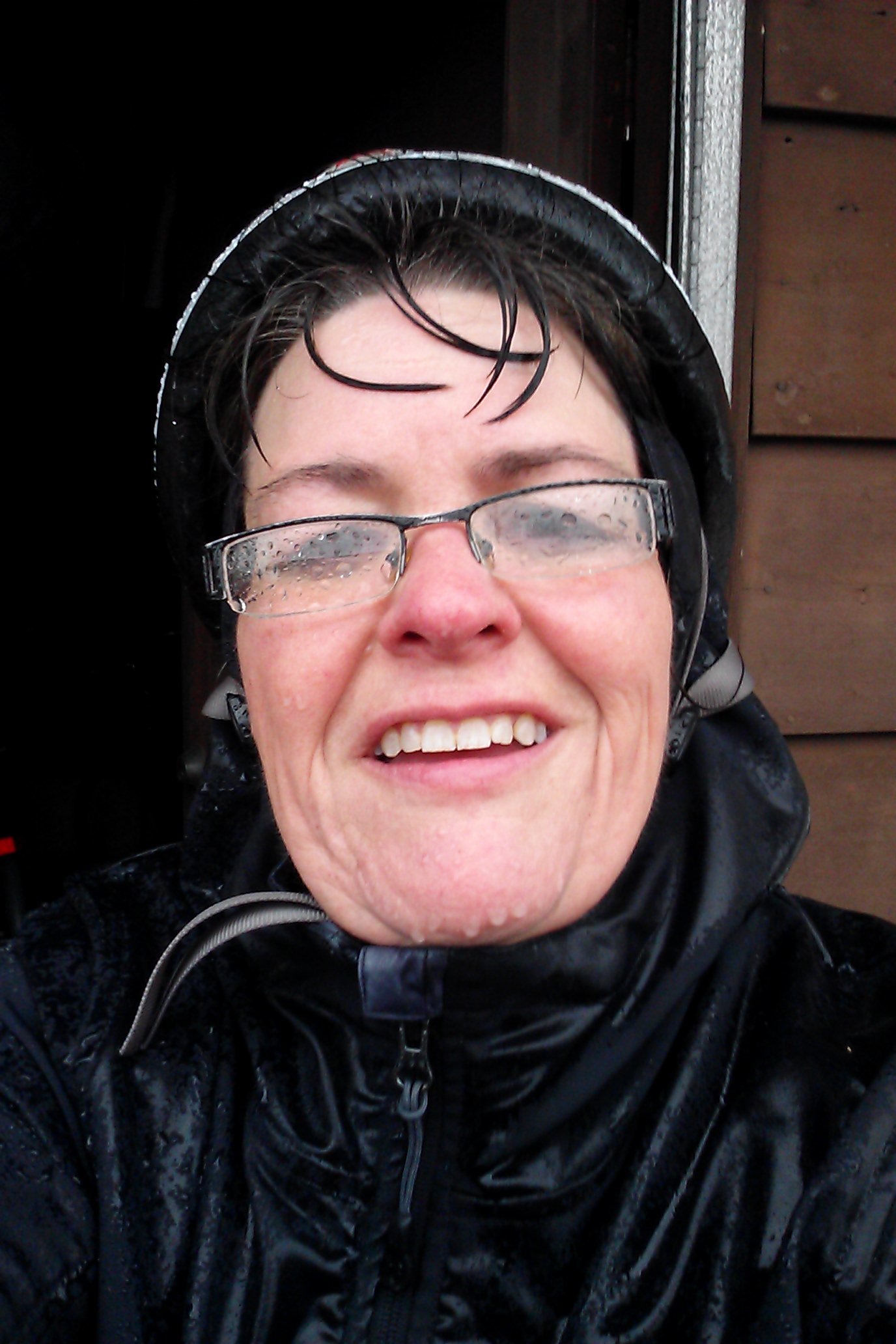
Soaking wet, freezing cold, and fiercely joyful?!


Joy is a strange concept. In some ways, I’ve always thought of it as a feeling too big to be contained in an ordinary day. And I certainly never intentionally associated it with words like commitment or dedication. But cycling, over the past few years, has taught me that they can and do align. And during this 30 Days of Biking, I’ve felt the joy of follow-through that only comes after commitment. On days when no part of me wanted to get my bike out of the garage, the ride often took on an edge of fierce joy – as if my heart recognized something my brain was slow to comprehend. Namely, that fulfilling my agreements when I am the only one who knows or cares is one way to feel really good in my own skin. Would anyone have judged me if I’d missed a day? Not at all! A joyful community is an accepting and inclusive one.

We do tend to judge ourselves harshly, though. So moments that remind us we are capable of overcoming laziness and inertia help to silence our inner critics.  We see that we can rise to meet challenges placed in our lives – whether they come to us through external forces or whether we willingly take them on in the form of 30-day challenges. It is an act of self-affirmation to put our butts where our mouths promised they would be – in this case on the saddle of my bike every day in April.

Has the world been changed because I did this? Perhaps in a small way, since my participation and minimal financial contribution add to the number of Free Bikes for Kidz being given away via 30 Days of Biking. But if I am truthful, not really. Have I been changed? I hope so. When we wish to “be the seed in soil”, we are wishing for growth. There is no growth without dedication and self-reflection. Riding a couple hundred miles in early spring offers the chance for plenty of self-reflection (once you get past the “dear lord, why am I doing this?” stage).

I have often heard that converts are the most zealous believers. In this case, as one newly converted to joyful commitment, to my “dedication to dedication”, I zealously wish the same for you!

Take it all the way
No in between
My dedication to dedication
I dedicate this to you

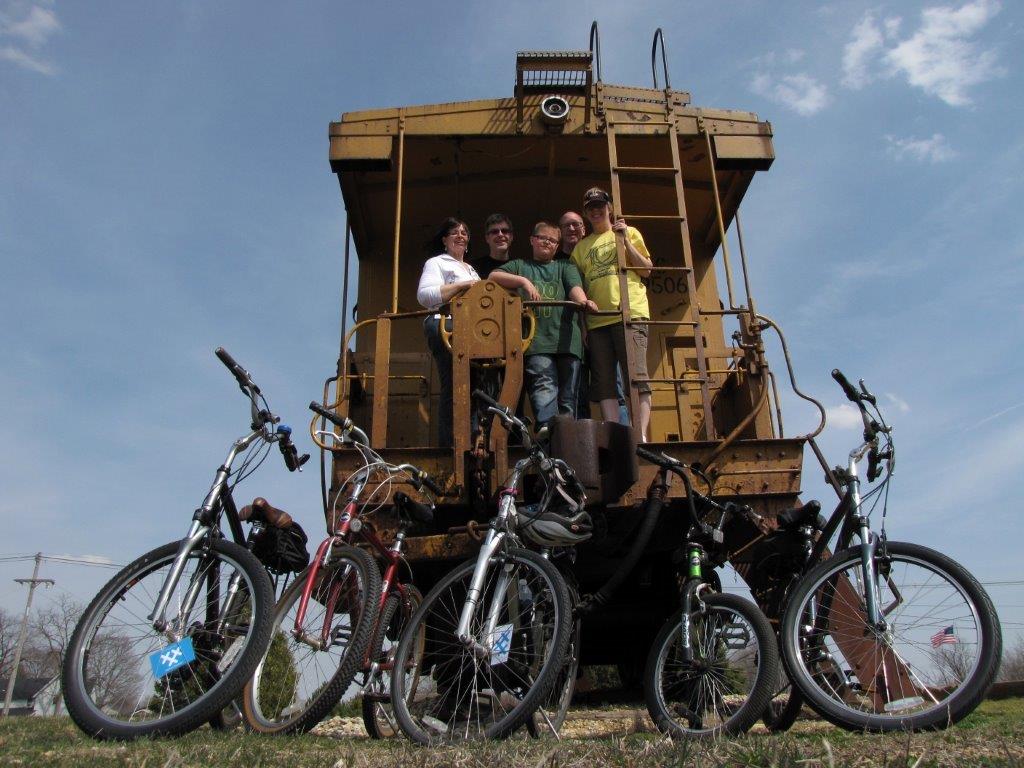
Easter Sunday #30DaysofBiking ride in Delmar, Iowa

*Please note:  The title of this post and the lyrics posted throughout are from “Like You Mean It” by Sims/Doomtree. Please check out the link and listen to the whole song – Doomtree is a collective of friends who create and make music together here in Minneapolis. I discovered this song, serendipitously, on the final day of 30 Days of Biking when the link was tweeted by @Artcrank, another member of the MSP cycling community!

What Rob Lowe and I Know

A few days ago I found myself clicking on an article from Oprah Magazine that popped up in my Facebook news feed: “Ten Things Rob Lowe Knows For Sure”. I can’t say I was pining for an article showcasing Rob Lowe’s personal epiphanies, but I also can’t say I wasn’t curious once the opportunity to learn them presented itself. Since Rob and I are both featured in Oprah in May, I thought I would take a page from his book (or O’s magazine) and share some things I know for sure. I don’t have as many on my list (Lowe shared 10) and mine are likely to be less succinct – but then, these items are being written by me (unlike Rob’s, which are tagged, “As told to…”).

1. We all have a nasty voice in our heads that speaks to us in horrible ways. Telling it to “shut the @#$* up” until it can be respectful is one of those practices, like meditation, that we know is good for us but is really, really hard to do. Do it anyway. None of us is perfect. Letting that voice call us stupid, ugly, incompetent or worse doesn’t change that. Instead, it undermines our resilience and self-confidence. If you don’t want to channel Stuart Smalley, (aka Senator Al Franken!) that’s ok. Start by noticing when your inner voice is bullying you and take a moment to say, “Stop!”

2. Eating five slices of Casey’s pizza and chasing it with a bag of Easter candy isn’t the end of the world. Is it a great choice? Probably not. But it was the choice you made and there’s no point in dwelling on it. The good news is, it says nothing about your ability to make better choices in the future! It has been five years since I began serious efforts to live a healthier life. I haven’t reached a point at which I feel ready to say I’ve achieved all my goals; however, I’m proud of what I’ve accomplished and that I continue to move forward. I’ve learned that staying the course isn’t about never straying, its about always reminding yourself that you’d rather get back on the path.

3. Being happy and feeling happy are not the same things. Learning to differentiate between the two is an important aspect of self-awareness and self-discipline. Seeking the high of feeling happy in every moment leads us to take the easy road, to settle for lack of personal and/or spiritual depth, to flit from one person or experience to another in hopes of feeding the happy. There’s nothing wrong with feeling happy, of course. But right relationship with others, with our life’s purpose, with ourselves is what makes us deeply happy – and achieving these things takes us through tough times and difficult moments.

4. It isn’t all about me – neither how others behave toward me nor how I behave toward them. Remembering this allows forgiveness and compassion to flow between us. Especially if we both operate under this assumption!

5. What I know for sure is flexible, adaptable, malleable. It is these things because what we understand changes as we grow and as our life experiences inform our perspectives. At 18, the list of what I thought I knew for sure was long and adamant. Not so at 52. Now, I feel grateful for this lifelong learning process – I’m enjoying being surprised when life shows me new things. Which brings me back to Rob Lowe, who says,

“Staying young is an inside job. Look at what kids are. They’re curious, they’re excited, they’re interested—all of the very things that, if you’re not careful, you’re not when you’re old.”

And that, friends, is something both Rob Lowe and I know for sure!


Rob Lowe

Knitting Spoons?

“I define connection as the energy that exists between people when they feel seen, heard, and valued; when they can give and receive without judgment; and when they derive sustenance and strength from the relationship.” – Brene Brown

I want to share a story about something that happened at my knitting group last night. But first, you should know one thing about knitting group: I don’t knit.

You might think that fact would somehow preclude me joining such a group. And in other circumstances, you would probably be right. But I was invited to join the group late last fall, at a time when I was hungry for human contact – and I was grateful that these very nice ladies were willing to include me. I immediately discovered that, although the group is self-described as a knitting group because knitting is something most members do (and it’s easily done in a social setting in a coffee shop), most of the women who attend also love beads and beadwork – a serendipitous connection that allowed me to feel less self-conscious about my yarn-free lifestyle. My second discovery was that no one really cares what I bring to work on, in fact, last night I showed up basically empty-handed.

To say no one cares gives the wrong impression. I should say, no one judges. They clearly care, because whatever I have brought has occasioned curiosity and interest. Like most loosely affiliated groups, the attendance at these gatherings ebbs and flows, so in the three or four monthly installments I’ve been able to attend, the faces have varied. I’m not yet entirely sure of everyone’s names, and last night was the first time I met the infamous Anna (who brought a treasure trove of handmade beads for show and tell).

The day had been a busy one for me, and I arrived at knitting group still in the clothes I had worn for a late-afternoon job interview (also why I was sans project). After everyone had caught up and most were beginning to work on the projects they had brought, I started to excuse myself saying I needed to get home to write my blog post for today. One of the women, Anne, asked me what my blog was about. I’m never certain how to answer that question. What is this blog about?! So my friend Kathe, who was my connection to this group, piped up and shared her thoughts then said, “Jen, tell them how your blog got started.”

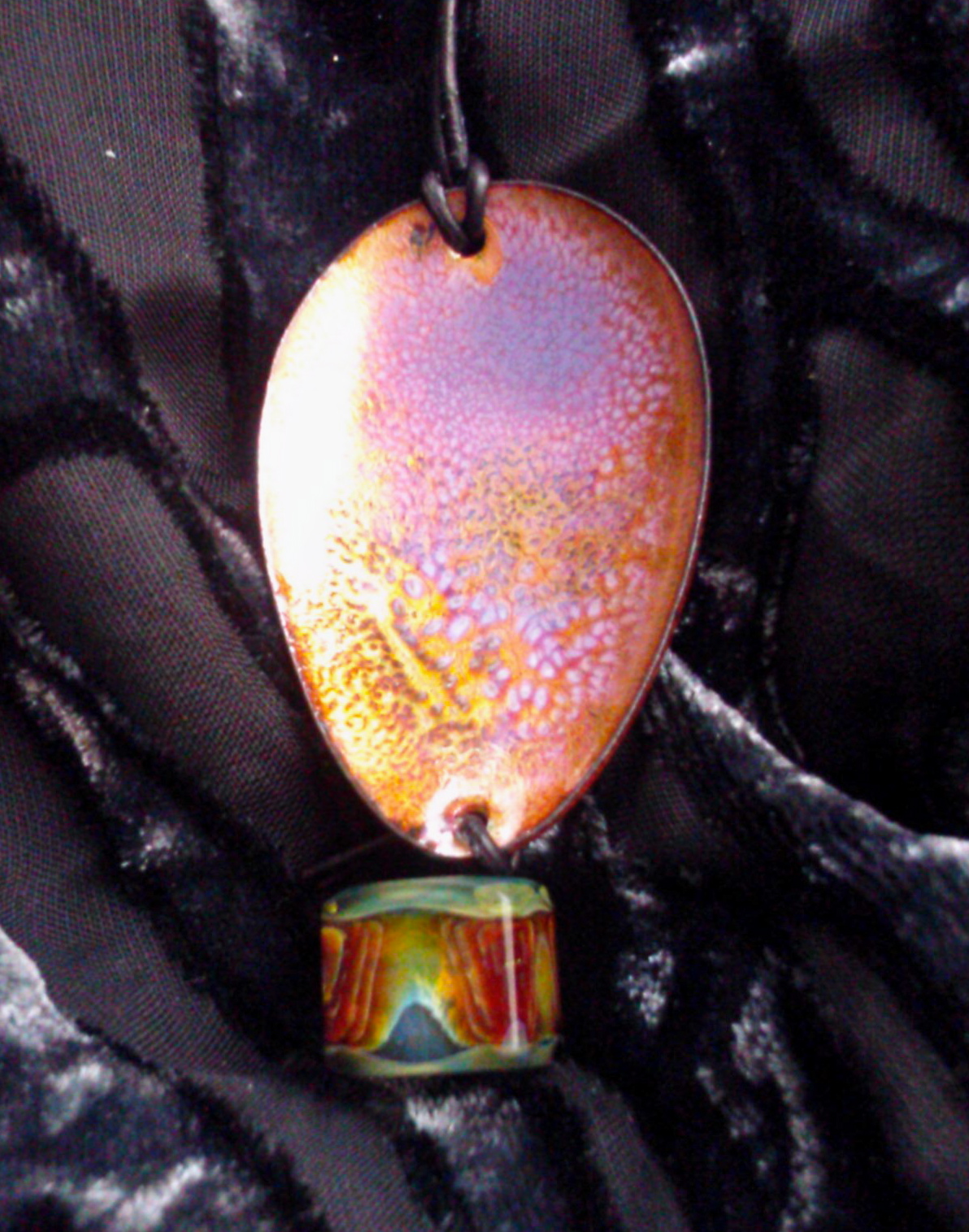
When I finished sharing what I hope was an abridged version of the hunger challenge/weight loss journey chronicled on Jenion, Anne spoke up again, sharing that she had participated in a hunger-related charity called “Empty Bowls“. For the fundraiser, Anne made a copper-enamelled bowl which raised over $2,000 for the organization. She said, “I was at a friend’s house who does copper-enamelling and she asked what I wanted to do, so I made three items. The first was the bowl, and I’d like you to have whichever of the other two you like.” With that, she handed me two enameled pieces strung on thin leather chords. Both were lovely. I didn’t know what to say – I was so moved by her generous impulse. I removed each necklace from it’s protective plastic bag. As I turned them over in my hands, trying to decide, Anne commented that the larger of the two reminded her of a spoon, which was a fitting connection to both the hunger issue and the Empty Bowls fundraiser. The piece was crafted with a beautiful iridescent enamel, and two holes for findings to connect. The bottom one has a simple piece of leather chord attached, but Anne said, “You can attach whatever you want to the bottom of it.” And next thing I knew, Anna of the wondrous bead display had plopped a glass lamp-worked bead down in front of me, saying, “This one would look perfect!”

And that’s how I left knitting group with a beautiful piece of handmade jewelry that I will always treasure.

There are so many lessons for life contained in this story. The first is about openness – mine AND that of the knitting group. When I told Mike I was invited and planning to participate in knitting group, he asked me in surprise, “Do you even know how to knit?!” I just laughed and shrugged my shoulders – not being a knitter seemed surmountable, whereas remaining lonely and disconnected did not. That the women in the group have been open and accepting of someone who shows up with odd projects unrelated to knitting (or none at all)  is cause for gratitude.

The second lesson I see in this story is one of true connection – which only happens when you are able to get beneath the surface of things. Kathe is a great one for nudging me to share authentically in a variety of ways. She rarely allows me to leave things at an off-hand comment. Had she not encouraged that I share more than a surface-y response to the question about my blog, Anne and I would not have discovered our connection to caring about hunger issues.

The third lesson is about freely sharing our gifts. Kindness and generosity are traits that come naturally to some. The rest of us need to cultivate them with mindfulness and attention. Sometimes those gifts are tangible, like the gorgeous handcrafted items I held in my hands as I left knitting group last night. Other times, the gifts are intangible but deeply felt, like the gifts of friendship and connection that I carried home in my heart.

The spoon-shape of the necklace brings to mind a story I first heard at a youth group meeting in high school. The story goes that, in hell, everyone sits at a table set with an incredible feast. Permanently attached to their hands is an impossibly long-handled spoon. All at the table are invited to eat to their hearts’ content – however, they find the spoon handles are so long that they can’t actually bring food to their mouths. So they sit at a feast, frustrated, starving, and unable to eat. In heaven, the story continues, the scene is set in exactly the same way: a table groaning under the weight of a sumptuous feast. Each person has a long-handled spoon attached to their hand. The difference: in heaven, the guests at the table use the spoons to feed each other. I love this metaphor, not so much as a story about heaven and hell but as a way to approach life today: be open to the opportunities to be fed by the generosity of others. At the same time, be as open to expressing your own heart through generosity toward others. That reciprocal flow of energy can, I believe, not only benefit the direct participants, but will also add to the measure of good in the world. Every time I wear my new necklace, I’ll be reminded of this and spurred to act accordingly!


The two pieces haven't been united yet, but here you have an idea (and can see the generous gifts from Anne and Anna)!
The two pieces haven’t been united yet, but here you have an idea what the final necklace will look like (and can see the generous gifts from Anne and Anna)! Trust me, the photo doesn’t do justice to the enamel-work.


On Honesty: Reflections of a Reformed Liar

Always tell the Truth. That way, you don’t have to remember what you said.
~ Mark Twain

I guess I’ll just blurt this out: I haven’t always been a stickler for the truth.

In fact, during my formative years, my parents grew weary of me stonewalling where the truth was concerned. Once, I was sent outside to get firewood from the pile against the back wall of our house, underneath the picture window in the family room. There had been wet weather, followed by plummeting temperatures, which caused ice to form like a layer of cement between the neatly stacked rows. I grabbed a piece of wood and it wouldn’t budge, so I applied brute force. The log broke free from its ice casing and flew upward – directly into the plate glass of the huge window, cracking it straight up the middle. After brief consideration of my course of action, I quickly gathered the rest of the firewood and took it inside. I didn’t mention the broken window to anyone as I nonchalantly proceeded through the day.

At dinner that night, my dad said, “Your mother and I would like to know who broke the window in the family room.”  I looked around the table at the innocent faces of my siblings and surprised myself by fessing-up. My folks were so astonished that I had stepped forward they were speechless. I didn’t even get in trouble for the costly damage. Years later my parents told me that they knew it had been me, but had never anticipated that I would own up to it: they always gave me the opportunity to come clean but I so rarely chose any road but the one to perdition.

In graduate school, I worked as an intern in a research and service project in which we provided values-based career counseling to academically gifted students in exchange for their participation in our research. Each student took several instruments – a personality test, a vocational preference assessment, and a values inventory. The values inventory (a version of the Rokeach Value Survey) asks takers to rank order values according to the importance of that value to them. The interns who provided the counseling interventions and interpreted survey results to the student participants took the instruments and engaged in the counseling session activities during our training. Many of my graduate cohort selected “honesty” as one of their highest values. (This was also true of professional colleagues later in my career.) I never understood this. Not once did honesty crack my top five.

In group discussions about the values we selected, I often found myself stating that “The truth is overrated.” I had numerous arguments to shore up my position. I believed, I said, that truth was malleable and an absolute reliance on it was detrimental to one’s overall smooth functioning in life. I can’t even remember all of the examples and justifications I used – they were many and I was eloquent in explaining my position.

As I matured (remember I was a late bloomer), I began to believe my own hype about truth less and less. When I noticed some inner discomfort with my old stand, I decided that I had been confusing the concepts of truth and honesty. I decided that truth was not always convenient, therefore could be set aside in unimportant situations. Honesty, on the other hand, was linked somehow to character and integrity. As such, Honesty should be observed, in spirit at least, at all times.

Yes, I am capable of the mental gymnastics to have accepted that I could tell an untruth (a lie) while in service to the greater value of honesty. However, it is instructive to note that at the time I engaged in these mental gymnastics, I was living a very constricted life – one in which I was emotionally isolated in spite of being surrounded by people constantly through my work in higher education. I was ballooning up in weight – until I reached a high somewhere above 350 pounds. I felt insecure, fearful, and lonely.

Something was seriously wrong with my whole perspective on truth and honesty. Eventually, I came to see this. One of my great “AHA” moments in life came when I realized that my vigorous defense of lying was a way of supporting my decision to continue lying to myself. And the whole argument that I could be honest without being truthful was simply a rationalization to allow me to feel like I hadn’t completely given up on the concept of integrity. The truth was that I lied to protect myself – in exactly the same way that I gained weight to erect a self-protective barrier to keep from being hurt. The two were inextricably bound with one another, entwined coping mechanisms. When I began to address one, I was forced to take a hard look at the other.

A few things I’ve learned on this journey to be more truthful with myself and, therefore, to create a more honest presence in my life and the world:

  • “Some people will not tolerate such emotional honesty in communication. They would rather defend their dishonesty on the grounds that it might hurt others. Therefore, having rationalized their phoniness into nobility, they settle for superficial relationships.” ~ unknown author

When we fear emotional honesty, we choose isolation. I once thought that people must not pay close attention to me because they didn’t “get” me. When I started being honest with myself, I realized that people didn’t get “the real me” because I never shared her. I was virtually always posing as a person I thought others might like. Getting beyond the superficial requires dropping the pose.

  • “We tell lies when we are afraid….afraid of what we don’t know, afraid of what others will think, afraid of what will be found out about us. But every time we tell a lie, the thing that we fear grows stronger.” ~ Tad Williams

The fear grows stronger because we have added the fear of being “found out” in our dishonesty. It grows stronger because we have fed it. And it grows stronger because we have further removed ourselves from right relationship – with others and with ourselves. Being that far removed from human connection is a very frightening place to be.

  • “Our lives improve only when we take chances- and the first and most difficult risk we can take is to be honest with ourselves.” – Walter Anderson 

I originally set out to lose some weight. That’s all, just improve my health and get in better shape. I quickly realized, however, that for me that task would be impossible without getting real with myself – without telling myself the truth about what I ate, how much, and why. I’m not sure I would have set out on that journey if I had realized how it would affect every aspect of my life, every thing that I thought I believed. Because once you begin telling the truth in one area of your life, it has a cascading effect. You find you need to do so in other areas. The risk is real, because choosing to be truthful with yourself will lead to change.

All that said, you’re probably wondering whether I always tell the truth now. I can honestly say that I try to. This new life I’m working to establish offers me daily opportunities to assess the veracity of what I tell myself – about who I am, about what I want, about how I relate with others in my new community. I don’t have to share it all with everyone, but I do have to take some time daily to reflect on how honest I’m being with myself.

Integrity is telling myself the Truth. Andy Honesty is telling the Truth to other people. – Spencer Johnson

The Wonder Years

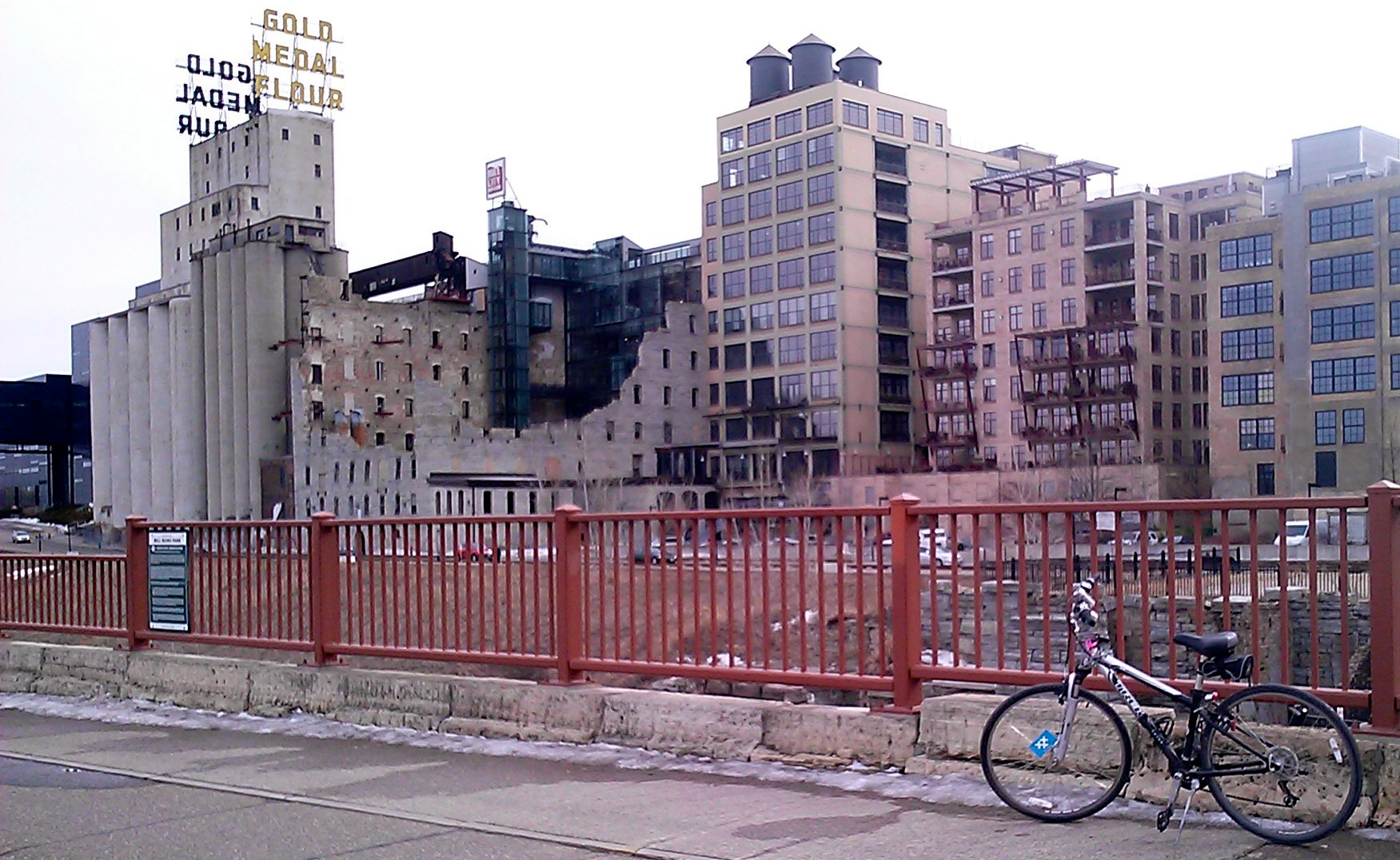
Crossing the Stone Arch Bridge (Day 2, #30daysofbiking)

Tonight I started thinking about the television show “The Wonder Years”. I loved that show, including the way it always left me feeling slightly melancholy with nostalgia for the early ’70s. I know exactly what triggered it: on my afternoon bike ride I crossed the Mississippi River by bridge twice, reminding me of how central a character the river has been in my life. I thought about the towns I’ve lived in along its banks, including Hastings, Minnesota.

I never think about Hastings without thinking about my yellow 10-speed bike. I miss it, and that makes me feel a bittersweet longing for my preteen life. Hence, “The Wonder Years” (“The series depicts the social and family life of a boy in a typical American suburb from 1968 to 1973, covering his ages of 12 through 17.” Wikipedia) Each episode was narrated by the adult that the lead character, Kevin Arnold, eventually became. In the series finale, the final narration goes:

“Growing up happens in a heartbeat. One day you’re in diapers, the next day you’re gone. But the memories of childhood stay with you for the long haul. I remember a place, a town, a house, like a lot of houses. A yard like a lot of other yards. On a street like a lot of other streets. And the thing is, after all these years, I still look back… with wonder.”

Cue one lone tear, gently gliding down my cheek.

1968-73 were some pretty great years in my own sepia-toned memories (though at 7-12 years of age, I was a bit younger than Kevin Arnold). It is easy to look back at those years with both nostalgia and wonder. But as I started down that memory lane one more time, a thought stopped me in my tracks – “NOW – these years – are the real wonder years”.

What?! These are the wonder years? Although the thought was my own, I questioned it. Truthfully, childhood is easy to idealize in its remoteness from our adult lives. And while our teen years are, indeed, full of discovery, they are characterized more by self-consciousness than by self-awareness. Most of us only feel the wonder retroactively, as we look back later, seeing the things we learned and discovered from the vantage point of understanding. The years themselves are anxious and angst-y. We learn by trial and error, we don’t actually understand the ramifications of much of what we do – we barely comprehend that there ARE or WILL BE ramifications, which allows us to experiment. In retrospect, this process of self-discovery seems wondrous.

Compare that with the reality of adult life, when we know that there will always be costs associated with benefits, when knowledge of our limitations tempers our vision of possibilities. When caution often precludes change. Suddenly, the wonder all seems to be behind us.

Unless we get lucky. For several years, I’ve been thinking about the changes that have taken root in my life as somehow unique. Unusual. A mid-life transformation that I was singled out for, gifted with. Admittedly, it began with a literal message from God (a fellow retreatant saying, “In prayer, I was given a message for Jenifer: God says he has a new path for you. Be ready.”) I am grateful, and still feel amazement at the changed life I am living and creating. But I’m also looking around me and seeing some truly incredible transformations in lives other than my own: Kathe has created a happy second marriage, moved from the suburbs into the city, and begun a career she loves, finally working for herself. Sue returned to her hometown after surviving a frightening end to her marriage and an actively malicious end to her job; she faced the demons of depression, and has created a life that includes a fierce passion for serving adult learners and the grace of time and closeness with her family. And then there’s Mike.

On Sunday, just a year after beginning his journey toward health and wholeness, Mike began the day running in a 15K with friends. The man who specifically told his trainer he wouldn’t run, voluntarily joined new friends to run further than he had ever attempted before. After the run, he changed into different spandex and we hopped on our bikes for 16 miles of riding, joining a community of friends for the afternoon. On Monday, he blew past a personal goal he was fearful he wouldn’t achieve.

I stand in awe, or as Rabbi Heschel called wonder: radical amazement. These stories and transformations (and others) have prompted me to think that perhaps that point just after the middle of our lives are the wonder years. The years when we wonder, “Is this all that I am meant to be and do?”, or, “What would it take for me to truly live a better life?” and that wondering leads to change.

Change is hard, and later in life – unlike in youth – we undertake it knowing it will be hard. Transformation requires commitment, tenacity, a willingness to follow through on actions that scare us. Transformation is work. Childhood and the years immediately after it have taught us this. So the real wonder is choosing change and transformation anyway. The real wonder years are the ones in which we keep choosing to change and grow despite having already experienced life long enough to know how it can test us.

Part of me will always wax nostalgic about my childhood. I’ll always miss that yellow ten-speed. The Mississippi River will flow through my veins no matter where I go or who I become. But I think the part of my life I will invest with the most awe and, yes, with the most wonder, is NOW.


When the Dog Bites

This looks a lot like the little yapper that bit me.

So, Thursday evening, I got bitten by a dog. It was my first real dog bite ever, and from a complete stranger dog, too.  Last night as I arrived home late from visiting a friend, I was approached by a man I’d never seen before as I parked my car – he wanted money and couldn’t understand why I refused to get out of my vehicle after he assured me, “I’m a good guy, I promise!” (I was fine, I opened the window a crack and passed him the only dollar I had. I watched until he was a full block away before turning off the ignition and going inside). Today, I inadvertently left my favorite gloves on the fender of my bike while locking the bike to a rack. When I returned to the bike: yep. Totally stolen.

But am I going to let these things harsh my buzz? No way. Because today I am focused on the things that make me happy.

Instead of the dog bite, I’m thinking about the awesome weekend I had with friends and family. Hanging out with Sara and her kids helped me truly relax. Friday’s dinner with my brother Jeff and his wife Marsha was particularly special because it served as a reunion between Jeff and our friend Mike after decades apart. I’m thinking about how grateful I am for the blessing of positive health news on all three family members about whom I’ve been concerned – a late-night panhandler can have my last dollar in light of that! The kindness of a stranger who wrote a personal note to me in a rejection letter or my coworkers bringing me information about low-cost services are good counterbalance to the theft of my gloves.

Earlier today I read a post on Allison Vesterfelt’s blog (This is Where Your Fear Comes From) in which she recounts watching an interaction between a mother and child in which it appears that the mother, in an attempt to reassure her child, actually convinces the perfectly content child to be afraid. Allison’s “AHA” that fear is a learned response got me thinking about how so many of our reactions to life’s events, big and small, are learned responses. And once we’ve learned to respond in a particular manner, we practice it until it is habitual.

If you’ve been following Jenion since I moved to Minneapolis, you’re aware that I’ve been living in two different realities at once – the reality of loving my new life and new city, engaging with new experiences and people; and also the reality of panic, fear and loneliness. Here’s the thing: most of my life I practiced what I learned as a kid and I got really good at risk aversion/avoidance, waiting for the other shoe to drop, feeling insecure, and worrying about bad things that could happen. Then, I experienced life-altering change, and began developing new skills like optimism, trust, confidence in my ability to figure things out. Also a belief that joy is readily available if I choose it. But these are fledgling skills, neither as strong nor as ingrained as the others. So I struggle to keep them active, to make them the default instead of the less-helpful skills I’m valedictorian of.

The lyrics of the song “Pompeii” by Bastille perfectly illustrate my conundrum these past few months:

I was left to my own devices
Many days fell away with nothing to show

And the walls kept tumbling down
In the city that we love
Great clouds roll over the hills
Bringing darkness from above…

A pretty bleak picture, that. But the song goes on to ask what, for me, is an all-important question, “How am I gonna be an optimist about this?” 

No matter what we may have been told in the past, optimism and pessimism are not mutually exclusive or immutable traits with which we are hard-wired. You may, like my sister Gwen, be born with a disposition that bubbles with laughter. Or you might have an Eeyore-like tendency to overemphasize that which is glum. But these are predispositions, not personality requirements. We can practice rewiring our thinking, keeping the best traits of both optimism and pessimism, thereby impacting our physical and emotional health for the better. “Both personalities could use a little bit of one another to really keep an individual at peak health. The optimist needs the caution of the pessimist, and the pessimist needs the drive of the optimist. For well-balanced health, the middle road is the ideal way to go.” (“How being an optimist or a pessimist affects your health”)

So, since I may have been describing myself, above, instead of Eeyore, I am taking my cue from Bastille’s “Pompeii”. Whenever the negative threatens to overwhelm me, I’m asking, “How AM I going to be an optimist about this?” The truly amazing thing is that I can usually come up with workable answers. Answers that allow me to invest my energy in skills and beliefs that take me out of the anxious reality and back into the engaging one. Because there’s no question which one I – or any of us, really – would prefer to live in, is there?


Taking a Picnic to the Battle

“It became clear that the anticipated battle would take place on Sunday, July 21, 1861. Stories would often be told about how spectators from Washington, riding in carriages and bringing along picnic baskets, had raced down to the area so they could watch the battle as if it was a sporting event…And by late afternoon the Union Army was in retreat. The road back to Washington became a scene of panic, as the frightened civilians who had come out to watch the battle tried to race homeward alongside thousands of demoralized Union troops.”  (Battle of Bull Run in Summer of 1861 Was a Disaster for the Union Army, Robert McNamara)

I remember hearing this story in a history lesson sometime in my youth and wondering, even at my tender age, “What were they thinking?!” In all honesty, though, I’ve remembered this story primarily at moments in my adult life when I find myself in frightening situations that I am in only through my own volition.

An example may be helpful to illustrate. One mild midnight, everyone trooped out of a friend’s New Year’s Eve party to stand on the deck of her neighbor’s pool while he set off a celebratory fireworks display. The pyrotechnician/arsonist for the evening was highly intoxicated, which should have been a red flag. In fact, my friend’s husband (a former firefighter) refused to join the group and this, too, was a warning that went largely unheeded. When the first volley of rockets was lit, they all came zooming straight at the spectators standing where we had been told we would be “safe.” I imagined the headline: “12 Revelers Hospitalized: Too Idiotic to Avoid Drunken Fireworks Display”.

I could give many more examples. But the point is that we all sometimes walk blithely into situations that, given a little time and forethought, we might otherwise avoid. So while I occasionally think of these events and rue my naiveté, I don’t beat myself up over them. Instead, I try to learn from them for the next time. Just as I’m fairly certain no one who rushed out with a picnic basket to watch the first Battle of Bull Run made that same mistake at the second Battle of Bull run, I am pretty sure I will listen to my gut telling me to distrust drunk men with matches and incendiary devices.

Usually, I’ve thought of the Bull Run revelers from the perspective of advanced reasoning skills – and whether or not these unknowns from the past employed them. I can totally see how it happened, though: everyone had been talking excitedly about the impending war for weeks; the rumor was that one battle would determine the war – and as luck would have it, that battle was going to take place in their backyard! They grabbed their friends, some food and beverages, and headed out to see history in the making. How cool is that?

Lately, I’ve been thinking about those picnickers from a different angle. I’ve been empathizing with the fact that they found themselves in a frightening predicament. Admittedly, they got themselves into the mess. Still, I imagine their bewilderment as the day went from anticipation to terrified retreat. I imagine them thinking, “How did this happen?” or “How could I have been so stupid?” or, for the high-feeling types just “Aaaarrrrggggggghhhhh!!!!!!”

This time last year, I was pondering a significant outing in my own life. I worked with a coach, I talked about my options with friends and family, and I carefully combed through my own inner desires. I worked with a financial consultant and parsed my choices. All of the work, the research, the endless discussions came down to this – I either packed my basket and went off to the battle or I stayed where I was. The battle was where great things might happen, where history might be made. Staying put was where, in the immortal words of Barry Manilow, it was “all very nice, but not very good.” Despite the forethought I gave this life change, I had no way to predict the course of the future. For this very reason, my empathy for the picnickers at Bull Run has increased – while they might, admittedly, have seen the downside to their plan, even they could not have known the future ahead of time.

In fact, upon reflection, it turns out that spectating at the Battle of Bull Run and taking a leap of faith into our own possible futures have a lot in common.

  • No matter what we’re packing for our journeys, we can’t predict what we will actually need. Did the Bull Run picnickers pack weaponry and ammunition with their sandwiches and lemonade? Lord knows, they likely needed things they hadn’t brought with them. We’ve all been there. You open your basket, or suitcase, or toolbox, and what you need is conspicuously absent. There is no point in crying about it, you have to just let it go and move one with what you DO have.

“Incremental growth is walking down familiar paths carrying the same assumptions. But, the first – real step – toward exponential growth is a profound and dreadful letting go.” Or so says Dan Rockwell, the Leadership Freak. (http://leadershipfreak.wordpress.com/about/) He goes on to say you must let go of one rope while reaching for the next – which means there is a moment in time when you are not actually holding on. Nothing you’ve packed prepares you for the disorientation of that “moment”, the length of which varies from literal moments to months or longer. Rockwell goes on to reassure us that “change happens quickly on the inside, even though it took a long time to get there. But, change on the outside continues to be painfully slow.” This is a reassuring message when you aren’t certain you’re holding onto anything that can support your weight – something is happening even if you can’t yet see it. (For more of Dan’s insights on radical growth, read this blog entry http://leadershipfreak.wordpress.com/2014/03/19/8-growth-principles-that-transform-leadership/)

  • Keep the faith, but also take the action. If you ever find yourself in the midst of a pitched battle, pray for guidance and assistance. Then, ditch the picnic basket and run! Cowering is a human reaction. Allow your humanity its experience of panic. But don’t stand still and wallow. I expected change in my own life to be hard. I am, by nature, risk-averse and here I was, taking a huge risk (quitting my job, relocating, starting over). What I didn’t expect was for it to be this hard – reality-hard, as opposed to thinking-ahead-hard. This horrible winter encouraged my natural reaction to hunker down and wait it out. The more I ducked-and-covered, the higher my anxiety climbed. What I have discovered is that any action with forward momentum, no matter how small, results in a lessening of the  fear.
  • We’re all on the road to hell So you didn’t intend to get caught in the middle of a pitched battle between two armies? Too bad, because that’s where you are now. What we intend and what actually happens don’t always match up. When this occurs, life doesn’t stop and wait for us to catch up with it or to get with the program – it inexorably marches forward. For example, I’ve had to intentionally tell myself that I can’t keep putting things off while I am “in transition”. I may not feel or even be settled, but my life IS this moment, not what happens down the line. If you’re not where you intend(ed) to be, work to change that. Just don’t forget that tomorrow is never guaranteed. Today is your real life, inhabit it!
  • Adrenaline might help you run faster, but it wreaks havoc on your health over the long haul. If you are in physical danger, by all means keep running! Your flight response is intended to keep you alive, to help you survive. But when the danger is fear of the future, it is probably time to take steps to let the adrenaline dissipate. There is a pandemic of anxiety in our society these days. One way to counter it is to make yourself stop running. Slow down, breathe, pray or meditate. Recently, I felt my own panic and anxiety rising daily to the point where it seemed to sit on my solar plexus like a huge granite boulder – immovable. One night it became unbearable; I laid in bed struggling to breathe around its weight. That’s when I discovered a secret: I could just give it away.

I said out loud, “God, I’m giving this to you. Its yours. Both this boulder of anxiety and the future I’ve been so panicked about. I’m trusting that you’ve got this.” I felt immediate relief in that moment. I strongly recommend letting God/the Universe/your Higher Power take this burden.  When the anxiety threatens, remind yourself that the future isn’t your problem or concern. Put the faith back in the phrase “leap of faith”.

We will all find ourselves at points in our lives asking, “What did I just do?” or “How stupid can I get?” These questions may occur at the surface (such as in the case of the New Year’s eve fireworks) or at the deep, interior level of growth and change. Like me, you may find yourself wondering, while feeling vulnerable and exposed, “Did I just show up for a battle with nothing but a picnic basket?” Our best response is to be open to the possibilities for exponential growth this may provide. Will it be frightening, difficult, and/or life altering? You bet. Will it also be worth the pain and self-doubt? Martha Beck, life coach and self-help guru says, “You’ll find that the more annoying or even devastating an adventure is to live, the better wayfinding tale it makes.”  Let’s take that as a “Yes”.

Big Coffee – It is What it Is (My life in Coffee, part 2)

Note: Last week, I shared my personal history and love for coffee. This week, I’m sharing about my experience working in a coffee shop. Plenty has been written about coffee baristas hating their jobs and, especially, their customers. For examples of what you are NOT about to read here, check out these links: Why Your Stabucks Barista Hates You, Starbucks Gossip: Starbucks Barista: We’re Not Your Friends. I can’t deny some of it rings true, if hollow and one-dimensional. Because so many have asked, this post offers a glimpse of my experience working for Big Coffee in a licensed store – meaning, I have been trained on the “Big Coffee Way” and attempt to provide that same “Big Coffee” experience, but I am actually employed by another company. 

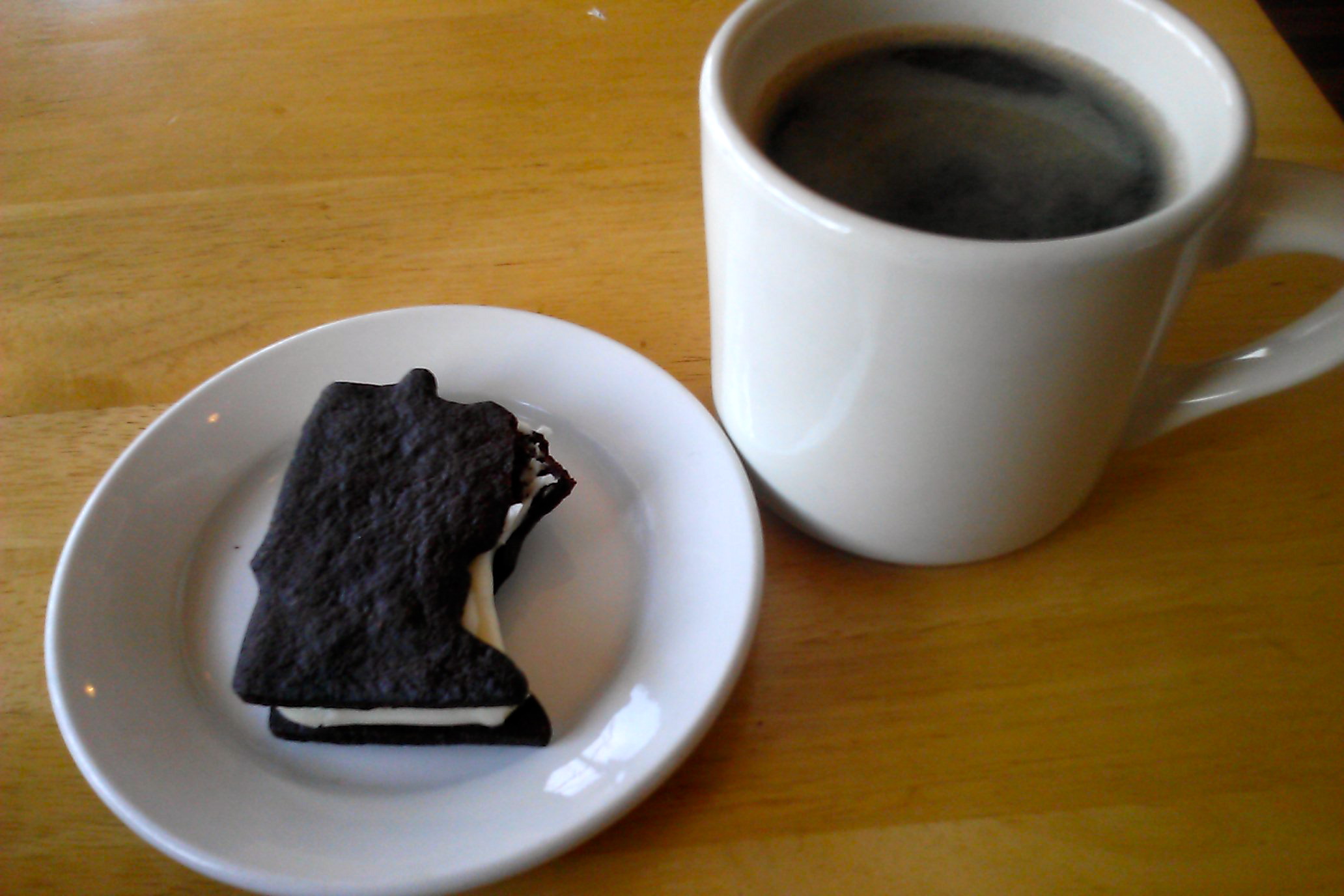
Black coffee and a Minnesota sandwich cookie from Gigi's. (never mind the missing upper right arm of the state. I took a bite first, photo second!)
Black coffee and a Minnesota sandwich cookie from Gigi’s. (never mind the missing upper right arm of the state. I took a bite first, photo second!)

When I resigned my professional position in higher education and relocated to Minneapolis, my friends and I repeatedly said, “If nothing else, you/I can get a job as a barista!”. This was a nod to my love for coffee and the hours I’d spent in my local coffee hangouts, and an acknowledgement that I wasn’t in any way certain about what the future held. In some ways, it was also the real-life equivalent of Monty Python’s famous line, “And now for something completely different!”. We all knew I had loved my job for years, but was seriously burnt-out and experiencing a deep sense of betrayal – so much so that the thought of continuing my career with a simple move to a different institution was anathema for a time.

At the beginning of my job search, I applied for a variety of professional positions, primarily in nonprofits throughout the Twin Cities. As weeks went by with barely a word from prospective employers, I began to think more seriously about hourly jobs as a means of tiding me over, financially, until the right full-time professional position came along. And that, my friends, is how I began working for Big Coffee.

I remember talking about customer service at my interview. I said, “Its important to read the customer. Some will come in looking for a pleasant exchange or to be recognized/known. Others just want to get their coffee and be on their way. How well you read what they want can make or break their day.” This has proven true. Very few of our customers want to chat at any length, but most are seeking a smile and expect me to ask how they are. In fact, a surprising number of them ask how I am first – and their question is more often than not a genuine one. The only customers who sometimes get on my nerves are the ones who can’t decide but don’t step aside to let the next in line go ahead of them. Ok, they’re not the only ones. As a licensed store, rather than a franchise, there are a few things that don’t work exactly the same way – I am also irritated by customers who get irate and yell at me because the corporate negotiations left these gaps in service. I sympathize, but am powerless, so please stop yelling at me.

I was surprised, as I trained, to learn that Big Coffee actually wants its baristas to be fairly knowledgeable about coffee. There were tastings of different blends with discussion of the flavor notes. There are strict standards for coffee brewing and the length of time a pot is allowed to sit before being replaced. And then there is The Machine: the fully-automated espresso machine which means that the barista never actually pulls a shot – s/he simply pushes a button. The shots are produced with a perfect crema on top. I already possessed a good grasp of steamed milk and the right quality of foam, but this was the first and most time-consuming part of my training.

My co-workers are an interesting lot. I didn’t expect to work with so many people who don’t actually like coffee. One of the difficulties for our store is that, due to not liking coffee, some of our baristas don’t understand the point of the standards for brewing or the time constraints placed on how long a shot of espresso can sit before it is served to the customer. To these baristas, it all tastes terrible anyway, so they cannot tell the difference between old coffee and fresh coffee. The lack of coffee-love also shows in the difficulty some have had in memorizing the recipes. On the other hand, with perhaps occasional lapses, my coworkers display excellent customer service…except for the somewhat high percentage of wrongly made drinks, which we remake with a smile, following the recipe the second time rather than relying on faulty memory.

The store I work at is located in an affluent community. People throughout the Minneapolis area refer to this community in negative terms, suggesting that they are particularly difficult because they carry a sense of entitlement. While I have certainly had a few experiences with customers who fit this stereotype, a much larger percentage of our customers than might typically be the case in other Big Coffee shops, are elderly. By and large, these individuals have manners and use them. Though an older clientele may sometimes slow the pace, it also offers the opportunity to engage with people who truly appreciate the extra assistance as we carry their coffee to the cafe or explain the differences between roasts.

As with all new experiences, working in a Big Coffee shop has been a learning experience. There are things that surprised me, things that bum me out, and things that I truly enjoy. I’d like to share a few in each category:

Things that surprised me:

  • Because we are a licensee rather than a franchise, our corporate owners have decreed that baristas may not accept tips. What surprises me, and warms my heart, is the number of customers genuinely outraged to learn this. (More on this in the “things that bum me out” list.)
  • Customers who know the exact recipe for what they are ordering – helpful on special orders, annoying on regular orders. There are customers who order their drinks made to a specific temperature – how do they determine their optimal temp? I just know I like my coffee very hot – but I am at a loss to quantify that.
  • How many children are allowed to order highly-caffeinated beverages. Yes, there is caffeine in most of the blended drinks.
  • How much I enjoy making caramel macchiatos, even though I would never order one (too sweet for me). These are basically the only coffee order that requires some artistry on my part.
  • How many people throw their money at you or drop it on the counter out of your reach. What is that about?

Things that bummed me out:

  • The Machine. I wanted to be a coffee artist, not a button pusher. The Machine allows consistency and is faster than hand-pulled shots. But. If I compare a Big Coffee Americano with one pulled by my black-and-green-haired barista at The Boiler Room there’s no comparison for taste. The hand-pulled shots win every time. Granted, some of this may also be the brand and roast of the espresso used – but it is also the care and consistency demonstrated by the barista.
  • Working for a licensed store can suck. There are a handful of us at Big Coffee, while all of our other coworkers are Union employees, which creates a glaring pay disparity. When hired, we were told that tips would be allowed – in Minneapolis this translates to hundreds of dollars per month of extra income for baristas. Without tips, what I make working 30 hours a week doesn’t pay for much. Big Coffee benefits such as health care, much lauded in the media, do not apply to us – even down to a cuppa during our work shifts. Official policy is that we must purchase anything we consume (including brewed coffee, despite the fact that we dump pots of it out every 30 minutes), except for testing samples when a new product is rolled out.
  • Schedules are produced on a week-by-week basis, without reference to the previous week’s schedule. This means that I never know in advance what my schedule will be, and I might have worked four days in a row at the end of the last schedule and four at the beginning of this one, making an 8-day week. This prohibits planning as well as doing in my off hours. Volunteer work? No one wants a volunteer who can’t commit to a set time. Job interviews translate to begging others to trade shifts. Time off requests mean that you are penalized those hours that week – it is always assumed you would have been scheduled for an 8-hour shift during that time and those 8 hours are “counted” against your total of 30 or fewer for the week. The upshot is that no one requests time off, resulting in a cut-throat trading free-for-all the minute a new schedule is posted. Health codes require us to call in sick under certain conditions. But no one does, because none of us can afford the lost income.
  • I remember a faculty member in graduate school saying that the higher your earned degree level, the more control and autonomy you would experience in your work life. Altogether, these bummers are teaching me a lot about things I may not have valued as deeply as I ought to have in my previous career.
  • The final bummer I want to share has to do with our elderly customers. Big Coffee is expensive. Every shift there is at least one person who approaches and says that they’d like to “have a treat today”, and asks the price of coffee or a pastry item. When told the price, s/he is crestfallen. Not irritated that it’s expensive, though we get that too. But genuinely, clearly unable to afford a small coffee. We have one woman who comes every day and asks for a sample of brewed coffee. She then sits in the cafe for an hour, nursing that thimbleful of coffee. Technically, this isn’t quite above board. But who is heartless enough to address it with her? It may be an affluent community, but it is clear who is living on a strictly limited income.

Things I enjoy:

  • Working the coffee bar when we’re busy. There’s a pleasure that comes with testing yourself to work fast with accuracy, and still manage to connect with the customers.
  •  I like being assigned to sample products. Many of my co-workers don’t like sampling, but I enjoy this process – a soft sell, answering questions, delighting people by giving them something yummy for free. Its the little things, right?
  • When I first started the job, I was disappointed that it wasn’t a more hip location. One where I might meet interesting artists or writers or…just a more diverse crowd. But as I’ve gotten to know our clientele, I’ve really liked working with the older customers. One customer orders a pour-over or a French Press every day, and every day with enthusiasm instructs us how to make it while also waxing poetic about how good it is compared to what he makes at home. Another older gentleman came in daily when we first opened, and garnered a reputation for being surly, cranky, and unfriendly. A month or so later, he showed up with a woman in tow – his wife who had been ill. He actually smiled, throwing everyone off. He still comes in daily, but with his wife – and the change in his demeanor has endeared him to all of us. There’s a quite elderly woman who has never ordered anything from us, but she is often waiting for her ride for 40 or 50 minutes. When I see her, I get something out of the case to sample. She’s particularly fond of anything chocolate!

There was some speculation, on my part as well as among my friends, whether working at Big Coffee would adversely affect my relationship with, my deep love for, coffee. I can happily report that it has not. Which is not to say that it hasn’t had an impact. For one, if Big Coffee is the only option available, I will go there. But now the idea of voluntarily spending my money and time at Big Coffee is much less agreeable to me. Not because I’m a hater – I’m not. But you know what they say about familiarity…some things are better with more separation. Besides, I’ve always preferred independent and local to chains anyway, and I have not come close to exhausting the coffee shop options here yet!

Some days, I wake up and all I can smell in my little apartment is coffee. I don’t know if it is something I bring home on my work clothes, in my nostrils, or if it is a remnant of the last pot I made in my galley kitchen. It doesn’t really matter which it is. I inhale deeply and think, “Hmmm. Time to make some coffee.”

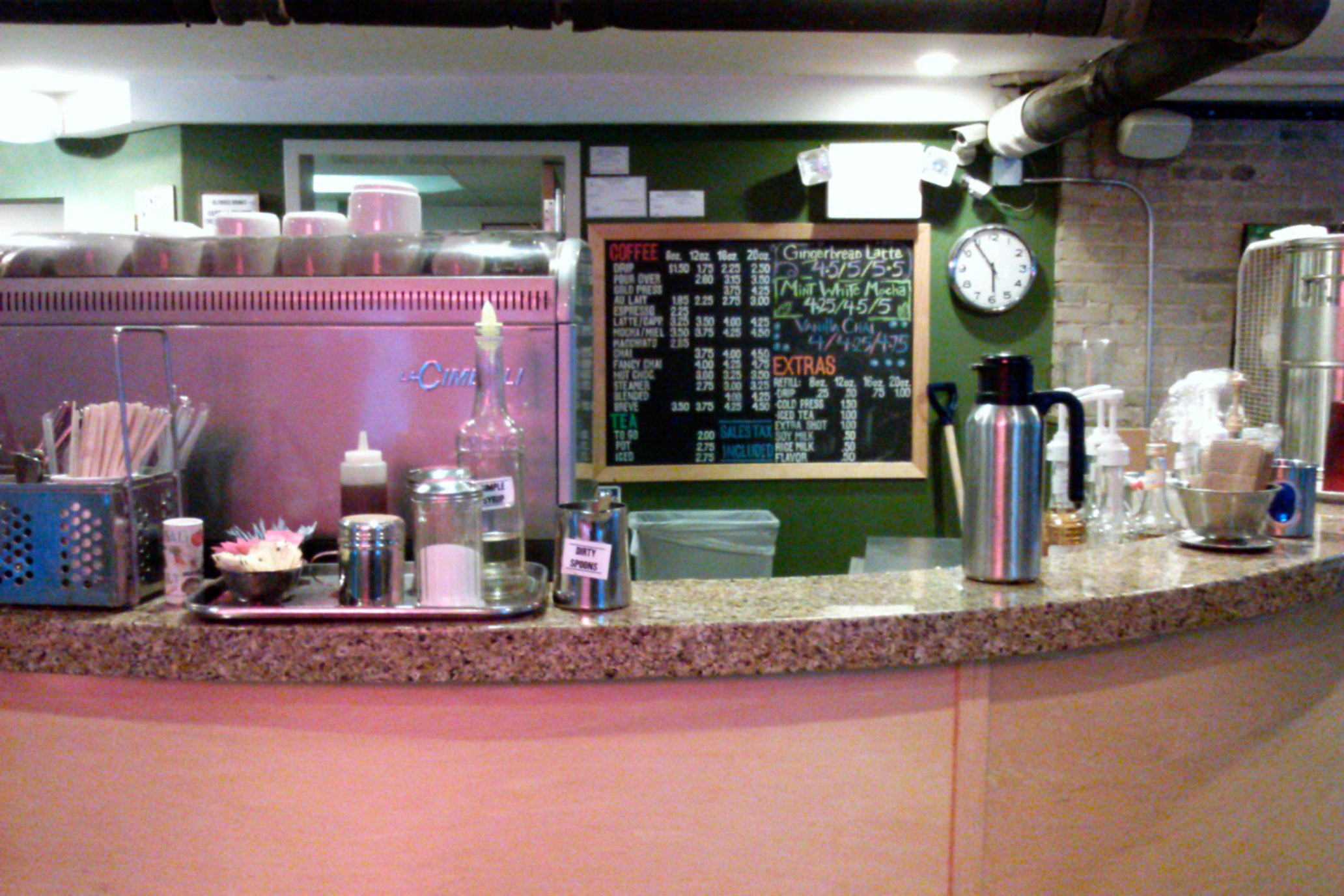
The coffee bar at The Boiler Room.

You say addiction, I say love affair (My life in coffee, part one)

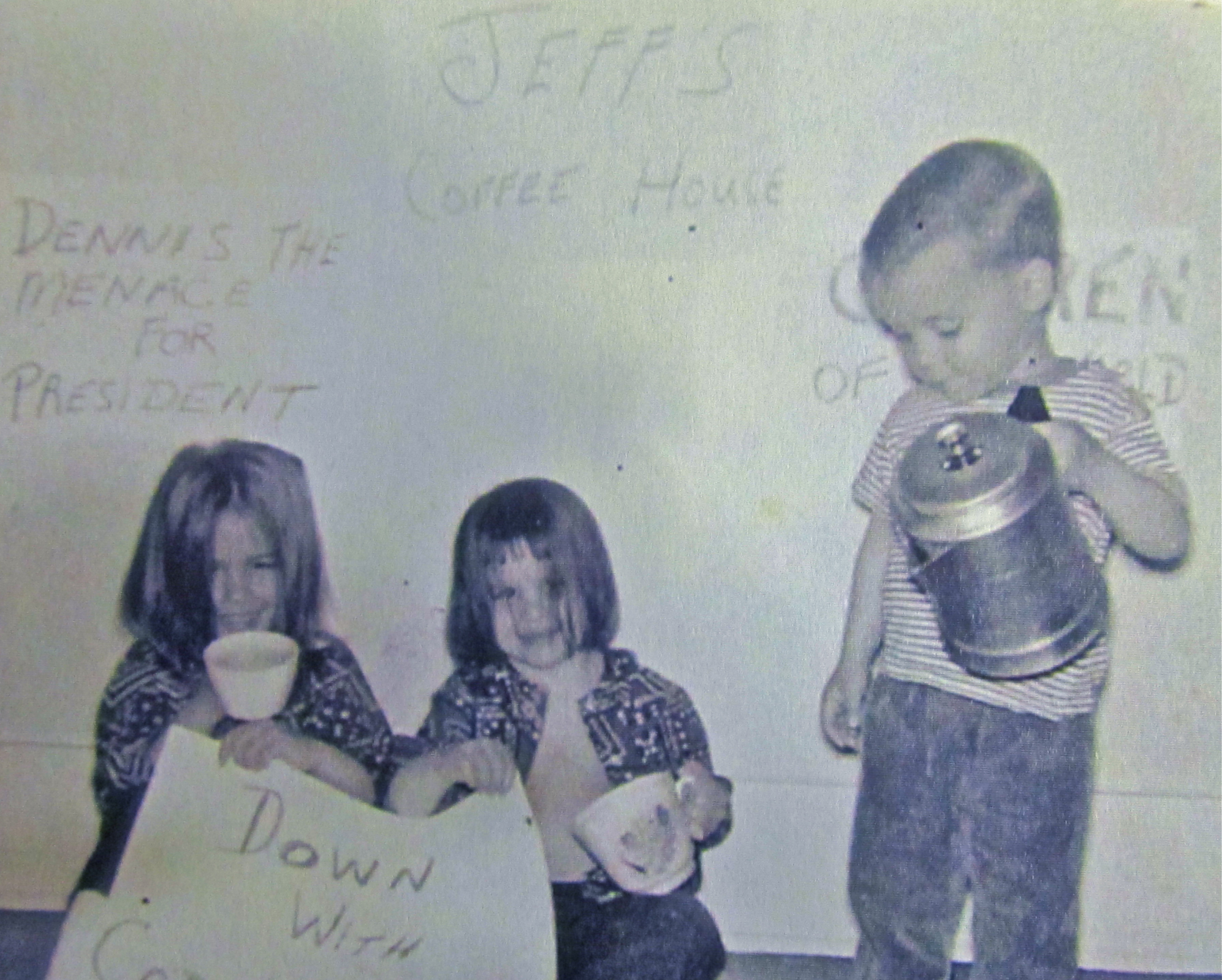
I posted this once before as a Flashback Friday: my sister Chris, brother Jeff and me (in the middle) in a staged photo from our childhood. Coincidentally, Jeff now owns a coffee shop!

Let’s get this out on the table right away: I don’t really care what anyone else thinks about this. I definitely don’t care what conflicting medical studies show. And I don’t really even care if what I am about to tell you is factually true. That’s how one-sided I am when it comes to my life with coffee.

When I was a kid, my grandpa Postel lived in an apartment in the basement of our house. Occasionally, I got to stay overnight in the apartment with him. (There were six of us kids, so by the time he cycled through the bunch, it was a rare and special event). After spending the night, we’d get up early and go to 6:00 a.m. mass at the Cathedral, followed by breakfast at Rings Restaurant on Dodge Street. On these special mornings, I was given the choice: a cup of tea or one of coffee, loaded with sugar and creamer. I always chose tea. To this day, I regret my childish mistake.

My parents lived on coffee (reference the 6 children mentioned above). My mother didn’t leave her bedroom in the mornings until she’d had her first two cups, delivered by my father or one of us kids if a proxy was needed. Depending on the day, there might be a pot at lunch, but there was WITHOUT FAIL coffee at supper. I learned how to use an electric percolator at an early age.

By the time I was in high school, I was regularly helping myself to my parents’ stash. Of course, I poured in the sugar and milk, but there was no mistaking that dark, earthy coffee flavor. Then, in 1976 a coffee shortage happened, and prices skyrocketed. In an effort to curb their children’s burgeoning taste for the liquid gold, my parents instituted a “drink it black or not at all” rule in the house. They said that if we didn’t like the way it tasted on its own, we didn’t like it enough to justify the expense of drinking it. Unfortunately, their Machiavellian plot backfired, because 1976 marks the year I fell truly, madly, deeply in love with the bean.

Throughout my college years, I was an aficionado of the greasy spoon coffee: Saturday mornings at a breakfast cafe where a waitress named Patty kept it hot and filled to the brim; late nights at Perkins, where my friend Marty would wave the empty pot over his head to signal our server that we’d reached the bottom of yet another “bottomless cup”. By the mid-80s, I was in grad school and the modern coffee trend finally reached the midwest. Coffee shops with flavored coffees, brew bars, and coffee drinks proliferated. (Unbelievably, it took almost another twenty years for Big Coffee to claim any real estate in Iowa.) I officially became a coffee snob.

Regardless of the ambience or delivery method, I remained true to my coffee purist roots. I drank it black and strong, first thing in the morning and all day long. Occasionally, I ordered a cappuccino to experience the sublime flavor of coffee sipped through expertly foamed milk. (Eventually, a trip to Ireland changed my coffee habit irrevocably – the first time I drank coffee with real Irish cream. Now my Americano is almost always softened with half-and-half.) I often drank copious cupfuls of the stuff at night, then went to bed and fell peacefully asleep as soon as my head hit the pillow.

I realize that everything I’ve shared thus far serves as an argument for addiction. I can’t deny that. About ten years ago, I was suffering from horrible heartburn and acid reflux. I gave up soda and coffee, cold-turkeyed them both. I felt horrible for several days as I suffered with the telltale splitting headache of caffeine withdrawal.

And here’s where the love affair side of things kicks in. After successfully removing coffee from my life for almost a year, I felt physically fine but found myself still longing for a cup, for the taste of it in my mouth: I missed my cup of joe. More important, I missed the ME who indulged in those cups. So I started up again – and, like a miracle, discovered that coffee was not the cause of my previous discomfort. I still only rarely indulge in sodas, but I quickly returned to drinking coffee daily.

Why did I miss coffee so much? I missed the ritual of having a “first thing in the day”. I missed holding the warm cup in my hand. I missed the warmth of familiarity coffee offers in cold new surroundings, and I definitely missed the purposefulness of “going for coffee” as opposed to wandering about town aimlessly. Most important, it wasn’t until I gave up coffee that I discovered just how much a part of my social engagement with family and friends it was. When I visit my parents, morning coffee is my favorite part of the day – we read the paper or watch the morning news and talk in an unguarded way that is never really replicated at other times of the day. With my siblings (one brother actually owns a coffee shop) and friends, long, rambling, silly or serious discussions are had while hanging out over coffee. Or, like when I visit my brother Matt in Chicago, we get up and out to walk over to Cafe Mustache and engage with the neighborhood – something I’ve happily replicated in my new neighborhood by heading over to the Boiler Room. When I am alone, as I am so often since moving here, coffee shops are always welcoming, and good coffee fuels my ability to relax then focus on projects.

I’d like to mention that I have dear friends and family members who DON’T drink the stuff. Even some who cannot understand in any way its appeal. We have awesome times together, too, though they’ve accepted that I might bring coffee with me to their homes (and drink it while they share a bottle of wine). My friend, Sue, even keeps an elegant electric percolator in the cupboard – and coffee in the freezer – just to make me feel at home when I visit.

Can I live without coffee? I know the answer is yes. Would I want to? Not really.

So, you may be wondering, why am I sharing this long reminiscence about the role of coffee in my life and personal history? Well, I wanted you to understand my relationship with coffee, my love of it, before I share part two next week – my adventures in working at a coffee shop. Stay tuned!