What Do Adventurous Women Know…and how do I learn it?

I am a devourer of true life adventure stories by the women who lived them. It started casually, with travel anthologies. Then I discovered Tales of a Female Nomad by Rita Golden Gelman and I had a new hero and a new secret passion. Of course Eat.Pray.Love.  More recently, Wild.  And it hasn’t just been books. My friend Wendy and I obsessively watched the movie “Under the Tuscan Sun” the summer it came out on DVD (based, if loosely, on a true life adventure story). I’m a sucker for blogs by women on adventures – Travel Destination Bucket List, for example. I began following this blog while its author, Anita Mac, was chronicling her solo trans-Canadian bike journey and have since travelled to Croatia and on pilgrimage to Santiago de Campostella with her. My latest avidly followed blog is My Meandering Trail, where I am following Jordana on her solo through-hike of the Appalachian Trail.

Each of these women have great stories to tell, and they tell them well. And while each gives space in her storytelling to moments of fear or self-doubt, by and large the overriding impression I come away with is of admirable courage, self-efficacy, and joie de vivre. They have moxie, pluck…and whatever other old-fashioned words are reserved for women who have a little something out of the ordinary in their make-up. With my life in transition, my jumping-off point only three weeks away and no firm plan in place yet, I find myself looking to these women and wondering if it might be possible to channel the skills and qualities they embody and which I so desperately need. With that in mind, I’ve identified some things adventurous women seem to know that I’d like to get more conversant with:

Adventurous women know how to manage their stuff

I’m mostly talking actual, as opposed to figurative or emotional, stuff here. These women know how to organize, manage and corral the daily items that fill our lives: furniture, linens, shoes, and tchotchkes. They ruthlessly purge, pack, or otherwise pare down much of what they own in order to begin their adventures unencumbered. So far, I have managed to recycle three small cardboard boxes and shred a pile of old credit card bills. To say “I haven’t hit my stride yet” is to make a prize-winning understatement. Here’s an example: I have a decorative item which was given to me as a gift. It isn’t the kind of thing I’d look at, much less choose to purchase, in a gift-shop. But the person who gave it to me is beloved, and it was given to commemorate a special occasion in my life. In an effort to decide if it is worth packing and hauling to storage, I’ve carted the darn thing into every room multiple times this week. It has surely travelled more miles within my house than the paltry few between here and my storage unit. (Which, by the way, I haven’t actually reserved yet.) And I still can’t decide whether to keep it or put it in the “donate” or “regift” pile. Thankfully, my adventurous friend, Sue, came to visit one evening this week. She walked me through the best ways (and which containers to use) to pack my house. Her advice about what to keep and what to divest myself of: “Be ruthless”. Ruthlessness in the management of stuff – the first thing I need to learn to become an adventurous woman!

Adventurous women don’t hesitate to ask

In the past nineteen years, I’ve lost count of the number of people who have said to me, “I could NEVER do what you do!” Often they follow this comment with something about how they hate conflict. And it’s true – my career has been full of high-conflict, high-stress moments when the issues at hand have been incredibly difficult to navigate. And I am proud of how I’ve handled these difficult situations. But I have a secret to share. In spite of a reputation for direct and honest communication, I cannot make a cold-call to a business to ask questions. Additionally, I am terrible at asking people for help if what I need help with carries an emotional component. Adventurous women are curious, and ask questions because it is part of their nature. Part of how they successfully navigate their courageous lives is their willingness to ask for what they need. How can I plan a whole new more adventurous life when it takes me three days to work myself up to contact storage companies? I think of Jordana, contacting companies to ask for sponsorship of her trip – and getting some awesome support and swag as a result. I definitely need to get me some of those questioning cajones! (Hey, has anyone heard of companies willing to sponsor a middle-aged woman’s career/life change?)

Adventurous women have a specific plan

Well, I’m just plain screwed on this one. I can’t seem to think past vacation, which is the first step of my journey to a new life. I have a vague plan. No specific dates, no specific locations. Just a gut sense that I have to take most of the summer to feel my way – unless right livelihood presents itself. In which case, I’ll know it and change my trajectory.

At this point, my parents and many of my friends are reading this post and beginning to hyperventilate. Please don’t. I am holding enough fear, panic, and fear- and panic-induced motivation at bay to satisfy all of us. But it is back there, behind the voice telling me to take my time. Cheryl Strayed had never tried to lift her backpack until the morning she planned to set off hiking the Pacific Crest Trail. Foolhardy? Probably. But did she survive? Hell, yes – even thrived. Sometimes, adventurous women know what they need, and they move toward it even if they haven’t got all the answers in advance. My whole life, I’ve been an answers (and fool-proof assurances) in advance girl. This feels like my opportunity to step forward with trust instead of surety. Eek!

Adventurous women don’t sweat the “solo” part

When I’ve lamented being alone in life, my friend Layne has tried to comfort me by asserting that everyone is just as alone. Her approach is unique; most of my friends try to convince me that I’m not alone because of the large number of people who love me. The truth is, when it comes to making decisions and living the consequences of those decisions, I’m on my own. I have no idea whether it would be easier if I was part of a couple, or if it would be harder. I look at the women whose adventures have inspired me, and I see that they have struggled with the same things – and yet, they’ve found ways to be empowered by the solo nature of their adventures. Empowered because they’ve remained open to meeting new people, to having new experiences, to learning about themselves and the world around them. I’ve lived “smaller” out of fear in the past. One of the things I want to learn from adventurous women is how to live “larger” in spite of the fear. As one blogger says, “I will never be fearless, but I can choose to fear less.”

Adventurous women dare to go “all in”

In every one of the true-life adventure stories I’ve come across, women have let go and jumped in with both feet. For some, this has meant the start of a completely new life. For others, it has been a shining experience which stands out from the ordinary life lived both before and after the adventure. Perhaps my coming adventures are on a smaller scale than selling my home and all my belongings and living the rest of my days as a world-travelling nomad – but they are still a stunning departure from my previous life-choices. My friend, Sara, put it this way for me, “You’re not really the ‘leap of faith’ type, are you? But you’ve been risk-averse for so long, you’ve probably stored up some really good risk karma, so why not use it now?” Not exactly an “all in” mentality – but close enough to get me started!

So, I have my work cut out for me – both with the actual activities associated with leaving my job and my house and with the mental and emotional preparedness for leaving. I’ll figure out the stuff, develop the plan as I go, and remind myself to cultivate curiosity so that asking for things (even if it is only information) gets easier. I’ll continue to be inspired by other women who’ve taken courageous and adventurous paths, hoping that the reality of living with less fear of the “what ifs” will translate into living more completely, more fully. Maybe someday other women will be reading my “true life adventure story” and deciding they can choose differently too. That would be an amazing end to this story, wouldn’t it?! I guess we’ll all have to wait and see what happens with each turn of the page.
Learning not to be scared of scarcity

“After doing this work for the past twelve years and watching scarcity ride roughshod over our families, organizations, and communities, I’d say the one thing we have in common is that we’re sick of feeling afraid. We want to dare greatly. We’re tired of the national conversation centering on “What should we fear?” and “Who should we blame?” We all want to be brave.”
                      –Brene Brown, Daring Greatly
 

There’s nothing like resigning from your job without the next job lined up to make you aware of the scarcity mentality. Last night I was driving, listening to an economics expert on NPR discussing the “cascading” taking place in the American workplace. Essentially, there is a scarcity of jobs for those of us who are highly educated and credentialed. So we are taking jobs a few rungs down from  those we would typically be qualified for. He said, “I’m not saying everyone is becoming a barrista at Starbucks, but…” The cascading effect then causes the next most educated/qualified people to take jobs even further down the ladder and so on, until those who were on the bottom rung fall off completely. Later, on Facebook, I saw a post which included a note to a politician written on a paper plate. The note began, “I never thought that at 52 I would need the services of a food pantry…” 52. The age I will be in July.

As word of my resignation last week has filtered out, I’ve received a few shocked and fearful responses from people who are worried about my future livelihood. Mostly, though, the response has been overwhelmingly on the side of, “I’m jealous!” “I wish I could do that.” These responses support the contention made by Brene Brown in the quote above.

For me, while I may like the idea of being brave, this move isn’t about wanting to be brave. This move is about wanting to be whole. Those things seem very different – even though I had to screw up my courage to set this whole thing in motion. In another part of her book, Dr. Brown says she took the familiar question, “What would you attempt to do if you knew you could not fail?” and turned it around, making it, “What’s worth doing even if I fail?” The original question is easy to answer – I can come up with a whole list in a matter of moments. If there were no risk in trying, why wouldn’t I try…skydiving, tightrope walking, asking someone out, going all-in at the casino, riding my bike cross-country? (Cut me some slack, that list was literally off the top of my head!)

The second question, “What’s worth doing even if I fail?” is a worthy question. The answer that came to me as I pondered it is simple – “Listening.”

It is worth it to listen to the voice inside urging me to live my own life more congruently.

It is worth it to listen to the call I hear, the call to engage the gifts I have been given but have allowed to take a less central role in my days.

It is worth it to listen to my heart, which asks me to free myself to love this life more completely.

Even if I fail.

Which brings me back to the idea of scarcity. The idea that there isn’t enough – or that I am not enough – to risk making a chancy change. Scarcity makes us choose staying safe over being fulfilled. But security is an illusion – people have accidents, lose their jobs, the economy tanks, things happen – that can be ripped to shreds any day, even if we take the “safe” road. If we listen to the message that scarcity is so scary we should cower through our lives hanging tightly to our illusions of security, we can pass years and decades living half lives. This I already know from personal experience. Now, I want to know something else from personal experience.

So I am staring the scarcity monster in the eye and calling it by its true name: fear. This is worth doing, even if I fail.

I’ve Entered the Long Jump of Faith

“The woman silhouetted in the painting is leaping – with abandon and joy, it seems — across a chasm. She is looking ahead, at her goal, not down at what is or is not currently beneath her feet. Does she know, I wonder, what lies ahead? I doubt it – it seems clear that this is a leap of faith. Faith that she’ll land safely on the other side. Faith that the choice to leap was the right one. Faith that the time for leaping had arrived. And faith that, whatever awaits on the far side of the chasm, will be worth facing and taking the leap.” 
                   —Jenion, January 24, 2013 “Take a Flying Leap”
 
“And with that experience and knowing, perhaps it is time for me to become a person of faith, not just a person of beliefs. Time to close my eyes and take a step, trusting that I will put my foot down in the very place I need to be.”
                    —Jenion, April 4,  2013 “Have a Little Faith”
 

On Monday, April 22, 2013 I finally took the leap of faith that I’ve been working myself up to all year – I resigned from my job without having a clear idea of where I will land when my feet touch down on the other side.

Hopefully, there will be time before May 31, when my resignation takes effect, for looking back and celebrating. But right now, there are so many things that need to be done and prepared. It’s not one of those leaps that happens immediately – it is more like a slow-motion long jump. I pushed off the ground with my resignation, but I won’t actually be out over the chasm of the unknown for a little while yet. I have paperwork, planning, and packing to do before then. Mountains of each. I want to thank the friends and family with whom I endlessly debated my options – your promises that I would never be homeless or hungry went a long way toward lessening the fear of action.

What am I hoping for? I believe it is time to create a different life for myself. One in which I am not as limited by the demands of my job (nearly 20 years as a first-responder, ever on call, others as my top priority) so that I can be free in my off-hours to engage in a variety of pursuits that have been tabled – whether that is creative work or volunteering or exploring. I don’t know what the future holds. How strange is that feeling? I might find right livelihood quickly, or it may take a while. I might stay here or I might go elsewhere. I do not expect it to be easy, but I do expect that I will find my way.

Composing a life is an improvisation, one which calls on us to be clear about what we value so that the decisions we make along the way are made from the right place. Whether we are staying put or moving on, whether we are staying the course or charting a new path, we need to remain centered in what is real as opposed to what is mirage – what is true value as opposed to imposed value (imposed cultural values, such as “more is better” or “busy equals virtuous”). As environmental activist, Julia Butterfly Hill said during her campus address Monday, (serendipitously just hours after I tendered my resignation): “We are all co-creating our world every moment with every choice…Regardless of perceived boundaries. We are not victims, we are co-creators.”

The thing about a leap of faith is that you have to practice actual faith. Faith isn’t the absence of fear, rather it is the knowledge that beyond the fear lies the right path. Faith that, wherever my feet touch ground, I will be walking the path that I am meant to be on.

Dear readers, I hope that you will come on this journey with me – I will certainly be keeping up to date through weekly posts on Jenion! I’m interested in your stories of taking a leap of faith – please feel free to share your stories in the comments section!

Learning to Love Rain

“She enjoys rain for its wetness, winter for its cold, summer for its heat. She loves rainbows as much for fading as for their brilliance. It is easy for her, she opens her heart and accepts everything.”
                          –Morgan Llewelyn

I used to be very selective about which seasons I enjoyed. Spring was too wet and muddy, summer too hot and humid. Fall was perfect and Winter was endurable. When I got active and lost weight, suddenly my experience of the seasons opened up. I began to love summer and winter, as well as autumn. I discovered that I love being outside, that my body can do a lot to regulate its internal temperature so I don’t need to be inside a climate controlled environment to feel comfortable anymore. Turns out, I don’t mind sweating that much, and braving the cold presents a challenge and a gift.

But Spring is still a difficult season, primarily because of that pesky weather condition known as RAIN. Springs in Iowa are characterized by one of two possibilities: no rain or too much rain. Last year was a spring with no rain. We moved from winter almost directly to summer, skipping the renewing season of spring. Springs with no rain are characterized by anxiety about crops (or gardens and lawns, if you live in town). And drought weighs heavily on the psyche of a state known primarily for its corn and soybean production. I remember feeling a dismay akin to loss when, on RAGBRAI last year, we rode on highways bordered on both sides by dead or stunted fields, parched and thirsty.

The dry weather continued, right through most of this winter, leading to drought forecasts for another year, with cities and counties rolling out their drought plans – water conservation being a less common concern in Iowa than in California or New Mexico, where my family have routinely practiced water austerity measures. In Iowa we are, sometimes shamefully, profligate with water.

And then the rain started. And now, instead of drought forecasts, we are listening to flood warnings (and believe me, since 2008, flood is the “F” word in these parts). In the past 24 hours, rain totals have been high, 3-5″ throughout eastern Iowa. Many people love thunderstorms, but last night when I calculated that it had been thundering and lightening for the better part of 18 hours, I was pretty much over it. As I listened to my house, dripping water from a leaky roof and down the chimney onto the hardwood floor in my living room, I couldn’t bring myself to have cheerful thoughts about the rain. I’m tired of gray skies, tired of the hemmed-in feeling of fog and clouds.

I share all of the above to make the point that, like most people, I experience weather at the practical (if selfish) level of “How does it affect me today?” I like days when the weather doesn’t adversely affect my plans. It has been a lovely gift that, in recent years, the number of days when weather doesn’t adversely affect my plans has been broadened because my tolerance has broadened. But in regard to this earth we inhabit, it is my goal to become like the woman described in the quote opening this post: “It is easy for her, she opens her heart and accepts everything.”

As another Earth Day approaches, I am taking stock of my openness to the natural world and finding pockets of resistance, like my aversion to spring and intolerance for more than incidental rain. This is important, because our cultural movement away from direct experience of the natural world, away from stewardship, has led us to a place which is dangerous for the earth itself. It is also dangerous for our spiritual survival, as well. When I set out to lose weight, I didn’t realize that what it would take was healing the emotional separations I had fostered – between my head and heart, between my body and my soul, between myself and others. And as I reflect on what it will take from me, personally, to participate in the healing of our planet, I realize that I have to heal this unnatural separation between myself and the planet we all call home.

I often go out and troll the internet for information or quotes to support the theme I’m writing about in a post. This morning, I thought I’d look for a Joanna Macy quote to end this post. Macy, an environmental activist and scholar, has been thinking deeply about these issues for a very long time. Serendipitously, I came across the paragraphs below on the first Macy-related page I clicked on. She says what I mean in a much more eloquent and complete way, and I’d like to close with her words (apologies to my friend, Martin, who hates it when I use long quotations):

“In the first movement, our infancy as a species, we felt no separation from the natural world around us. Trees, rocks, and plants surrounded us with a living presence as intimate and pulsing as our own bodies. In that primal intimacy, which anthropologists call “participation mystique,” we were as one with our world as a child in the mother’s womb.Then self-consciousness arose and gave us distance on our world. We needed that distance in order to make decisions and strategies, in order to measure, judge and to monitor our judgments. With the emergence of free-will, the fall out of the Garden of Eden, the second movement began — the lonely and heroic journey of the ego. Nowadays, yearning to reclaim a sense of wholeness, some of us tend to disparage that movement of separation from nature, but it brought us great gains for which we can be grateful. The distanced and observing eye brought us tools of science, and a priceless view of the vast, orderly intricacy of our world. The recognition of our individuality brought us trial by jury and the Bill of Rights.Now, harvesting these gains, we are ready to return. The third movement begins. Having gained distance and sophistication of perception, we can turn and recognize who we have been all along. Now it can dawn on us: we are our world knowing itself. We can relinquish our separateness. We can come home again — and participate in our world in a richer, more responsible and poignantly beautiful way than before, in our infancy.”

Defending, not Defensive

One benefit of entering your 50s (and believe me, I’m on the lookout for benefits) is that you not only know but have learned to accept who you are. With your strengths, your weaknesses, your shiny bits and your warts. In my case, this acceptance came late and as the result of a lot of self-examination – always the late-bloomer! Regardless of how hard-won, or how much forced growth was required, I can now say I know myself well.

When I was 19, this was far from the case. That New Year’s Eve, my beautiful three year friendship with a guy named Richard ended. We fought when he believed his girlfriend, who told him I had gone out of my way at his party to make her feel uncomfortable. I was insulted, incensed, hurt. And I was feeling too defensive to admit that maybe, while not 100% consciously, I may have had a slight motivation to make her feel a tiny bit the outsider. I ended the argument by saying, “If that’s the kind of person you think I am, then maybe we aren’t really friends.” I slammed the phone down. To my lasting regret, we never spoke again. Looking back, the fact that he called and wanted to discuss his concerns speaks volumes. As does the reality that I didn’t want to look critically at my own behavior and motivations.

Thankfully, these days, I am not so easily pushed off-center, nor do I feel the need to be particularly defensive. I know and apologize when I’ve behaved badly; I have little difficulty taking responsibility for my mistakes; I am willing to engage in reflection when someone offers criticism. Occasionally, though, someone fundamentally misconstrues who I am at my core, or accuses me of behaviors which are anathema to me. These experiences are rare, and invariably catch me by surprise, unsure how to respond.

When these interactions occur, they are almost always based more in perception than in concrete experience. Because concrete experience is only concrete in the abstract – it is always filtered through perception in order for humans to apply meaning. A simple sentence, such as “I like blue” can simply mean what it says. But when I say it to another person, they may hear it as “I like blue more than I like all other colors” or “I like blue, not green” or “Blue is the best.”  It doesn’t occur to me to clarify, explain, or qualify the statement, “I like blue”, and so the hearer and I walk away from this exchange with completely different perceptions of what has been communicated. Much later we may have another exchange in which the hearer says, “You only like blue.” I am surprised, because I’ve never said such a thing, nor felt it. However, how do I correct a perception that has existed now since the original conversation? That has been reinforced in the other person’s thinking every time it has been remembered?

There is a lot to be learned by staving off defensiveness and trying to understand the experience or perception through which another person sees you and/or your choices. Most of the time, I truly try to do this – and most of the time insight into my own psyche is the result or reward of maintaining a nondefensive stance. Sometimes, though, it is important to stand up for yourself, to defend yourself. In these situations, how do I manage to be a self-advocate without also giving in to the temptation to go on the offense? When my ethics, values, commitments are questioned, how do I speak on my own behalf without crossing over into the territory of counter-attack?

This is where being in my 50s becomes an asset. I’m more comfortable sitting with the situation for a while before responding. Letting the “feedback” sink in first, especially if it is hurtful or  potentially damaging to me. In my 50s I’ve learned that not everything leveled at me has merit, and this pause lets it sink in far enough to gauge whether merit exists or not. I’ve finally learned that not everyone launching stuff my direction has the best of intentions – and when this is the case, I don’t have to be touched by their criticisms or accusations in the tortuous, self-doubting manner I would have in my youth. This understanding is critical to engaging in the appropriate level of response. I don’t have to attack, I simply have to stand in the truth.

In my 50s I’ve also come to understand that I can’t control the outcome of these events. I can only control my response to them so that it is in alignment with my Self: my commitments, ethics, integrity, beliefs. Holding to my own center is such an important component of feeling empowered – especially if, despite my mature and reasoned response, I get smacked down by false attributions and/or the outcomes are crappy. As Dr. Wayne Dyer has famously said:

“How others treat you is their karma. How you react is yours.”

I opened this post with the observation that knowing myself well is a benefit of being in my 50s. I am going to hold fast to that idea – in part because, in my 50s, I finally believe that the person I am is worth knowing and standing up for. There will be no hanging up on people who challenge or criticize me, neither will there be laying down to be walked all over. Instead, knowing me, there will be more standing centered in my truth.

Thursday, April 11, 2013

IMG_2102

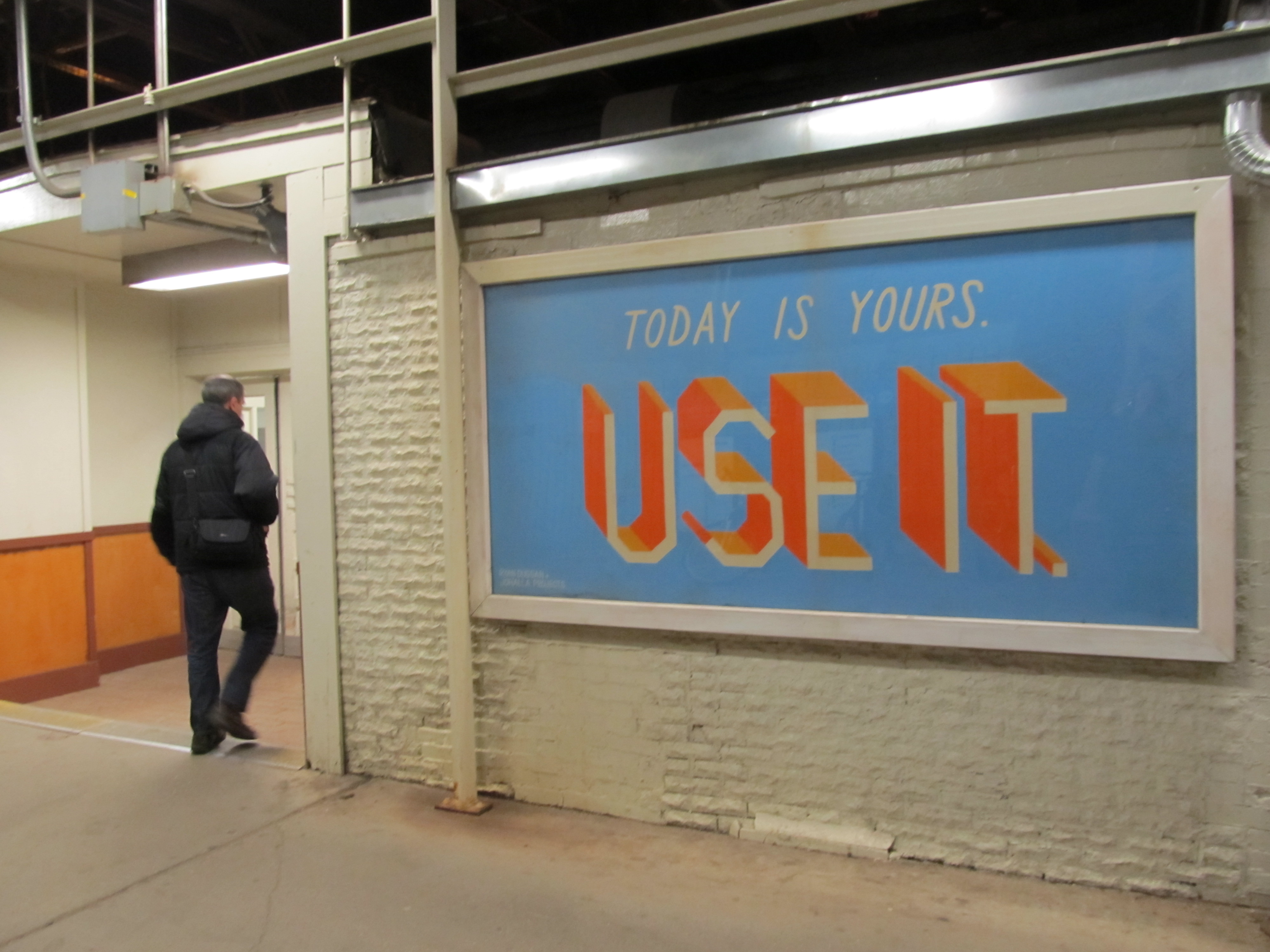
No scale post today, because I just didn’t feel like it. It has been a rough week and I am bone tired this morning. This photo was taken on my Easter weekend trip to Chicago. That’s my brother, Matt, walking out of the train station down the block from his house in the Logan Square neighborhood. We had just returned from a trip downtown with our cameras to photograph the city at night. The sign caught my attention, and seems so appropriate a reminder for a snowy, cold Thursday in mid-April. Let’s go out there – and remember that today is ours!