In other words: Forget about the dots

“Wanting an intimate relationship doesn’t mean I get one. But to paraphrase Stephen Stills, if I can’t be with the one I love, my best insurance policy against a sad, lonely old age is to love the one I’m with. The one who will never leave me, no matter what, for real. That one, of course, would be me.”         — Meredith Maran The New Old Me: My Late-Life Reinvention


You take a step. Make a choice. Decide.

You never know exactly what to expect, how it will “turn out”, where it will lead. But you think you’ve looked at it from every angle you can, and it seems like the next right thing to do, so you think you know approximately, at least, what will happen.

In Steve Jobs’ famous commencement speech, he said ““You can’t connect the dots looking forward; you can only connect them looking backwards. So you have to trust that the dots will somehow connect in your future.” You know this is true, but even hearing Jobs’ wisdom in your head at each decision-point doesn’t stop you from trying. Doesn’t keep you from thinking that, maybe, this time you’ve managed to connect the dots forward. This time you’ve mapped the trajectory of your own future correctly and all will proceed accordingly.

But it doesn’t.

You fail. Someone you rely on fails. Markets fail. You get sick. Someone you love gets sick. You calculated based on certain assumptions, now proven incorrect. (Donald Trump gets elected President proving all bets are off.) People refuse to act according to your predictions. Life refuses to act according to your predictions.

You feel disappointed, disillusioned, depressed. Alone.

Now what?

Self-recrimination (what did I miscalculate? how could I be so wrong? I must be missing a crucial gene!)? Shut down and spend days, weeks, just getting through until I can sit in my easy chair at night and fall asleep? Blame everyone else for not meeting my expectations (which, of course, are perfectly reasonable)?

I don’t have any prescriptions for fixing a life that goes off the rails, for solving the endless riddle of “how did this happen?” or “How did I end up here?”  But here’s what I’m learning*, or at least what I think I’m picking up on right now:

Whatever happens, wherever I go – I am the common denominator. Blame, anger, self-loathing…not helpful. Helpful? Compassion, forgiveness, self-awareness. If I have to live with myself, I prefer peaceful, loving cohabitation.

Whether I am proactive and take-charge or reactive and passive, I will experience the results. In which case, doing is preferable to wallowing; action preferable to waiting; woke-ness preferable to somnolence.

Endlessly ruminating on what happened yesterday or last week or four years ago, trying to pinpoint a moment “where it all went wrong”, is a waste of my energy. If I had known when I was 29 what my life would look like at 49, I might have chosen differently. But I didn’t know. And I chose what I chose. Move on.

Endlessly ruminating on the future, on my fears of being old and alone, or getting sick, or…just not ending up where I wish I would end up…only paralyzes me and wastes my days in longing. “Stop gazing at your reflection in the Mirror of Erised,” I practice saying to myself; step away, then step onward.


So you must not be frightened if a sadness rises up before you larger than any you have ever seen; if a restiveness, like light and cloudshadows, passes over your hands and over all you do. You must think that something is happening with you, that life has not forgotten you, that it holds you in its hand; it will not let you fall. Why do you want to shut out of your life any uneasiness, any miseries, or any depressions? For after all, you do not know what work these conditions are doing inside you.”       —Ranier Maria Rilke

* Like most important lessons in life, these “learnings” are not new to me. I am simply spiraling through them on another curve. Right now, it is helping to read a bunch of books about women my age reinventing themselves, changing their lives (whether forced to change or choosing to change).
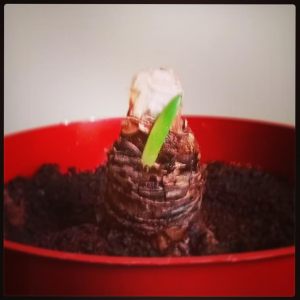


Green is the Color of Grace

Act as if the future of the universe depends on what you do, while laughing at yourself for thinking that your actions make any difference.                                                                                                –Mihaly Csikszentmihalyi

Back in December, a friend gave me an amaryllis bulb. Follow the simple instructions, then…Voila!…in mid-winter you’ll have a beautiful flowering plant to lift up your spirits!

As you might have guessed, I didn’t follow the instructions.

First, I forgot to bring the bulb home from the office. In late January, I finally carried it into my apartment and deposited the box, unopened, on my dining table. It sat there until I was home sick one afternoon in late February. I was ill, depressed and tired of the unremitting grayness that is Iowa in winter. I thought that planting the amaryllis might help me feel more hopeful. And it did, at first. I not only planted and watered the bulb, I spoke to it daily about growing and hope and life.

The papery top of the bulb developed a green tinge, which seemed promising, although I couldn’t discern any actual growth. Over time, though, even that greenish color went away. It seemed unlikely that anything would ever grow. February ended, March passed, April flew by. The lifeless brown bulb just sat on my table, unresponsive for so long that I stopped talking to it, even stopped noticing it as more than just another item on a perpetually cluttered surface.

Except for the days I felt especially discouraged – on those days, I saw it as an emblem of my inability to do anything right.

Lately, I’ve been overwhelmed by the sheer number of things there are to get done in any given day. Mired in these tasks, I am unable to focus on the bigger picture – the one where what I’m doing makes a difference in the world, is about more than just running on an endless hamster wheel. Every time it seems like things are getting on track, that there might be an opportunity to look ahead – maybe even get ahead – things fall apart and I’m buried again.

The sense of failing at my own life overrides other perspectives.

In the middle of such a seemingly hopeless cycle this week, I was frantically searching for one piece of paper among the piles on my kitchen table when I happened to glance at the forgotten amaryllis pot. One tender green shoot has emerged from the bulb’s dry papery skin. Of course, it happened when least expected, when hope of it happening had been surrendered.

“Of course,” I exclaimed aloud, likely startling my neighbor whom I could hear leaving her apartment just then.

Of course – because we won’t always immediately (if ever) see the fruit of our labors.

Of course – because nurturing hope, tending growth, changing hearts, holding space for healing is important work, but accomplished below the surface.

Of course – because our most meaningful work often resides in attending to the drudgery of details.

Of course – because when we take/hold everything too seriously, too personally, too joylessly, too fearfully we forget about grace.

When you’ve forgotten that grace exists, each time it manifests in your life it is a surprise. A miraculous, living, green tendril that reminds you: everything matters.


Thoughts on moving forward

“You can change or stay the same, there are no rules to this thing. We can make the best or the worst of it. I hope you make the best of it. And I hope you see things that startle you. I hope you feel things you never felt before. I hope you meet people with a different point of view. I hope you live a life you’re proud of. If you find that you’re not, I hope you have the courage to start all over again.” –Eric Roth, The Curious Case of Benjamin Button screenplay

Each of us is on a journey. Some days it feels like an adventure. Other times it feels like a forced march through difficult and trying terrain. How we think of the journey, what emotional baggage we carry with us, directly impacts our perspective.

Weight and body issues have been a major story line in my personal narrative, as they are for so many of us. In this blog, I have chronicled my own process through losing half of my body weight (from just over 350 pounds to a low of 176) and, recently, of regaining a significant portion of that amount. Over these years, I’ve learned so much – one important lesson being not to judge anyone else’s journey.

Early in my weight loss process, I undertook a hunger challenge – raising money for hunger relief as I lost weight myself. When I asked friends to sponsor me for this challenge, one sent me an email saying, “I’ll sponsor you as long as you aren’t having weight-loss surgery.” I assured him that I wasn’t, and his response was to say, “I don’t agree with people having surgery to fix a problem because they don’t have the willpower to fix it themselves.”

At the time, his comment didn’t really bother me – probably because I agreed with him. I had not yet undertaken either the physical work nor the emotionally difficult excavation of my underlying issues that significant weight loss required. When I did do that work, I discovered that coming into a “right relationship” with myself, and my body, is about so much more than the actual weight. When I realized that I had been trying to keep my head above water in a sea of self-loathing and shame, I understood the loving compassion I had often extended toward others needed to be extended toward myself. Once I began doing that, I could see that my judgement about other people’s bodies or weight loss methods, my attitude about other peoples’ life journeys, had simply been a projection of my own nasty insecurities and fears.

Three weeks ago, my sister Gwen had gastric sleeve surgery. I am so PROUD of her! First, I am aware of how much energy it requires to undertake such a major step. There was the better part of a year spent in medical and psychological screenings and preparation. Then there was the surgery itself, not a minor consideration. Finally, there is the life-long behavior change required to make the rest of it worthwhile.

Gwen had to face her inner demons – I don’t know them because they are hers, but I have no doubt they are as powerful as my own! Many people never manage to face theirs, much less stare them down. Many people keep finding reasons for inaction when action feels daunting.

It requires courage to do these hard things.

In fact, it requires courage to move forward in our journeys – whether in bold steps or incremental. Our fears, our shames, our regrets, our guilts are voiced repetitively in our heads. Every day they tell us to avert our eyes, to distract ourselves, to comfort ourselves with things that may feel good but are not nourishing to our souls (food, habits, consumption, competition – whatever). Their real message is “Don’t.” Don’t try. Don’t change. Don’t think you’re special or worthy. Don’t take that next step – stay here where you may not be happy but at least you feel safe.

This is true for everyone – not just those of us with weight concerns. Once you see this clearly for even a brief span, you can’t really go back to judging other peoples’ journeys as if it is your business or as if you actually know their innermost secrets. Once you see this clearly for even a brief span, it is much more difficult to brutally judge yourself.

“Owning our story can be hard but not nearly as difficult as spending our lives running from it. Embracing our vulnerabilities is risky but not nearly as dangerous as giving up on love and belonging and joy—the experiences that make us the most vulnerable. Only when we are brave enough to explore the darkness will we discover the infinite power of our light.”                                                                                                  –Brene Brown


Ubuntu


Last week, my niece posted a photograph of her new tattoo: hands, holding the Earth, with the word “Ubuntu” inscribed below it.

The next day, I met singer/songwriter Sara Thomsen, and saw her project booklet (from an event combining music, art, poetry), titled Ubuntu.

On the third day, I walked into my brother’s home in Chicago and immediately saw a sign, “I am because we are”. In other words, ubuntu.

Some, perhaps many, people would have me believe this is a great example of the Baader-Meinhof phenomenon (also known as frequency illusion). But that would remove all of the magic and wonder from the experience of such synchronicities – and I believe that magic and wonder are absolutely necessary these days. I refuse to give them up in the name of psychology.

I first heard the word and concept of ubuntu in a televised interview with Desmond Tutu 20 years ago. He roughly translated it as “A person is a person through other people” – I remember it because I immediately wrote it in my journal so I wouldn’t forget. It spoke to me very deeply of what I knew in my heart but always had difficulty articulating: namely, that we are all intimately connected with one another. The concept has a long history, and has been translated in various ways, though maintaining throughout it’s essential character. Ubuntu is about relationships. (See more history here)

Though I haven’t had a chance to ask her yet, my niece Hallie most likely became aware of the concept because of her love for and travels to Africa. Hallie is our social justice warrior, our peacemaker, our world citizen. Ubuntu is a concept she has understood since she was quite young, regardless of when she learned the word that names it. Hallie has a heart for the world and will fight for equality and opportunity and fairness for all. When I saw the beautiful photo of her tattoo I couldn’t help but feel emotional. ‘My humanity is inextricably bound up in yours,” she declares. It is written on her body.

I met Sara Thomsen when she was one of the facilitators for our annual spirituality conference. I had heard several of her songs, and have been especially drawn to this one, “Water is Life”. After the first evening session of the conference, a few of us went out for dinner. That’s where I heard about Sara’s commitment to art as a unifying force in the world. In particular, I learned about her work with the Echoes of Peace community choir, and their “Art of Ubuntu” project. And while our dinner was a serendipitous celebration of Cinco de Mayo with new-found friends, our laughter was underscored by a mutual understanding so beautifully stated in this quote from the “Art of Ubuntu” project materials:

It is like the Beloved Community, the “network of mutuality” of which Martin Luther King, Jr. spoke…   “We are caught in an inescapable network of mutuality, tied in a single garment of destiny. Whatever affects one directly, affects all indirectly. This is the interrelated structure of all reality. You can never be what you ought to be until I become what I ought to be.”

Immediately after closing our conference on Saturday, I drove to Chicago. The main reason for the trip was to see my niece Zoe in the role of Veruca Salt, in her school production of “Willy Wonka”. (She was awesome!) After the play, I found myself in an Irish pub, surrounded by women I love and admire. Our discussion ranged all over, but eventually found it’s way back to politics every time. It was an incredible experience to, once again, be surrounded by fierce women who are taking action in whatever ways they can to create a world where ubuntu is the dominant paradigm. “I am because we are”, as the sign in my brother’s living room declares.

Ubuntu: I so needed this repetition of the concept. I refuse to chalk it up to a mere mental trick or illusion. When you are parched and thirsty, water is always a miracle, not only a chemical compound of hydrogen and oxygen. More than anything, I needed the reminder that there are many others who hold ubuntu in their hearts. It is inspiring and affirming and it offers me energy for whatever this day or the next may bring.

The fire in my heart, my soul flame burning
Is the fire in your heart, your soul flame burning
We are Spirit burning bright, by the light of day, in the dark of night
We are shining like the sun, and like the moon, like the Holy One

By breath, by blood, by body, by spirit, we are all one

— Sara Thomsen, from “By Breath”

Counting Feathers

I went to bed angry last night, and I woke up angry today.

I went to bed filled with grief last night, and I woke up today weighed down with my sorrow.

I went to bed last night feeling betrayed and let down, and I woke up this morning feeling crushing disappointment.

Last night I felt despairing and hopeless. I went to bed and the mattress sagged with the sheer weight of my heavy emotions. No pillow could rest my aching head; no moonlight shone its cleansing rays into my room, just a dead orange glow from the streetlight on the corner. My dreams were chaotic and fearful. They left my body feeling tense and sore when I awoke this morning.

How, given all of this, will I face today with the fortitude and grace that today requires?

I will count each reason for gratitude or hope that comes my way, each reason a feather forming the wings that will eventually lift me up out of this depression.

One: My morning coffee is hot and comforting.

Two: The sun is shining.

Three: The red-winged blackbird perches on a branch just inches from me. He looks right at me, opens his beak and sings!

Four: I am surrounded by people who smile and greet me and try to make a difference in this community.

Five: A guest stops by my office to say she is looking for Joanna Macy’s book, Active Hope, but hasn’t found it in the book store – and I have an extra copy to offer her!

Six: Many people are standing up for a culture of compassion and justice, not just a culture of the bottom line. I am able to hear their voices, read their words.

Seven…Eight…Nine…Ten….

I can count all day – each one thing fortifying my emotional resilience.

Each one thing whispering that love is not a lost cause.

Counting my feathers, one at a time: I am trudging under the weight of fears and concerns and dark emotions, until each step is perceptibly lighter, less heavy; until hope and gratitude become air under my feet and I am lifted up.

“Hope” is the thing with feathers –
That perches in the soul –
And sings the tune without the words –
And never stops – at all –
       (Emily Dickinson)


On the Nature of the Onion

Note: The post, below, was originally published on November 21, 2013. This week I lacked the time, energy, and (sadly) the “juice” to write an original post. So I thought I’d reprise this piece – in which I consider a friend’s question about whether I’ve peeled enough layers with this Jenion blog – as a way of taking stock.


The Traveling Onion by Naomi Shihab Nye
 
“It is believed that the onion originally came from India. In Egypt it was an object of worship —why I haven’t been able to find out. From Egypt the onion entered Greece and on to Italy, thence into all of Europe.” — Better Living Cookbook
 
When I think how far the onion has traveled
just to enter my stew today, I could kneel and praise
all small forgotten miracles,
crackly paper peeling on the drainboard,
pearly layers in smooth agreement,
the way knife enters onion
and onion falls apart on the chopping block,
a history revealed.
 
And I would never scold the onion
for causing tears.
It is right that tears fall
for something small and forgotten.
How at meal, we sit to eat,
commenting on texture of meat or herbal aroma
but never on the translucence of onion,
now limp, now divided,
or its traditionally honorable career:
For the sake of others,
disappear.

3697037417_b04ebeef9d_z

How do some people do it? Make you, a complete stranger, feel “seen”? Valued, like you are the most welcome person to enter their presence that day? I had that experience last Saturday, as I strolled through the 12th Annual Book Arts Festival at the Minnesota Center for Book Arts.

It was raining outside so, having just arrived, I was dripping wet. I stopped at a table covered in beautifully crafted paper sculptures and handmade books, most in shades of white. I was clearly reluctant to touch anything on that table, but the artist, Regula Russelle, encouraged me to do so anyway. She said, “I believe that book arts are tactile”, touching was practically required. We struck up a brief conversation when she mentioned that she is working on a collaborative show on the theme of “Hospitality” – which is, of course, one of the Mercy values I now carry in my heart.

Regula embodied that value, and it touched me more deeply than she realized, I’m sure. As I wrote last week, I feel bare lately. Every perception lands as if on sensitized skin, every emotion burrows beneath the surface at first breath.  As I lingered at Regula’s table admiring her work (but also just wanting to stay close to her warmth a little longer), I picked up a small hand- printed and -bound volume of poetry. It fell open almost eagerly to the poem above. The poem, the ambience, Regula’s hospitality, brought tears to my eyes.

As you know, the name of this blog is Jenion, the tag-line: Peeling Away The Layers. Last week, my friend Layne, in her inimitable style, asked me, “Are you still peeling away the layers, Jenion? I kinda think we got to the middle a while back.” Well. There’s a long answer to that question and a short answer – and I have been pondering them both since Thursday.

The short answer is “You’re right, we got there a while back”. The original purpose of Jenion was to peel away the layers of denial and shame, in fact, all the layers of muck associated with my disordered thinking and emotions about food and weight. And I believe we have worked through these things together, as so many of you supported my walk through that difficult and emotional labyrinth (some even joined me). I may never be completely content with the number on my scale, but I can, without reservation, claim to be in a sound emotional place regarding my relationship with food and a healthy life.

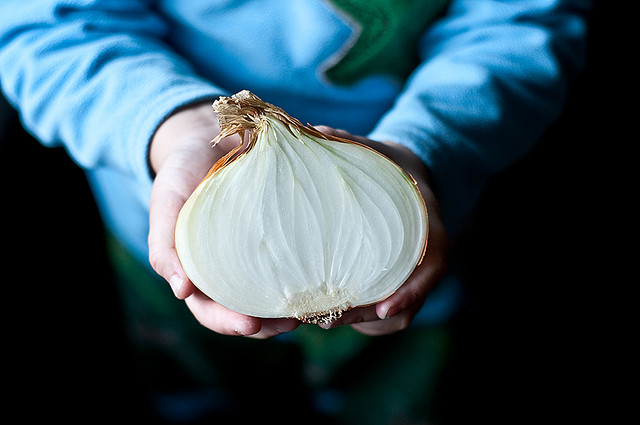
As for the long answer, I refer to the poem by Naomi Shahib Nye. I can relate to the poem on the surface level, as can anyone who cooks (especially health-conscious food). Onions are in nearly every dish I make – sautéed greens, omelets, casseroles, soups. I work very few recipes that don’t begin with “one medium onion” (chopped, finely diced, or sliced). As an ingredient, I have come to know the onion intimately. Its very omnipresence causes us to overlook its importance to our palates, to the fullness of flavor of much of the food on our table.

That is so often how we relate to the layers of our selves, as well. We see ourselves as ordinary, and we seem so obvious to ourselves that we sometimes forget to look below the surface. The tough papery layer of our skin remains intact even when peeling it off, when revealing parts closer to our hearts, would be in the best interest of self and/or others.

In the beginning, Jenion was the just a clever (at least I thought so) name for my blog. Over time, though, it has become my pseudonym, my alter-ego, and that part of me that remembers there are layers upon layers beneath the seemingly standard surface of my days and activities. And it is the part of me that honors the layered-ness in others as well. Am I still peeling the layers? It is in the nature of the onion.

Considering Layne’s question has brought about intense focus on the image of the onion. Almost tangentially it has occurred to me that an onion (in addition to being a metaphor for soul-searching) may be a perfect symbol of hospitality. It offers itself to us, layer by layer. It flavors our meals, it accepts our tears, it nourishes us – and asks nothing in return. The poet says, “For the sake of others, disappear.” Hospitality may not require disappearance, exactly, but it does require that one place the “flavors” (needs, presence) of others in the central, starring role. What a gift that is to give another soul – and what a joy to receive.

Tulips Rising

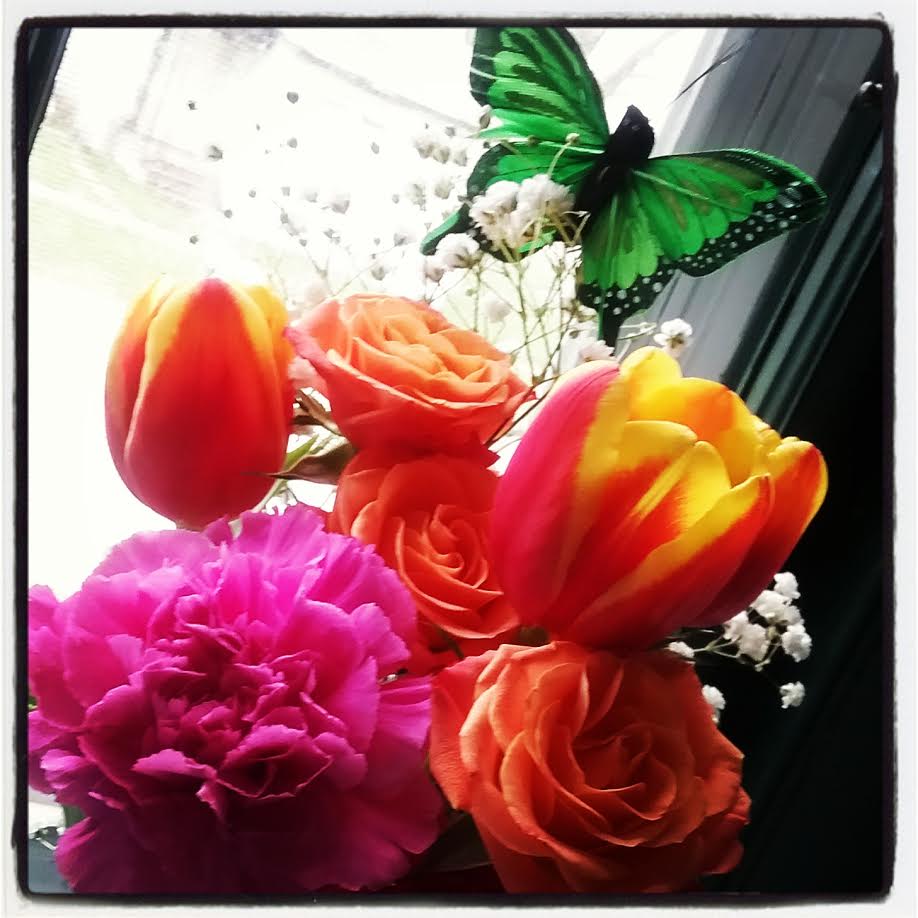
Last week a friend brought me a bouquet of flowers. There were several roses, some mini carnations, three pink tulips and some baby’s breath in the bunch. I brought the flowers home and put them in a vase on my dining room window sill.

The next day, admiring the lovely display, I noticed that it looked a little different than when I had first put the arrangement in water. Was it my imagination, or were the tulips growing? I decided it was a trick of the eye – cut flowers don’t grow. Over the next several days, though, I watched as the tulips steadily inched their way higher in the bouquet than the other flowers. Now, as the entire bouquet is wilting, those three pink tulips stand approximately 5 inches taller than the rest. Their slim stems delicately arch toward the window, the blossoms seeming to peer longingly at the street scene outside.

Turns out, unlike other cut flowers, tulips do, in fact, continue to grow after they’ve been cut! I found several online sources that say so, and though I’m still unclear as to the biological mechanism by which this happens, I find the fact of it amazing!

I look with astonishment at the tulips. I now know they not only grew, but the stems’ delicate yet decisive curve is because they are phototropic: tulips bend toward the light.

In his long poem, “The Wasteland”*, poet T.S. Eliot observes that April is the cruelest month. The wasteland he describes is the spiritual desert of modern life. This April feels particularly cruel to me – in part for the very reasons Eliot describes in his poem, exacerbated by our world’s political climate. But also this year, I am watching dear friends grappling with illness, loss, and grief. And I am deeply aware of the small windswept desert in which my own spirit is walking.

In the midst of this difficult April, I couldn’t help but think as I googled information on my extraordinary tulips, that these three pink blossoms are a perfect and lovely illustration of hope.

When we feel we’ve been cut – no longer rooted in the soil at our feet, hearts disconnected from the people and things that usually feed us, fear or grief overwhelming our energy reserves – it is easy to feel that life has deserted us. The tulips on my windowsill tell us otherwise: growth, new life, potential remain within us despite all expectations to the contrary! Growth will happen, unexpectedly, perhaps miraculously.

It is also true that deep in our hearts we carry the urge, the inborn desire, to bend toward the light. We will do it without consciously knowing, just as the tulips do. In that bending, we will eventually find nourishment – in the warm hug of a friend, in a peaceful moment of silence, in the promise of a soft spring rain.

*Click here for a nicely concise explication of Eliot’s poem, “The Wasteland”

Compassion is not a virtue

When I was in graduate school, like so many students then and now, I was poor. So when my lower right wisdom tooth became impacted, without dental insurance I had little choice but to go the the college of dentistry where I could get low-cost care from supervised dental students. X-rays were taken, and I was given two options for treatment: pull the offending tooth now as an outpatient procedure, or schedule in-patient surgery and have all four wisdom teeth removed at once. Of course, the second option, while the preferred one presented by the supervising doctor (not a student), necessitated cutting the other three wisdom teeth from the bones as none of them had shown signs of descending into the gums.

Faced with the choice of ending my current pain swiftly and immediately, or fixing the problem by experiencing exponentially more pain at an astronomically higher cost, the choice seemed clear. I chose the “easy option”, and the supervising doctor shrugged his shoulders and signed off on it. Laughing gas was administered and two dental students (my dentist and another called to assist him) reassuringly told me it would soon be over.

Obviously, I wouldn’t be telling this story if that were the case. At one point, I opened my eyes to see one dental student standing on the table above me, pulling at the tooth which refused to come free, using his entire body weight for leverage. The second student stood on the floor behind him arms and hands up – spotting him in case the tooth gave way and he fell backwards. The guy above me saw my open eyes and said, “Honey, trust me, you want to keep your eyes closed.”

What the x-rays hadn’t shown was that the roots of the tooth had hooked backwards, and as they pulled the roots were actually digging in deeper, like a fishhook.

When the carnage was finished, I was sent to the waiting room. Dazed and unsteady, I sat patiently waiting for “clearance” to leave – I had no one to drive me home and more nitrous oxide than typical had been administered. At closing time, the receptionist told me I needed to go to the check out window. Once there, I paid my 20% cash down and was told that, if I experienced any pain, I could take ibuprofen.

I didn’t feel at all well, having just been through what I could only describe as a horrifically barbaric experience. I drove, unsteadily, to my brother’s apartment, praying that he would be home. When he answered the door, he cried out, “Oh my God, what happened to you?”, grabbing me and pulling me quickly into his living room. He swiftly locked the door behind me, before ushering me to a seat.

When I tearfully told him about the traumatic experience I had just been through, he sat back, visibly relieved. “Thank God!,” he exclaimed. “I thought you had been mugged or something!!”, which explained the swiftness with which he had locked the door behind me. We went down the hall to his bathroom, so I could see myself in the mirror. My face was swollen, bruised, and covered in dried blood and saliva. I was astounded, and angry. Not one person at the dental college had blinked an eye at my appearance, nor had anyone suggested that I should stop in the restroom and wipe the blood off my face before leaving.

My brother drove me home, made sure I was able to safely clean up and get into bed, then went to the grocery store. He came back with soft foods that were on the list I’d carried home from the dental college. And ice cream – he brought me plenty of ice cream.

Throughout that horrible day, I was vulnerable. First, because I was in pain I was vulnerable to suggestion. I knew that the supervising doctor had more experience and made his recommendation for surgery based on his superior knowledge and experience. But the dental student offered me an easier and less painful option. I took it, although in retrospect, both the student and I regretted that choice.

After the tooth was pulled and while under the influence of the anesthesia, my grogginess and growing pain made me vulnerable. I docilely followed the terse instructions I was given, assuming that those staffing the clinic had my best interest among their concerns. It never occurred to me that they would just leave me sitting there, unattended and unwashed. Or that they would send me home with insufficient medication for the trauma I had just experienced. Or that they would allow me to drive myself home, if it were unsafe to do so in my state of dazed confusion.

When I knocked on my brother’s door, I was a vulnerable mess. I was in serious pain, I was exhausted, and I was already feeling that I had made bad choices. I was fairly certain I was, at that moment, incapable of taking care of myself.

All that day, I interacted with people who ought to have been both aware of and compassionate toward my state of vulnerability. People who by virtue of their roles might have been expected to be concerned about my well-being – or at least worried enough about their own professional liability to see to my safety. Of all the people I had a reasonable expectation of care from that day, the only one who responded with concern and trustworthiness was my beloved brother.

I’ve been thinking about this long ago day quite a bit the past few weeks. It sticks out in my life experience because, in general, the people I interact with, whom I expect to be trustworthy by virtue of their roles or jobs, actually do behave in a trustworthy manner. However, every evening’s news contains at least one story or reminder that this isn’t always the case. And for those in my community who don’t look like me, the possibility is greater that they will experience disinterest or even cruelty when compassion might reasonably be expected.

Brene Brown has said, “Compassion is not a virtue — it is a commitment. It’s not something we have or don’t have — it’s something we choose to practice.” I’d like to think that compassion is a commitment and a practice that I choose regularly – and not only toward those I already love. I like to think that I am especially compassionate toward those who are experiencing unsought-for vulnerabilities. But I wonder: how often have I just wanted the girl with the swollen face to go home already? How often have I purposely given the impression that my busyness trumped someone else’s need? How often have I done the barest minimum for the vulnerable person standing in front of me?

I want to be the kind of person who tucks someone into bed, then runs out to get them ice cream.


Anticipation

“If you come at four in the afternoon, I’ll begin to be happy by three.” – Antoine de Saint-Exupery, The Little Prince

Last night I had dinner with my friend Molly and her two daughters, Kate and Anne. After a somewhat chaotic time together at the table, Molly and Anne wandered away to do dishes and instigate mayhem (I’ll let you guess who did what), while Kate and I stayed at the table for a few minutes of chatting.

“I have two things I’m excited about for tomorrow,” said Kate (my 6 year old goddaughter). “Science club! And making my bumble bee punch-out with Miss Paige.”

After a brief silence, she exclaimed, “Wait! I have three things I’m excited about for tomorrow!” Counting on her fingers, Kate enumerated, “Science club, making my bee, AND baking cookies with Aunt Candy!” She smiled almost triumphantly, her eyes sparkling and her cheeks rosy with sheer happiness.

Later, on the drive across town to my apartment, I tried to think of three things I could be excited about for the coming day. “I’m excited this honking rain might stop” was about all I could come up with. It wasn’t exactly the vibe I was going for; I wanted the shiny-eyed anticipation Kate displayed, not mere relief that something depressing would cease.

The thing is, I know I’m the only one who can make that happen. Excitement and anticipation come pretty naturally when you’re a kid; you have to choose them as an adult. So I’m experimenting with choosing something to be excited about each day. And if there isn’t already something planned that fits the bill, I’ll pencil something special in – an afternoon walk, pick up some flowers at the grocery store, order a new book of poetry (Rising to the Rim by Carol Tyx, Brick Road Poetry Press is a good buy!), etc.

I’m not sure where the experiment will take me, but I can tell you this: when I woke up to sunny skies this morning, it was a lot easier to imagine exciting things were about to happen!

Choice Reflections

When I was in college, I had a job in the student accounts office. Every afternoon, it was my responsibility to reconcile the day’s receipts – to make sure that the total of cash and checks in stacks on my desk matched the ledger of payments made. It was meticulous and systematized work. And it had to happen every day. It was inexorable: I knew that every afternoon I would clock in precisely at 3:00 and spend the next two hours with my pencil, adding machine, and a stack of account ledgers.

One spring afternoon, late in my junior year, a friend convinced me to skip work in favor of a trip to the park. This was completely against my sense of responsibility. It took a lot of cajoling and needling on my friend’s part to convince me to be truant. Once I agreed, however, I felt something akin to the spring sap in the trees coursing through my own blood stream and I was lost to the glee of the moment. I had no excuse, so I didn’t call my boss to tell her I wouldn’t be in. I just didn’t show up.

We had a great time at the park – I felt a bit guilty at first, but that soon gave way to the exhilaration of playing with abandon. In that world before cell phones, no one knew where we were, no one could reach us with sober responsibilities: we were free!

Returning to campus later, everyone I saw asked where I had been. “Mrs. Peacock was looking for you. She was worried when you didn’t show up for work.” It seemed that every student on campus had reason to stop by the student accounts office that afternoon, only to be questioned by a concerned Mrs. Peacock about whether they had seen me.

I spent the next day with my stomach roiling from a soupy mess of anxiety, dread, and regret. I had no idea what would happen when I arrived at work that afternoon, but I felt certain that I deserved whatever consequences Mrs. Peacock served  up. A tiny part of me resented that this awful feeling was the price of one carefree afternoon. I  felt remorse about causing concern and extra work for my boss, along with a generalized shameful flush of self-loathing: I was a bad person for shirking responsibility – people of character don’t just skip work to have fun.

All these years later, it doesn’t really matter what happened when I was finally face-to-face with Mrs. Peacock.  Obviously, I survived.

This could be a story about learning to accept responsibility, about showing up when you’re counted on, or about facing the consequences of your choices. OR, it could be a story about throwing off the shackles, making the best choices for yourself regardless of censure from others, choosing to live life fully in the face of pressure to conform to rigid social norms.

It could be a story about one perfect, pure afternoon of sunlight and laughter at Flora Park: a last gasp of childhood before fully facing the realities of the adult world.

It might be none of those.

That is the gift that time bestows on our choices: we can reflect upon them and see them from a variety of perspectives. Many of life’s stories can be crafted with multiple meanings, constructed as metaphors for a wide range of life lessons.

It is infinitely harder to construe meaning, much less multiple possible lessons, from the choices we are living with right now. We make choices and we live with those choices. Often, we must live with those choices regardless of how stressful or difficult or unfulfilling they turn out to be. In a world rife with inspirational quotes and “blame yourself” memes (“Everything you do is based on the choices you make. It’s not your parents, your past relationships, your job, the economy, the weather, an argument or your age that is to blame. You and only you are responsible for every decision and choice you make. Period.” – Wayne Dyer) we learn that it isn’t ok to be unhappy with the consequences of our choices. Suck it up, buttercup – or make a different choice.

But what if it isn’t that simple? Just yesterday a friend commented, “…things are more stressful than I would like. And I see no way to change the choices we’ve made.” What if the choice is right, but the consequences, what we live with right now, are painful? What if, regardless of whether we chose rightly or wrongly, choosing differently now is out of reach financially, or prohibitively impactful in the lives of others who depend on us (children, elderly parents, etc.)?

Sometimes, the resources required to change the choice you’ve made are not simply inner resources – they are real resources you don’t have – like money, time, or knowledge. Lack of those resources might be insurmountable in this moment. What now?

These are the places where we get stuck, and there are no easy solutions for getting unstuck. Since there are no easy solutions, perhaps it would be best if we merely tried to withhold judgment – of ourselves or of others. From the outside, life might look static, like we are simply living inside the painful choice we’ve made. But on the inside, what if it could feel like we’re proactively holding space for what will emerge? If we replace self-loathing (the roiling stomach of anxiety, dread, and regret) with self-loving-kindness, with compassion, for the flawed, human person who made these choices?

Eventually, someone will emerge from the painful choice-cocoon we’ve constructed for ourselves. There will be time, then, to craft meaning and construct metaphors and life lessons; to articulate how our choices helped define the someone who emerged. Clarity tends to come upon reflection rather than in the immediacy of now. And because the attribution of meaning is one of – if not THE – great gifts of time, we have to wait for it. It can’t be rushed.