Dare to be powerful.

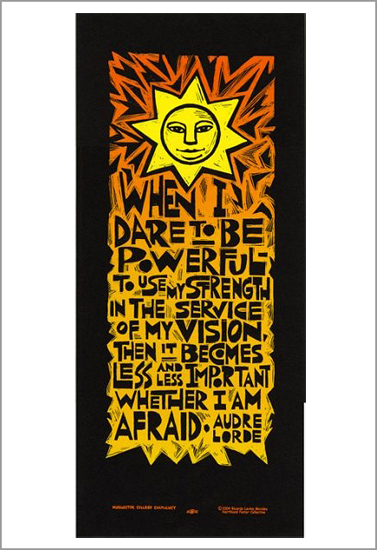
When I dare to be powerful…

Mostly, I forget that I have power. I forget or stop believing that I have volition, choice. What I remember is what we were all taught to remember: to follow the rules, to play nice, to do what I’m supposed to do or have been told to do. I don’t take issue with having been taught these things – they are one part of the equation of being a person with character and integrity. But there is another piece we should all have been taught – that part of being an adult of character is knowing when and how to break rules that are inappropriate, to play hard when it is called for, to say “It is MY responsibility to decide what I’m supposed to do”. The rare occasions when I dare to be powerful truly require every ounce of emotional strength I can muster, to go against the programming of my youth. However, I’m beginning to learn something important – like all muscles, it gets stronger when used. The more I exercise my power, my choice, my voice, the more powerful I become.

To use my strength in the service of my vision…

My vision? To use anything in service to my vision, I need to have a vision. Friends, for so many years I confused “vision” with “fuzzy daydream about the future”. They are, unsurprisingly, NOT the same! What differentiates a vision, for your life and/or the world you hope to live in, from a daydream? One, steadfastness. You have it and are able to hold it in front of you. Two, actions. You are able to identify – and TAKE – steps necessary to achieve the vision you steadfastly hold before you. Three, a convicted heart. Each step you take convinces your inner being that you are moving in the right direction, no matter how hard or how much it requires you to exercise your power.

Then it becomes less and less important whether I am afraid.

Because I AM afraid. Afraid I’ve made the wrong choice, chosen a vision that wasn’t my highest calling. When I exercise my power in service to my vision, I stand alone to bear responsibility for the consequences of my choosing. I’d rather blame someone or something else if it doesn’t turn out well. (But she told me to do it! I was only following orders. That’s what we were instructed to do in training. Its in the policy manual.) I like having someone or something else to blame, it feels more secure, less exposed. Really? Accepting responsibility for my own life is what makes me afraid? (Until I wrote that, I didn’t know I felt that way. Now I have a mental picture of myself, the “cheese” standing alone, quaking in my boots.)

However, as Cheryl Strayed says in Wild, fear is a story we tell ourselves. We can tell ourselves a different story – one in which fear is less significant because we are using our power in service to something important. We can tell ourselves an empowering story. We can tell ourselves, “I’m not THAT afraid.” (True story: I once talked myself out of a panic attack while driving cross-country alone by telling myself this story over and over – ‘The sun is shining. I am well. I didn’t run over the turtle. I will be safe.’ The only parts I knew for sure were true were the shining sun and the lucky, still alive, turtle.)

What is so important that we should practice using our power in service to it? What is important enough to teach ourselves the contours of courage (which, contrary to some inspirational quotes, doesn’t come naturally to most of us). Simply this: to be who we were meant to be. To live the life we were born to live. That is the ultimate personal responsibility we bear – to be fully the unique and sacred persons we were created to be. When we dare to be powerful, to use our strength in service to our vision, fear becomes irrelevant – still painful, still hard – but irrelevant. Because what is relevant is the vision we are bringing to life in our lives and in our world.
Learning to Shift

I wheeled it into the shop before work on Monday morning, July 2nd. I remained stoic as the guy enumerated the items that needed to be repaired or replaced. As the cost rose I interrupted him to ask, “Bottom-line it for me – will it cost less to repair this one or buy a new one?” He laughed, assuring me the repairs would fall well short of the price of a new bicycle. I was still holding my own as he consulted a calendar on the wall and said, “I can give you a guaranteed pick-up date of the 13th.”  And that is what brought the tears to my eyes.

Two weeks without a bike in early July when one is training for RAGBRAI is an eternity. At least it is for me – I’m still trying to make up for forty years of inactivity, carrying 50 pounds I should have shed by now. And it was just one more crappy thing on top of a bunch of other difficult things that have made this summer one of stress and anxiety. The one thing that hadn’t, till then, been stressful (except for the two crashes that led to the extensive repairs) was cycling. I was finally getting the hang of shifting to maximize the usefulness of 21 gears. Hills were no longer daunting. Well, not completely daunting. Even crashing had added to my confidence – I got right back on and rode 18 miles, didn’t I?

Anyway, later on Monday I lamented to a friend that I would have to cancel plans for a 4th of July ride out to Ely, and she promptly offered to lend me her bike. I gratefully accepted the offer, and later that night, she dropped it off at my place: bright blue, low, wide handlebars and the fattest tires I’d ever seen. The bike turned out to be specifically engineered for beach riding. I recognized the brand, a nice bike. But not intended for the type of riding I do. Six gears, the lowest of which required the level of exertion I usually used for riding along straight, flat land. Hills were only possible if I stood to pedal, a skill I had hardly used, much less perfected. I shifted gears, and they shifted again on their own, often slipping out of gear randomly. Occasionally, the chain fell off. I learned to enjoy the feel of riding closer to the ground, of the easy manueverability of the wide handlebars, and, yes, even the burning in my quads and hammies.

And then the unthinkable happened. The loaner bike broke and was unrideable. That day’s ride ended in a two-mile walk, pushing the bike along beside me. In 105 degree weather, midday. But the loan and riding of the beach bike had done more for me than build up some new muscles and develop my hill-climbing skills. It had reminded me that I had resources, support, people to help me. So, even before I showered after the long walk home, I was on the phone to another friend, asking if I could borrow a bike from her family.

I picked the big chrome men’s Huffy. Taller than my bike, with a strangely tilted saddle, six speeds but the lowest speed was more like the “granny gear” on my bike. I expected a less difficult transition than I had experienced with the beach bike. But, no, it was not meant to be. At the beginning of a 40-mile ride, I put the new loaner through its paces, and immediately discovered it was incredibly difficult to shift gears. In fact, I wrestled with the handlebar shifting mechanism for a full 30 seconds before I could get it to shift out of 4th gear. First gear, granny. Second, super-easy-almost-granny. Third gear, a grinding clicking sound that did not inspire much confidence. 4th gear, where it had been stuck, wouldn’t work and now ground until it automatically found 5th gear. It was clear to me that 4th was where I wanted to be, but 5th was where I would do my riding. By the tenth mile, I was aware that my knees were not enjoying the added strain. However, it was easy to take the hills, and I figured I could tough it out. And I did, including the two miles I rode without glasses when I lost the lens of my prescription sunglasses.

I’ve learned a lot in these two weeks of my bike being in the shop. Valuable lessons, not the least of which is to take care of my bike and keep it in good repair. More important, though, I’ve learned:

  • We all have plenty of gears, but most of us discover a sweet spot and pretty much stay there. Sometimes, it becomes so ingrained, it’s difficult to shift into a new or different gear. We feel stuck when we try. If we shifted more frequently, and not just when it was forced upon us, we’d find the whole process would go more smoothly and comfortably.
  • And about that “sweet spot”. If we stay in it, rather than try the other gears available to us, we don’t develop skills or new muscle. We just get more efficient at what we already know how to do. Sometimes, stasis is what we’re after; however, growth is both more challenging and more fun.
  • Hills. Every life, every ride, has some. How we handle the climb – not the equipment we use – is what reveals our character. Its easy to psych ourselves out before we start the uphill, to think ourselves into failure. It’s even easier to let ourselves off the hook when we have something outside ourselves to blame (Really? A beach bike is NOT intended to do this…) The truth is, hills are conquered by perseverence and discipline applied with a dash of positude – by internal qualities, not equipment.
  • Equipment may not be what conquers the hills in life. But it does help to have the right stuff in good working order. Take care of what you have, pay attention to what it needs, lube it and wipe it down when necessary. Treat your equipment with loving care and attention, people!
  • Even a small adjustment can bring big changes. Just ask my quads. Shift your perspective and you work differently – you will feel and see different things.
  • Wide handlebars = open arms.This can make you feel vulnerable until you get used to them. And then you just feel open. Open and ready to embrace new experiences.

Keep on dreaming, even if it breaks your heart

In the early 1980s, I wrote a poem about driving around the deserted city streets of my home town at 3:00 a.m. on the 4th of July. No one but me ever really liked that poem. It was a snapshot of a moment in which I was consciously aware of my own being. I was fully in the moment, though it was a truly unremarkable one: two people, a pack of cigarettes, a Chevy van, a dying blue collar town.

I remember thinking, self-consciously, that it was like we were living in a Springsteen song. But I also remember thinking that, someday in the distant future, I would look back at that particular moment and be really glad for it. Glad for the friendship, and the cool night breeze off the river, and for the opportunity to really know where I came from. Now, decades later, I do remember, and I am glad for all those things.

Tonight, 4th of July 2012, I was driving home in the evening light, too hot in this heat wave to have the windows down. I haven’t smoked in decades, nor have I lived on the mighty Mississippi since the last millenium (and my hometown refused to die; in fact, is currently experiencing a renaissance). I was thinking about past Independence Days, when I heard a song on the radio that imposed itself on my conscious mind and drew me out of my reverie. It’s a song about a kid falling in love with music, and dreaming of creating a life playing and singing. The repetitive lyric is, “Keep on dreaming even if it breaks your heart.”

Keep on dreaming even if it breaks your heart.

I’ve written before about the distinction Parker Palmer makes between a heart breaking into pieces, and one which breaks open. Beauty and memory can both be occasions of breaking the heart open. As I listened to this song on the radio, I realized that dreams can, as well.

When I was a kid, I had a recurring nightmare in which nothing happened other than the tragedy that my siblings and I all grew up and stopped living together. I would wake drenched in tears. Ever since, I have had a dream of home which includes roots deep in a community, friends and family surrounding me, a house filled with love and laughter. I have realized all the pieces of this dream in my life, though never the whole. In lonely moments, this breaks my heart in pieces. Almost always, though, those moments are short-lived. They give way to the “broken open” heart. The heart that welcomes people into my life joyfully, the heart that fills with gratitude when I am welcomed.

We all dream of loving and being loved. Again, this dream causes many moments in life in which we feel broken apart. And then there are those moments when we become present to the ways our hearts can be broken open – open to capacity, open to realignment, open to acceptance. I had one such moment a couple of weeks ago while visiting the Santuario de Chimayo in New Mexico. I found myself taking a pinch of the “holy mud”, famed for it’s miraculous healing powers, and smearing it over my heart with a prayer for my willingness to remain open to this dream. And a second prayer, to remain open, in gratitude, to the ways the dream is already fulfilled in my life.

This morning, I stood in line for a pancake breakfast, an annual fundraiser for the Ely, Iowa fire department. Behind me stood a group of older people, most in their 70s and 80s. They were talking about all of the fun they were having these days: volunteering, getting together with friends, keeping busy. One woman said, “I could stay home feeling sorry for myself. But I’m not going to!” It was a slow moving line, and the group kept all who stood around them entertained. When they discussed whether anyone was attending the evening fireworks, one gentleman (who had proudly proclaimed his age as 92) said, “Nope. After this, we’re going home and making our own fireworks.” Everyone, including the eavesdropping bystanders, laughed aloud. I found a new dream taking shape in my heart – the dream of a life well and truly lived to its very edges. This is a dream that requires effort and choice, no matter what happens in life to break your heart.

Some dreams stay with you forever
Drag you around and bring you back to where you were
Some dreams keep on getting better
Gotta keep believing if you wanna know for sure…
 
…Keep on dreaming, even if it breaks your heart.
 
(You can check out the music video of the Eli Young Band performing “Keep On Dreaming Even If It Breaks Your Heart” here)

The Sunday Roast: Guest Post by Susan Stork

When Sue and I met, in graduate school at The University of Iowa, we kept trying to figure out how we knew one another. Eventually, we came to accept that while we had never met before, we were clearly meant to know one another in this life. We have been friends and professional colleagues for 26 years now, and the things we could share about each other…well, I’ll leave it at that! Trust is a huge part of this enduring friendship! I am truly excited to introduce you to my friend, Susan Stork!

Growing up, I didn’t have much confidence in myself or my body.  The reasons are immaterial at this point, but suffice it to say that I was awkward, and seemed only to reinforce that when I tried to do things that others did very naturally.  As a result, I tried to avoid doing anything remotely challenging – like throwing a ball, doing a sommersault, playing dodgeball or dancing.  It’s a wonder I ever learned to ride a bike!

Once when I was 8 or 9 years old I was rollerskating on the sidewalk in front of our house when I hit a crack where the sidewalk had heaved up.  I hit the pavement so hard it knocked the wind out of me.  My dad saw it happen and ran over to pick me up.  I can still remember the panic of being breathless and the shame I felt about not having seen the sidewalk crack.   That lack of confidence only increased throughout my childhood.  I was the uncoordinated kid who was picked last for team games at recess, and while I learned to swim, I was anything but smooth in the water.  At school dances I don’t know which I feared most – not being asked to dance or being asked to dance!

There were brief hints of the physical gifts I would later discover I possessed.  After high school graduation, I took a trip to Rocky Mountain National Park with a friend and climbed Long’s Peak.  We started in the dark of early morning (so we could be down before afternoon thunderstorms were a risk) with little more than some advice from hikers we’d met the day before, a flashlight and some water.  We didn’t “summit” – altitude sickness leveled us “flatlanders” – but before we turned around we knew we had done something physically challenging in getting to around 13,000 feet in elevation.  The peak is 14-something.  Not bad for a couple of out-of-shape Midwestern girls whose only prep for the trip had been hours of dreaming during breaks in band practice our final semester of school!  What we lacked in skill, we made up for in endurance.

Miraculously, I had learned to ski in high school P.E. class at our local ski hill, and it was skiing that provided the enticement to go to college in Montana. I loved the active, outdoorsy, and athletic vibe in my environment. Maybe I hoped some of the athleticism would rub off on me…?  I became a good skier during those years, but surprisingly, that didn’t bolster my confidence in my body.  I continued to think of myself as clumsy, soft and weak.

A few years later while in graduate school, my advisor asked me to be on the staff at a summer leadership camp.  Her confidence in my academic and social skills was encouraging, but I was worried about embarrassing myself if I had to do anything too physical.  When I arrived at the camp, I was asked to fill in for a last-minute staff resignation to team-teach a group of about 40 high school freshmen and sophomores for the two-week session.

One of the lessons on teamwork was to be conducted on the camp’s challenge course or ropes course.  This activity presents small groups of people with controlled physical challenges at a series of stations, each with a different goal and many potential solutions.  The learning comes as group members identify potential solutions to the “problem”, recognize and utilize each other’s strengths and weaknesses, and encourage each other to trust that the group will respectfully support each individual’s effort and contribution to the task, regardless of the nature of that effort.

Ropes course day was anticipated by campers and staff with both trepidation and excitement. I was so nervous I was unable to eat breakfast that morning.  A lifetime of angst, shame, and fear about my body and its shortcomings was about to be laid bare to a group of kids, a co-teacher and the ropes course staff.  I considered not going, but only briefly.  I felt obligated as a leader to demonstrate my faith in the power of teams, so I went.  What I learned about teams and about myself that day altered my confidence in ways from which I am still reaping the benefits.

I don’t remember much about that morning, except the station that required us all to cross an imaginary river full of piranhas using nothing more than a series of tires hung by ropes and suspended from a cable.  The first step was to launch yourself from a platform on a knotted swinging rope, and grasp the first tire.  I immediately slipped off the rope and into the “river”.  The entire team goes back to the beginning when one person falls off the course.  But somehow, my team supported me emotionally, got me back on that platform, and when I launched the second time, one of my teammates was there to hoist me up by the back of my pants onto my tire, while another person held his tire steady.

I don’t remember getting across the “river”, but I do remember talking about what that support had felt like as we de-briefed.  For the remainder of camp, whenever I was free, I was at the ropes course helping other groups through their adventures and encouraging the kids in whose eyes I recognized that familiar mix of fear and shame.  By the end of the week I had shimmied through a web of ropes, balanced on a log see-saw, climbed telephone poles and fallen backwards off a platform into the arms of a bunch of kids below.  On purpose.  More than once.

Now let me assure you, I was not a latent athlete waiting to come alive.  I was, and still am, kind of awkward at a lot of physical things.  I still hate dancing.  I still have a rotten throw.  I’m still not coordinated well for things like team sports.  But I am strong and I don’t quit.  I rarely back away from a physical task.  I can push wheelbarrows loaded with rock, carry heavy boxes and furniture up flights of stairs, grow things, stack hay bales and step safely from a dock into a boat.  I can assemble IKEA furniture, kayak two miles across a lake and back again, climb up and down a ladder all day to paint, nail shingles to a roof, and dig out old tree roots.  I like to ride my bike.  I like to train with weights.  I am proud of what I can do with this body.

I will not likely run a marathon, or dance gracefully, or golf.  But that’s ok because I can help the marathon runner unpack boxes and be completely settled in her new home in one day.  I can plant and grow a flowering landscape that the ballroom dancer with a brown thumb needs only to water to enjoy.  And I can skillfully drive a cart so the golfer can play 18 holes despite painful arthritis.  Yes, I am proud of this body.

My ropes course experience happened 26 years ago.   In the years since, I have led countless groups of students through challenge course activities in the name of teambuilding.  I am always conscious that on that day, in that group, there is someone who feels about his or her body the way I did about mine.   And I hope to catch his or her eye at some point and silently, confidently, offer the strength in my body to help them swing to that tire and grasp the power, as yet undiscovered, in her own body and mind.

Words That Changed My Life: Hubris

For much of my early life, I was not particularly self-aware. Self-conscious? Absolutely. But I had not yet learned to see myself, my actions, my interactions with others from an analytical perspective. I simply could not stand outside myself and review with honesty my actions, motivations, or emotions. As a result, I was often taken by surprise, both by my own choices and by the reactions of others toward me.

My junior year in college, I took a Greek Mythology course as an elective. The course was taught by a nun who had spent most of her career teaching in grade school. We were horrified, on the first day of class, to be told we must respond in unison to her questions. We were also given worksheets and made to place them in exact order in our notebooks at the exact same moment, so that the noise of opening our required 3-ring binders (then snapping them shut) would take place all at once – no stragglers allowed. We were required to turn in the binders weekly. Misplaced worksheets resulted in deducted points. We began the semester hating that we were being treated like children. After all, we were confident and competent adults.

Through the course of the semester, though, my classmates and I grew to love Sister’s techniques. First, we decided to have fun with the novelty of returning to our third grade classroom structure. Then, the sheer amount of information we were actually learning – and retaining – became fun in a different way.

One concept that has stuck with me from that course is the idea of hubris. “The word was used to refer to the emotions in Greek tragic heroes that led them to ignore warnings from the gods and thus invite catastrophe. It is considered a form of hamartia or tragic flaw that stems from overbearing pride and lack of piety.” (eNotes: Guide to Literary Terms) Hubris: on one level I kept the word in my arsenal because I love words, and this is a good one to pull out in arguments and essays.

On another, deeper, level the idea that overbearing pride could be a tragic flaw was working on me. How would I know if I suffered from this? I mean, does anyone with this problem know they have it? Or are they all so arrogantly sure of themselves that they would never recognize their own puffed-up sense of self? The more I thought about it, the more relief I felt. After all, I was the opposite of self-confident – I was fearful in every way. And I was sure that everyone could see my inadequacy, despite my efforts to cover it up.

Pride, as they say, cometh before a fall. I reached a point in my life when it occurred to me that I had been allowing my life to happen to me, rather than actively living it. Of course, this realization came about as the result of pain and unhappiness that finally became too great to ignore. I think for most of us, these emotional growth spurts are often the result of difficulties, challenges, sadness rather than of happy times. The rawness of our emotions can cleanse away the lethargy and inertia of daily life, and we see ourselves more clearly.

What I saw in myself was an unbending pride that approached the level of tragic flaw. My pride didn’t stem from arrogance and overblown confidence. Mine stemmed from that very sense of inadequacy rooted deep in my psyche. My pride did everything it could to hide my unworthiness. I never wanted anyone to know I was clueless in a new situation, so my pride prevented me from asking questions. I never wanted to appear as stupid as I felt, so my pride kept me from venturing opinions or seeking out mentors and teachers. I certainly didn’t want anyone to feel sorry for me, so my pride prevented me from reaching out honestly and letting my friends know I was in pain, or lonely.

In Greek mythology, the story of Icarus is often used to describe the concept of hubris:

The main story told about Icarus is his attempt to escape from Crete by means of wings that his father constructed from feathers and wax. He ignored instructions not to fly too close to the sun, and the melting wax caused him to fall into the sea where he drowned. The myth shares thematic similarities with that of Phaëton — both are usually taken as tragic examples of hubris or failed ambition — and is often depicted in art. (Wikipedia)
 

Presented with hubris in the context of my mistaken pride, which prevented me from fully engaging with others in my life, or with that of Icarus, I now see the second manifestation as preferable. At least Icarus’ pride led him to strive for something greater with his life – rather than using pride to keep life small and crabbed into a safe little box. I can’t say with utter assurance that I have mastered my tragic flaw. But I can say that, finally, I am self-aware enough to be able to see my choices and behaviors in light of how they either are filling my life or depleting my life – and then to take corrective action. Sometimes, I am even able to reflect on possible choices and take the best path first. And that, friends, is worth suffering a blow to one’s pride.

Words That Changed My Life: Intention

Note: This is the first in a series exploring words that have had an impact on my life, either by changing my perspective or by helping me to grasp a concept I had struggled to understand. The series will appear periodically, interspersed with other posts. For those of you thinking about a guest post for the “Sunday Roast” series, one option is a post about a word that changed your life !
 
From the gospel of John: “In the beginning was the Word, and the Word was with God, and the Word was God. 2 He was with God in the beginning. 3 Through him all things were made; without him nothing was made that has been made. 4 In him was life, and that life was the light of all mankind. 5 The light shines in the darkness, and the darkness has not overcome[a] it.”

I am a word person. I always have been, though for much of my life I relegated the power of words to my heart – by which I mean that I understood their power to affect my inner life and to stir emotions, but I didn’t fully comprehend them as vehicles for the outward thrust of energy. I didn’t know that some words could affect my daily experience.

In graduate school, we spoke about the need for educators to create “intentional” programs, designed to challenge and support our students in their personal development. Rather than throwing together a hodge-podge of experiences, think and plan carefully with a particular goal or goals in mind.

Goals. I learned how to write them, how to operationalize them, how to assess progress toward them. I just couldn’t get the hang of actually having them.

And then the idea of “Intention” (and it’s sister concept, “The Law of Attraction”) exploded on the scene. The New Age Movement meets Quantum Physics. I watched “What the Bleep”, read Lynn Grabhorn’s “Excuse Me, You’re Life is Waiting” – there is no shortage of material out there which says that we can create our own reality and attract into our lives the things we want, by “setting our intention”.

I liked these ideas, despite the fact that much of what has been written is tinged with magical thinking and focused on achieving material abundance. Although I’m not bent on earning my first million, I am attracted to the concept that it might be up to me whether any day is a good day. I have tried several experiments with the idea of intention. One notable example ended up with me getting free meat at the grocery store – it was a fun experiment, but the free meat has not been a replicable outcome.

What has and can be replicated is the intention to manage my own choices such that a positive outcome is practically guaranteed. I remember the first time I approached an annual event, one which I had annually dreaded, with this specific intention: “Today, I will be calm and open to every person who approaches me. If there is a problem, we will resolve it with compassion and respect.” I wrote the intention down, and said it aloud. Each time throughout the day that I began to feel anxiety or my composure began to slip, I would remind myself of the day’s intention.

In the end, it was a great day. In the end, I learned that the power of intention isn’t magical at all. It simply requires two things: the intent (in this case a short-term goal for the day) and the willingness to remain consciously focused on aligning your behavior with that intent. Simple, but not easy. Not easy, but what life-changing behavior ever is?

This may be one of the reasons the Gospel of John is my favorite. It’s first sentence “In the beginning was The Word” is perhaps my favorite sentence of all time. Then: The Word was with God and was God, and it was focused outward with a mighty intent. God’s intention created everything – how amazing and powerful is that? And the light created by that intent has not and cannot be overcome by darkness.

In my life, I try to use intention to reflect some small measure of that light. Simple, but not easy. Some days, I set my goal/intention for the day and my focus never wavers. Other days, it unravels or comes apart in shreds as I lose control of my attention, I get pulled in too many directions, I am unable to stay centered. As with every change we try to make in life, practice is called for and perfection is a million miles away. But I have more successfully intentional days now than I did five years ago, or five months ago. And that has, indeed, changed my life.

What Defines Us

I didn’t post a weigh-in today because I didn’t want to share my current weight. The important thing about that weekly snapshot of my scale has always been, in my opinion, the concept of honestly sharing both the ups and downs of my path with others who might struggle with things in their lives, too. Today, I feel like copping out.

For a month now, my time and attention has been elsewhere than on my weight. In some ways, it has felt good to let my guard down a bit, to worry about other things, to enjoy other things, to just not let the central factor of my life be the scale. In other ways, I have felt stressed and out-of-sorts, with various life issues pulling at my focus.

I haven’t made horrendous choices in that time. I’ve continued to work out. I haven’t suddenly begun eating between every meal, or eating outrageous menus or triple helpings. I haven’t given in to temptations such as the Taco Bell drive through to try one of those Dorito-shelled tacos I’ve seen on TV.

But the scale has inched up anyway.

One of my favorite television moments ever was on the Roseanne show. The family is in debt, having trouble paying their bills, and at the end of the episode their electricity is shut off. From the dark screen, we hear Roseanne’s voice, “Well, middle class was fun.” I feel a little bit like that today, “Well, One-derland was fun.”

Except for this: I can choose differently.

Not every family has control over the financial vicissitudes in life. But each of us has control over where we place our attention, the choices we make on a daily basis, and the attitude we bring to each day.  These are the real lessons I’ve been learning via the process of losing weight. And while I can’t say the scale doesn’t have an impact on me, I can truthfully say my weight no longer defines me.

Because I am choosing to define myself.

One of the lessons I am still learning is to never underestimate the power of that. We live in a world that wants to define us externally (using standards set outside ourselves) – by our looks, our weight, our gender, our sexual identity, our politics, our socioeconomic status, our race…so many factors. But none of these is who we are, no matter how central that factor is to our lived experience. Who we are depends on us.

With that in mind, there’s one other thing I’d like to share with you this morning:

Drinking The Kool-Aid

The day of my Nana’s funeral was the first time I saw my father cry. It was a shock to me, which is probably why I remember it so vividly. That, and the incident with the kool-aid.

After the funeral, relatives and friends gathered at our house. For us kids, it was like the best party ever – my dad’s sister Rosie’s nine kids were there, five or six of us (can’t remember which siblings had been born by then) and other assorted cousins and kids. We were playing outside, running around sweaty and thirsty and begging for something to drink. So my dad made a pitcher of kool-aid. But as we stood in a line on the back porch ten or so kids realized at the same moment that something was terribly wrong. The kool-aid was beyond tart. Dad had forgotten to add sugar. I remember suggesting we should just go ahead and drink it, rather than bother my Dad with our complaint. That idea was vetoed by the other kids. But I couldn’t get the image of my father’s grief out of my head. It seemed like the most thoughtful thing I could do was drink that terrible, sugarless, beverage.

In November of 1978, when I was 17, Jim Jones and members of his People’s Church committed mass suicide in Guyana by drinking poisoned kool-aid. This is the origin of the phrase, “drinking the kool-aid”, generally meaning blind, uncritical faith in a leader. I am not using the phrase in this sense, though perhaps my use is a distant relative. Instead, I am talking about those times in life when what is before us is a decision to either do or not do a bitter, unsweetened thing. Sometimes, like on the day of my Nana’s funeral, we want to be kind and thoughtful, but there will be no true benefit for anyone if we drink (though there may be real cost involved). At other times, we do the hard or bitter task because the benefit to others outweighs the cost to us. Learning to differentiate between these two types of occasions is an art form.

How do you know, when circumstances are murky or clouded by emotion, whether or not to drink the cup set before you? How much effort do you put forth for others in your life? How many contortions do you make in your day to do what you think someone else wants or needs? These are difficult, sometimes gut-wrenching questions.

I’ve developed a few guidelines that are, I think, serving me pretty well.  They were developed after years in which I often found myself bitter because I was making the effort to drink the kool-aid, yet it was going unnoticed and/or unappreciated by the person for whom my effort was expended.

  • First, I have to ask myself: Do I have a hidden agenda? Do I want to do this as an expression of my care for the other, or is it an attempt to “make” another person love me, appreciate me, beholden to me? Believe me when I say this is one of the hardest questions I regularly ask myself. It is hard because I want to lie to myself. I want to say, every time, that I am only thinking of someone else’s happiness. I want bluebirds to fly out of my mouth because my soul is just that pure. However, if I am drinking from the bitter cup because of a hidden agenda, the bitterness becomes palpable in my reactions to the other person. Ever hear of a martry complex? I am susceptible to this failing, and I truly hate seeing it in myself – so much so that I’d rather be honest with myself about my agenda!
  • Another important question: Will my doing this be meaningful to the other person? I have been known to go to every store in town to get the exact gift I think will be perfect for someone. This is a process which gives me happiness, and whether the other person ever sees or knows the effort is incidental to my enjoyment. I am motivated by my love and the sheer joy of expressing it in this manner, and I can sense those lovely little bluebirds flitting around my altruistic head. There are times, however, when a desire to please becomes a crazed nightmare. One time a friend who rarely asks for help told me she was feeling overwhelmed and could use some help that would necessitate my availability for a Saturday. I was scheduled to work that Saturday, but didn’t want to say no in my friend’s hour of need. I rearranged my schedule, calling in favors and making deals with several other people in order to be free to help my friend. Saturday morning, just as I was donning my superhero cape, my friend called to say that she had changed her plans and didn’t need me after all. My ego was deflated, I was angry, and my feelings were hurt. Didn’t she realize the effort it took to come to her rescue?! But the failure was mine – I hadn’t been honest (“Oh, no, I’m free on Saturday”), I hadn’t been direct (“I am scheduled to work, but if this is really important to you, I’ll make some calls and switch things around”) and I hadn’t asked myself whether I had a hidden agenda (SuperJenion to the rescue!).
  • A final question that I’ve learned to ask is: Does this really matter to ME, or am I doing it because I think I SHOULD? If the answer is that it matters to me, great. I do it. If the answer is “because I should”, I need to dig a little deeper. So the next question needs to be: Why should II am not one of those people who advocate never doing things because we think we should. There are times we SHOULD suck it up and do things, whether or not we want to or they are meaningful to us, because they matter to others to whom we are committed. If this is one of those moments, knowing it goes a long way in adjusting my attitude toward the positive. But sometimes I say “I should” when the reality is it doesn’t matter. That “should” is coming from a place of insecurity – I am afraid that someone else will be angry or not love me if I don’t say yes. So, I drink the stanky kool-aid from a place of fear. I’m the only one who thinks drinking it is a sign of love. Often, no one else really even notices what I agonized over. And then, we’re right back to that icky martyr complex.

The story of the kool-aid that wasn’t “cool” has become a legend in our family. Told and re-told with mirth over the years. For me, it is a reminder that sometimes our kinder impulses can lead us to make empty gestures. All of the adults, including my Dad, found humor in the reactions of their children to the sugarless kool-aid. I needn’t have worried so much about further burdening him in his grief, nor did I need to be the lone child choking down a glass of foul liquid. In my adult life, being clear with myself about my motives and the actual needs of my loved ones, instead of acting from misplaced obligation, insecurity, or hidden agendas has saved me from a great deal of bitterness and martyr-ing. Besides, I’m sure we can agree, a nice cold glass of sweet kool-aid with loved ones after shared effort is truly good for the soul – and what it was all about in the first place!

Gutcheck 2012

Last night I was invited to participate in an annual event: Gutcheck 2012. The event begins at The Irish Shanti in Gunder, IA with a feast – each participant devours a Gunderburger (a 22 ounce burger with fixin’s, click here for photos). After eating the Gunderburger, participants go for an 8-mile run through the nearby countryside. The 8-mile run is followed by the ingesting of a giant tenderloin. As the invitation says,

“Gunderburger + 8 miles + Giant Tenderloin = Gutcheck. Take as much time as you need, but you can’t yak.”
 

While it may sound strange, I have to say I’m honored to be invited. The crew who plans and participates in this event are all alumni, all were student-athletes (track and cross country), and all are decades younger than me. And while I am not a runner, and not likely to begin a running career with Gutcheck 2012, I have to say the concept appeals to me.

Not the part of the challenge that is all about not throwing up. But the concept of an event which requires you to push beyond the limits of what you have thought yourself capable of doing. That kind of exercise is valuable in many areas of life – not just the novelty run arena. Just imagine…

  • …if you pushed your limits by asking for what you want. In your job, in your relationships, from God. So often, I find myself holding back from articulating what I want – whether what I want is something I’ve already earned, something that should be accorded to anyone with whom we interact, or is simply something I want. Where is it written that wanting things is inherently wrong or selfish? Or that in order to have the things we want in life we need to wait in silence for those things to be given to us? I’ve come to believe that asking is often an eye opening experience for both parties, in part because until we say it to someone else, we often don’t know for sure what it is we want. But also, others cannot assist us in achieving the things we want if they don’t know or we don’t ask. And I have truly found that, by and large, people actually want to assist others in getting what they want in life.
  • …if you pushed your emotional boundaries and reached out to new people and new kinds of relationships in your life. How might your days be enriched by including a diversity of ideas, styles, personalities? Pushing the limits of my openness to others has brought amazing gifts to my life in recent years. The results: incredible people, wonderful experiences, nuances of friendship and relatedness I hadn’t known were possible. It isn’t easy to maintain openness, to push emotional boundaries. After all, we set those boundaries for a reason. But boundaries are meant to shift over time, and it is healthy to test and reshape them.
  • …if in the grand tradition of The Gutcheck, you pushed your physical limits beyond your comfort zone? What might you be capable of if you got out of your head and into your body? Here’s what I’ve discovered: my body, abused and tired as it was from years of excess weight and sedentary days, is AMAZING. Resilient. Strong. And capable of more effort, endurance and courage than I ever understood.

So, I may not participate in Gutcheck 2012: The Event. (Although I’m keeping my fingers crossed there’s a video again this year!) But I think it is important to occasionally stop and do a personal Gutcheck. In what areas of my life have I allowed myself to grow too comfortable with mediocrity? In what ways can I stretch myself in order to discover something new or to enrich my days? Sometimes, we might take too big of a stretch and end up yakking. So what? Yakking happens. It may not be polite to put it in these terms, but I’d rather throw up, make a mess, and move on than not make the attempt to stretch further in my life.

Goodbye, Yellow Brick Road

Today, I want to look at the past. Not the generic past – my past.

When I was a kid, I loved the Wizard of Oz. In those days, it truly was a special occasion when it aired on television, and I watched every second – even the scary parts with the flying monkeys. Over the years, I’ve seen the story used as a metaphor for a variety of things from women’s empowerment to college graduation advice. So I’ve decided today to use it as a metaphor for my life.

Since the inception of Jenion, I have tried to write honestly about my life – “the good, the bad, the ugly pizza binges”. What I haven’t done is spend much time or blog space talking about the realities I experienced when I tipped the scales at 350+ pounds. In part, I haven’t wanted to hang on to a past self that has (literally) disappeared. But part of the reason I haven’t spoken too directly about my life as a morbidly obese person was my own ambivalence about my worth as a human being during that time period. It is hard to admit, even now, the embarrassments, indignities and huge burden of self-loathing – coupled with the disgust of total strangers – which comprised my daily life for twenty years or so. In many ways, I embodied Dorothy’s companions from the Wizard of Oz.

Like the Scarecrow, I felt stupid, and acted that way. I chose faulty logic over clear understanding so that I wasn’t required to change. Moreover, other people acted, sometimes, as if I was incapable of normal thoughts and emotions. It was a symbiotic relationship: they treated me rudely, with cruelty at times, dismissively at others – and I believed they were right to do so.  But I always had the brains to figure things out, if I chose to use them.

Like the Tin Man, I had a heart full to overflowing. I just didn’t know how to feel it or express it, so I covered it up with food, then fat. I loved. I yearned. I hoped and dreamed. I blocked those feelings and hid my heart – most of all from myself. But it was there, all along, if I only chose to feel my emotions instead of pretend they didn’t exist.

Like the Cowardly Lion, I feared everything. My own shadow was terrifying (and huge). Not to mention the things I ought to have been afraid of, like health risks and chronic pain. My fear paralyzed me from making choices, moving forward, loving wholeheartedly. But there was courage waiting, untapped, if I only decided to reach for it.

And like the Great and Terrible Oz, I was only acting a part. Hoping no one would look behind the curtain and see the creature cowering there. I didn’t realize it,  but the curtain was only fooling me. Those who loved and worried for me could see right through it. I could have pulled it back and revealed my true self anytime.

Finally, I set out on an unknown road as someone who didn’t even know herself. I wasn’t sure whether I could find the thing I was searching for, and I was terrified of bogeymen (lions, tigers, and bears are not scary to me compared with looking foolish, failing, rejection). I wore my layers of fat like Dorothy wore her Kansas naivete – for all to see, both a protection and a problem situation to work my way out of.

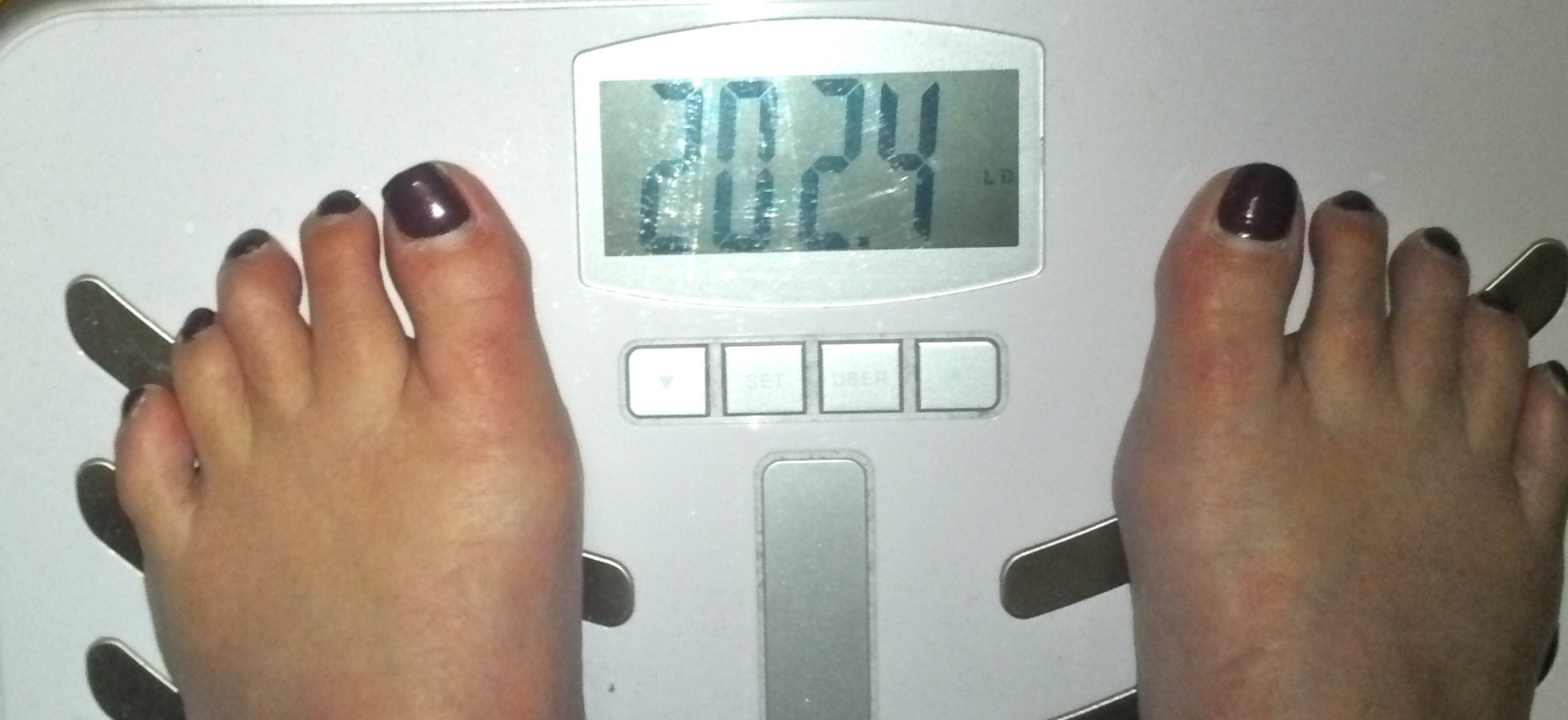
Today, for the first time, I am posting a weight with a one at the front – not a 3, not a 2.

Today, I am a much different person than the woman who hid inside that real-life fat suit. I finally realize I don’t have to revile her, hate her, deny her existence in order to become the person I want to be. I simply need to accept who and what I once was. And as I’ve watched this moment approaching it has become clear that, in order to take my life where I want, I have to say a final, loving, goodbye to that frightened fat girl. Goodbye to timid Dorothy-from-Kansas. I’m letting her go for good and all.

Standard weight charts still list me as obese. Whatever. After following the spiralling yellow brick road into “One-derland” the old thought patterns, fears, negative self-talk simply won’t do anymore. Here, I am the central character of my own life: I am Dorothy of the Ruby Slippers. I’ve had the power all along, but here is where I truly take hold of it – no more looking elsewhere for strength of mind, a stout heart, and the courage of my convictions.