A RAGBRAI Story – Part 2

(When we left the story at the end of Part I, the Mustangs were living it up at the beer tent in Homestead, Amanas: sweat-drenched but smiling, and just a little cocky about being “almost done” with the day’s ride)

And so the Mustangs mounted up and began what can arguably be called the most important part of the experience. Tricia and I decided to ride together, and this was the pivotal decision of the day for me. The ride from Homestead to Oxford, a 5.8 mile stretch, was a little hilly, but do-able. Tricia and I commented on the beautiful scenery. It must not have been too difficult a ride if we were still noticing something other than our burning quads and gasping lungs.

As we pulled into Oxford, the party was in full swing. It certainly appeared that many riders were already celebrating the completion of a successful ride. I was flagging, but surrounded by that happy, upbeat atmosphere, I felt reasonably confident I would finish. I not only wanted to finish the 75 miles, I also wanted to be able to say I rode every foot of it. I understood that there is no shame in walking up difficult hills, and that many riders do so. But I wanted to stay on my bike.

Within minutes of leaving Oxford for the last (17.7 mile) leg of the ride, I was questioning my determination. The ride from that point forward was one long, steep hill after another. After another. After another. As we approached the crest of another hill, I could hear the riders in front of me cursing, as they caught sight of yet another hill in front of them. Groaning and cursing. But I also heard a paraplegic rider pedaling with his arms, saying to another cyclist, “We’re gonna do it!”. An older gentleman, passing me by and saying, “That’s it, take your time!”. I heard Tricia, waiting for me at the top of the hill saying, “You’re doing great!”

Hill after bloody hill. I thought I was in hell. A rider passed me, carrying a passenger who was playing the guitar. An ADULT passenger, whose only contribution to the effort was music!  A guy in a cape rode by, as did a bride and groom whose helmets were embellished to look like a top hat and veil. Ok, maybe not hell exactly. More like rural Iowa on an acid trip.

Hill. After. Bloody. Hill. Partners and team members were practically pulling each other up the hills with their words of encouragement. One young girl apologized, “I’m sorry, I have no legs.” But her teammates wouldn’t hear of her stopping, and I saw her three hills later, still riding.  Solo riders were cared for, as well, though. One woman, stopped at the side of the road tinkering with her bike was asked multiple times, “Do you have what you need?”  Strangers looked on us with compassion, including a lovely family with hoses who sat at the crest of a particularly difficult hill. I begged them to spray me with the cool water. At several consecutive driveways, families were shouting, “You’re almost there! Only six miles to go!” I’ll never be able to thank any of them for helping me get through.

Riding up those hills, mostly I was just thinking, “Keep pedaling. Keep pedaling. Keep pedaling.” But it was impossible not to marvel at the people around me who were pushing through. Every shape, size, fitness level. Every age. Bike riding is adaptable to all kinds of ability levels, and people with more to overcome than weight and an inactive past were continuing on. Riders whose whole purpose was other-centered (raising money for HIV-AIDS, for a cure for Diabetes or Breast Cancer) were pushing themselves up and down those hills, too. It reminded me that the zeitgeist of RAGBRAI is part rolling folk festival and part pilgrimage. And in this reminder was the realization that I was participating in the kind of experience that, most of my life, I would only have watched from the sidelines. This wave of committed, possibly crazy, humanity helped to carry me forward when I began thinking I couldn’t keep going.

And then, unbelievably, we crested and in front of us was Melrose Avenue! I couldn’t believe it – Iowa City, about to turn the corner into Coralville, our destination. There was jubilance all around us. Waiting for the State Patrol to give us the right of way, another rider’s radio was blaring Vanilla Ice – and Tricia and I broke into spontaneous dancing astride our bikes. Someone in the crowd yelled, “You go girls!”. The State Patrol officer danced with us.

We turned into a lovely downhill run, the road lined with welcome signs from the colleges and universities with officially registered teams. And then, in the midst of celebration, the final test. One more long-ass hill. I almost cried. Other riders were giving up, dismounting in larger numbers than at any other point on the ride. If Tricia hadn’t been there, I might have been one of them. It took every last reserve to ride that hill. And it was slow going. But Tricia and I rode it together, and when I pulled ahead as we coasted down the other side, I waited for her to catch up. She called, “You don’t have to wait”, but I told her, “The hell I don’t! There’s no way I’m crossing the finish line without you.” How could I, when her encouragement and friendship had just pulled me through the last 17 miles?

The finish line was designed to look like the arched entrances to Kinnick Stadium, home of the Iowa Hawkeyes, with the road painted like a football field. Layne and Kristen, the most awesome and patient road crew ever, were waiting and watching. When they caught sight of us, they jumped up and yelled and cheered, Layne filming us coming in.

I’d like to say that I was overcome with joy, but the truth is, I was exhausted, overwhelmed, dehydrated, hungry and I hadn’t peed in nine hours. I was incapable of joy in that moment. We stopped, and waited for Layne to join us with directions for where we were meeting up with the team. When she arrived, she pointed up the hill in front of us and said, “Go up there to the second stop sign and turn right.” I looked in that direction, and to my shame, burst into tears of frustration. I said, “I cannot ride up another f-ing hill. In fact, I can’t get back on my bike.” Layne hugged me and said, “Its ok. We’ll walk together, and I’ll push your bike.”

I owe a debt of gratitude to a huge community who made my RAGBRAI experience a day I will never forget: The people of Iowa who opened their homes, hometowns, and hearts to the massive river of riders. The cyclists, themselves, who were compassionate comrades on the quest to achieve personal goals. My fellow Mustang riders (especially my girls: Sarah, Colette, Wendy, and Tricia) without whom I would surely have failed – whose love and support held me up throughout the long day. Layne (and her parents for the loan of their truck) and Kristen, the road crew who loved us enough to spend a day waiting, cheering, manoevering through traffic and congestion. They didn’t have the payoff of endorphin highs or self-congratulations at the end – just thankless jobs and a long, sweaty day. The Lange Family, who hosted a reception/party for all the Mustang riders in Coralville, welcoming stinky sweaty strangers into their lovely home.

Each person in a long list vital to the success of the whole. Vital to my success.

The community story is not a story I was expecting, because until I was there, it wouldn’t have seemed possible. There is a lot of hype and mythology surrounding RAGBRAI. Turns out, a lot of it is true. But the magic of it, in my opinion, comes down to love.

I know, some of you just groaned, reading that! Here she goes again, you’re thinking, reading too much into every little experience. I’ll accept that criticism. But I will also say that I am no Pollyanna – ask Tricia, who saw me at my absolute snarliest at the end, after successfully completing the day. Ask Layne, who saw me tensely coiled at 5:20 a.m. when I was worried about the derailers on our bikes being  smashed as we loaded the truck. No Pollyanna visible in those moments, I assure you.

However, throughout the ride, there were moments when I was able to be outside my own fear and self-doubt enough to really see the events and people around me. Those moments were emotional – and more true than the fears. At one point in the day, a rider towing a boom box passed Tricia and I, blasting Martina McBride’s “Love’s The Only House”, one of my all-time favorites. That day, I swear, love was a big enough house to shelter all 10,000 bicyclists.
A RAGBRAI Story – Part 1

A Saturday afternoon, July or August, 1978, Loveland, Ohio (just outside Cincinnati). Flipping through the television channels, my father and I start watching a documentary. It is about a bike ride across the state of Iowa – our home state, which we still love. More of the family wanders in while we watch, and by the end of the show at least my Dad and I are convinced: RAGBRAI (The Register’s Annual Great Bike Ride Across Iowa) is the coolest thing ever. We SO want to do it (never mind the small fact that neither of us rides our bikes voluntarily.)

##########

8:15 a.m. Friday morning, July 29, 2011. My friend and training partner, Sarah, and I crested a hill on Highway 6, outside of Grinnell, Iowa. Morning fog was just burning off the cornfields covering the rolling hills which spread off in every direction. We looked at each other, grinning, but also misty-eyed. A brightly colored river of people on bicycles, its current weaving and undulating, was visible for miles ahead on the pavement that lay before us. We were finally riding on RAGBRAI!

For every rider on RAGBRAI, there are two narratives: one that is purely individual and another which is all about community. The individual narrative is about the motivation, preparation, and determination required to successfully complete what can be a physically grueling test of endurance (even for someone, like me, only riding one 75 mile day of the week-long event). In all of my training rides, every mile I rode leading up to that morning’s start in Grinnell, I thought that this individual story was the story. I was completely inside my own head.  Had I progressed far enough away from the 350+ pound sedentary couch potato I once was to successfully complete this challenge? At 50? For me, this individual story is an important one – but it pales by comparison to the other narrative – the one about community that took me by surprise and brought me to tears numerous times throughout the day.

The second story began at 5:16 a.m. when I was standing in my driveway, in my bike shorts and Mustang jersey, trying not to freak out because my ride and the other bicyclist embarking with us, weren’t there yet. Then I heard a honking horn and my friends, Layne and Kristen, shouting “Yeah, Mustangs! RAGBRAI here we come! Woo Hoo!” Did my neighbors appreciate this serenade? Doubtful. But it brought a smile to my face. We loaded my stuff, and my friend Tricia’s, into the back of the borrowed pickup truck, then rendezvoused with the two other trucks loaded with our team and their bikes.

Once we arrived in Grinnell via gravel roads (the main access to town was blocked due to RAGBRAI), it was time to wipe off the road dust, pump up the tires, and meet the rest of “Team Mustang” at the park in town. Before leaving the park, our “road crew” got out the sharpie markers and wrote on our legs, telling the other 10,000 riders that I was celebration turning 50. Talk about a birthday celebration – nothing like having hundreds of birthday wishes shouted to you by passing strangers! Anyway, at 8:02, it was time to mount up and take off. We rode through town to the cheers and well-wishes of Grinnell’s citizens.

There are so many details of that day etched in my mind. I would love to share them all, but in the interest of time, I will share those which most illuminate the story about community. My friends Colette, Wendy and Tricia chose to participate on the ride primarily to join me in the celebration of my birthday. They, too, have their own individual narratives about the ride, but I know that they chose to put themselves through the experience in support of me. Sarah spent countless hours with me, the slow-but- slowly-improving rider, leading up to the day. While we were separated on the road, it helped to know that, somewhere in that sea of polyester and spandex, were people who love me.

We met up with our support team again in Marengo (the halfway point) for lunch and some much needed companionship – not to mention rest. I was daunted by the morning’s ride. Not ready in any way to give up, but very unsure if I had the reserves to finish the day. Truthfully, after the initial happiness of seeing the group together again, we were all a bit sober – having discovered that the day would be harder than we anticipated. But the hour we spent, eating and laughing on a stranger’s front lawn, reminded us that we were in it together, no matter how alone we necessarily were in pedaling our bikes. We left Marengo in a pack of matching blue and gold jerseys, to the cries of “Go Mustangs” from passing cyclists.

After lunch, I lost Tricia, who had been my riding partner most of the morning. I rode the entire first leg of the afternoon on my own. The road from Marengo to Homestead, Amanas, was a long, flat one. It wound through a valley so beautiful that I could not believe my good fortune – no hills AND the best of Iowa to look at! My spirits lifted, and I was so overcome by gratitude, I pulled out my phone and called my parents in New Mexico just to tell them how amazing it was. I wanted my Dad to know that we were right, back in 1978 – RAGBRAI is the coolest thing ever!

Heading into Homestead was a long hill, but I could hardly complain after the miles of flat terrain just completed. I shifted into low gear and took as long as I needed to crest the hill. Just as I did, my phone rang – my friends were in Homestead and waiting for me in the beer tent!

In front of the concession tents were hundreds, maybe thousands, of bikes. Some were very expensive, most had bags attached crammed with valuable items for the ride. Not one was locked. Such was the community feeling. The party in the beer tent was one of the happiest I’ve ever participated in. Not one person looked anything but sweaty, dirty, tired and completely exuberant. As the Mustang team congregated, the live band performed “Mustang Sally” for us. Amid the dancing and cheering, every 50 year old woman in the tent found me to wish me a happy birthday and offer me a drink (which I politely declined because I don’t trust myself to drink and ride). Serendipitously, I literally ran into a college friend, Sue Sweeney, whom I hadn’t seen in 30 years. But it was the hugs and congratulations of my teammates and friends that put joy in my heart. When Ryan Scheckel, who had been sleeping off the effects of the previous day’s ride (and party) finally caught up with us, proudly wearing his Mustang jersey, I thought the day was complete.

Except that we still had 25 miles to go. And the final 17 were expected to be the hardest, with over 1,000 feet of uphill climb.

(Tomorrow: Part 2)

50 about 50: Friends

On Sunday, I returned home from a 60 mile bike ride, tired, but pleased with the beginning of my birthday week. Wedged between the screen and wood doors at the side of my house, was what could only be a present! I could not imagine who had left it. It was a lovely surprise when I discovered it came from friends I would never have guessed. The card brought tears to my eyes which spilled over when I unwrapped the present – a lovely, decorative plate with these words:

“We all let people into our lives, but you will find that really good friends let you into your own.”

These words are among the most true I’ve heard. My life, and the people who have helped me to live in it, are proof. So today’s final 50 About 50 list of ten: the friends who have brought me joy, helped to mold me as a person, shown me through their examples what it means to be generous and kind.

1. First Friends

My parents, Jack and Shirley, believe in being parents, not friends, to their children. Among the milk, manners, and morals they fed me as a child were nuggets that continue to inform my daily choices. They will always be my parents, but they are, finally, also the friends in whom I see myself.

2. Siblings who are Friends

Growing up, my five siblings were my best friends and my arch enemies. No one comes out of a large family unscathed! We fought. We hid things from each other in an attempt to have some measure of privacy in a household of eight people and assorted strange pets. We relied on each other through multiple moves to new neighborhoods and towns. And over the years, these people became my hoarcruxes (to borrow from Harry Potter). Pieces of me reside within them, and would be lost without them.

3. Friends who are siblings

While I would never trade my family of origin for another, I have been blessed to be adopted into a couple of special families. First came deep friendships that have the feel of sibling relationships, then their generous families took me in as well (and I’m not just talking about a Scheckel Brothers group hug, though that was pretty great, too!). These friends make sure that I have family to spend holidays with, to celebrate life’s joys and mourn life’s losses with, to feel connected with as a singleton in a family-oriented city. The Smiths/Kohls and the Dennis’ – they are my family as surely as the Hansons/Finnegans/Browns.

4. Teacher Friends

Some people are put in our lives to teach us how to be human, how to be good, how to push ourselves forward in compassion and truth. In my life, a few of these friends have actually been teachers, while a score of others have, in fact, been students! Some friends have simply demonstrated ways of thinking and being that I strive to emulate. Its been said, “When the student is ready, the teacher will appear.” The teachers almost invariably show up before this student is ready – hopefully, I am learning to be open and fertile ground. I know I have already learned from these teachers to be a better me.

5. Friends and Colleagues

I came to my current university for a two-year grant-funded position. In 1994. What kept me here, when a decision-point came in 1996, was the strength of relationships with colleagues who share my vocation and my values. My sense of humor, and my vision for what we hope to accomplish. At each decision-point along the way, my colleagues and the genuine sense of respect and love between us is what has kept me rooted to this spot.

6. Children Friends

“Are you my aunt?” You might be surprised how often I’ve been asked this question by small children to whom I am, in fact, unrelated. I LOVE this question! I would have liked to have children of my own, but since I did not, I feel truly blessed to have been so connected to children, be they my actual nephews and nieces or the other wonderful children who aslo bring joy and laughter to my life.

7. Fleeting Friends

We have all had the experience of friends who are part of our lives for varying periods of time, then slip away. The fact that they are not actively part of our days forever does not mean they have not been important, or have not been loved. In fact, it is to some of these individuals that I owe great debts of gratitude for the gifts they’ve brought to me, the lessons I’ve learned from them. I will always think fondly of them, always be glad for good things to enter their lives, as they entered mine.

8. Beloved Friends

I do not fall in love easily or often. This is, therefore, a very small (though important) category. I know people who have begun their relationships with significant others as dating relationships. Not me. Significant feelings have only ever been the outgrowth of what have been significant friendships first. Amazingly, each of these individuals can currently be called, “Friend”, and each may actually read this post. You know who you are. All I can say is this: you have taken up residence in my heart, and there you will always have a home.

9. Friends who “let you into your own life”

Unlike the previous category, this group is big, and has grown exponentially the past couple of years. Lots of self-help and personal growth books will tell you to surround yourself with people who bring forth your best, people who challenge you to be more than you currently are. I can’t say I followed this advice, because I can’t say that the fact I’m surrounded by incredible people was something I did. Instead, each of these precious friends arrived in my life as a gift. They have surrounded me with love, support, generosity and trust. They have tested me, challenged me, called me on my crap. They have knocked at my door when I was hiding out, they have braved snarky comments when they got too close to some truth I was denying. Most importantly, they have loved me. At my best AND at my worst.

10. The friend who is my self

Strange to be so far into one’s life before deciding to befriend, rather than sabotage, oneself. Now that I’m here, its pretty clear that this is how it is supposed to work.

You may wonder why I didn’t mention very many names as I described my list of friends. Most practically, I was afraid of leaving people out. More importantly, most of the people in my life who would make this list cross over from one type of friend to another as circumstances and need require – the categories are not mutually exclusive. The name calling (name dropping? naming?) would have gotten repetitive. Rest assured, though: from my friend Carol, who has been loyal and steadfast since fifth grade, to little Femto Finnegan, who has yet to be born, the names and faces of many loved ones have been before me as I type this entry. Standing on the 50 year line, looking back at the past, forward at the future, I see one thread inextricably connecting the two – the thread of relationship. Friends, you are with me now, and will be as we move forward on this crazy trip of life. For that, I am humbly grateful.

i carry your heart with me(i carry it in
my heart)i am never without it(anywhere
i go you go,my dear;and whatever is done
by only me is your doing…
e e cummings

In My Tribe

Back in the ’80s, the phrase “In My Tribe” was most closely associated with the band 10,000 Maniacs, fronted by Natalie Merchant. The album of this name contained songs I can sing along with, word for word, today – many of them “issue” songs: child abuse, military conditioning of young men, depression, domestic violence.  I loved this album for many reasons, not the least of which is that its songs mirrored my political leanings as well as the issues I was in graduate school preparing to address. I had joined the 10,000 Maniacs’ tribe, for sure.

Today, I watched a TED talk by Seth Godin, here, in which he posits that tribes are what matter now, groups of people connecting and coming together over shared ideas. He says each of us has the ability to find something worth changing in the world, then assemble a group of people who share that vision. This group will, in turn, assemble another group and pretty soon, we have an agglomeration of groups affiliated with one another via this shared idea. And this new tribe of like-minded souls can change anything. Godin gives a nifty 3-step process on “How to Change Everything”: 1. Challenge the status quo. 2. Build a culture (connect people, develop a language that allows members to recognize each other, etc.) 3. Commit. At the end of his talk, he challenges the audience to take 24-hours (what Godin claims is all the time needed) and create a movement. If you have a few minutes, watch him, its definitely engaging whether you find yourself agreeing with him or not.

This week I am in an introspective space personally, and I find myself especially drawn to this concept of tribe. Particularly, the idea that one person might belong to several such groups, since they are idea or issue based.  I belong, for example, to the tribe of people who are concerned about where our food comes from, how it is processed and engineered, how it nourishes us or harms us. I am a new member of the tribe of bike-riding enthusiasts. More particularly, over the past couple of years, I feel like I have been working with a few committed others to build a tribe in our workspace. While it has taken us much longer than the suggested 24-hour time table proposed by Seth G., I like to think that our tribe is, in fact, changing the world (albeit slowly and one person at a time).

This tribe began as a group of strangers who happened to be hired to work together. I had been here for more than a decade, while the others were new to this environment. You always hope that you will connect with coworkers, and we did. However, something a little different than the usual work-related friendships began to develop. We began to challenge one another to reach for and embody what we value and what gives meaning and purpose to our work. We offered one another support, but we also challenged each other to live our best professional lives. One woman put it succinctly: holding up one hand at waist height, she said, “Most of us and the people around us are living here.” Then putting her other hand up at forehead height, she said, “We want, and need, to remember to live here.” High energy, high intent, high sense of values and purpose. As a result, we’ve created some amazing relationships, opportunities, programs. We have challenged and encouraged not only one another, but also our students and our institution, to strive for that higher plane. Has our work been perfect? No. Are there other tribes accomplishing good things here as well? Absolutely.

Ultimately, what makes this, or any tribe, special is the quality of the people and the vibrancy of their shared vision or cause. On the bike trail, I find a tribe of friendly, enthusiastic and welcoming others moving 10-30 mph. In the sustainable food tribe, I find others who put their food dollars where their mouths are (farmers’ markets, CSAs, organic, local) and who work tirelessly to educate themselves and others about their concerns. But in my tribe of colleagues, I have found people who sustain me, who push me, who comfort and mentor me. And I know they find those things in me, as well. And as we engender passion and compassion in one another, we pass it on to others with whom we come in contact. I have to believe that this is how we, in our small way, are changing our world.

(NOTE: This week, today in fact, my dear friend and valued colleague, Tricia moves on to the next phase in her life and the life of her family. She has been pivotal in creating an environment in which our tribe has flourished. We are all sad to see her go – Tricia may be most sad of all – but that is one of the great things about the idea of a tribe. Our connection is about the ideas and passions we share, not about our physical location.)

64,288 (give or take)

Wednesday. May 18, 2011. 5:34 a.m. My alarm had been ringing for four minutes before I woke at its insistence. I got up, feeling like a tub of something 72 hours past its use-by date. I was too tired to pee, so I got dressed first, then went in search of the bathroom. After vainly attempting to locate the light switch, I decided I could brush my teeth without looking at them. By 5:54 I was out the door, in my car, pencilled street directions in hand.

Trying to follow detour signs through the Loop in Chicago is an exercise in futility. There is one sign, telling you of the detour. Once you’ve followed that one instruction, the detour pretty much becomes DIY. Luckily, 6 a.m. downtown is not a heavy traffic time. Also, I have a pretty good sense of direction. I eventually found I-290 W and headed home in earnest.

It was raining. Morning rush hour was in full swing on the expressway. My brain was alert and fully occupied through the bottleneck that begins at Austin and ends just past Harlem (every/any day, every/any time, including Sunday afternoons). Eventually, though, the traffic thinned. I paid my first tolls, and I was out of the city. Another 3 hours of driving with the monotonous swish swish swish of the wipers. Unrelenting gray. And eyes that burned with the desire to close.

To keep myself awake, I began replaying the previous night in my head, attempting to reconstruct it from the moment Oprah drove past in the back seat of a taxi (filming the 25,000 people, mostly women, waiting to enter the United Center for her tribute show). In order. There were so many stars, so many video clips, so many images. I couldn’t timeline it. And that’s when the number at the title of this post came to me. It may not be the exact number -though I think it is at least very close. (I was not taking notes.)

64,288. This is the number of people who have received an education because of Oprah. (They didn’t have footnotes explaining how they determined this number, so for once, let’s agree to take it on faith that the number is accurate.)

64,288. I couldn’t stop thinking about how many people that is. How can one person have made such an important difference in so many lives? During one segment of the show, Oprah Winfrey Scholarship winners from Morehouse College filled, and overflowed, the stage. When Oprah joined them, they mobbed her, with hugs and thank you’s. That might have been my favorite moment of the night.

As I drove, I was thinking that these 64,288 people could change everything. I could see the assistance that came from Oprah as the catalyst, like a stone dropped in the middle of a still pond. The first ripple, the lives directly affected by her generosity. The second, the way those lives changed course and affected their families, friends, communities. The ripples, and the number of people affected, could grow exponentially, moving outward into larger and larger circles of influence.

And then I started mentally following the ripples back inward, toward the center. From 64,288 back to one. The still point at the center: one person. OK, so it was Oprah, not exactly your ordinary individual.

Still. I am one person, too. I can be that point from which change ripples outward into the world, if I choose. What would that look like, coming from very ordinary me? One thing I know for sure, to borrow Oprah’s phrase, is that it wouldn’t happen accidentally. Creating real change in the world – whether it is generating a greater atmosphere of kindness, educating the masses, building wells so that whole communities have clean water, or ending hunger – real change doesn’t happen without both intent and action. It isn’t accidental.

And this, my friends, is what kept me awake on the drive home, the morning following the Oprah tribute show. Not remembering the amazing celebrities or their incredible performances, though that was truly an unforgettable experience. Instead, remembering the 64,288.

I am one person. What will I do to change the world for the better?

(note: Thanks to my sister Anne for giving me the ticket to the show! It was a wonderful experience, sis! I love you!)

Internal Landscapes, Part 2: Maps of Meaning

I am sitting in a coffee shop in my hometown of Dubuque one frigid January Saturday. Outside, the wind howls and the temps have dipped to -30. Inside, I look around at this shop I have never entered, but which is in a room familiar to me all the same. It used to be Theresa Delaney’s living room, when we were in grade school at St. Raphael’s. The entire neighborhood in which my friends and classmates lived has been turned into boutiques and shops of one kind or another. As I sit there, thinking about how surreal it is, the front door keeps opening of its own accord.

The barrista comes from behind the counter to slam it shut each time. The third time he says, “You probably think its the weather, but trust me, we have ghosts. This happens no matter what kind of weather we’re having.” As he returns to his post, I find myself wondering, “Are these ghosts anyone that I know?”

I start thinking about this small midwestern city, my hometown, and about how so many things about it are familiar to me despite the long years in which I have only visited. Much of the city is imprinted on my soul. Thinking about it, though, I realize that what I carry within me isn’t so much the actual city, as it is my version of it.

I remember learning about “memory castles” used by great thinkers back in the days before the printing press or Moleskine notebooks were invented. In their minds, these intellectuals (mostly members of religious orders) would build a castle with many rooms and specific features. Each thing they wished to remember, they would carefully place in a specific location or superimpose on one of the castle’s features. This allowed them, once proficient at the technique, to remember and retrieve huge storehouses of information.

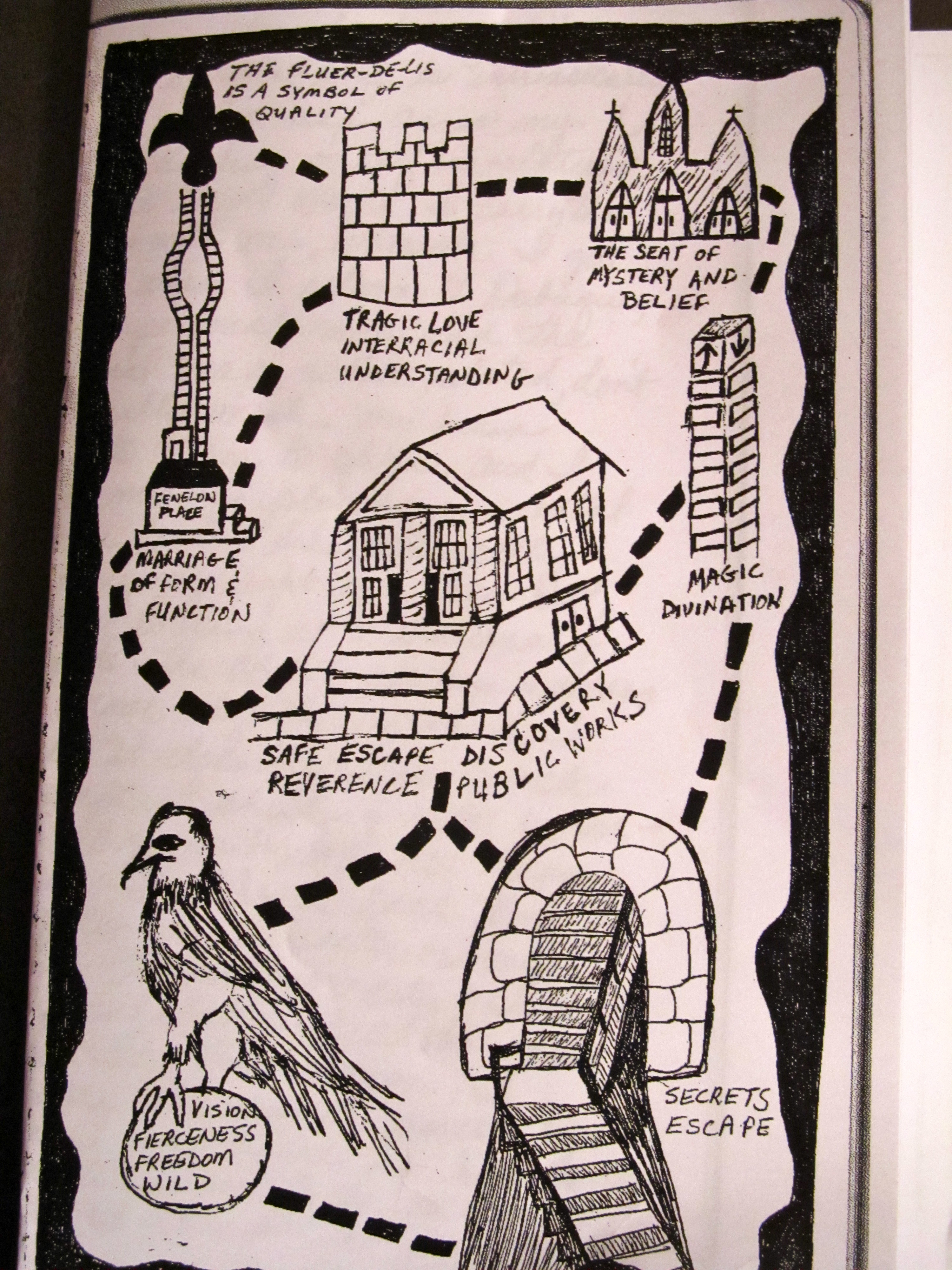
I think, “Like a memory castle, there is a map of Dubuque that I carry within me that bears only minimal relationship to the actual city’s map.” This map contains my memories and my memories of emotions. Attached to each site on the map are sensations, values, concepts experienced or learned throughout my formative years. My spiritual self is intrinsically tied to this map, as is my understanding of self in relation to the larger world.

The map in my psyche looks something like this:

Each location on the map is both a real place (the Fenelon Place elevator, the bank weather tower, the Carnegie-Stout Public Library) and an icon for the meanings I have associated with it (examples listed on the map above).

I carry this map with me, wherever I go. But when I return to Dubuque, my personal map and the actual map, while related, don’t actually match. My brain wants them to align, and I find myself playing a mental game much like alternately closing my right eye, then left, while looking at a stationary object. The object always appears to move slightly, although I know it doesn’t really. This quick perceptual shifting never works – the alignment will not happen. I have to choose each time to be in the exterior city or in the interior city – I can’t fully inhabit both at the same time.

For this reason, I treasure the small pieces of time I am alone in Dubuque. These turn out to be moments when I can sit in an actual physical location and touch the wealth of internal information I’ve stored in its metaphorical twin. Its a bit of a deep moment — like sitting in the coffee shop that used to be Theresa Delaney’s living room. Whatever keeps blowing the door open may be the wind or a ghost — but I can’t help thinking it might also be my other self (the self who has continued to inhabit my internal Dubuque long after the external self moved away) coming to join me for an Americano, extra-hot.

(Note: this post, and the map drawing it contains, are adapted from a journal entry I wrote several years ago)

…Changing the Dream (part 2 of 2)

“The arc of the moral universe is long, but it bends toward justice.”

–MLK Jr.


When I was in graduate school, we used a visualization activity called “The Perfect Future Day Fantasy”, in which we were to imagine ourselves waking up on a “perfect” weekday 10 years into our future. I specifically remember processing this activity with a group of fellow students, when one friend said that, in his perfect day, he was presiding over negotiations to reunify Germany. We all laughed at him, saying “As if…that will never happen.” That was 1987. By the end of 1990, German reunification was a reality.

In the “Awakening the Dreamer, Changing the Dream” symposium, the module which discusses “What is possible for the future”, asks us to shift our perspective from what is probable to what is possible. We live in a cynical world (did I really just quote Jerry McGuire?!). A world in which many of us look at the enormous issues confronting us and decide they are so over-arching, so all-encompassing, that we can do nothing…and we therefore continue in our comfortable dream world.

And yet. Apartheid ended. Change is sweeping through the Middle East. Millions of people the world over are participating in organizations and movements to make justice, sustainability, spiritual fulfillment real in the world in new and creative ways. Just a few who have inspired me: Emmanuel Jal, Curt Ellis and Food Corps, Annie Leonard, and so many others. Each of these individuals has taken their unique talents and skills and employed them in service to justice and creating a different dream for the world. And I am heartened to know there are millions of others, whose names and faces I may never know, but whose voices are represented by an activist in the symposium video module who says, “We didn’t believe we could change anything, but we did it anyway.”

Inspiration is important. It needs to translate into action in order for me to be part of co-creating a new dream for our world (a universal Perfect Future Day Fantasy!). But what can I do? I’ve thought about this long and hard in the week since attending the symposium. First, I can talk – that’s something I’m good at! – and write about what is in my heart. Second, I can start with the environments I am already a part of. For example, on Thursday, the symposium attendees from my university met for lunch to discuss an action plan to bring the symposium, and active outgrowths from it, to our campus community. I can evaluate the corporations with which I do business, and make a conscious effort to support those who use a “triple bottom line – people, planet, profit”. Because food and hunger are issues which are already important to me, I can recommit myself to work on these with my time, talents, and treasure.

It would be overwhelming if we looked at all that needs to be done and thought that we, personally, needed to do it all. Heck, even thinking that we need to do something big, make one grand gesture, is an overwhelming idea. What I am discovering, though, is that each of us has within us the ability to make a difference. If we stop thinking it needs to be a difference that the whole world will see and recognize, and instead think of it as a difference that changes our hearts and touches at least one other, it becomes much less daunting. Do I really think that will change where the earth is headed? You bet I do. And I am far from alone in that:

“It is a moral universe despite all appearances to the contrary.”

–Desmond Tutu

“Never underestimate the power of dreams and the influence of the human spirit.”

–Wilma Rudolph


Conference – Day 2: Activism

I began the day with an early morning trek to the Philadelphia Museum of Art. It was too early to enter the museum and see the exhibits, but that is not what I was there for, anyway. Like millions of others over the years, I visited the museum to see the Rocky steps. You know, the ones Rocky tackled as part of his training for the big fight in the original Rocky film. One of the reasons that movie has inspired so many is the whole idea of one regular guy taking on a corrupt system and, through application of hard work and heart, overcoming the odds that are stacked so high against him.

Turns out, this was a fitting way to begin the second day at the NASPA Conference. The morning’s featured speaker was Emmanuel Jal, whose autobiography War Child tells the story of his turbulent youth in Sudan, where he witnessed many atrocities, at the age of eight became a child soldier, then a refugee and one of the “lost boys” of Sudan. But Jal’s path was destined to cross that of Emma McCune who saved him (along with 149 other Sudanese children). Jal now works for peace and to better the lives of those in his home country living in poverty. His goal is to change the world. I know he managed to take a bunch of college administrators and turn us into dancing fools this morning, so maybe he will succeed.

The afternoon featured speakers were Ian Cheney and Curt Ellis, the documentary filmmakers who brought us King Corn the story of how hidden corn in our diets has literally changed us. They also took on a project of farming out of the bed of an old pickup, leading to their high-profile Truck Farm.  Advocates for sustainable practices in food production, they have also started an activism project modeled on Americorps, called Food Corps. Their aim is to send young adults into communities to teach about whole foods, grow school gardens, and get communities really thinking about the startling effects of our current food consumption patterns in the United States. This is a public health crisis (1 in 3 children is on track to develop Type II Diabetes), it is a social justice concern (our poorest communities have the least access to fresh foods), and it touches everyone. After the session, I spoke briefly with Curt Ellis, who is spearheading the activism side of their ventures. He indicated that Iowa (my home state) is one of the first 10 states to which Food Corps workers will be sent. We spoke about some of the challenges in Iowa of speaking directly and truthfully to farmers and to powerful business interests about these concerns. He said he’s met with higher level management at businesses such as Cargill (to name one major industry in my community) – and he believes that by and large they want the same things he does, among them food that makes people healthy rather than sick. The ten states they’re starting Food Corps in were selected because they already have statewide organizations which will support Food Corps’ mission and purpose. In Iowa, there are a couple of campuses with strong Americorps programs, and they will also be working with the National Center for Appropriate Technology.

In addition to the two featured presentations, I went to two additional sessions. One of these also fit todays theme. The presenters, from Marquette University, discussed the development of a social justice living-learning community based on the life and work of Dorothy Day, founder of the Catholic Worker Movement. Dorothy Day, an activist whose example has inspired many to enter fully into lives of those who have little.

In all, I walked away from today’s formal events ready to take action in both my work and my own life. Inspiration is a great thing, but today’s speakers reminded me that without action, great ideas remain just that. As Emmanuel Jal, Ian Cheney, and Curt Ellis know, inspiration must lead to action in order to spark real change.  And this brings me back to Rocky. As we all know, sometimes the road to change is difficult and requires hard work. We love what Rocky stands for because he succeeded through sheer perseverance. Emmanuel Jal fasted for over 600 days to raise money to build a school in Africa because he promised the children he would do it. I don’t know about you, but I definitely call that perseverance! I’m happy to have both the fictional hero and a real life one to learn my lessons from. And the lesson I learned today is that it isn’t really a question of CAN I do it (am I good enough, strong enough, talented enough to change the world). Its more a question of WILL I do it? And the only way to answer yes to that question is…to get busy!

Conference – Day 1: Inspiration

I am currently in Philadelphia, attending the annual conference of the National Association of Student Personnel Administrators (NASPA). The theme of this year’s conference, stemming from our location in this city of our nation’s birth, is “Educating for Lives of Purpose”. I have to admit that, more than twenty years into my professional career in Student Affairs, I can be a bit cynical about meaningful titles and conferences which suggest there might be things seasoned professionals can learn from the programs being offered. Tonight’s opening session, though, may have set the tone for a transformative experience I wasn’t anticipating.

The opening session of professional conferences can be…well, boring. You hear from numerous speakers who congratulate themselves and thank everyone under the sun, give “updates” and “housekeeping notes”. And when that is done, your keynote address is from someone who might be marginally entertaining but, let’s face it, rarely actually knows anything about student affairs. Not tonight.

We began with the theme song to Rocky, which as anyone who reads my blog knows, has personal significance for me beyond the movie. The conference chair gave a gracious welcome, which was succinct and minimalist (as these things go). The NASPA President, Elizabeth Griego, from University of the Pacific, gave a stirring speech on the theme, “We are the people we have been waiting for”. She called us to personally creative leadership, lives and work of purpose, and to ask ourselves whether what we are doing is clear, focused, intentional, and systematic enough to bring about real transformation in the lives of our students and in the communities our institutions are part of.

The featured presenter for the evening was Donna Shalala, President of The University of Miami (and well-remembered as the Secretary of Health and Human Services for eight years under President Clinton). President Shalala made a few brief remarks about her career. She was engaging to listen to, and it is clear that she not only understands the student affairs profession, but sees it as essential to the work of colleges and universities.

President Shalala’s remarks were, however, brief. The majority of her session was devoted to a panel (which she moderated) of recent college graduates who are engaging in lives of purpose through community service: the Peace Corps, Teach for America, City Year, and the Clinton Global Initiative University. These young people were amazing – articulate, thoughtful, bright. And they were challenged, supported, and mentored by student affairs colleagues at each of their respective institutions. As a young woman named Sajena Erazo said, “I pour myself into my students to make them better than I was at their age. And I realize that is what you did for me when I was a student.”

Before the panel, as a way of introducing the panelists and the organizations they are working with, we watched a video. I wrote down one set of words which flashed by on the screen: raise money, raise hope, raise the bar. And while I don’t do a lot of fundraising associated with my career (except for a current pledge drive raising money throughout Lent for Kids Against Hunger), I do believe in the very real possibility of both raising hope and raising the bar in my work. And I am ready to ask myself, as President Griego suggested, “What does it mean to me to live with purpose?” Hopefully, the rest of the conference will also inspire me to ask myself this difficult question. To challenge myself to be the person I have been waiting for.