Feeling Time

Oh, it’s time to start livin’
Time to take a little from this world we’re given
Time to take time, cause spring will turn to fall
In just no time at all….

One evening last week, I got dressed up (well, if fleece leggings under a long skirt passes for dressed up) and made my way to Minneapolis’ Orpheum Theater to see the musical, “Pippin!” I was very excited to go to my first big theater event in the Twin Cities – and there was the added element of adventure since I was attending alone (though I planned to say hello to my favorite usher, who was working that night). I had longed to see this show for several reasons. First, since high school, I have loved the show’s most well-known song, “Corner of the Sky”. Second, I saw a piece on CBS Sunday Morning about the preparations and practice the touring cast (the very cast I was about to see) had made to be ready for this physically demanding revival, re-imagined as a circus-themed production complete with acrobatics and high-flying aerials. Third, I knew nothing about the actual story, so the show would be almost entirely new to me.

A fourth reason I was excited about this particular experience was that it was taking place at the Orpheum Theater. Years ago, before I ever thought of moving here, I visited my friend Mike on a Halloween weekend. That visit was memorable for several reasons, most importantly because I met Mike’s sons (Alex and Matt) for the first time. One of the things we did that weekend was take a haunted tour of the Orpheum. It was a fun, almost magical, tour – but not once did it occur to me that I would ever attend a show in that beautiful, historic theater. So, as you might imagine, my heart was full before I walked in the door to see Pippin. (Oh, and my favorite usher, mentioned above? Mike, of course!)

I found my aisle seat, toward the back of the main floor. I was thrilled, as a vertically challenged viewer, to discover that no one was seated in front of me. In fact, mine was the only occupied seat in my entire row and the row in front of me. The house lights went down and the stage lights up, and I was in my own little envelope of space with the show.

A brief plot synopsis might be helpful. Pippin is a young prince who feels he is called to lead an extraordinary life, and sets out in search of his place among meaningful events and activities. In the end, however, he discovers that giving your heart to the life you have is truly meaningful, even if that life is one of ordinary pursuits. (Check out www.stephenschwartz.com if you want to know what the show’s creator has to say about its themes and meaning.)

In Act 1, Scene 4, Pippin visits his grandmother, Berthe (played in the show I saw by the amazing, Tony-award-winning Priscilla Lopez). Berthe’s show-stopping number, “No Time At All”, was a song I knew but didn’t realize was from Pippin. The 66-year-old Berthe/Lopez not only looks incredible when she strips down to a trapeze-artists’ costume, she manages to fly through the air AND SING, appearing completely at home in the aerial number. “No Time At All” becomes an audience sing-along, and while I thoroughly enjoyed belting out the choruses, by the last one, I found myself overcome by emotion.

Now, days after my Pippin! experience, I find myself still singing that chorus – and ready to share why it choked me up.

One reason was the sheer admiration I felt for Priscilla Lopez. What an inspiration that was – I hope in my mid-60s to be ready, willing and able to engage so audaciously with the challenges life offers me.

But there was also a more spiritual component to what I felt. Throughout my life, there have been moments when, in the midst of a special experience, I have felt myself step out of the stream of time. When this happens, my “normal” self remains as is, doing whatever it is doing. In this case, I remained in my seat thoroughly enjoying the performance. But my consciousness somehow steps outside my experience, and is able to look upon it (and myself) with some separation. Briefly, at Pippin, I stood outside the moment, and saw myself shining with enjoyment, radiating life and energy. The worries and cares of the day had dissipated, I was no longer concerned about the financial splurge required to purchase my ticket; no longer worried that I had forgotten where in the unfamiliar ramp my car was parked; no longer awkward about indulging in this experience solo. Looking at myself, I saw beauty. I knew that this is how we are meant to live: without unreasoning fear, without concern for conforming to expectations, but with energy and joy for this moment we have been given. The gift of this present.

As we grow older, our sense of time changes. It rushes past us, faster each year. Sometimes I am stunned that another week, month or even year is already gone. This feeling of time rushing past creates anxiety, bordering often on fear. Though people talk about young adults being in too much of a hurry, of their need to slow down and let their lives unfold, I am finding that this is much harder to do at 53 than it was at 23 or 33. Back then, I thought I knew there was time for everything. Now, I am very aware as each day passes that it was another grain of sand in a rapidly diminishing hour-glass. I can’t count the grains that are left and I have no way to accrue more than are already there. This makes it very difficult to allow my life to unfold. To have patience. And so the anxiety creeps in, ratchets up as I worry that I’m not moving fast enough in my life.

The gift I received during that musical number was awareness that this is a false sensation. It is always time to be living, always time to make the most of this world we’re given. Spring will turn to fall, it is inevitable. No point in getting all angst-y about it. No point in regretting the past or looking with fear toward the future. I am not in control of it. All I can do is choose how I interact with the gift of the present as it unfolds. I can be in it, living it, or I can waste it with fear, worry, anxiety.

When I arrived home after the show (after having no difficulty finding my car in the ramp, though I drove in circles on the one-way streets downtown for a while) I was still so energized by the experience that I couldn’t sleep. I posted this on my Facebook page:  “This is what the best art in any medium can do: shine a light into our shadowed spaces and allow us to see with new eyes.”

We are often advised in life to “pick our battles”. What I’m seeing with new eyes this week, thanks to Pippin!, is that my battle isn’t with Time. Time is unchanging – time is as and what it is. My battle is with false perceptions of time, which lead to fear and anxiety. And that is a battle I know I can win with faith in God, trust in myself, and attention to this gift of the present.

 

Renewable Energy: Tapping our Inner Resources

I continued to focus on my breath, exhaling forcefully then inhaling again without a pause. Inside, I began to feel a buzzing, humming sensation similar to standing next to an electrical generator. It began at my diaphragm and radiated upward. I could feel the energy expanding and filling my body, sending electricity through my arms and up through my chest, my neck, my head. My facial muscles began to twitch involuntarily, until suddenly there was a huge pulse of internal light and I felt as if the energy that had been building inside me had just burst forth. It leaked out through my pores, and shone in a beam of light out the the top of my head. 

At least that’s how I pictured it in my minds eye.

I felt radiant, expansive, and more than usually ALIVE. After a few minutes, I spoke quietly to my friend, Melissa, who was standing next to me. “Can you feel that?” I asked.

“Your energy field is about out to here,” she said, holding her hand roughly 16 inches in front of me. “I can see it.” Truthfully, I could feel her hand before I opened my eyes, even though it was more than a foot from my body. 

Last summer I volunteered to assist my friend, Melissa, who has been getting her certification as a facilitator in guided breath work. The experience described above was from our tenth and final session last week. What I’ve felt during these sessions has varied, but the best ones have led to similar high-voltage experiences.

It’s got me thinking a lot this week about energy: how we get it, how we make use of it, how we replenish it.

As a starting point, let’s consider that Albert Einstein said energy “cannot be created or destroyed, it can only be changed from one form into another.” While Einstein’s words carry the weight of scientific genius, they remind me of another quote that I have seen attributed to various famous individuals: we can be miserable or we can be happy – the amount of work is the same. I take these statements, together, to mean that we are expending energy no matter what. Whether that energy is spent procrastinating, complaining, creating or exclaiming is up to us. It is all energy.

If energy can only be transformed, then a good place to start is with fear and love. Fear is an energy that makes us smaller, causes us to contract. It vibrates on one frequency. Love is an energy that enlarges us and our world, that helps us to expand beyond previous boundaries and expectations. Love vibrates on a different frequency than fear. It seems a fairly safe bet to say that connecting with what we love is more likely to produce positive energy, and positive results, than connecting with our fears.

In my experience, authentically engaging with others and with the world around me often leads to feelings of increased energy. Authentic engagement is a form of love energy. It calls for openness and vulnerability – you have to share some true part of yourself for this to come about. With others, this can mean lowering your defenses and/or pretenses. With the world, I believe this means being open to possibilities, allowing our guarded hearts to be cracked open by beauty or the ineffable. There is a quality of permeability that is called for. We have to be willing to let what is outside us touch us on the inside, as well as to allow our deep selves to come out of hiding.

For example, risking authenticity with others has recently led to offers of mentoring and support for my creative endeavors. It has also yielded the opportunity to brainstorm with a friend about a new business venture she is contemplating. Risking authenticity means I am now actively feeling that internal buzz that signals high energy frequencies. My creative juices are flowing and I can’t seem to find enough hours in the day to address all I want to accomplish.

Another important factor that allows our energy to be transformed into something powerful is the simple step of taking action. I would never berate wishful thinking, daydreaming, or hoping – I believe that spending time in these activities allows us to open up to new ways of seeing the world and to new possibilities. However, it can also lead to an energy build-up that, if we give way to procrastination or just move on with the mundane tasks of life rather than implement some portion of what we dream about, dissipates without transforming. Worse, habitually doing this leads to negative energy – we feel like failures who have wasted our time and our talents. Feeling this way adds to the inertia we were already fighting.

The opposite is true, though, if we begin to take action. If you’ve ever spent time dreaming or wishing you could conquer some obstacle, then taken even a small step toward resolving the problem, creating the solution, or achieving the goal you’ve seen it can lead to an incredible upsurge of positive energy. Suddenly, you find you’ve moved farther faster than you thought possible. That higher energy frequency you’ve attained is allowing you to experience what has been described as “flow”. Or, as motivational speaker Tony Robbins has said, “The higher your energy level, the more efficient your body. The more efficient your body, the better you feel and the more you will use your talent to produce outstanding results.”

Now, I’ve been talking about the kind of energy that can be generated from within, from attuning your heart and your mind to things you love, things that you think of as positives. There is also the kid of energy that is generated by a healthy body – one that is fueled well with clean eating and good hydration, moves well due to exercise, and is rejuvenated by restful sleep. This kind of energy cannot be overrated in any way. However, that’s another post entirely!

In thinking about my expanding energy field during my last breath work session, it occurs to me that we all have energy reserves we may not be aware of – that these reserves are available for our use should we choose reach for them, and that they are inexhaustible. This doesn’t mean that if we begin to practice using them we will never feel our energies flagging (sometimes this happens for reasons beyond our control, such as illness). Instead, when we do feel our energies vibrating toward fear, procrastination, inaction, or isolation we have inner resources we can tap. All we need do is remember to engage with our love instead of our fear. That, and breathe.


The Pregnant Pause

On a summer evening, after a long day of sunshine and blue skies, you watch storm clouds gather in the west. You feel the humidity skyrocket as the air grows more still. On the edges of the storm clouds you see lightening flash, too far away for concern. A bit later you finally hear it, in the far distance, a rumbling of thunder. In that pause before the storm arrives, it seems the whole world is holding its breath, waiting.

Which do you feel: anticipation or dread?

#################

A dear friend of mine is pregnant, expecting her first child. Last night she texted, with relief, that she has a doctor’s appointment today. She explained her relief this way:

First you find out you’re pregnant at home. You call the doctor’s office, and they say, “ok, we’ll see you in a month”, because they won’t see you until you’re like nine weeks. And then you finally see the baby, and you’re like “Thank God”. Then you get sick, which is actually the most reassuring thing ever because at least you know its in there doing something to make you feel sick. And then you’re waiting four weeks before the next appointment. And while you wait into weeks 10/11/12/13, your sickness gets better which means you can’t tell if anything else is going on. You just have to hope it is. And so I go in tomorrow, and they won’t do a picture but they will do a heart beat and I’ll feel better. And then I’ll wait four more weeks. You can’t feel it move or anything right now, so it’s all just a bunch of hope. Hope that someday at the end it’s a happy human.

After our conversation, it occurred to me that the process she had just described was familiar in some ways, despite the fact that I’ve never been pregnant. A year ago this past week (June 6, 2013) I packed my car and left Cedar Rapids to create a new life. The first month, I was vacationing in New Mexico – enjoying my family and the natural beauty of the area. I alternated between relaxing into the moment and wishing to move time forward more quickly, to jump ahead to the process of settling into my new home in Minnesota. Like my friend waiting for her first pregnancy appointment, I wanted the confirmation of sight – the city, my apartment (rented from a distance) – wanted to know it was real and not still a “someday” dream.

In the process of creating a new life pregnancy-style, there are markers. Your monthly exams, books that compare your growing child to various foods (a peanut, a grape) so you can visualize the growth inside you. A wealth of information, a nearly day-by-day road map of what to expect. My friend will eventually have a sonogram and be told the baby’s gender. She’ll feel the baby’s first kick, feel her body expanding and conforming to the little person inside it. And with all that, there is still the unknown, the waiting that my friend describes.

In the process of creating a new life for oneself, there are no road maps. No handy “What to Expect When You’re Taking a Blind Leap of Faith” books parsing the days for you. No trimesters to mark off on the calendar. But there are check-ups and check-ins along the way, like my friend’s monthly doctor’s visits. Moments that confirm you’re on the right track. Moments that make it clear a course-correction is needed. Moments of extreme joy and of fear and of quiet acceptance. Moments when you can’t wait for what is to come and moments when you dread what may be next.

We all know it takes nine months to give birth to another human – no matter how often we witness it, we are still spellbound by the miracle of it.

How long does it take to give birth to a new self, a new lifestyle? That gestation period is trickier because it is different for each of us who takes on the journey. A year into it, I’m still not sure how far along I am. So far, each set-back has been met with a reprieve. Each moment of despair with one of joy. I didn’t know ahead of time that I’d slip downward on Maslow’s hierarchy to the bottom rungs; didn’t realize how hard that would be or what I’d learn about myself when it happened. I’m finally beginning to trust that my basic needs will be met – now, I’m squarely focused on satisfying the need for belonging and love, setting my sights on “esteem”.

When I decided to transform my life, I thought it would be a relatively smooth transition upward to “self-actualization” – even though I ought to have known better: there are no guarantees of achieving the highest levels of actualization – just the desire to keep climbing in that direction. Life cycles back around to the hard parts even if you don’t take drastic steps toward change, so why not take the chance to create something bigger?

In the midst of change, no matter how long it takes, there will be times when you see the path ahead and times when you can’t. Times when you must move forward with just the hope that someday, at the end, you’re a happy human.

#################

Whether you waited with anticipation or dread, the storm arrived.

The next day dawned. And it was spectacularly beautiful. Clean, fresh, cool air. Pink skies giving way to cerulean blue.

Which begs the question: if you can choose, why not choose anticipation? The next day dawns no matter what. Why spend your energy dreading it when there is so much more power in anticipating, in looking forward?


I Am #YesAllWomen

On a beautiful spring day in 1972, I was walking home from Pinecrest Elementary School (Hastings, MN), enjoying the sun on my face and what ee cummings called the “true blue dream of sky”. I was the kind of kid who, even in 6th grade, wasn’t very aware of my surroundings – always lost inside my own head. Eventually, though, the fact that someone was following me, and speaking to me, impinged on my awareness. I half turned, though I spun back around immediately once I realized that the kid talking to me was Randy – the guy I had a crush on.

“You better walk faster ,” he said. “Cuz if I catch up to you, I’m gonna rape you.”

I had only a vague sense of the threat in those words, but I sped up.

Randy and I lived in adjacent neighborhoods, so his group of boys and my group of girls had a tendency to circle one another, occasionally intersecting in a game of horse or some version of “kill the man with the ball”. My friends said his following me and taunting me were signs that he liked me. After that, I became aware of his presence and gaze on me during these neighborhood kids free-for-alls.

One day, a few weeks later, my friend Cheryl and I were walking the circumference of our subdivision, following the streets that bordered the cornfields that hadn’t been plowed under for houses yet. Randy and his friend, Shannon, were in Shannon’s front yard and called us to come over. We stood talking for a couple of brief minutes, “What are you doing?” “Nothing really. You?” Suddenly, Randy shouted “NOW!” and he and Shannon each grabbed one of my arms and began dragging me into the back yard. Cheryl followed, neither of us sure what was happening.

At first, we were all laughing and it seemed like just another, more intimate, version of “kill the man”. Then Shannon said, “Randy told you he was gonna rape you.” Suddenly, real fear replaced my uncertainty and I began truly struggling to get away. As I was dragged into the cornfield behind Shannon’s house, I managed to free one arm, then pull away by almost slipping out of my shirt (I remember it was my favorite t-shirt, the one with the peace sign on the front that I had taken from my dad’s closet). Randy let go as we heard the fabric rip and I took off running toward home.

At the time, I wasn’t sure what would have happened had I not broken away. I felt serious ambivalence about whether I had been in danger or if this was typical behavior when a boy liked you. What I was clear on, however, was that this episode was one to keep to myself. So I did.

####

In seventh grade Math class, we were often given time to complete homework problems at the end of the class period. At least once a week, sometimes more often, I would be diligently attempting to figure out the difficult story problems when one of the boys (my assigned seat was surrounded by them) would use something – a pencil, a ruler, even one time the point of a protractor – to reach around my arm and poke my breasts. Then they’d all laugh. Once or twice, the male teacher asked what was going on, but how could I have spoken up in that situation? In front of the whole class? No way.

####

Flash forward a few years, and I’m in high school in a suburb of Cincinnati, Ohio. Randy (another Randy – the names have not been changed for the purposes of this post) lived across the street and I thought he was the hottest boy ev-ah! His parents were never around, and I killed a lot of afternoons hanging out at his house with Randy, his older sister Lisa and their kid brother. One afternoon, just Randy and I were in the house when Lisa came home. She appeared to be in a bad mood, and almost immediately picked a fight with Randy.

After a brief but intense shouting match between the two of them, Randy grew quite calm and told me to follow him to the kitchen. When we got there, he opened a drawer containing several large and clearly sharp knives and began fooling around with them. I said, “Hey, you’re gonna cut yourself! You should put those away.”

Randy flew into a rage, grabbed my arm and twisted it behind my back, holding one of the knives against my throat. “Do NOT tell me what to do,” he yelled at me. I tried talking him into letting me go, but before I got very far, Lisa came into the room and started yelling at him to “stop being such a fucking asshole”. Instead of letting me go, Randy applied more pressure to my arm, torquing it so painfully that I was required to bend at the waist to avoid it being ripped from its socket. Randy pressed the point of the knife into the middle of my back and said, “You’d better stay put. If this knife stabs you in the back, it’ll be your own fault.”

I was terrified. I can remember my breath coming fast and shallow, the feel of my heartbeat pounding in my chest. The utter and complete belief that he was capable of carrying through on his threat – both because of his superior physical strength and because of his rage.

He and Lisa yelled at each other while I kept still, focused almost entirely on the point of the knife and the degree of pressure with which it was pushed into my back. Eventually, Randy threw me to the floor and said, “Get the fuck out of here.” I didn’t need any other incentive to run.

Lisa stopped me halfway across the street and begged me not to tell my parents. She said, “You’ve seen what our life is like, he wouldn’t really have hurt you he’s just got problems that aren’t his fault.” Later that evening, Randy came to the door with Lisa. She said, “Randy has something to say,” and nudged him in the shoulder. He said, “I wouldn’t have cut you.” When my parents asked, “What was that all about?”, my reply was, “Nothing.”

####

At a dance in the student union, my senior year of college, a man I didn’t know grabbed me and gave me a huge hickey on my neck. Although I shouted at him to get off me, and beat at him with my hands, my friends looked on, laughing. When he ran off, I turned to my friends and angrily asked why they had done nothing. Their response was, “We just assumed you knew him.” I was speechless.

####

Like most women I know, I have a litany of such stories: from the almost mundane (inappropriately spoken to by strangers) to the truly dangerous (a naked man with a shotgun). These experiences have made my life smaller in many ways. They are the reason I am afraid to be alone in the woods – no Cheryl Strayed odysseys for me. They are the reason that I’ve never worn a bustier in public. They are the reason that, even though I don’t have air conditioning, I close and lock my ground floor windows when I go to bed. They are the reason I don’t go out alone at night. They are the reason I evaluate my safety at all times, why I can’t bring myself to sit with my back to the room or the door; why I sometimes feel like a coward who has given away my freedom in order to feel safe.

Many of these stories went untold when they occurred, due to my own immaturity or conflicted emotions about them. I thought that a boy threatening to rape me was unusual – until I saw almost the exact scene played out in a movie called, “Welcome to the Dollhouse”. As I got older and learned more about other women’s’ lives, I realized my experiences were hardly beyond the pale.

In fact, by comparison, they’d hardly register a blip on the misogyny scale. I’m one of the lucky ones – the men in my family, the men I’ve dated, hell even the men I’ve been shit-faced drunk with – have been kind, generous, respectful. They’ve been the type of men who don’t abuse women.  The men I’ve trusted have not beaten, raped, or commodified me.

Even so, I HAVE been dissed: disrespected, disenfranchised, disregarded.*

Even so, I HAVE felt fear my whole life – and been made to feel that fear was my own fault. I was overreacting. I was dreaming things up. I had an overactive imagination. Reading the #YesEveryWoman tweets has been a moving experience, reminding me that I am first and foremost not dreaming, overreacting, or imagining. Second, that I am not alone – though it is hard to take comfort in that thought.

Hard to take comfort…because tonight I stopped by the coffee shop down the street. The young barrista who makes my order before I place it limped as she walked from the credit card reader to the espresso machine.

“What did you do to yourself?”, I asked, genuinely concerned to see her legs scraped and bruised.

“I didn’t do it to myself,” she said. “Be careful if you go out alone after dark around here. It’s not the best neighborhood. I mean I knew that, but then I thought, heck, its my own block. The police haven’t caught the guys. Seriously, be careful.”

So there is no comfort in #YesAllWomen. There is only (finally) giving voice to the truth of our experiences. If you are one of the people backlashing against the hashtag, that’s your right. I would just say that it is also our right to give voice to our shared experience; our right to say “enough”.

If that makes you uncomfortable, welcome to our world.

#YesAllWomen


*Note: While this post focuses on the ways women are, from a young age, routinely physically and psychologically assaulted, the daily kinds of sexism we face – in school, relationships, on the job – are an important part of the #YesAllWomen experience and hashtag. Had I focused on these experiences, my post would have been beyond lengthy.


Jumping the Tracks

“The enormous lake stretched flat and smooth and white all the way to the edge of the gray sky. Wagon tracks went away across it, so far that you could not see where they went; they ended in nothing at all.” — Laura Ingalls Wilder

OLYMPUS DIGITAL CAMERA

No one tells you, when you’re young, that there are choices you make that set you on a road from which there will be no deviation. Or at least from which you will not know or feel you can deviate. A woman who counts the days (in years) until her kids graduate so she can quit the job she hates. A man who has created two lives, his public one and his private one, who always feels divided within himself. Another who randomly got a job in a lucrative field and has never been able to walk away. Me, working my ass off in a job that was fulfilling but also usurping, leaving almost no space for me in my own life.

Sometimes, I resisted change out of love – love for the mission and mercy of the institution I worked at, love for the students whose lives I was privileged to participate in, love for my colleagues whose hearts and souls were so amazing. Sometimes, I resisted change out of fear – of failing, of being too much or not enough of the “right” things. Whether out of fear or love, resistance kept me on the track I was on, moving forward as far as my eyes could see into a future that held more of the same. Resistance, when we give in to it, is  an insidious form of self-betrayal.

Resistance is self-betrayal because it manifests in these ways: it causes us to be silent when we need to speak; it  justifies dishonesty about our true selves; it effectively hoards our gifts and talents when they exist to be shared. Marianne Williamson has, famously, said “Our deepest fear is not that we are inadequate. Our deepest fear is that we are powerful beyond measure. It is our light, not our darkness that most frightens us.” So we hide, we make ourselves small. Not to prevent us, in my opinion, from outshining others, but to prevent us from being seen when our true shining selves are revealed. What we love and what we fear cause resistance because they both carry the price of vulnerability.

So, what is it like to jump the tracks? I wondered for a very long time. Years of agonizing soul searching. Years of excuses. Years of making my friends listen to all of that soul searching and excuse-making. (Obviously, I have the most incredibly supportive friends!) And in all that time, I didn’t do any real planning. Any real preparing. I felt incapacitated until the thought of remaining on the tracks, the resistance, became more prominent and painful than either the fear or the love keeping me there – and I just jumped.

Here’s what it is like: it is like being a new soul again.

I cannot contain my curiosity. There is so much to see and read and learn, so much content and innovation, so many ideas. I read and explore on-line until I can’t see anymore.

Then I go outside and explore my city. I knew I didn’t care for the city I lived in and called home for almost two decades. I didn’t realize how stifling I found it. I don’t mean to dis Cedar Rapids – it is objectively a great place. It just wasn’t for me. This city makes me feel expansive: the diversity of people, of neighborhoods, of opportunities.

I am in love with creating. When I unpacked my boxes, I discovered fifteen unopened artist’s sketchbooks – which definitely says something about what my heart knew I should be doing (not necessarily drawing, but creating). I’ve been busy taking photographs, writing, creating recipes from delicious food. Here’s the thing about allowing your creative self the freedom to breathe after years of pushing it down inside – you’re a newbie and you suck (not so much with the recipes, they’re tasty. But with the writing…oy!) Even sucking feels pretty good right now because I am writing.

I have two primary fears: not finding a job, and conversely, taking one out of necessity that recreates the “tracked” lifestyle. Out of fear, and a whole new set of loves, I still betray myself via resistance – I hold back, I worry about acceptance rather than experience, I allow discomfort with the unknown to stop me. I am also discovering that the world in general prefers when we are on the tracks. It makes more sense to people, they know how to define us when we’re on a specific track in life. There is a subtle pressure to get back on, to resume that endless trip toward a gray horizon.

I probably could have jumped the tracks sooner. I could have chosen a different means or method of doing so. I could even, probably, be doing this trackless exploration differently right now. Perhaps in the future I’ll look back and think, “Wow, that was a dumb way to do it!” The only thing I know for sure right now is that I can breathe more deeply than I have in years. That each day seems to be so brimming with possibilities it is often difficult to choose from among them. But I’ve always been a hard worker, it’s in my DNA. So I am gradually buckling down to the work of self-discipline – which is vastly different when the things I am being disciplined about feed my soul and don’t just earn a satisfactory performance review and a heap more work.

It is a strange thing to realize that I have had these choices all along. No matter what I was told, or what I grew up believing. No matter what pressures I felt internally or externally. It is strange to know that I will continue to make some choices out of fear or love or resistance that may not be the best choices for me. It is especially strange to realize that I took comfort from the very tracks that steered my life away from being the life, and me becoming the person, that was meant to be. When you jump the tracks, that false comfort is denied to you. You have to find your own stride in the trackless wilderness.

And that seems a fitting way to describe where I am today: I jumped the tracks, and now I’m finding my own stride. I can’t quite see the features of the horizon, but it isn’t gray. And my tracks won’t end up going nowhere at all – they’re heading somewhere of my own creation.

OLYMPUS DIGITAL CAMERA

The Case for Uncertainty

Image

When Reverend Robert H. Schuller posed the now famous question: “What would you do if you knew you could not fail?”, I wonder if he had any thought of its ongoing impact – of how often it would be presented, posted (reposted), asked as a motivational tool. I get what he was going for, but the truth is, I’m kinda tired of this question.

I’m tired of it because I think it is the wrong question.

Let’s face it – for most of us, the truthful answer when asked “What would you do if you knew you couldn’t fail” would be, “What I did yesterday. What I am doing today. What I plan to do tomorrow.” We build our lives around daily routines that are composed of things we can’t fail at: eating, sleeping, working, laundry. On the micro/daily level we don’t fail at these. At the macro/lifelong level, we may question whether or to what degree we were successful at these things – but mostly we muddle through without labeling ourselves as failures. We feel secure in our “fail safe” routines, as if our lives are manageable, predictable.

Besides, we can all point out, in fact are hyper-aware of, the times we do or have failed. We deal with failure to the best of our ability and move on – what else can we do? There’s even a kind of trendy “failure is good” meme out there right now, encouraging people to take risks, reminding us of how many times Michael Jordan missed a basket or how many rejection letters J.K. Rowling got before someone agreed to publish the Harry Potter books. The message is that failure is a necessary risk if we hope to succeed at anything worthy in life. I don’t take issue or argue with this point.

However, last winter I read Brene Brown’s book, The Gifts of Imperfection, in which she alters Rev. Schuller’s famous question. Brown suggests that we ask ourselves, instead, “What is worth doing, even if I risk failure?” This raises the stakes by introducing the concept of uncertainty. Not “I can’t fail” but “I might fail”. I would argue that the most important word here isn’t fail, though that’s the word that captures our attention and most of our immediate fear. The word to pay attention to here is might.

What is glossed over or skipped entirely in most pep talks for daring greatly is that uncomfortable period during which we must live with uncertainty. If we want to create real change in ourselves, our lives or the world, we will have to get comfortable with uncertainty. “Real change only comes from encountering what is unfamiliar, what is new and unknown”, say authors Fred Mandell and Kathleen Jordan. “We can copy ourselves over and over again, every day. Or we can step into the unknown.” (from Becoming a Life Change Artist: 7 Creative Skills to Reinvent Yourself at Any Stage of Life).

Stepping into the unknown is uncomfortable. Un-easy. Underappreciated. I remember a conversation with a senior colleague, a woman the same age as me, in which I was told, “You still dream of accomplishing something new and different with your life? I’m not sure I do.” When I actually resigned my job of nineteen years, with no detailed plan for what came next, that same colleague called me courageous. At the time, I felt courageous – because I felt certain. Certain that leaving was the right decision. And,  though I am less likely to apply the “courageous” appellation now, I continue to feel that certainty.

But certainty is old news, or at least isn’t my uppermost experience these days. For months now I have been living with and in uncertainty. Living contentedly with the daily unknown of “What’s next?” comes neither easily nor naturally to me. Here’s what I think I’ve learned so far, the tentative case I am building for the importance of uncertainty:

  • Living in uncertainty, for any length of time, requires the development of trust. Trust that there is a higher purpose or good to be unearthed in my life, and trust in my ability to recognize it when it begins to unfold.
  • Expertise is a hard shield of certainty that can be used to protect us from the openness required of beginnings. Stepping out of my role as expert, no longer having a “professional pigeon-hole” in which to dwell and shedding certainty about what I know opens my mind to new thoughts about the world and the role(s) I wish to play in it.
  • Lacking certainty about tomorrow puts attention more squarely on today. Living in the present moment takes practice, and I wasn’t ever very good at it.  Now, though, it is abundantly clear when I stray out of the present – anxiety and fear serve as barometers that immediately register my movement into past recriminations or future fears.
  • In a similar vein, living with daily ambiguity forces me to be vulnerable – something I, for one, have always avoided. In the present I feel my emotions (is it ok to say I have a love/hate relationship with feelings?). But I also have the time to examine them and tease out the jumbled threads to understand them, something I could never do when time was always in short supply.
  • Uncertainty allows for play. Trying new things on for size. Engaging in exploration that can’t happen when every step is already mapped out. It allows us to give up, for at least some portion of time, the need to succeed and instead to focus on process rather than results. Carla Needleman, in The Work of Craft, says: “…the desire to succeed is the progenitor of real failure and…this attitude is a far more pervasive force than we realize…The craving for results in objects, or in opinions, the need to name, the need to ‘know’, which means to end the discomfort of not knowing, is the seemingly innocuous backdrop against which all our activities take place. I don’t know how to feel about the pot (she’s talking ceramics here) because I don’t know how to feel about myself. The pot and I then make a closed circle in which no new knowledge can enter precisely because it hasn’t been asked for.”

Uncertainty may not be comfortable, but it is certainly fertile – if we allow it to be so. Recently, a friend shared a blog post by a woman who quit an unfulfilling job in a community she didn’t care for, moved to Colorado, and took the better part of a year finding the right situation for herself. She characterized herself, during that year, as being “uninteresting”. Her conclusion was that all she did was worry about money and finding a job. This focus prevented her from engaging in interesting activities.  I read her post as a cautionary tale – after all, our stories are similar. What I am beginning to grasp, if imperfectly, is that the gifts of uncertainty are sometimes difficult to mine, but in the end are worth any extra digging or effort on my part. Whether there is an eventual outcome which can be labelled as a success or as a failure, I want the hallmark of this time to be growth. The treasures being unearthed are knowledge, efficacy, compassion, gratitude – of and toward both myself and this amazing world I am part of.

I’ll close my case for uncertainty with one more elegant argument, which I stumbled across online earlier this week:

“If you take away uncertainty, you take away motivation…There’s no magic to getting where we already know we can get.”
           — Pete Athans, alpinist, from National Geographic, “Famous Failures”
 
Image 1
 

Unfolding: Rilke, a paper crane, and me

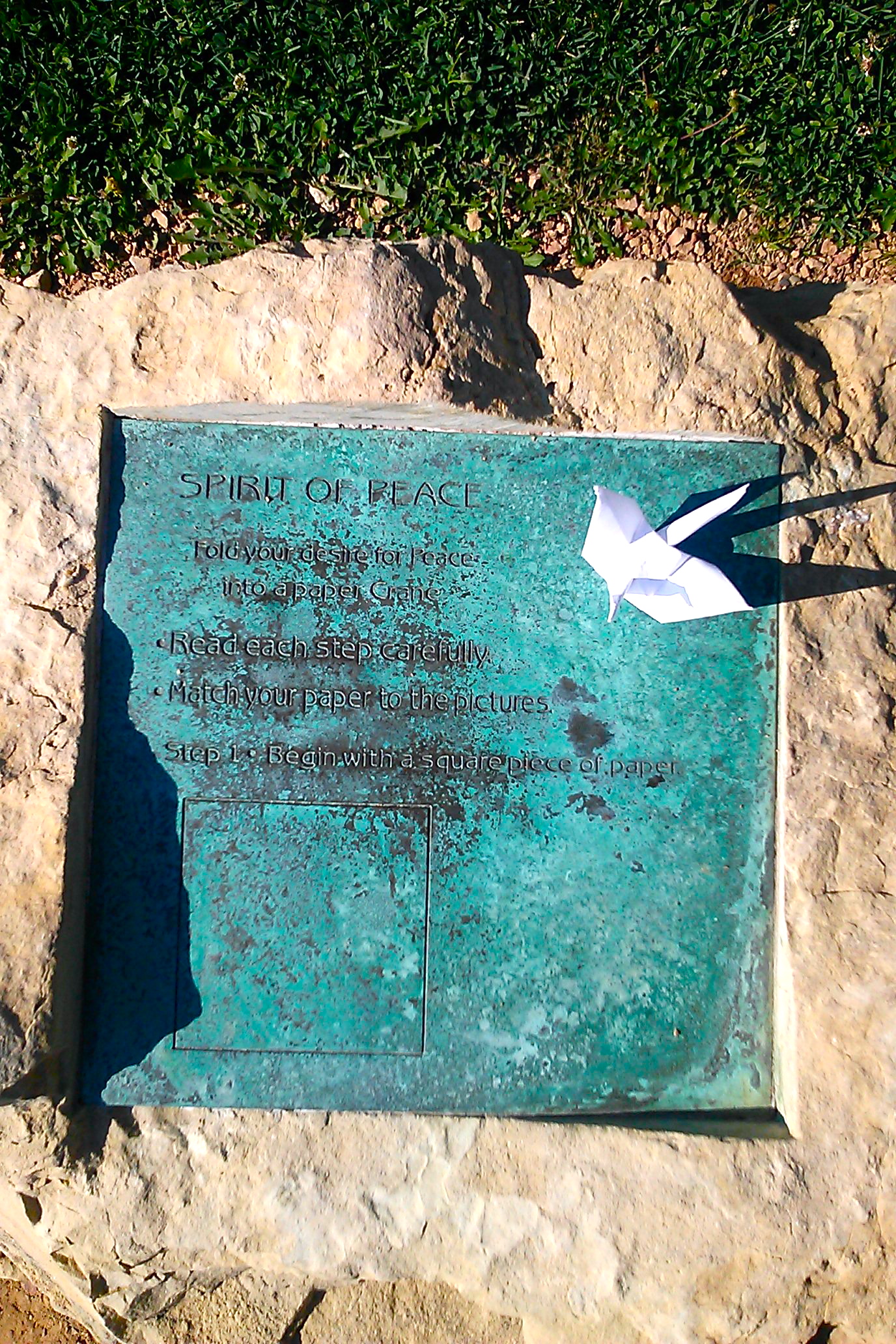
Image 2I don’t know the official name of the garden. I had seen it from my bike as I rode past. It looked like a quiet place to sit and think, across the street from its showier cousin, the Rose Garden. It wasn’t until after I had admired the little waterfall that I thought to notice the copper statue of a stylized crane, green patina-ed from the weather, or the boulders surrounding it. Each boulder contains a plaque, also weathered, with instructions for folding an origami crane. The first plaque begins, “Spirit of Peace: Fold Your Desire for Peace into a Paper Crane…”

I had come to the garden to contemplate a poem which came to me through circuitous routes, and which I knew upon my first cursory reading would require quiet and space. Here it is:

“I Want to Unfold” by Ranier Maria Rilke
 
I’m too alone in the world, yet not alone enough
to make each hour holy.
I’m to small in the world, yet not small enough
to be simply in your presence, like a thing —
just as it is.
I want to know my own will
and to move with it.
And I want, in the hushed moments
when the nameless draws near,
to be among the wise ones —
or alone.
I want to mirror your immensity.
I want never to be too weak or too old
to bear the heavy, lurching image of you.
I want to unfold.
Let no place in me hold itself closed,
for where I am closed, I am false.
I want to stay clear in your sight.
 

In the art of origami, a simple square of paper is folded in such a manner as to be transformed into something else, something other than itself. These days, I feel tightly folded, holding myself erect with the artificial strength of reinforcement from bent and pleated layers. I may appear to have wings, like the crane. But that is an illusion: I am earthbound, folded tightly in upon myself as a protection from all my self-doubt and fear.

I want to know my own will, and to move with it. That was, after all, the whole point of the changes which led me here. I felt I had a firm idea of it in April and May, but as the summer passed it slipped more and more from my grasp. August and it seemed to disappear altogether. My days are peaceful on the exterior, but inside they are a turmoil. I have folded my desire for peace, let alone to know my own will, so deep I can’t quite get my fingers on it.

I want to unfold. Let no place in me hold itself closed, for where I am closed, I am false. Closed equals hidden, equals secret. Why choose folded, to remain closed? Fear, shame, guilt. Fear of my own inadequacies; shame that after all of the grace and the love I am still much afraid; guilt for the ways (large and small) that I know I am failing the gift of this time.

Unfolding. Unfolding equals exposing, unearthing, truth-telling. Exposing my vulnerabilities (the snivelling coward that lurks in my heart); unearthing through careful toil my hopes and dreams; telling the truth about my uncertainties and shortcomings, but also my talents and courage (which share space with that coward).

I want to unfold. Because, unfolded, I am myself: a plain square of paper, open to the sunlight. Able to breathe because I am no longer tightly crimped. My pride wants me to “be among the wise ones — or alone”, but truthfully, I am content to be alone and small enough for this world. It’s only on my bad days I think, “Any smaller or more alone, and I would disappear.”

As I sat in the Peace Garden, contemplating the Rilke poem through the oddly curved lens of my current life-in-limbo, I wasn’t thinking about the Divine, or Rilke’s obvious desire for deeper connection and relationship with God. I wan’t thinking of peace. I was thinking about the falseness of being closed – of pretending to be less needy or more sure than I am. Of the artiface, not the art, of origami.

Image 4

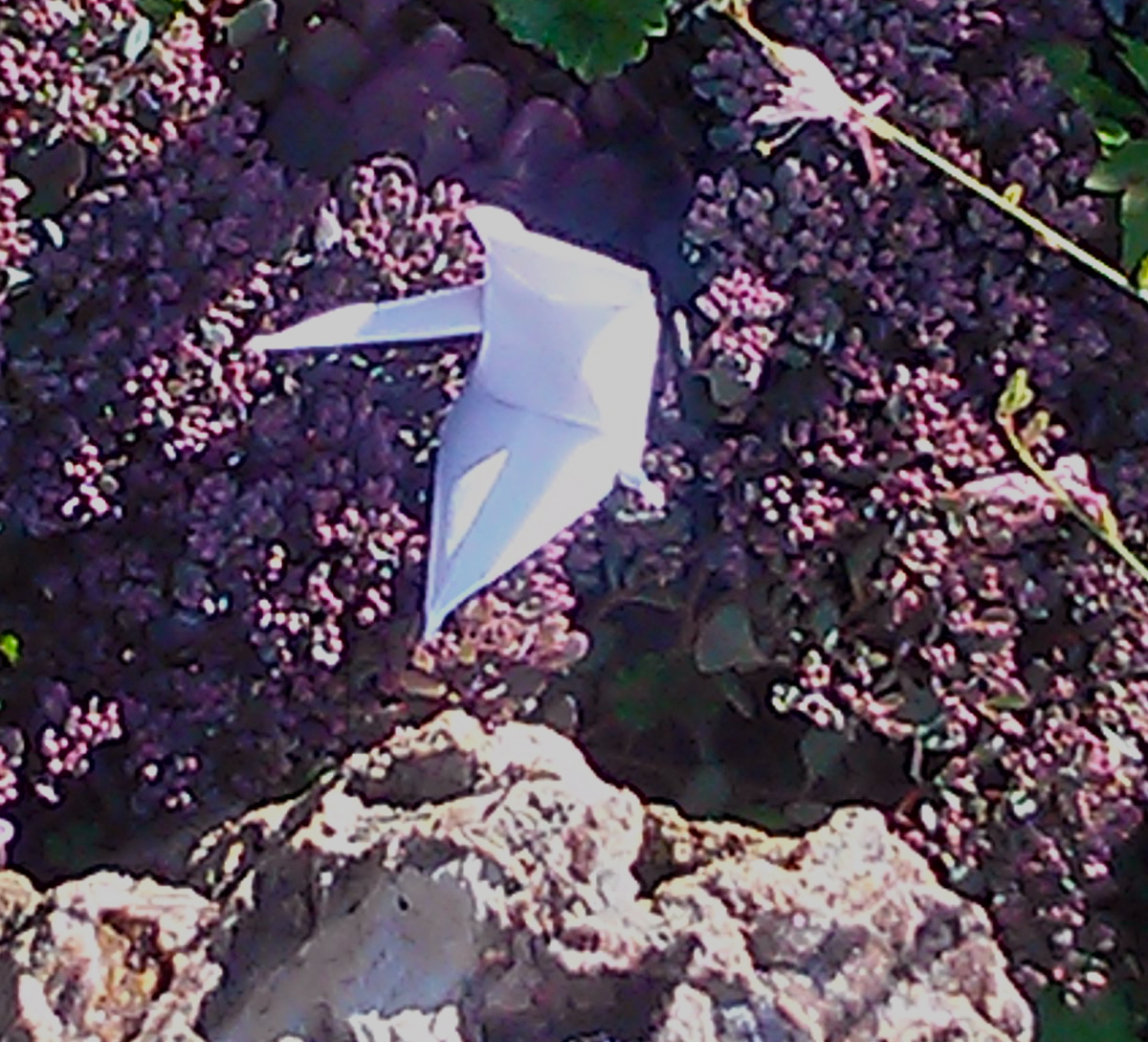
And then I saw it: one tiny white paper crane among the plantings. Fragile and pure, untouched by the dirt it rested upon. One wish, not the famous one-thousand, for peace. One tiny, fledgeling hope for something better. And I laughed, realizing that while a person should take care to remain unfolded, it is fine for paper. The paper crane was made more by folding, while I was less. Yet both of us yearn for peace – the peace that comes with understanding and compassion.

That peace must find a beginning in my own heart.

Image 3


Imaginary vs Real (or Polyanna vs Jenion)

When you write about your own life and its emotional and spiritual peaks and valleys, you want to find ways to connect that experience to other people’s inner lives so that they will be comforted (“I’m not the only person who ever felt that way”) or maybe even inspired (“It IS possible to achieve/get past/change my perspective on that!). Barring comfort and inspiration, perhaps readers will at least be able to think, “Oh, thank God that wasn’t me!”.  These are things I hope for, anyway, when I post my weekly blog reflection. The problem is that this desire can lead to writing not about my actual life, but about my imagined one – you know, that fictional life where everything makes sense and has some ultimate form of meaning. Before I know it, every post purports to be about some lesson or insight that encapsulates the world, ties up my experiences in little yellow sunshiny bows, and makes me sound like a Pollyanna.

Which I am not.

In my real, as opposed to imaginal, life, I am “hanging in there”. Not being as proactive as I probably should be, but not doing nothing, either. It’s the dry land equivalent of treading water – I’m keeping myself afloat, but not really going anywhere. Because I am especially self-focused right now, I have a tendency to be in close-up view, the scene pulled in tight on me: surrounded by space, arms and legs working hard but staying in one place. If the scene zooms out, there is a huge body of life around me, heavily populated. Some people are moving in swift racing form, others playing around with friends and loved ones, still others battling a rip-tide that threatens to pull them under. Eventually, in this wide-view, you’ll spot me, off by myself, seemingly holding still.

In my real life, I’m lonely a lot of the time. There’s a rabbit-hole that is easy to wander down when you feel lonely. It takes you to a place where you allow yourself to think that other people are responsible for your happiness. And your inner voice becomes petulant and whiny, like the nine year old you once were, complaining that someone “stole” your friend. I hate hearing my own voice sound that way, hate this particular rabbit-hole. I do my best to avoid it, but it isn’t always easy to recognize until I’m in and suddenly tune in to the whining.

In my real life, my old friend, Generalized Fear, arrives at my doorstep most days. He barges in and sits for a spell, even when I tell him in the strictest terms to go away. People sometimes ask which I’m more afraid of – success or failure. I laugh at that question, because I fear them equally, as I fear most things. That’s what GF has taught me over a lifetime of hanging out together (even though I haven’t wanted him in my life).

But here’s another truth about my real life – and I’m not imagining it at all – every day I feel more convinced that I am in the right place.

When I picked Minneapolis, I had good, solid reasons for doing so. My awesome life coach, Charlynn Avery, gave me the assignment of researching which cities met certain criteria based on the lifestyle I hoped to establish. Minneapolis came out at or near the top of every configuration I tried. I also had a gut feeling, based on numerous visits over the past few years, that it would be a good fit for me.

When I opted to take this quirky apartment in the same building as Mike’s, I said I was doing so for expedience – it was a good deal, in a neighborhood that may not be perfect but at least I was familiar with. Mike would be easy to find if I had questions or needed anything. But my intuition also whispered that this was a good place for me to begin.

I’m not always a good one for trusting my gut feelings or intuition. And most of my family and friends don’t trust them either – so there were many concerns expressed and questions asked about my choice. I mostly responded with the facts, rather than get too caught up in a discussion of feelings. I guess I wanted people to think I had thought this through very carefully, weighed all the evidence and possibilities, and chosen the one that made the most objective sense. And I did…but the actual decision was based on my heart – my intuition and guts led my heart to be set on this place.

It is too soon to know how this will all turn out. How hard or how easy will it be to establish myself here. I don’t have any sense, yet, of how or where I will make a living, for example. I haven’t actually made new friends, though I’ve met some cool people and had some great experiences.

I remember being here a couple of years ago in mid-winter, a snow storm raging around me. I bundled up against the below-zero temps and headed to the Starbucks two blocks up. As I drank my very hot Americano surrounded by the Somali cabdrivers who hang out there between fares, I had a vision of myself living here. Walking to markets, to coffeeshops, to little organic restaurants. Feeling at home with the beat and pulse of life in this city. Not even the winter reality deterred the appeal of that vision. But it was just my imagination.

In my real life, late afternoon yesterday found me walking to The Wedge, a grocery coop not far from here. On the way, I discovered a tiny farmers market in the church parking lot across the street from Starbucks. I took a detour to check out a small florist around the corner on Nicolette. As I walked, I knew which cross streets were one way, which had stop signs or not. I watched for familiar sights along the way (particularly some lovely gardens), nodded at other people passing on the sidewalk. I had the sudden realization that I am growing to love my neighborhood – and that my definition of neighborhood is expanding as my comfort level with the area is expanding. I could envision the same walk through the changing seasons. Later, as I ate the nutritious meal I prepared from my purchases at The Wedge, I looked around my strange little apartment and felt at home.

Maybe there IS a lesson here, an insight about trusting our intuition. Real life isn’t always easy, it is sometimes messy and frustrating and lonely. We don’t always like the person we see in the mirror (or hear in our heads). But there are bigger pictures and deeper truths that exist at the same time, within the same space, as all the flawed realities.

And if that ties things up too neatly, or makes me sound like a Pollyanna…then so be it.

Any Place I Hang My Hat Is Home

Image

As we were leaving church after the service, slowly processing out in single-file, my mother stopped the man in front of me.

“Mike! Mike! Is this your hat?”, she asked, handing him a straw cowboy hat.

“Yes, ma’am it is. Almost left without it!”

“Did you see my daughter taking a picture of it?,” Mom asked.

“Is that what you were doing?,” Mike asked me. “I wondered.”

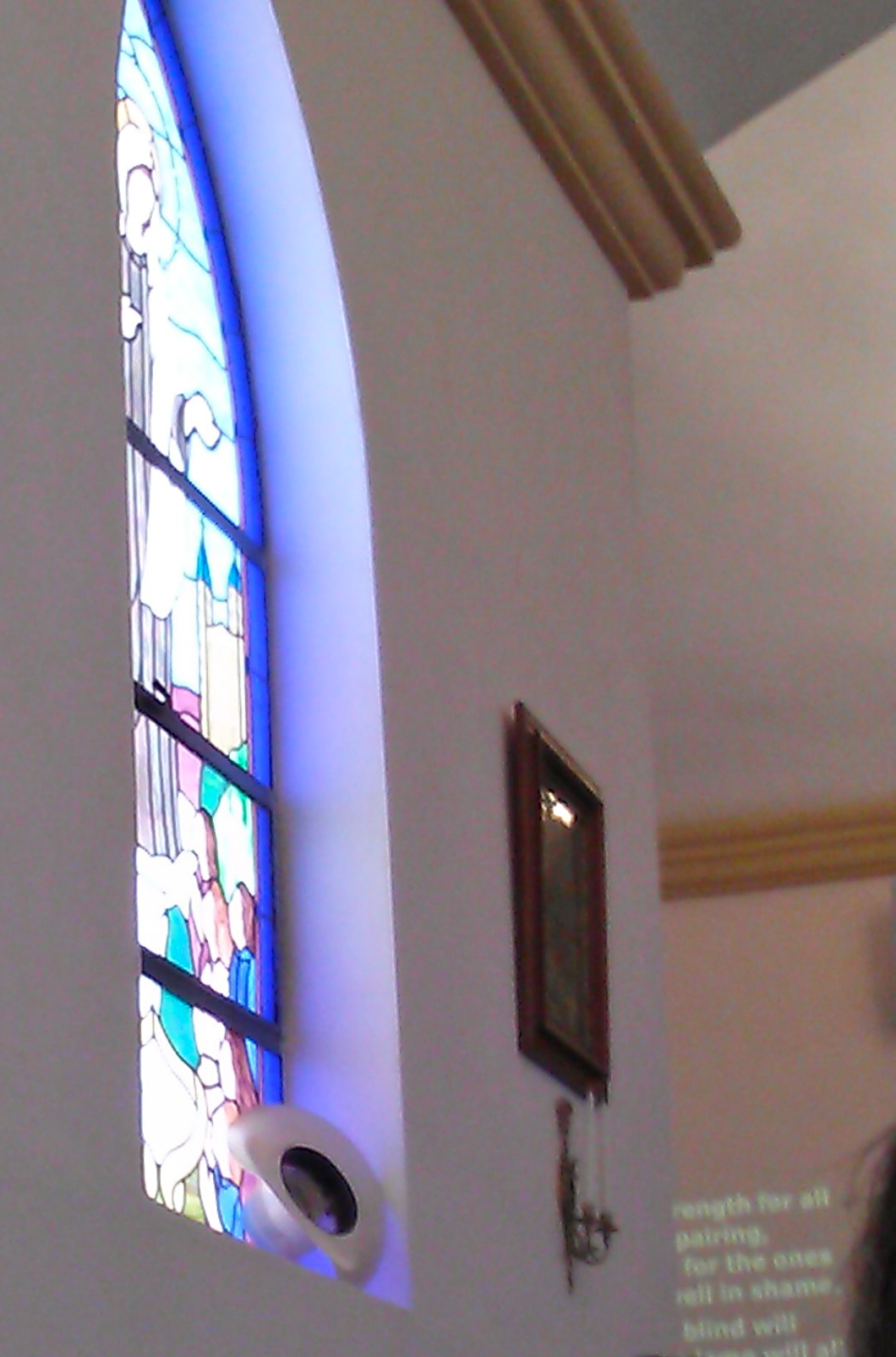
“Well, you just don’t see that in Iowa,” I said, referring to the cowboy hats left resting on the adobe sills of many of the church’s stained-glass windows.

Mike frowned. “Don’t they allow hats in the churches up there?”, he asked.

* * * * * * * * * * * * * * * * * * * * * * *

A brief conversation was all that was needed to explain that most midwestern churches don’t have thick adobe walls and, thereby, deep window ledges on which to rest hats. And that most men don’t have expensive Sunday hats – their feed caps are left at home or in the car during church services. However, as I departed Nativity of the Blessed Virgin Mary Catholic Church, the cowboy hats sparked a train of thought. I was thinking about the phrase “Any place I hang my hat is home”.

Home. Always an evocative word, but especially so now, when I find myself both unemployed and homeless (albeit both busy and sheltered). Where is home for me now?

At mass on Sunday, I felt at home. Although I am by no stretch of the imagination a practicing Catholic, my spiritual life began in the Church. Despite years of choosing not to participate, I find that Catholicism’s rites are comforting to me in times of upheaval and change. As comforting as it may be, though, I don’t really think the Church encompasses the definition of home for me.

When, as now, I am staying with my parents, I think of myself as at home – though I’ve never actually lived in either this house or in Rio Rancho. The last actual structure I shared with my parents was on Andrew Court in Dubuque, Iowa 30 years ago. Whenever I find myself in Dubuque, I think of it as my hometown. I also feel deeply connected to the Mississippi River, and regardless of which state I am in when I see her rolling waters, I have a sensation of home.

Interestingly, I lived in Cedar Rapids for 17 years and never thought of that city as home. Instead, I thought of the people who populated my life, though they bore no blood relationship to me, as family. Since “family” is what typically populates “home”, I suppose in some sense Cedar Rapids could be considered home. Mount Mercy University probably deserves that appellation, though I’ve definitely left that home in my past.

After racking my brain to answer the question, “Where is home for me now?”, all I was able to come up with were bits and pieces. The truth is, while home may be a physical place, when we say home, we so often mean something more than mere geography. In a 2011 article in The Atlantic, Julie Beck writes, “If home is where the heart is, then by its most literal definition, my home is wherever I am.” When I read it, that statement struck me as the same level of cliché as “Wherever you go, there you are.” Obvious. Literal. True. But missing the point. My beating heart is wherever I am physically located, but my feeling heart is often elsewhere. Despite my best efforts to live in the present moment, I find that I am divided – that my emotional heart has left pieces of itself – among many homes.

In the weeks leading up to my move, I felt courageous and strong. I have rarely felt as grounded and ready for the future as I did at my going away party, surrounded by my oldest, youngest, and many of my dearest friends. Realizing this, I did a quick inventory of the recent past and discovered that, as I have developed stronger and more meaningful relationships, I have also felt less fear in new situations: sightseeing on foot alone in Philadelphia; losing my way on a detour and self-navigating out of Chicago’s Loop; a host of smaller solo adventures. It seems that having a deeply rooted sense of belonging or connectedness, of an emotional home, is key to maintaining a sense of courage and adventure – is central to holding an idea of myself as strong enough to keep venturing into unknown territory.

And having that connectedness for several years now, I was unprepared for the fearfulness I felt this week in ordinary situations I would typically take in stride.  On Monday morning, for example, I was nearly paralyzed with fearful indecision about where to ride my bike. Every choice seemed dreadfully scary.  In the Harry Potter novels, the character, Voldemort, split his soul and placed pieces of it in a variety of objects called horcruxes. These horcruxes preserved his immortality but left him vulnerable. That is how I felt, suddenly. Like I had left a piece of myself with each of the people who gave strength to my sense of self, and who were now separated from me by great distances. I felt very vulnerable. I found myself wanting to cling to my parents, the warmth of their physical presence comforting me.

Thankfully, I’ve learned that when fear and anxiety begin to ratchet up, it’s best to take a time out and practice some good mental hygiene. So I spent some time in reflection, thinking about the difficult nature of transitions. After some quiet thought, prayer, and deep breathing a couple of simple truths occurred to me. First, I’m already mid-leap. The time for fear, if there was a time, was before I quit my job, packed all my belongings and stuffed them in storage. If my life were a game of poker, I’d already be all-in.

Second, the horcrux analogy is flawed. I haven’t left pieces of myself behind with the people I love. We’ve spent years building those relationships, binding our hearts to one another’s with cords that are flexible (and stretchy), but incredibly strong. And while I am vulnerable because of these relationships, it is the ordinary vulnerability that we all risk when we open our hearts to another person, not a fatal flaw like Achilles’ heel. This kind of vulnerability is, paradoxically, necessary to the development of strong relationships – and to the development, at least for me, of a strong sense of self-efficacy.

After I realized these things, I could once again think about the concept of home without panic. So what if I don’t have a physical location to designate as “Home” at this very moment? Maybe it is cliché to think that if home is where my heart is, wherever I am is home. What’s so wrong with being cliché sometimes? I’ve brought the strength that I receive from the love and support of friends and family with me, as surely as I arrived in New Mexico with a framed photo of the extraordinary women who make up my book club. Their smiles remind me that, while I may be required to face my fears alone sometimes, I will be loved whether I meet with success or failure. And isn’t that part of home, too? They’ll take you in, at home, no matter whether you succeed brilliantly or fail miserably.

After all of these musings about the nature of home, and its meaning for me during this moment of transition in my life, I had to smile when I received a text from Minneapolis, a city I’ve never lived in. It contained a photo of kites and the line, “We are so doing this when you get home.”  Still smiling, I grabbed my bike helmet (the closest thing I have to a hat) and headed out the door to face my “scary” biking options.

I guess, after all, it’s true what they say: “Any place I hang my hat is home.”

The Goodbye Girl

In 1977, the movie “The Goodbye Girl” was released. The movie starred Richard Dreyfuss and Marsha Mason, who mostly didn’t screw up the screenplay or Neil Simon’s characteristic fast-paced dialogue. To top it off, the movie’s theme song was written and performed by David Gates – that’s right, David Gates of the supergroup “Bread”. There was not a thing about the film (or the song) that my 16-year-old self didn’t love.

One of the reasons I loved the film so much was that I identified with the title: The Goodbye Girl. My family moved around – not a lot, but more frequently than most of the kids I knew, who had been going to the same school, with the same kids, since kindergarten. I saw myself as the girl who was forced to move on just about the time I got good and settled someplace. I was always saying goodbye, and it was usually permanent. In the movie, I didn’t really care for Marsha Mason, but I completely saw my jaded, highly defensive, young self in her character’s self-protective snarky-ness.

Given this self-concept, a song lyric that promised, “Goodbye doesn’t mean forever”  was pretty appealing. I can remember singing it with my friends, Pam and Steve, as we hiked back to our car one night in Cincinnati after attending an England Dan and John Ford Coley concert. This was just a couple of weeks prior to my family’s move from Ohio back to Iowa at the end of my junior year in high school. “The Goodbye Girl” lyrics were our promise to each other – “Goodbye doesn’t mean we’ll never be together again” – and it was our theme song from the day I told them of the impending move until the day I left town. I wanted it to be true, a promise I wouldn’t break. But in my heart, I suspected otherwise.

After returning to Iowa, I lived in Dubuque for seven years. Then Iowa City for nine. But even though there was continuity in the towns, I changed locations/homes and occupations frequently- college, graduate school and my first few professional positions meant a continuation of the goodbye theme. People were always coming and going in my life. I thought I was pretty good at goodbyes, and I maintained a certain stoicism through “goodbye” moments which I took as evidence of my skill.

What I didn’t understand until much later was that I wasn’t good at goodbye, I was actually good at never saying a truly open “hello”. After not letting anyone get too far under my skin, too close, when it came time to say goodbye, I could just let go. And I was really good at that.

Then I came here. Two years, the duration I originally signed on for, somehow became nineteen. And while there have been plenty of goodbyes – it is a college campus, after all: a fresh crop in each fall and a mature crop out each spring – there has been a great deal of stability, as well. Facebook, twitter, texting have all exploded during this time, impacting the ease and affordability of staying connected. I’ve changed in important ways, including intentionally opening myself to close relationships, even bringing some of those people I “just let go” of in the past back into my life.

All of which begs the question, as I prepare to leave, am I still The Goodbye Girl?

Of course, the first and most true answer is no. I never really have been. I’ve gotten it wrong in the past – refusing to get too close so goodbye won’t hurt isn’t a good or life-affirming coping skill. Burrowing in and creating a warm cocoon that I refuse to leave despite every part of me – head, heart, soul – urging me to move on isn’t a great approach either. And the truth is, I’ve been stuck in this warm, loving, cocoon for a long time: an incipient butterfly afraid to test my wings. Afraid that goodbye really does mean forever.

In the movie, Richard Dreyfuss’ character gets an acting job that requires him to leave to do a film on location. Marsha Mason’s character believes he is leaving her forever, and she tries, fiercely, to accept that and to stave off hurt. Then she discovers that he has left his prized possession (a guitar) behind – a sure sign that he will indeed return to her. Two weeks from today I expect to be on the road. I will have said my goodbyes to the campus, to the  women at Sister’s Health Club, to my colleagues and acquaintances. To my friends, to the families I am part of here, I will have made promises: to stay in touch, to come visit, to not be afraid to ask for help if I need it. I will be taking my prized possession with me though – this open, trusting, healthy, whole Jenion that you have all helped me to become. So it comes down to this: I know I’m not the girl I used to be. I trust that I will be able to stay centered within myself even when I am no longer anchored to this place. And I trust that the people, who make this place so important to me, will not disappear from my life like a puff of smoke – I have different, better, coping skills now. One of these is the knowledge that my home is right here in my heart, and it comes with me wherever I go. And those of you who populate my home do too. So I take courage and comfort from the words of the incomparable David Gates:

“Though we may be so far apart, you still would have my heart. So forget your past, my goodbye girl, cause now you’re home at last.”

(Note: for those of you who don’t know the song, here’s a link. It is way too sappy to actually include in the post! The movie is a classic, if you haven’t seen it.)