
What Shapes Us

Kasha-Katuwe Tent Rocks National Monument

On our recent road trip to New Mexico, my family took Mike and I to Kasha-Katuwe, better known as Tent Rocks. The unique landscape was originally formed by massive eruptions in the Jemez volcanic field, which “spewed pyroclasts (rock fragments), while searing hot gases blasted down slopes in an incandescent avalanche called a ‘pyroclastic flow’.”  The resulting formations are spectacular.

We climbed a little over 1100 feet (from an altitude of 5570 to one of 6760), taking in the most amazing views of both the tent rock formations and the surrounding New Mexican landscape.


Tent Rock formations
Tent rocks in foreground, mountainous New Mexico in background

One of my favorite parts of the hike, both on the way in/up and on the way back/down, was the trail leading through the slot canyons. Over time, wind and rain have carved canyons and arroyos into the rock, creating passages (like the one pictured at the top of this post) of surpassing beauty. For most of the morning, we hiked through 100 degree temperatures, thin air and a burning sun. These canyons of layered rock were hushed and cool by comparison.

The stillness of the canyons gave rise to contemplation. Like the rock, which was shaped by the forces of nature, we too, are shaped by the vissicitudes of life. Our choices, our experiences, who we love and how we learn – all have a role in shaping us. Therefore, it seemed especially poignant to share this experience, and these thoughts, in companionable silence with Mike.

We met when I was 18, Mike 19. We were still fresh, unmarked clay. Our faces shone with, as J.D. Salinger put it when speaking of college students, “the misinformation of the ages”. Over the next few years, we shared some powerful experiences as each of us attempted to discover the direction of our lives. Eventually, though, we found that we were bound in different directions, and we parted ways.

The weathers of life – births, disappointments, marriages, jobs, successes – had their way with us over the next thirty years. Molding and shaping us into mature adults, careworn and wiser (we hope). And then, surprisingly, bringing us back onto each others’ paths. Under the extra pounds, the gray hair, the wrinkles, the familiar past could be glimpsed. Only now, the layers and textures add depth and surprise. They offer possibilities that didn’t exist in our earlier friendship: wisdom and generosity of spirit, compassion and forgiveness. Human capacities with which youth is often barely acquainted.

So tonight, back home in my little house in Iowa, I am thinking of Kasha-Katuwe and the lessons it taught me. Time makes shape-shifters of us all. I am grateful for this learning. I am grateful for this earth which teaches me. And yes, Mike, lest you think I left out the most important part (again), I am grateful for your company on this path.
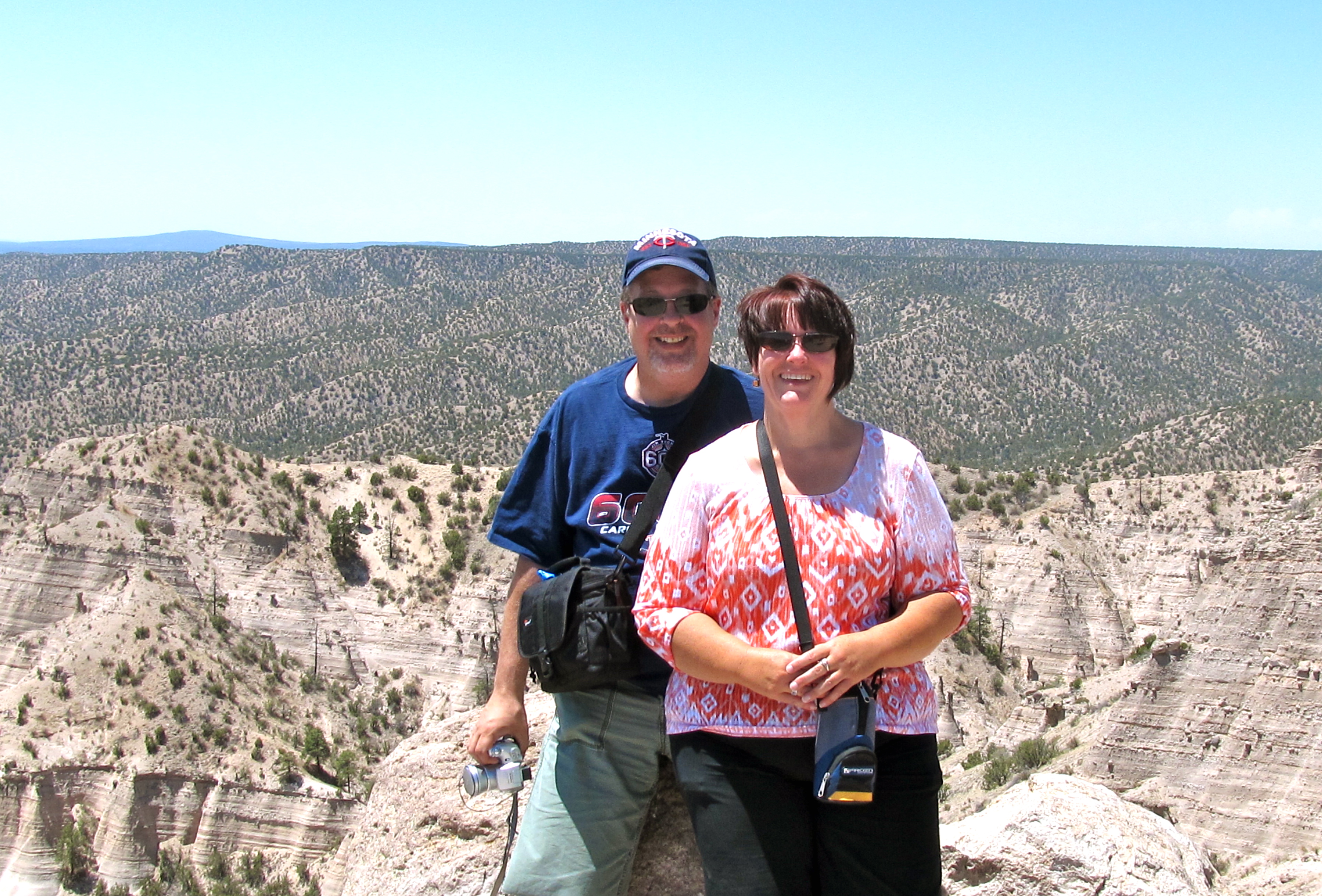
Mike and I, at the top!

The Guest House

A week ago Sunday evening, I drove a college van to the small town of Vinton, Iowa. We were a subdued group on the drive out, befitting the nature of our trip: to attend a visitation for the father of two of our students. At our arrival, there was a line out the door of the church. When we were finally allowed inside by the local fire department, I was stunned to see several hundred people waiting to make their way , single file, past the open casket and through the line of close family accepting condolences. It took our little group two and a half hours to process through. Along the way, we learned a great deal about the man whose death had brought us there. His was a story of love, engagement with the community, commitment to the people and activities of his life. While maintaining strong relationships outside the home, he also  supported and encouraged a truly loving family and helped raise some pretty wonderful human beings. Through the course of that day, literally thousands had come to pay tribute to his life.

On Tuesday of that same week, my sister underwent major surgery. When we spoke late on Monday, she was attempting to get one more workout under her belt before having weeks off her regular routine. What surprised me, throughout the process of determining the nature and extent of the surgical response to her cancer, was that every conversation included her words of gratitude for the blessings bestowed: that the cancer had been caught early; that she had competent and up-to-date doctors and surgeons in her small town; that she had trust in God and the unfailing gentle-kindness and support of her husband. After the surgery – more of the same, in a slightly more tired voice.

Adeline Bell Finnegan was born on Thursday, January 12 at 7:06 pm. She weighed in at 8 lbs 12 oz. and was 21″ long. My great-niece was welcomed into this world with much rejoicing – on the part of her parents (Ben and Elsa); by her aunt and uncle (Tim and Nikki) who arrived for her trip home from the hospital; by her Grandma Chris whose (almost) only verbalized complaint about her cancer recurrence was that she wouldn’t be there in person to welcome Ada. And by the rest of our “clan”, as my sister Annie posted on Facebook.

Sunday through Thursday – five days. But in those five short days, so much to learn, to process, and to celebrate. Three of the major human life events: death, illness, birth in such a short span of time. Those five days touched me profoundly, in ways I don’t have the grace to articulate. Luckily, the great poet Rumi said it for me, centuries ago. He tells us to welcome every experience which comes our way, even “if they’re a crowd of sorrows…treat them honorably”  because each experience brings a gift as well. And so I am practicing being the proprietor of the guest house of my heart – throwing open the doors to all who seek admission, with gratitude and welcome even for the difficult guests.

The Guest House

This being human is a guest house.
Every morning a new arrival.

A joy, a depression, a meanness,
some momentary awareness comes
as an unexpected visitor.

Welcome and entertain them all!
Even if they’re a crowd of sorrows,
who violently sweep your house
empty of its furniture,
still, treat each guest honorably.
He may be clearing you out
for some new delight.

The dark thought, the shame, the malice,
meet them at the door laughing,
and invite them in.

Be grateful for whoever comes,
because each has been sent
as a guide from beyond.


Flashback Friday – Nice Ride, Brother!

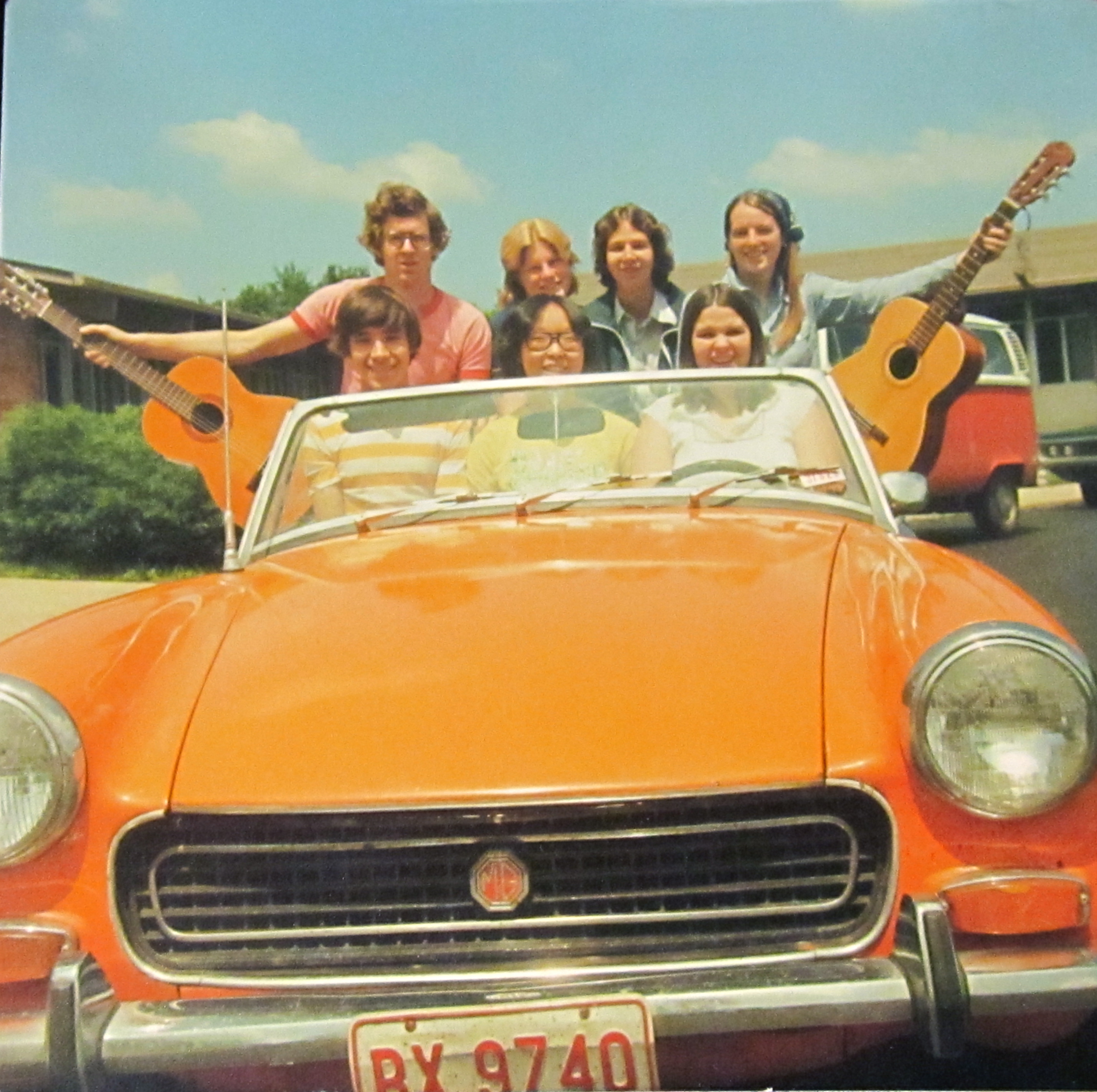
It was 1970-something. Back row: Dave, Debbie Ross, Stephanie Beller, Marla St. Clair; Front Row: Jeff Hanson, Susannah Ross, me.

The car belonged to my friend and youth-group leader, Dave Finnegan. From the first night we met, at a Tuesday night Inter-Church Youth (ICY) meeting, I thought he was awesome. Gentle of spirit, kind, and incredibly smart. Not a bad volleyball player. Or too shabby with that guitar.

In the ensuing 35 or so years since we met, Dave has been an important influence on my life AND a member of my family – he and my sister Chris were married a couple of years after this photo. They raised two amazing sons, my nephews Ben and Tim, together. And they have weathered more than their share of serious illness – Dave faced several bouts of cancer, culminating in a Stage IV diagnosis and a grueling experimental treatment program at M.D. Anderson in Houston (he has been cancer free since then, approximately twenty years). My sister, Chris, will have surgery on Tuesday for her second round with breast cancer.

What I want to say about Dave in this Flashback is that I couldn’t have chosen anyone better for my sister’s life companion. You know how it is with in-laws: they marry into a family like ours (big, loud, opinionated) and can spend years figuring out how not to be chewed up and spit out. Dave maintains his calm, faithful and principled presence – occasionally making us groan at his terrible puns. In the coming weeks, he will be the gentle rock upon which my sister will lean – and by virtue of his presence where we can’t be, we will all lean on him to an extent (poor guy). After more than three decades, I can  say with complete trust that he’s up to the task. I thank God, and my brother Dave, for that!

Of Photographs, Memories and Hope

As our plane left the ground, I watched our ascent – marveling at the sheer number of blinking lights, like strange red sparks, buzzing around us in the dark sky. I worried for a brief moment that we would collide, but we were well-choreographed by unseen air-traffic controllers. I relaxed. Suddenly, a scene of spectacular beauty appeared, perfectly framed in my window: the lights of Dallas spread out below as far as the eye could see; above them, the blackness of the night sky was pierced only by the blue-white sliver of the crescent moon. I was transfixed.

I thought, fleetingly, of the camera safely packed in the bag wedged under the seat in front of me. But I immediately knew two things. First, I would never be able to get to it in time, and the moment would be lost. Second, even if I did manage it, no photograph could capture what I felt about the expansiveness of the universe as I looked out that little window.

And that moment, dear friends, exactly mirrors my experience as I sit at my computer now to write about the  past year and look forward to the coming one. I cannot begin to capture the wonder, joy and sheer fun of the events comprising 2011, or the quality of hope I am feeling for 2012.

2011 has been a banner year for me: I turned 50, which feels not at all like my younger self imagined it would (thank you, God!). This was the year I fell in love with cities – Philadelphia, Denver, Chicago, Minneapolis. For the first time in my life, I travelled alone and explored with curiosity and excitement but without fear. At home, I renewed my love affair with the eastern Iowa landscape, viewing it with awe from the saddle of my bike (my bottom comfortably cushioned by chamois) both on training rides and RAGBRAI. March and April saw a renaissance of my passion for ideas and translating them to my daily, lived choices – especially as they relate to my vocation. I brushed elbows with activists who are impacting local, national and international communities – and was reminded that to act from my core beliefs is the important part of having core beliefs. I experienced the sheer joy of putting my arms around friends I hadn’t seen in decades. Looking back, I cannot believe the incredible experiences packed into this year!

More importantly, I am astounded by the gifts showered upon me in 2011 – the love of family and friends, the opportunities to learn more about this world we share and about the world inside of me. I learned about the single-minded-ness required to push past physical limits, and (strangely enough) I now understand a fraction of what true athletes experience. I’m learning to keep my heart open in spite of hurts; letting go of shame over what I feel; learning to speak my truth without riding roughshod over others and the truths they hold deeply. I am learning that all kinds of energy can, and likely will, come at me in a given day BUT I can hold my center and respond from my authentic self. Of all the insights from this incredible year, that is the most freeing and empowering one.

Given the fullness of my life, and the giftedness of 2011, it seems almost criminal to hold out my bowl crying, “Please, sir, may I have some more?” And yet, I hold out that bowl with hope, not demand, in my heart. I pray for healing where illness and despair currently reside. I pray for us to be awake in our lives, rather than sleepwalking through them as our modern culture so encourages. I humbly ask for the wisdom to act rightly in my life, and to recognize the incipient gifts in each moment, each challenge, each joy. May 2012 be a year of growth, happiness, and true spirit for each of us.

Happy New Year, friends!

Happy Holidays?!

Tis the week before Christmas, and all through my house,

not a present’s done wrapping, I feel like a louse!

The time is speeding by, it soon will be gone, 

with not much to show for it, at Christmas’ dawn.

When what to my wondering mind should occur?

With a to-do list to guide me, this week I’ll endure!

JENION’S PRE-CHRISTMAS TO-DO LIST

  • Update flash player on work computer in order to stream Christmas music 24/7
  • See Jen Tally to have my mustache removed  hair done
  • Call family members to wish them a Merry Christmas and assure them “pakages are in the mail”
  • Vacuum dining room multiple times to clean up glitter from holiday crafting “experiment” gone wrong; realize you now have a deep red area rug that permanently sparkles
  • Regale friends and co-workers with humorous – or do I mean scary? – stories of Christmases past (such as the time the house filled with toxic fumes and we began Christmas camped out at Perkins; we actually found the bottom of the “bottomless pot” of coffee)
  • Borrow Xanax Meditate on maintaining inner peace at the airport
  • Compare and contrast at least three film adaptations of the Dickens Christmas classic about Scrooge
  • Regale friends and co-workers with touching – or do I mean scary? – stories of Hanson Family Christmas Rituals (such as my mother’s traditional “Wait, I have to go to the bathroom!” exclamation just as we are about to go downstairs to see if Santa Claus came)
  • Schedule at least two more opportunities to listen to John Denver and The Muppets “A Christmas Together” – don’t forget to say out loud how angry you still are that they left Fozzie Bear’s rendition of “Have Yourself a Merry Little Christmas” off the CD (it was on the original vinyl album circa 1979)
  • Buy another box of 50 Christmas cards because you are certain the first box of 50 won’t be enough cards NOT to send out this year.
  • Try not to shout at other drivers. Santa or his elves may be watching.
  • Remember to say “Thank You!” and “Merry Christmas” to your sales clerks, postal carrier, the housekeeping staff at the office, and God.
Note: My last couple of posts have been very serious, so I wanted to share something a bit more lighthearted as we head into the long Christmas weekend. Despite the list, above, I’m just about ready for the celebration and time with my family. I want to wish each of you a very, very, merry Christmas. May we all remember to cherish the moments of love and laughter that come our way and to take at least some time out of our hectic rush of celebrations to allow gratitude space to flourish in our hearts. Peace to you and yours, and to this wide, beautiful world we call home.

Other Duties as Assigned

I was 35 years old when I accepted my first position in Residence Life, and moved into an on-campus apartment. In my career, as in so many other areas of my life, I did things backwards. Most people do their live-in position(s) early in their careers – when they are young.  With good reason.

My boss gave me a welcome gift on my first day: a  “survival pack” containing a roll of duct tape and a channel lock wrench. And that’s when I had my first true misgivings about the job. I had been working in professional student affairs positions for ten years, advising and educating students. Nothing I learned in my graduate program in Counselor Education or in any of my previous positions suggested that duct tape and/or a wrench would be useful tools in my profession.

We were seriously understaffed, and I was responsible for a 24/7/365 operation, sometimes without any assistance (though usually overnight, weekend, and holiday coverage was split 50-50 between myself and one other staff member). While the schedule was grueling, and the responsibility sometimes crushing, I loved my job with an intense passion. There was constant stimulation (I often saw 2 a.m. in my office, hanging out tossing a baseball with students or having a Minesweeper tournament on my computer while filing paperwork). There was the regular adrenaline rush that came with beingthe responder to all types of emergencies (busted water pipes, acute alcohol intoxication, a high-speed police chase driving across the residence hall lawn). And there were the Night Guys.

Have you ever seen those movies where the items in a store or toy room come alive at night, when the humans go home? A small college campus is a little like that – it comes alive in a completely new way at night. The seasoned professionals go home, the intellectual crowd thins, whole buildings go dark. And the remaining spaces come alive with students, completely at home and indulging in a proprietary swagger they don’t show during the day. At night, I was the ranking administrator and most things came my way: behavior issues, strange questions, facilities problems. I quickly realized that it was me and a few hourly night crew – housekeeping and security – who would be expected to find a way to deal until daylight.

Most of the Night Guys were engaged in solitary work, cleaning offices and classrooms in empty buildings or making security rounds with Detex wands tracking their progress. On breaks, they were grateful for anyone to talk to. We had almost nothing in common, me and the Night Guys (Dave, Lorenzo, Carlos, Dick, Ed, Jim and others). But we talked about their lives and their job complaints, and we shared lots of pizzas. We wet-vac’d together more times than I can recall, we sheltered in the tunnels during tornado season, together we were vigilant for the safety of our students. They called if they saw an intoxicated student vomit on her way up the hill from the parking lot (then they cleaned up the mess). They were with me in the aftermath of the tornado that hit in the middle of the night, taking down dozens of old trees on the campus. Together, we checked for the safety of people and buildings, readied an empty apartment when we deemed one roof damaged and possibly unsafe.

They watched out for me. In the winter, they shoveled my car out after the plows went through. They came running when I screamed after seeing a mouse in my apartment. They said, “It was a late one last night. Why aren’t you in bed tonight?” or “They should pay you more,” or “That kid should be more respectful to you.”

I learned a lot from the Night Guys. I learned that sometimes the people who are most overlooked in a workplace are among the most committed to doing a good job. I learned that a quick, sarcastic wit isn’t the only kind of humor that can make you laugh – so can self-deprecating stories about flubbing a simple task, or someone’s terrible Sean Connery impression especially if you’re not expecting it. I discovered that it doesn’t much matter whether someone is entirely scrupulous about personal hygiene if they are kind and generous of spirit. I learned to admire someone who instinctively gets how machines (and boilers, and toilets) work. Most importantly, I learned that my master’s degree did not mean I knew more than others. It just meant I knew different things.

Over the years, my job and the campus have changed. I no longer work multiple 18-hour days in a week, and I live in a detached house, rather than in an apartment one flight up from my office. Weekdays, I head home at a decent hour, and eat a dinner I cooked, rather than another “all you care to eat” meal in the dining hall. Occasional late night crises are addressed as quickly as possible, and I don’t linger to shoot the shit with whomever happens to be around. It has literally been years, now, since I personally used a channel lock to shut off a running toilet. The Night Guys have moved on too: retired, transferred to day shifts – or continue with their work at times and in campus corners where I rarely interact with them. Mostly, I prefer it this way now, though sometimes I run into one of the Night Guys and it strikes me that I miss the old times. I know I miss the guys, but I hope I’ve held onto the valuable things they taught me.

Perspective

I remember an art teacher trying to explain the concept of perspective in drawing class. Intellectually, I got the concept, but when I put pencil to paper, I could never quite make it come out right. Those long railroad tracks disappearing into oblivion always curved in a strange way that would have derailed a train had one ever ventured down them.

This week, I’ve been thinking a lot about perspective. In art, perspective allows us to see objects in three dimensions, although they are on a two-dimensional surface, in a way that looks realistic. In life, perspective is also about seeing things realistically. It can only be achieved when we allow the plane of our own understanding to intersect with that of another (or others), thereby bringing depth and dimension to our vision of the world. And richness to our experience.

When I was a kid, I often faulted my mother for things. On Crazy Hats Day at girl scout day camp, my mother produced two crazy hats she had made – one for me, one for my sister. I thought my sister’s was cute and mine was embarrassingly ugly. It occurred to me too late that it might hurt my mother’s feelings if I told her so. I had been thinking about it in only one dimension – never considering that my mother might view it differently. I was a kid, though – and kids aren’t supposed to understand perspective. You’re supposed to gain perspective as you learn things like empathy, or the adage, “Walk a mile in my shoes.”

As an adult, it can be surprisingly easy to lose perspective though you’re not supposed to. To revert back to the kind of thinking that only considers me: my experiences, my feelings, my hurts. It is frighteningly easy to devolve into “poor me-ism”. This past weekend, I was so there. It was my on-call weekend, and things refused to go right. Saturday night/early Sunday morning, I was called to go to campus and untangle a series of events which took the entire night to sort through, and which included deeply emotional students and concerned parents, and a complex series of life events and issues. I returned home around 7 a.m., exhausted after a completely sleepless night. It was easy to say poor me. Nothing ever goes right for me. Yadda yadda yadda. Blech.

And then something really sad happened.

I learned of the death Sunday of a former student, one who graduated just a couple of years ago. I remember meeting Hannah, her freshman year. She was positive, bright and upbeat. She wanted to be a nurse, because she had a chronic illness and was so grateful for the amazing nurses who had cared for her throughout her life. But shortly after her arrival on campus, her condition worsened and she needed to leave school. Eventually, she became a candidate for an organ transplant, and returned to school after her surgery. It wasn’t long before another medical setback for Hannah: an opportunistic cancer, a result of the immunosuppressants she was required to take. She fought the cancer, and returned to school again. For the remainder of her college career, she participated in campus activities, majored in social work, and shared her story with many.

Hannah was an extraordinary person masquerading as an ordinary college student.  The notice of her death in the newspaper says, “Hannah’s life embodied her middle name, Joy, with a smile and spirit that would brighten up the room. She was sincere and caring toward all people. Her courage and drive were an inspiration to all she met. Her strong faith and love for the Lord Jesus Christ supported her through all her medical problems. Hannah will be deeply missed by her family and many friends.” All of it true.

Which brings me back to perspective. So many students I work with are reckless with the lives they take for granted. Or worse, purposely try to end them. Yet Hannah fought for hers every single day – and not just to keep it, but to fill it. Many of us waste the gift of time sitting around feeling sorry for ourselves, while others find their time to be precious and short.

Today, I will begin the day with a workout class at my gym, then head to work and a schedule jam-packed with meetings. At the same time, Hannah’s family and close friends will gather to share their joy in her life and their grief at her passing, Her life intersected with and impacted so many, offering depth and dimension. Perspective. It is what allows us to live life in 3D, rather than in the one monotonous dimension of self-centeredness. Today will be a good day to remember that.

When compassion fails

One night recently, I was at a social gathering at a public venue, when my friend said, “Hey, Jen, did you recognize the guy who just served you at the counter? It’s your favorite student of all time!” I had not, in fact, recognized the man in question. Regardless, he is someone I will never forget: the only student I’ve ever worked with for whom my loathing and anger was so complete that absolutely no compassion existed in my heart for him. None. He was a liar, abusive to others, incapable of considering anyone else’s feelings, a bully, and – I felt sure – a sociopath. In all honesty, the only student I’ve ever claimed to hate.

Years have passed since he was a student. In the intervening time, whenever his name was mentioned, I’ve felt a residue of the negative feelings he inspired in me. Former students often ask, “Was I the worst student you’ve ever had?!”, and my answer is always, “Not even close,” because this other guy so clearly owns that label. So, when we were once again in the same room, I watched him surreptitiously. And was surprised to feel…nothing.

On one hand, it was good to know that the lingering feelings of rancor in my heart were no longer an active emotion. Rather, they were the ephemera left by long-remembered experience. On the other hand, it allowed me to think: what would our interactions have been had I attempted to express compassion for this young man when he was a student? Is it possible that one or both of us would be different people today had I been able to find empathy – something that I’ve been able to offer to most people with whom I interact – in my heart for him?

The easy answer is no. Nothing would have been different, because he was determined to act out in the aggressive manner he did. Compassion would have been laughed at, seen as weakness to be exploited. Indeed, I watched that happen with others who approached him offering friendship or care.

The much harder to accept answer, the one I reluctantly come to each time I parse it, is yes. I don’t know, and will never be able to say, whether compassion from me would have had a positive effect on him. But I know in my heart it would have positively affected me. It is so easy to slap a label (sociopath, for example) on someone and call your responsibilities toward that person done. I was careful to fulfill my professional responsibilities with regard to this student, and I tracked it all in reports and letters to him and to my supervisor. But I know I made a choice to forego my responsibility as a fellow human being out of anger and dislike. The fact that my feelings were activated by my care for those suffering from his actions was how I justified my choice. In hindsight, I know that is simply a way to let myself off the hook.

Why am I sharing this? The very day I saw my former student, was the day I posted on this blog that “love’s the only house big enough for all the pain in this world,” (lyrics from a Martina McBride song), and expressed my gratitude for compassion offered to me by friends and perfect strangers alike. It was not lost on me, as I sat looking at this stranger I had once interacted with, that I had not offered him as good as I’ve gotten. Mercy and compassion allow us to give back to the world some of the good we’ve been given. It isn’t supposed to just be offered to those who’ve granted it to us, a kind of karmic tit-for-tat. If I hope to add to the atmosphere of good in this world, and I do, the only way is to bring good where none previously existed. To offer compassion in response to aggression or apathy. To offer love when hatred has been put on the table.

Am I beating myself up over mistakes I made much earlier in my life? Not really. I’ve made so many, even I am aware this is just one of them. I can’t go back and change how those interactions played out. But I can learn a lesson when one slaps me in the face (yep, pretty much an apt description of my academic experiences, too!). I share it here, not because I grew up Catholic and have a need for public confession. Rather, I hope that by sharing what I’ve learned, I will hold myself accountable to practice my life accordingly. When compassion fails, my ability to be my best self fails. So does my hope to help create a better world.

In Recovery

On university campuses, May is a time of dinners, receptions, celebrations of many stripes. It is also the time when colleagues, holed up in offices all winter, emerge blinking in the sun, and greet one another with exclamations of “I haven’t seen you in so long!” At one such occasion the other night, I was happy to see the wife of one of our Deans, whom I hadn’t seen in, well, so long. She said, “You look fabulous! How have you done it?”

Normally, when people ask me that question, I assume they are interested in a short answer – diet and exercise OR bariatric surgery. So I generally respond, “The old-fashioned way.” For some reason, on this particular occasion, I launched into a longer and less clear explanation. I found myself telling her that I had refused for many years to take a real look at WHY I was fat. That, in fact, I preferred to believe that the only plausible reason was that I was engineered that way. I definitely wasn’t one of those people who was overweight for psychological or emotional reasons. I told her that I finally had to take a hard look at myself and evaluate my irrational thinking.

Last night, I attended a presentation being offered as part of our pre-finals “Stress Buster Week”, in which a panel of guests shared their personal stories of alcoholism and recovery. As I listened, for the first time it struck me just how much my relationship with food mirrored their relationships with alcohol. One panelist stated, “For most people, a few drinks quenches their desire or need for more. For an alcoholic, a few drinks just makes you more thirsty.” Substitute “food” for the word “drinks” in those sentences, and they will be true for me. In the same session, I heard the panelists say:

  • I knew I wasn’t normal. When I was drinking was the only time I felt normal.
  • Teachers and speakers told us alcohol was evil. But alcohol comforted me, so I wasn’t willing to do anything about it.
  • I drank in secret whenever I could get away with it. As long a no one saw me drink, I didn’t have a problem.
  • I was so ashamed.

Wow. These statements were all eerily familiar to me as well. I know there is a group called Overeaters’ Anonymous, patterned after A.A. I never considered joining, and when it was suggested to me periodically, I always said, “I’m just not a joiner.” Denial much?! And, if I am completely honest with myself, I wanted to distance myself from all those fat people. After all, I wasn’t one of them. I may have been fat, but that didn’t make me like those other people – I was smart and educated and never bought more than one value meal for myself at McDonalds. The fact that I looked upon others who struggled with the same issues as me with such repugnance is a testament to the irrationality of my thinking, and to the power of my addiction. I didn’t want to give it up, and if I admitted to having problems, I would be forced to face that food was just my drug of choice.

Another thing the panelists said last night that made me nod in agreement:  “The whole forever thing really tripped me up. To get better, I would have to stop drinking for the rest of my life. No way I was going to do that!” In order to truly face my addiction to food, I knew that the lifestyle changes I  needed to make would have to be lifelong. I read in one article that overweight women my age would need to work out 60-90 minutes a day, every day, for the rest of their lives to lose the weight and keep it off. Talk about a daunting prospect. Plus, I would need to maintain a change in my relationship to food – no more whole pizzas or whole bags of cheddar goldfish in a single sitting. In fact, I may have to forego some foods altogether if I couldn’t learn to control the portions. Yes, I definitely saw myself in the panelists’ struggle to come to terms with their addictions.

But here’s the really amazing thing: each member of the panel HAS faced his or her addiction, with incredibly positive and powerful results. Listening to their stories of living in recovery, and the positive changes that have taken place across all facets of their lives I started nodding along. I recognized myself in this part of the story as well. As I sat there, I was suffused with an overpowering sense of gratitude for each of our stories. I almost said, “for the happy endings to each of our stories”, but if I’ve learned anything (either in the last couple of years or from last night’s speakers), there is no happy ending to our stories. Our lives continue as stories being told one sentence at a time. One of the panelists summed it up, perfectly, “I take it one day at a time. Because I know that if I succeed today, tomorrow will be better.”

Let’s Call It “Experience”

“Experience is what you get when you didn’t get what you wanted.”

— Randy Pausch, The Last Lecture

When I was a kid, I wanted an Easy Bake Oven.  Think about it: a toy in which a lightbulb provides the heat source to bake all kinds of delectable confections and a kid obsessed with delicious goodies.  Why wouldn’t the two be destined for one another?  But, I never got one.  Turns out, I wasn’t alone in my disappointment.  The other day I was talking with friends, and someone said, in the stilted tones of a disgruntled 10-year-old,  “I never got one either. My mom thought they were stupid.”  My own mother’s sentiments exactly.

The Christmas orgy of gift-giving affords many opportunities to think about what to do, or what it means, when you don’t get what you want.  Disappointment in the gifts received is only the tip of that iceberg.  We hang so many hopes and expectations on the holiday — we want someone to stick a bow on us and say, “You’re my present this year” like in the coffee commercial.  We want that moment when we are completely aware that our life is rich and full of meaning (resulting in our buddy Clarence getting his wings).  We want to sing in four-part harmony about the white Christmas of our dreams while wearing gorgeous red-velvet dresses…ok, maybe that one is just me!  You get the picture, though.

I, personally, have been lucky in two ways.  First, growing up in a family with six children and a limited income, I had many opportunities to learn that I might not get everything I wanted.  I learned many coping mechanisms for this, from swallowing my disappointment with a 2000 calorie chaser of fudge to learning to be happy with what I did have.  Admittedly, some mechanisms were more helpful than others.

The second way in which I have been lucky is that, in the past year or so, I’ve gotten more than I ever expected on so many levels. I won a cruise, for crying out loud, not to mention healing relationships and recovering self-esteem along with some pretty amazing bike rides.  And I’ve been learning healthier coping mechanisms too.

Which, it turns out I’ve needed recently.  I got so accustomed to getting whatever it seemed I wanted, that I started to forget that life doesn’t work that way 100% of the time.  And BLAM! I ran smack up against it: not getting something I really wanted. Had this been something material, like an iPhone or a Nook, I think I would have taken it in stride.  But in the realm of emotional desires, I’ve discovered it can be much harder to find a way to manage extreme disappointment.  Here’s how I’m proceeding:

1.  I remind myself of the Randy Pausch quote, above.  Experience, as he refers to it, is just another name for living life as fully as possible.  And that is, deep down, what I truly want.

2.  I remind myself to be grateful for all I do have.  The list is long, and astounds me when I really think about it.

3.  I surround myself with people who make me laugh, to balance the private moments when, sometimes, I cry.

4.  I take action in other aspects of my life in order to feel positive momentum:  craft room clean, check; menu planned for the week, check; Tupperware organized, check. (If you know me, you’d better be laughing at this last one – when have I EVER been the kind of person who has orderly Tupperware?)

In these ways, even the awful feeling of not getting your heart’s desire can be transformed. Not what you expected, but not at all shabby.  And you’re able to remember that gifts come in their own time.  I believe that hope and patience are excellent qualities to cultivate because they contribute to resilience in the face of disappointment. And because, despite what you feel today, you can never know what the future holds.

Which brings me back to the Easy Bake Oven.  I received a Christmas gift on which there was a tag which read, “From Santa:  Sorry!  I’m a few years late with this. ENJOY!”  I’m sure you know what was waiting under the wrapping paper. Sometimes, if not always, you do get the things you want. Maybe in a slightly delayed time frame, or from a source you never anticipated.  Being ready for either outcome is, perhaps, what experience is meant to teach us.