Wish it. Will it. Do it.

“…you will sooner or later experience something almost magical: the moment when your mind, led by your sense of yearning, embraces the next step toward the best life you are capable of living. This is the moment when desire stops being just a story about what might happen and becomes a template of what will happen; the moment when “I wish” becomes “I will.”
          — Martha Beck “The Joy Diet: 10 Daily Practices for a Happier Life”
 

Earlier this week, I read a post over at “-200”, which made me cry. The post, titled “A life for my birthday”, shares Ben’s story of living in the depths of despair before deciding that instead of taking his own life, he would take action in his own life. I was moved by Ben’s honesty and depth of feeling, and by the fact that I recognized  Ben’s story as my own: different in particulars (of course), but very similar in essentials. (Thanks to April Hageman for sharing Ben’s blog with me!)

I can’t point to one moment. But I can point to a series of moments – and some very powerful experiences of intervention and grace – which led me to that magical point where “I wish” became “I will”…

…I will lose weight…

…I will make exercise a habit…

…I will learn how to eat healthy, whole, nourishing food…

…I will LIVE my life, not just wait it out.

The thing I didn’t realize, that I am still striving to learn in a visceral way every day, is that this particular magic will spur a person on to wishes they didn’t dare allow themselves before. And you’ll want to take these new desires and turn them into action too.

Wishful thinking. I know only too well the ways it can be a trap – it kept me sedentary and daydreaming my way through life for decades.

But wishful thinking can also be a catalyst once you’ve learned the trick of turning that desire into intention, and intention into action. Like all tricks worth knowing, you will have to talk yourself through it again and again (because practice is the only thing that perfects the technique). There are three simple steps:

1. Wish it.

2. Will it.

3. Do it.

Simple, I say. But not usually easy.

Joyful, but sometimes also painful.

Magic — as in “unfolding in wonder and awe”, not as in wand-waving incantations and instantaneous transfiguration. Practical, hard-won, life-changing magic. If Ben and I can do it, so can you.

Let your desire become intention.

Pulling a Forrest Gump

Forrest Gump: That day, for no particular reason, I decided to go for a little run. So I ran to the end of the road. And when I got there, I thought maybe I’d run to the end of town. And when I got there, I thought maybe I’d just run across Greenbow County. And I figured, since I run this far, maybe I’d just run across the great state of Alabama. And that’s what I did. I ran clear across Alabama. For no particular reason I just kept on going. I ran clear to the ocean. And when I got there, I figured, since I’d gone this far, I might as well turn around, just keep on going. When I got to another ocean, I figured, since I’d gone this far, I might as well just turn back, keep right on going.
 

Lately, I’ve been thinking I’ve lived my life, in some ways, a lot like Forrest Gump – at least during his running phase. In the movie, Forrest claims he just felt like it, so took off running and kept going. Until he didn’t feel like it anymore. Plain and simple, just like the character of Forrest Gump himself.

Those of you who have known me for any length of time are likely wondering in what possible way I have been like this image of Forrest – I rarely run, after all. And I am hardly considered simple (recent descriptions have included cantankerous, introspective, difficult and an overthinker – not one simple in the bunch).

As I look at my life and ask, “What next?”, I can’t help but look back and wonder – what the??? How did I get here? It is as if I just jogged along the path of my life, for no particular reason continuing on the same trajectory. When I came to a roadblock or a turning point, I made a minute course correction and kept jogging. I figured that since I’d gone this far, I might as well just keep going. This is how Forrest crisscrossed the continent, and it is how I passed a lot of my days. I just kept going.

Aside from the obvious oversimplification – there were, after all, moments of soul-searching, difficult decision-points, days when striking out in a different direction was a near possibility – this is a fairly accurate description of my adult life. It is only relatively recently that I’ve learned to recognize the truth – the downside of over-identification with your career, your social milieu, your physical condition or your whatever is not that others define you by it. The downside is that you define and limit yourself. You are so far “in”, you can’t even see that there is an “out”.

Don’t get me wrong. There’s a place for “staying the course”, for commitment. But Forrest just ran. He thought he “might as well”, which is hardly the same as commitment. And while he ran, a series of events and adventures happened around him. But they didn’t actually happen to him. They happened because other people were seeking meaning, looking for answers, trying to discover a purpose or a passion. (In the movie, others mistakenly assume that these things will be found by running with or after Forrest. We are meant to see these others as pathetic, but I think that’s open for interpretation. At least they are searching for something.)

One day, Forrest stops running and begins a new phase of his life. Who can say why, for sure? The same thing happened to me. One day I realized that I was just mindlessly running on a treadmill and calling it “my life”. I decided to stop doing that. Many people have asked, primarily wondering about my weight loss. “What was different? Why did it ‘take’ this time?” I don’t have a ready or easy answer for that. The day I stepped on the scale and decided 352 was a really high number felt, otherwise, like any other day. So did the day I started working out. I refused to begin with a solid statement of commitment, “This is the day I change my life!”, because I’d done that before and it hadn’t been true. I began with more of a “Meh. Maybe I’ll give this a shot.” I might as well.

If that’s how it began, very much in the vein of Forrest’s running phase, that’s not how it continued. Stepping off the treadmill I’d been running on took daily effort, and continues to take daily effort. I wake up in the morning and decide to exercise. Decide to eat more veggies and less dessert. Decide that I can go one more day without pizza. And in the other areas of my life, my emotional and professional and spiritual selves also have to make active choices, set goals, decide. There is no room for “I might as well” or “for no particular reason”. Because that old treadmill (or hamster wheel if you prefer) is still in working order and, even after several years of wakefulness, it is easy to step onto it and forget to choose. To just jog along with the status quo, to somnambulate at pace.

Steve Jobs famously stated that you can never connect the dots moving forward in your life. You can only connect the dots looking back. We still have to move forward, trusting that the dots WILL connect. There are periods when living consciously is exciting – we feel our own forward momentum and it is exhilarating. And there are periods when making deliberate choices day in and day out feels really hard. Sorry, Forrest, but as endearing a character as you are, I don’t want to be like you anymore. I would rather choose the hard way and stay awake, live with purpose, than look back at my life and say, “I did it for no particular reason.”

Flashback Friday: Sharing the Love

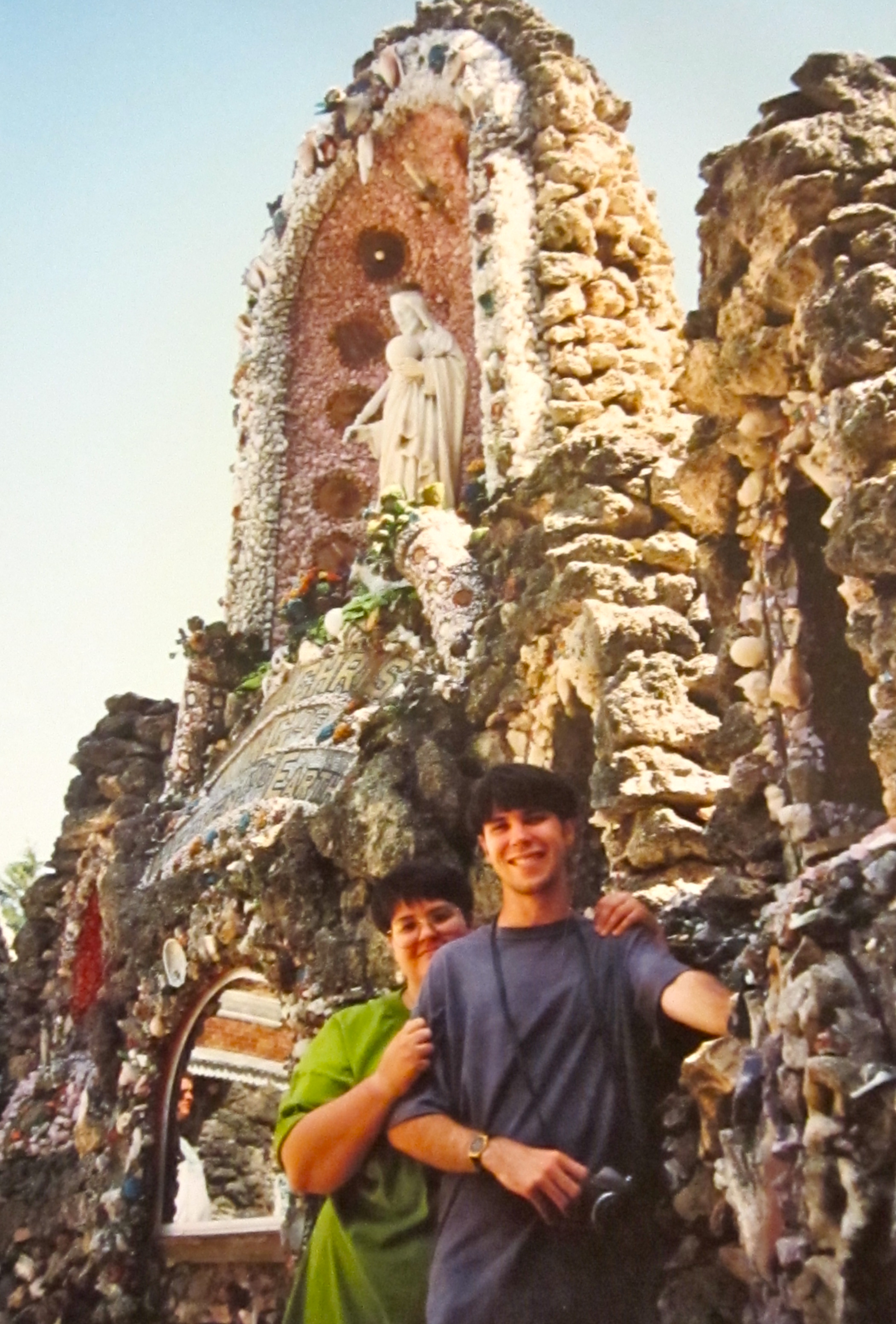
Today’s flashback is a photo of my brother, Matt, and me at the Dickeyville Grotto. It isn’t an especially extraordinary photo, but there are so many elements in that are important to me.

First, one of the best things about that time of my life (late 80s/early 90s) was the fact that I lived in Iowa City at the same time as my three youngest siblings. We spent a surprising amount of time together – by choice – developing strong relationships as adults. My brother, Matt, in particular encouraged me to explore interests that were beyond the scope of my very mainstream, straight, path. With his girlfriend (and to this day one of my favorite people) Syndy, we visited galleries, attended readings and plays, checked out all kinds of odd and unusual things and places: St. Isaac of Syria Skete, anyone?!

The Dickeyville Grotto has loomed large in my imagination since childhood. This particular trip taught me to think of it as not just the result of a crazed religious fervor, but as outsider art. Matt took tons of photos of the grotto and its varied elements. My Dad took photos of us enjoying the lengthy exploration of the grotto (this was the umpteenth time we had been to the grotto, but we were seeing it with fresh eyes).

It is no accident that I am hiding behind Matt’s shoulder in the photo. Of course, I hoped to hide my bulk, as my weight had been creeping up. But it is also indicative of the fact that Matt boldly walked into life experiences, while I often crept along in his wake. However, I will always be grateful to have had the opportunity to learn and explore so much from and with my youngest sibling.

Get Your Bloom On!

Springville, Iowa, July 27, 2012.
 
 I am standing in the middle of the main street of town, with my good friend Tricia Borelli and thousands of others, and I am suddenly overcome with emotion. I tell Tricia, “This is what I want for everyone!”

Let me explain what I meant – and it wasn’t for everyone to stand in the streets of Springville, Iowa-though I believe there could be worse fates. We had just finished what proved to be the hardest 10 miles of a 208-mile bicycling adventure (three consecutive days of RAGBRAI). With a sore body operating on little sleep, the 10 mile leg just completed, consisting of lots of climb against a strong headwind, called upon every reserve I had. This middle day of the ride was “supposed” to be the easy one, too. What a betrayal of my expectations!

As Tricia and I pulled into town, the members of our team who had arrived ahead of us flagged us down. We explored the town, grateful for the food and beverage options and for the hospitality of the local Methodist church which allowed us to used their indoor bathrooms. Take it from me: porta-potties used by thousands of bicyclists are not the preferred option. We had some time to kill before our last two teammates arrived, which meant real leisure to soak up the ambience.

People of all shapes, sizes, abilities, ages, ethnicities and backgrounds swelled the small town’s usual population of around one thousand to nearly ten times that. Banners flapped in the stiff breeze, music came at us from every direction, colorful costumes and jerseys caught our attention. The sun beat down on us and sweat caused our spandex-laden clothing to stick to our bodies. I downed a bottle of blue Gatorade with relish – something I would normally avoid as exuberantly as I avoid eating liver.

As I watched the spectacle and felt myself just one more colorful piece of it, I experienced one of those rare moments of clarity in life. This exact moment that I was living in with such joy, I would once have shunned. The July heat. The crowds. The physical exertion. The athletic, ebullient, friendly, happy individuals surrounding me.

Until the recent past, I eschewed entering fully into my own life. I stayed away from situations that called upon either my inner resources or the direct experience of strangers. In that way, I kept my world small and my life manageable. I felt safe but I rarely felt joy. I felt “in control” but never expansive.

All of that has changed, and my life is so much richer for it. Suddenly, standing in the middle of the street in Springville, my heart paradoxically wholly open and completely full, I realized:  it isn’t enough to want these things for myself. It isn’t enough to continue to work on my own growth and development. To know and experience my own “before and after” is to want that for anyone else holding back from fully living their own lives.

You know who you are – those of you waiting for something to change in your life in order for you to feel happier, better understood, more passionate. Those of you who feel stuck in a place you never really intended to be. Those of you who feel called to…something else, even if you don’t quite know what that is. For each of you, I want the more you’re longing for. The future you don’t quite know how to reach. And I promise you two things. First, I promise that I will continue to hold your heart’s desire  in my thoughts and in my prayers. Second, I promise that whenever the opportunity arises to offer something tangible – and within my power or ability to give – by way of support or encouragement to another late-bloomer (like me, like you) I will.

You may feel like a bedraggled weed, but you’re really a beautiful flower. You may not, just yet, believe in yourself or in your ability to change your life. But I already believe in you. After all, I’m just another slow-blossoming flower on the midwestern prairie – if I found a way to fully open my petals and bask in the sun, so can you.

You Cannot See Your Future From Here

I’ve been thinking about the future a lot this summer. It has alternately filled me with excitement and dread. I have found my heart racing with anticipation and with sheer panic. Beautiful fantasies, check. Hyperventilation, check. One day I found myself asking friends, “Which do you think is most likely – that I’ll develop an ulcer or have a heart attack?” (They immediately voted for the ulcer, their reason being I’m in good cardiovascular shape from working out.)

With all this mental and emotional turmoil, it would make sense to pull back a bit and spend some time in calm reflection. Of course, that’s how I got to this point in the first place – calmly reflecting on what it is I want for my life: who am I, how do I intend to live, what is my heart desiring? (I guess you really can’t start out on a journey to change your life and then be shocked when your life demands that you actually change.) Anyway, I did what many of us do when looking for perspective these days, and sat down at my computer. I googled “quotes about the future”, and found some interesting statements, my favorite of which is:

The future is something which everyone reaches at the rate of 60 minutes an hour, whatever he does, whoever he is.
C. S. Lewis
 

In other words, the future arrives in its own time, and all the hyperventilating in the world won’t bring it on any more quickly – or delay it, either. At the rate of 60 minutes an hour, there is time to breathe.

I quickly discovered, though, that a clever quotation – even from such an erudite source as C.S. Lewis – can only stave off anxiety or provide mental respite for a short time. I needed something more “meaty” to chew on. And that is when a friend reminded me of a book I read all the way back in high school. Hinds Feet on High Places by Hannah Hurnard.

This little book is an allegorical tale about poor Much-Afraid, who lives in the Valley of Humiliation, surrounded by her extended family, the Fearings. Much-Afraid is timid and suffers from physical disabilities and deformities which keep her feeling inferior and insecure. However, she has found employment working for the Shepherd, who promises to help her escape the Valley for the high places, The Kingdom of Love. If she will but trust and follow, she will be changed, her imperfections erased, and her feet will become “like hind’s feet”, able to leap gracefully and nimbly along even the steepest of paths.

Obviously, the reader is intended to identify with Much-Afraid. And I did (though not nearly to the degree I did when in high school). It is as she approaches the borders of the Kingdom of Love that the following passage appears:

“It did seem strange that even after safely surmounting so many difficulties and steep places, including the ‘impassable precipice’ just below them, Much-Afraid should remain so like her name. But so it was!”

Then, on the following page, the Shepherd places his hands on her comfortingly and says,

“Much-Afraid, don’t ever allow yourself to begin trying to picture what it will be like. Believe me, when you get to the places which you dread you will find that they are as different as possible from what you have imagined…”
 

And this is how God speaks to us, sometimes. In words or phrases which seem to appear in the moment of our need for them. It seems I read that whole book primarily for these few sentences. The first passage to remind me that everything in my life – my own weight loss, the journey I’ve been on to change so much about myself, the health issues and healings of my loved ones and SO MUCH MORE – should already have created a Fear-Less where a Much-Afraid once stood.

The second passage reminds me that there is no point in borrowing anxiety from the unknown – my creative imagination is not intended as a tool for anticipating, then dwelling on, worst-case scenarios. The reality is that worst cases, when they happen, are never quite what we thought they would be in specifics or scope or duration. Sometimes they are worse than we feared, other times, better or easier. In either case, we have to respond to them in the moment they occur. Having dreaded them in advance is not the tiniest bit useful in that moment.

As I adjust my thinking to encompass these two nuggets of wisdom, I find that my heart rate is slowing. I am not gulping big mouthfuls of air as if there will never be enough oxygen for me. I’ve mostly stopped worrying about an ulcer. Instead, I’m talking myself away from fear and into calm presence in the moment. And in that calm, I am able to identify the location of my next step forward – you know, a step that happens in this particular 60 minute increment of time. And then the next.


Learning to Shift

I wheeled it into the shop before work on Monday morning, July 2nd. I remained stoic as the guy enumerated the items that needed to be repaired or replaced. As the cost rose I interrupted him to ask, “Bottom-line it for me – will it cost less to repair this one or buy a new one?” He laughed, assuring me the repairs would fall well short of the price of a new bicycle. I was still holding my own as he consulted a calendar on the wall and said, “I can give you a guaranteed pick-up date of the 13th.”  And that is what brought the tears to my eyes.

Two weeks without a bike in early July when one is training for RAGBRAI is an eternity. At least it is for me – I’m still trying to make up for forty years of inactivity, carrying 50 pounds I should have shed by now. And it was just one more crappy thing on top of a bunch of other difficult things that have made this summer one of stress and anxiety. The one thing that hadn’t, till then, been stressful (except for the two crashes that led to the extensive repairs) was cycling. I was finally getting the hang of shifting to maximize the usefulness of 21 gears. Hills were no longer daunting. Well, not completely daunting. Even crashing had added to my confidence – I got right back on and rode 18 miles, didn’t I?

Anyway, later on Monday I lamented to a friend that I would have to cancel plans for a 4th of July ride out to Ely, and she promptly offered to lend me her bike. I gratefully accepted the offer, and later that night, she dropped it off at my place: bright blue, low, wide handlebars and the fattest tires I’d ever seen. The bike turned out to be specifically engineered for beach riding. I recognized the brand, a nice bike. But not intended for the type of riding I do. Six gears, the lowest of which required the level of exertion I usually used for riding along straight, flat land. Hills were only possible if I stood to pedal, a skill I had hardly used, much less perfected. I shifted gears, and they shifted again on their own, often slipping out of gear randomly. Occasionally, the chain fell off. I learned to enjoy the feel of riding closer to the ground, of the easy manueverability of the wide handlebars, and, yes, even the burning in my quads and hammies.

And then the unthinkable happened. The loaner bike broke and was unrideable. That day’s ride ended in a two-mile walk, pushing the bike along beside me. In 105 degree weather, midday. But the loan and riding of the beach bike had done more for me than build up some new muscles and develop my hill-climbing skills. It had reminded me that I had resources, support, people to help me. So, even before I showered after the long walk home, I was on the phone to another friend, asking if I could borrow a bike from her family.

I picked the big chrome men’s Huffy. Taller than my bike, with a strangely tilted saddle, six speeds but the lowest speed was more like the “granny gear” on my bike. I expected a less difficult transition than I had experienced with the beach bike. But, no, it was not meant to be. At the beginning of a 40-mile ride, I put the new loaner through its paces, and immediately discovered it was incredibly difficult to shift gears. In fact, I wrestled with the handlebar shifting mechanism for a full 30 seconds before I could get it to shift out of 4th gear. First gear, granny. Second, super-easy-almost-granny. Third gear, a grinding clicking sound that did not inspire much confidence. 4th gear, where it had been stuck, wouldn’t work and now ground until it automatically found 5th gear. It was clear to me that 4th was where I wanted to be, but 5th was where I would do my riding. By the tenth mile, I was aware that my knees were not enjoying the added strain. However, it was easy to take the hills, and I figured I could tough it out. And I did, including the two miles I rode without glasses when I lost the lens of my prescription sunglasses.

I’ve learned a lot in these two weeks of my bike being in the shop. Valuable lessons, not the least of which is to take care of my bike and keep it in good repair. More important, though, I’ve learned:

  • We all have plenty of gears, but most of us discover a sweet spot and pretty much stay there. Sometimes, it becomes so ingrained, it’s difficult to shift into a new or different gear. We feel stuck when we try. If we shifted more frequently, and not just when it was forced upon us, we’d find the whole process would go more smoothly and comfortably.
  • And about that “sweet spot”. If we stay in it, rather than try the other gears available to us, we don’t develop skills or new muscle. We just get more efficient at what we already know how to do. Sometimes, stasis is what we’re after; however, growth is both more challenging and more fun.
  • Hills. Every life, every ride, has some. How we handle the climb – not the equipment we use – is what reveals our character. Its easy to psych ourselves out before we start the uphill, to think ourselves into failure. It’s even easier to let ourselves off the hook when we have something outside ourselves to blame (Really? A beach bike is NOT intended to do this…) The truth is, hills are conquered by perseverence and discipline applied with a dash of positude – by internal qualities, not equipment.
  • Equipment may not be what conquers the hills in life. But it does help to have the right stuff in good working order. Take care of what you have, pay attention to what it needs, lube it and wipe it down when necessary. Treat your equipment with loving care and attention, people!
  • Even a small adjustment can bring big changes. Just ask my quads. Shift your perspective and you work differently – you will feel and see different things.
  • Wide handlebars = open arms.This can make you feel vulnerable until you get used to them. And then you just feel open. Open and ready to embrace new experiences.

What Shapes Us

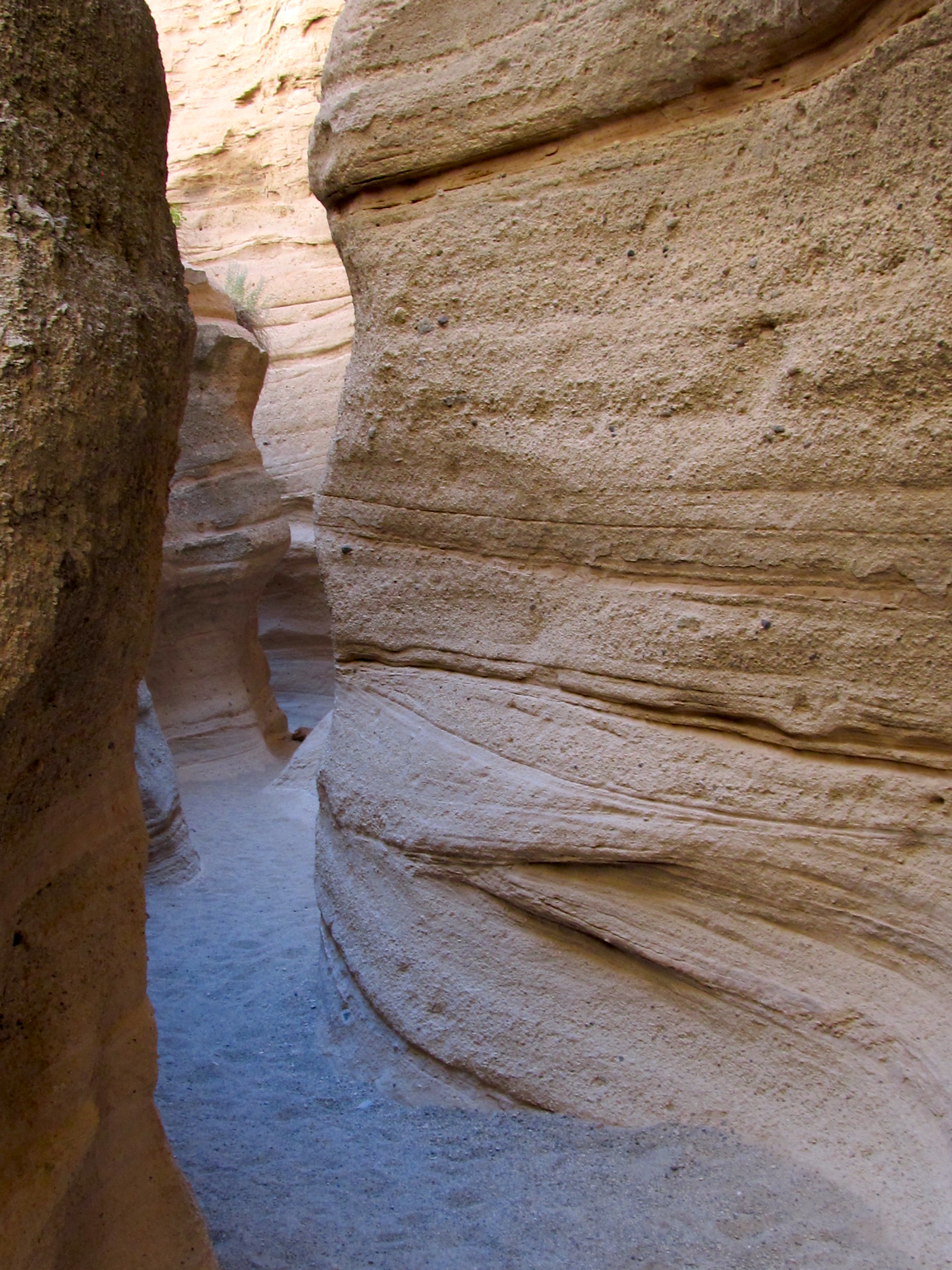
Kasha-Katuwe Tent Rocks National Monument

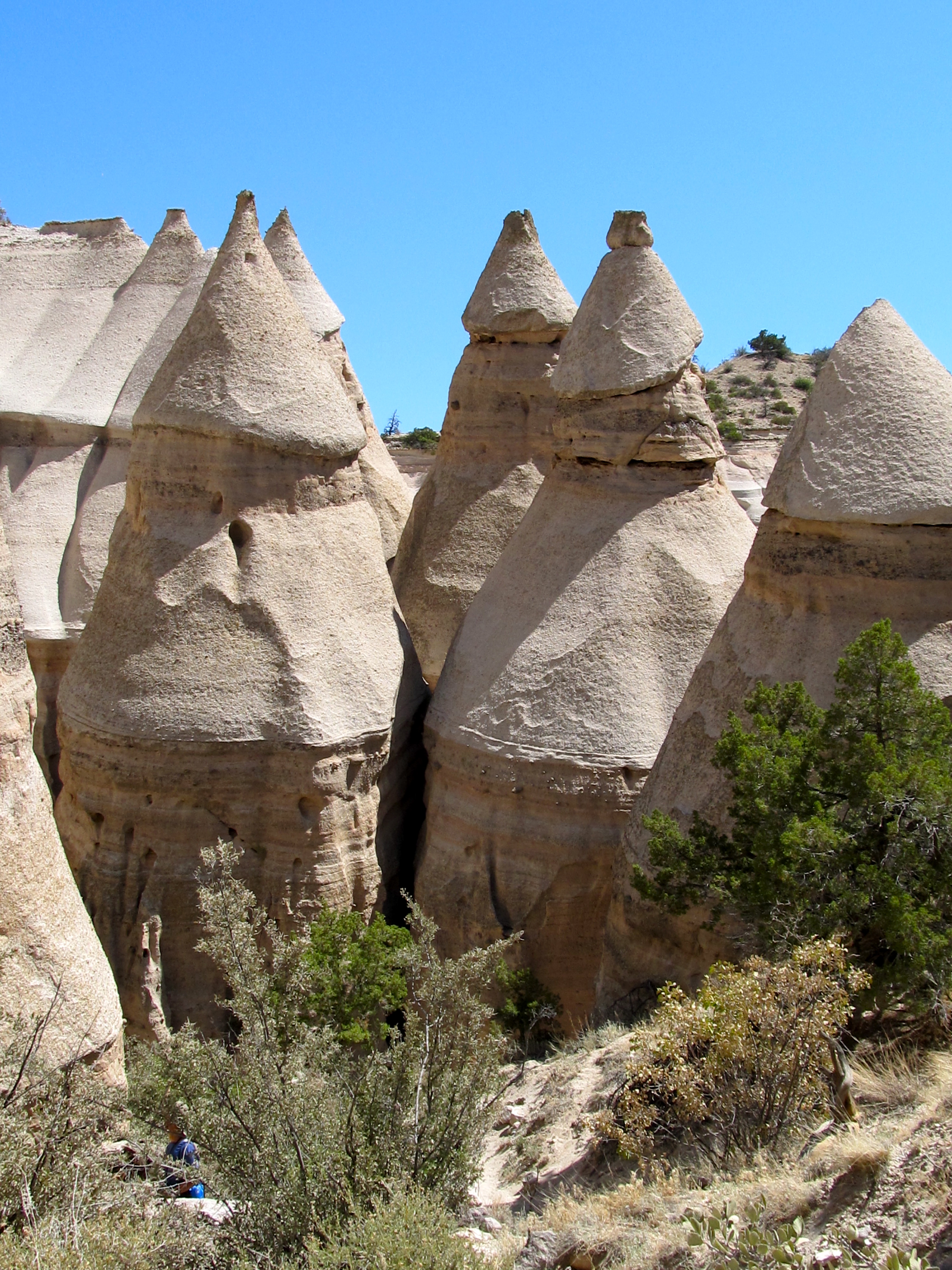
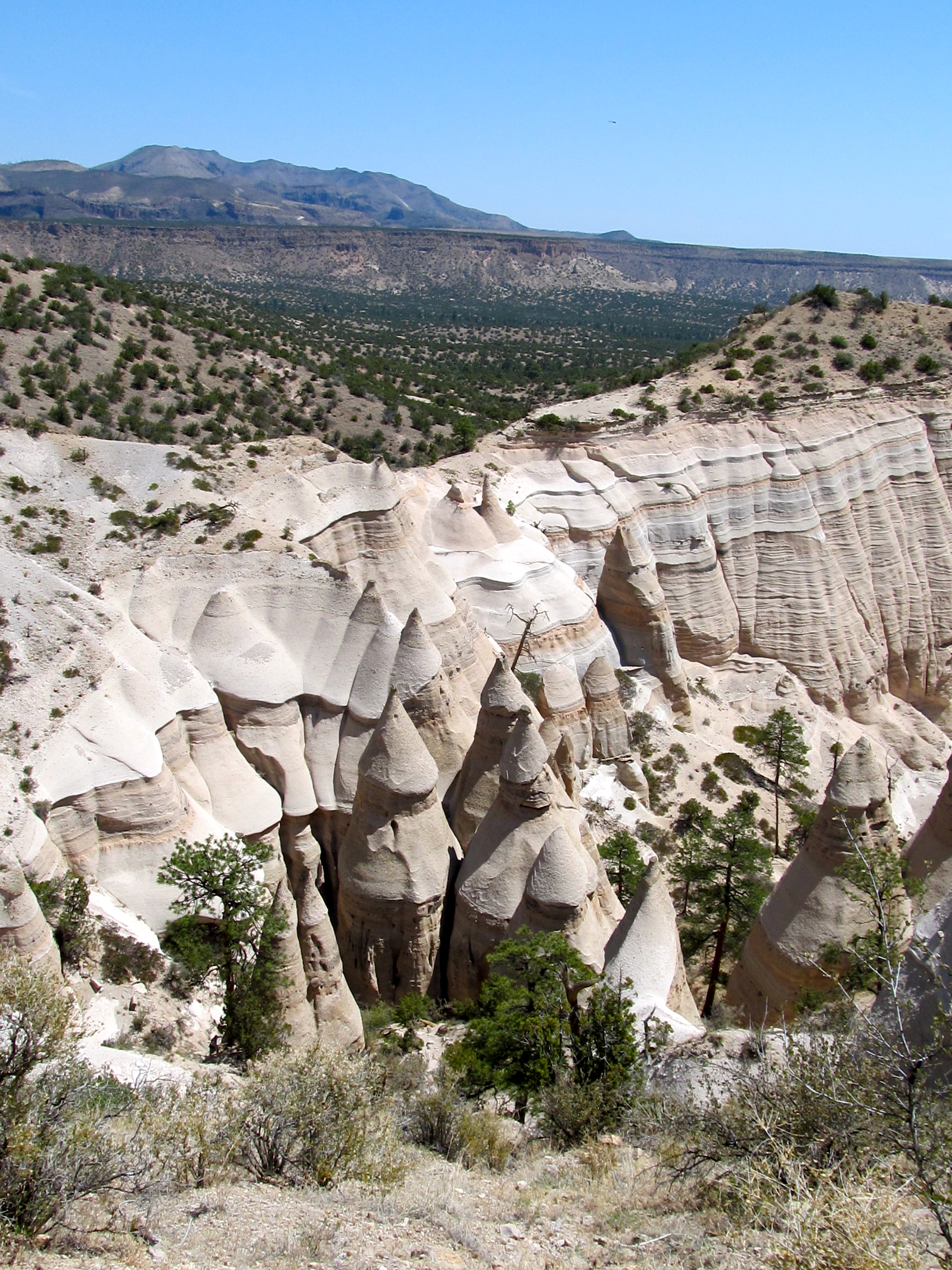
On our recent road trip to New Mexico, my family took Mike and I to Kasha-Katuwe, better known as Tent Rocks. The unique landscape was originally formed by massive eruptions in the Jemez volcanic field, which “spewed pyroclasts (rock fragments), while searing hot gases blasted down slopes in an incandescent avalanche called a ‘pyroclastic flow’.”  The resulting formations are spectacular.

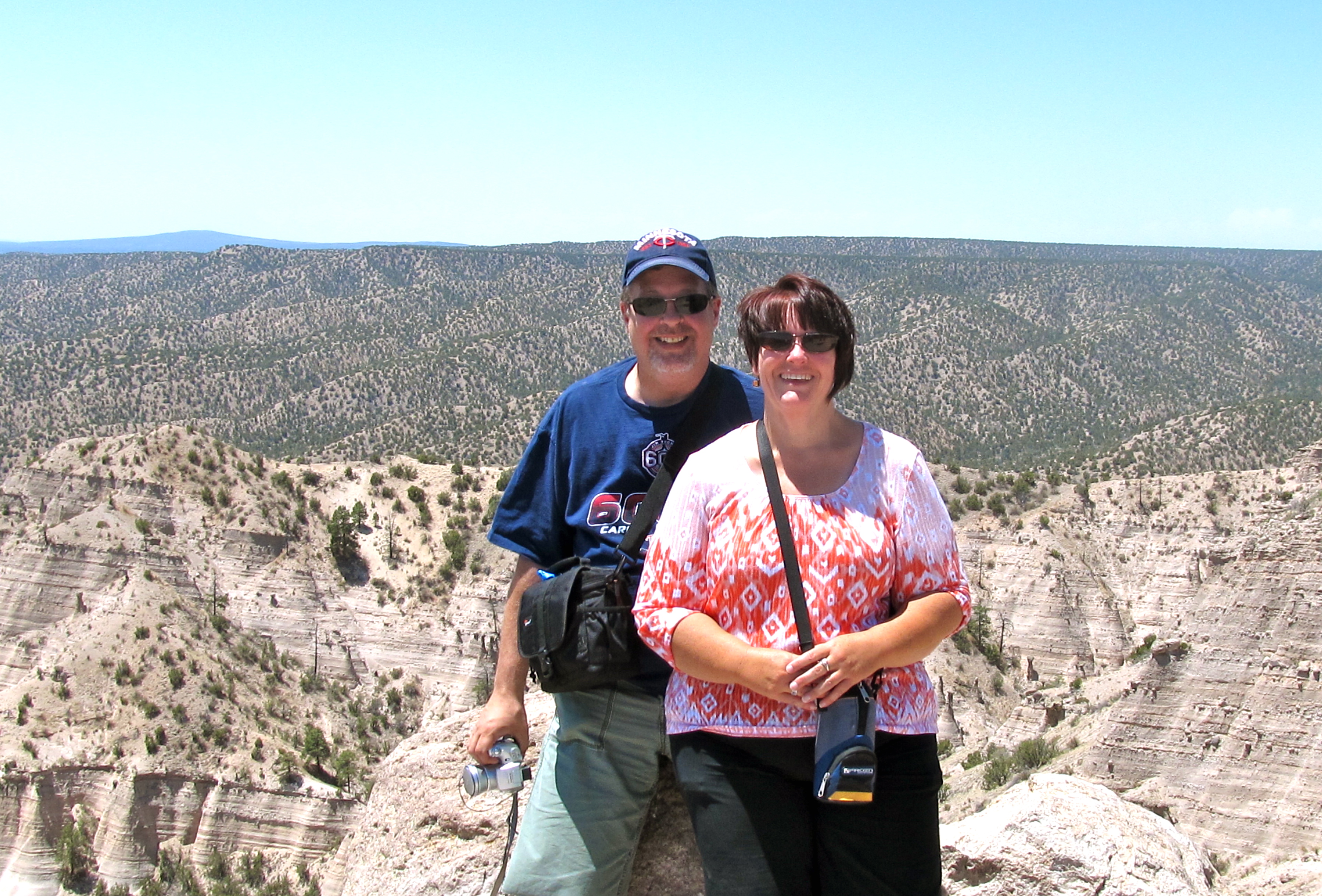
We climbed a little over 1100 feet (from an altitude of 5570 to one of 6760), taking in the most amazing views of both the tent rock formations and the surrounding New Mexican landscape.

Tent Rock formations
Tent rocks in foreground, mountainous New Mexico in background

One of my favorite parts of the hike, both on the way in/up and on the way back/down, was the trail leading through the slot canyons. Over time, wind and rain have carved canyons and arroyos into the rock, creating passages (like the one pictured at the top of this post) of surpassing beauty. For most of the morning, we hiked through 100 degree temperatures, thin air and a burning sun. These canyons of layered rock were hushed and cool by comparison.

The stillness of the canyons gave rise to contemplation. Like the rock, which was shaped by the forces of nature, we too, are shaped by the vissicitudes of life. Our choices, our experiences, who we love and how we learn – all have a role in shaping us. Therefore, it seemed especially poignant to share this experience, and these thoughts, in companionable silence with Mike.

We met when I was 18, Mike 19. We were still fresh, unmarked clay. Our faces shone with, as J.D. Salinger put it when speaking of college students, “the misinformation of the ages”. Over the next few years, we shared some powerful experiences as each of us attempted to discover the direction of our lives. Eventually, though, we found that we were bound in different directions, and we parted ways.

The weathers of life – births, disappointments, marriages, jobs, successes – had their way with us over the next thirty years. Molding and shaping us into mature adults, careworn and wiser (we hope). And then, surprisingly, bringing us back onto each others’ paths. Under the extra pounds, the gray hair, the wrinkles, the familiar past could be glimpsed. Only now, the layers and textures add depth and surprise. They offer possibilities that didn’t exist in our earlier friendship: wisdom and generosity of spirit, compassion and forgiveness. Human capacities with which youth is often barely acquainted.

So tonight, back home in my little house in Iowa, I am thinking of Kasha-Katuwe and the lessons it taught me. Time makes shape-shifters of us all. I am grateful for this learning. I am grateful for this earth which teaches me. And yes, Mike, lest you think I left out the most important part (again), I am grateful for your company on this path.

Mike and I, at the top!

Words That Changed My Life: Hubris

For much of my early life, I was not particularly self-aware. Self-conscious? Absolutely. But I had not yet learned to see myself, my actions, my interactions with others from an analytical perspective. I simply could not stand outside myself and review with honesty my actions, motivations, or emotions. As a result, I was often taken by surprise, both by my own choices and by the reactions of others toward me.

My junior year in college, I took a Greek Mythology course as an elective. The course was taught by a nun who had spent most of her career teaching in grade school. We were horrified, on the first day of class, to be told we must respond in unison to her questions. We were also given worksheets and made to place them in exact order in our notebooks at the exact same moment, so that the noise of opening our required 3-ring binders (then snapping them shut) would take place all at once – no stragglers allowed. We were required to turn in the binders weekly. Misplaced worksheets resulted in deducted points. We began the semester hating that we were being treated like children. After all, we were confident and competent adults.

Through the course of the semester, though, my classmates and I grew to love Sister’s techniques. First, we decided to have fun with the novelty of returning to our third grade classroom structure. Then, the sheer amount of information we were actually learning – and retaining – became fun in a different way.

One concept that has stuck with me from that course is the idea of hubris. “The word was used to refer to the emotions in Greek tragic heroes that led them to ignore warnings from the gods and thus invite catastrophe. It is considered a form of hamartia or tragic flaw that stems from overbearing pride and lack of piety.” (eNotes: Guide to Literary Terms) Hubris: on one level I kept the word in my arsenal because I love words, and this is a good one to pull out in arguments and essays.

On another, deeper, level the idea that overbearing pride could be a tragic flaw was working on me. How would I know if I suffered from this? I mean, does anyone with this problem know they have it? Or are they all so arrogantly sure of themselves that they would never recognize their own puffed-up sense of self? The more I thought about it, the more relief I felt. After all, I was the opposite of self-confident – I was fearful in every way. And I was sure that everyone could see my inadequacy, despite my efforts to cover it up.

Pride, as they say, cometh before a fall. I reached a point in my life when it occurred to me that I had been allowing my life to happen to me, rather than actively living it. Of course, this realization came about as the result of pain and unhappiness that finally became too great to ignore. I think for most of us, these emotional growth spurts are often the result of difficulties, challenges, sadness rather than of happy times. The rawness of our emotions can cleanse away the lethargy and inertia of daily life, and we see ourselves more clearly.

What I saw in myself was an unbending pride that approached the level of tragic flaw. My pride didn’t stem from arrogance and overblown confidence. Mine stemmed from that very sense of inadequacy rooted deep in my psyche. My pride did everything it could to hide my unworthiness. I never wanted anyone to know I was clueless in a new situation, so my pride prevented me from asking questions. I never wanted to appear as stupid as I felt, so my pride kept me from venturing opinions or seeking out mentors and teachers. I certainly didn’t want anyone to feel sorry for me, so my pride prevented me from reaching out honestly and letting my friends know I was in pain, or lonely.

In Greek mythology, the story of Icarus is often used to describe the concept of hubris:

The main story told about Icarus is his attempt to escape from Crete by means of wings that his father constructed from feathers and wax. He ignored instructions not to fly too close to the sun, and the melting wax caused him to fall into the sea where he drowned. The myth shares thematic similarities with that of Phaëton — both are usually taken as tragic examples of hubris or failed ambition — and is often depicted in art. (Wikipedia)
 

Presented with hubris in the context of my mistaken pride, which prevented me from fully engaging with others in my life, or with that of Icarus, I now see the second manifestation as preferable. At least Icarus’ pride led him to strive for something greater with his life – rather than using pride to keep life small and crabbed into a safe little box. I can’t say with utter assurance that I have mastered my tragic flaw. But I can say that, finally, I am self-aware enough to be able to see my choices and behaviors in light of how they either are filling my life or depleting my life – and then to take corrective action. Sometimes, I am even able to reflect on possible choices and take the best path first. And that, friends, is worth suffering a blow to one’s pride.

Words That Changed My Life: Intention

Note: This is the first in a series exploring words that have had an impact on my life, either by changing my perspective or by helping me to grasp a concept I had struggled to understand. The series will appear periodically, interspersed with other posts. For those of you thinking about a guest post for the “Sunday Roast” series, one option is a post about a word that changed your life !
 
From the gospel of John: “In the beginning was the Word, and the Word was with God, and the Word was God. 2 He was with God in the beginning. 3 Through him all things were made; without him nothing was made that has been made. 4 In him was life, and that life was the light of all mankind. 5 The light shines in the darkness, and the darkness has not overcome[a] it.”

I am a word person. I always have been, though for much of my life I relegated the power of words to my heart – by which I mean that I understood their power to affect my inner life and to stir emotions, but I didn’t fully comprehend them as vehicles for the outward thrust of energy. I didn’t know that some words could affect my daily experience.

In graduate school, we spoke about the need for educators to create “intentional” programs, designed to challenge and support our students in their personal development. Rather than throwing together a hodge-podge of experiences, think and plan carefully with a particular goal or goals in mind.

Goals. I learned how to write them, how to operationalize them, how to assess progress toward them. I just couldn’t get the hang of actually having them.

And then the idea of “Intention” (and it’s sister concept, “The Law of Attraction”) exploded on the scene. The New Age Movement meets Quantum Physics. I watched “What the Bleep”, read Lynn Grabhorn’s “Excuse Me, You’re Life is Waiting” – there is no shortage of material out there which says that we can create our own reality and attract into our lives the things we want, by “setting our intention”.

I liked these ideas, despite the fact that much of what has been written is tinged with magical thinking and focused on achieving material abundance. Although I’m not bent on earning my first million, I am attracted to the concept that it might be up to me whether any day is a good day. I have tried several experiments with the idea of intention. One notable example ended up with me getting free meat at the grocery store – it was a fun experiment, but the free meat has not been a replicable outcome.

What has and can be replicated is the intention to manage my own choices such that a positive outcome is practically guaranteed. I remember the first time I approached an annual event, one which I had annually dreaded, with this specific intention: “Today, I will be calm and open to every person who approaches me. If there is a problem, we will resolve it with compassion and respect.” I wrote the intention down, and said it aloud. Each time throughout the day that I began to feel anxiety or my composure began to slip, I would remind myself of the day’s intention.

In the end, it was a great day. In the end, I learned that the power of intention isn’t magical at all. It simply requires two things: the intent (in this case a short-term goal for the day) and the willingness to remain consciously focused on aligning your behavior with that intent. Simple, but not easy. Not easy, but what life-changing behavior ever is?

This may be one of the reasons the Gospel of John is my favorite. It’s first sentence “In the beginning was The Word” is perhaps my favorite sentence of all time. Then: The Word was with God and was God, and it was focused outward with a mighty intent. God’s intention created everything – how amazing and powerful is that? And the light created by that intent has not and cannot be overcome by darkness.

In my life, I try to use intention to reflect some small measure of that light. Simple, but not easy. Some days, I set my goal/intention for the day and my focus never wavers. Other days, it unravels or comes apart in shreds as I lose control of my attention, I get pulled in too many directions, I am unable to stay centered. As with every change we try to make in life, practice is called for and perfection is a million miles away. But I have more successfully intentional days now than I did five years ago, or five months ago. And that has, indeed, changed my life.