In Recovery

On university campuses, May is a time of dinners, receptions, celebrations of many stripes. It is also the time when colleagues, holed up in offices all winter, emerge blinking in the sun, and greet one another with exclamations of “I haven’t seen you in so long!” At one such occasion the other night, I was happy to see the wife of one of our Deans, whom I hadn’t seen in, well, so long. She said, “You look fabulous! How have you done it?”

Normally, when people ask me that question, I assume they are interested in a short answer – diet and exercise OR bariatric surgery. So I generally respond, “The old-fashioned way.” For some reason, on this particular occasion, I launched into a longer and less clear explanation. I found myself telling her that I had refused for many years to take a real look at WHY I was fat. That, in fact, I preferred to believe that the only plausible reason was that I was engineered that way. I definitely wasn’t one of those people who was overweight for psychological or emotional reasons. I told her that I finally had to take a hard look at myself and evaluate my irrational thinking.

Last night, I attended a presentation being offered as part of our pre-finals “Stress Buster Week”, in which a panel of guests shared their personal stories of alcoholism and recovery. As I listened, for the first time it struck me just how much my relationship with food mirrored their relationships with alcohol. One panelist stated, “For most people, a few drinks quenches their desire or need for more. For an alcoholic, a few drinks just makes you more thirsty.” Substitute “food” for the word “drinks” in those sentences, and they will be true for me. In the same session, I heard the panelists say:

  • I knew I wasn’t normal. When I was drinking was the only time I felt normal.
  • Teachers and speakers told us alcohol was evil. But alcohol comforted me, so I wasn’t willing to do anything about it.
  • I drank in secret whenever I could get away with it. As long a no one saw me drink, I didn’t have a problem.
  • I was so ashamed.

Wow. These statements were all eerily familiar to me as well. I know there is a group called Overeaters’ Anonymous, patterned after A.A. I never considered joining, and when it was suggested to me periodically, I always said, “I’m just not a joiner.” Denial much?! And, if I am completely honest with myself, I wanted to distance myself from all those fat people. After all, I wasn’t one of them. I may have been fat, but that didn’t make me like those other people – I was smart and educated and never bought more than one value meal for myself at McDonalds. The fact that I looked upon others who struggled with the same issues as me with such repugnance is a testament to the irrationality of my thinking, and to the power of my addiction. I didn’t want to give it up, and if I admitted to having problems, I would be forced to face that food was just my drug of choice.

Another thing the panelists said last night that made me nod in agreement:  “The whole forever thing really tripped me up. To get better, I would have to stop drinking for the rest of my life. No way I was going to do that!” In order to truly face my addiction to food, I knew that the lifestyle changes I  needed to make would have to be lifelong. I read in one article that overweight women my age would need to work out 60-90 minutes a day, every day, for the rest of their lives to lose the weight and keep it off. Talk about a daunting prospect. Plus, I would need to maintain a change in my relationship to food – no more whole pizzas or whole bags of cheddar goldfish in a single sitting. In fact, I may have to forego some foods altogether if I couldn’t learn to control the portions. Yes, I definitely saw myself in the panelists’ struggle to come to terms with their addictions.

But here’s the really amazing thing: each member of the panel HAS faced his or her addiction, with incredibly positive and powerful results. Listening to their stories of living in recovery, and the positive changes that have taken place across all facets of their lives I started nodding along. I recognized myself in this part of the story as well. As I sat there, I was suffused with an overpowering sense of gratitude for each of our stories. I almost said, “for the happy endings to each of our stories”, but if I’ve learned anything (either in the last couple of years or from last night’s speakers), there is no happy ending to our stories. Our lives continue as stories being told one sentence at a time. One of the panelists summed it up, perfectly, “I take it one day at a time. Because I know that if I succeed today, tomorrow will be better.”
Internal Landscapes, Part 2: Maps of Meaning

I am sitting in a coffee shop in my hometown of Dubuque one frigid January Saturday. Outside, the wind howls and the temps have dipped to -30. Inside, I look around at this shop I have never entered, but which is in a room familiar to me all the same. It used to be Theresa Delaney’s living room, when we were in grade school at St. Raphael’s. The entire neighborhood in which my friends and classmates lived has been turned into boutiques and shops of one kind or another. As I sit there, thinking about how surreal it is, the front door keeps opening of its own accord.

The barrista comes from behind the counter to slam it shut each time. The third time he says, “You probably think its the weather, but trust me, we have ghosts. This happens no matter what kind of weather we’re having.” As he returns to his post, I find myself wondering, “Are these ghosts anyone that I know?”

I start thinking about this small midwestern city, my hometown, and about how so many things about it are familiar to me despite the long years in which I have only visited. Much of the city is imprinted on my soul. Thinking about it, though, I realize that what I carry within me isn’t so much the actual city, as it is my version of it.

I remember learning about “memory castles” used by great thinkers back in the days before the printing press or Moleskine notebooks were invented. In their minds, these intellectuals (mostly members of religious orders) would build a castle with many rooms and specific features. Each thing they wished to remember, they would carefully place in a specific location or superimpose on one of the castle’s features. This allowed them, once proficient at the technique, to remember and retrieve huge storehouses of information.

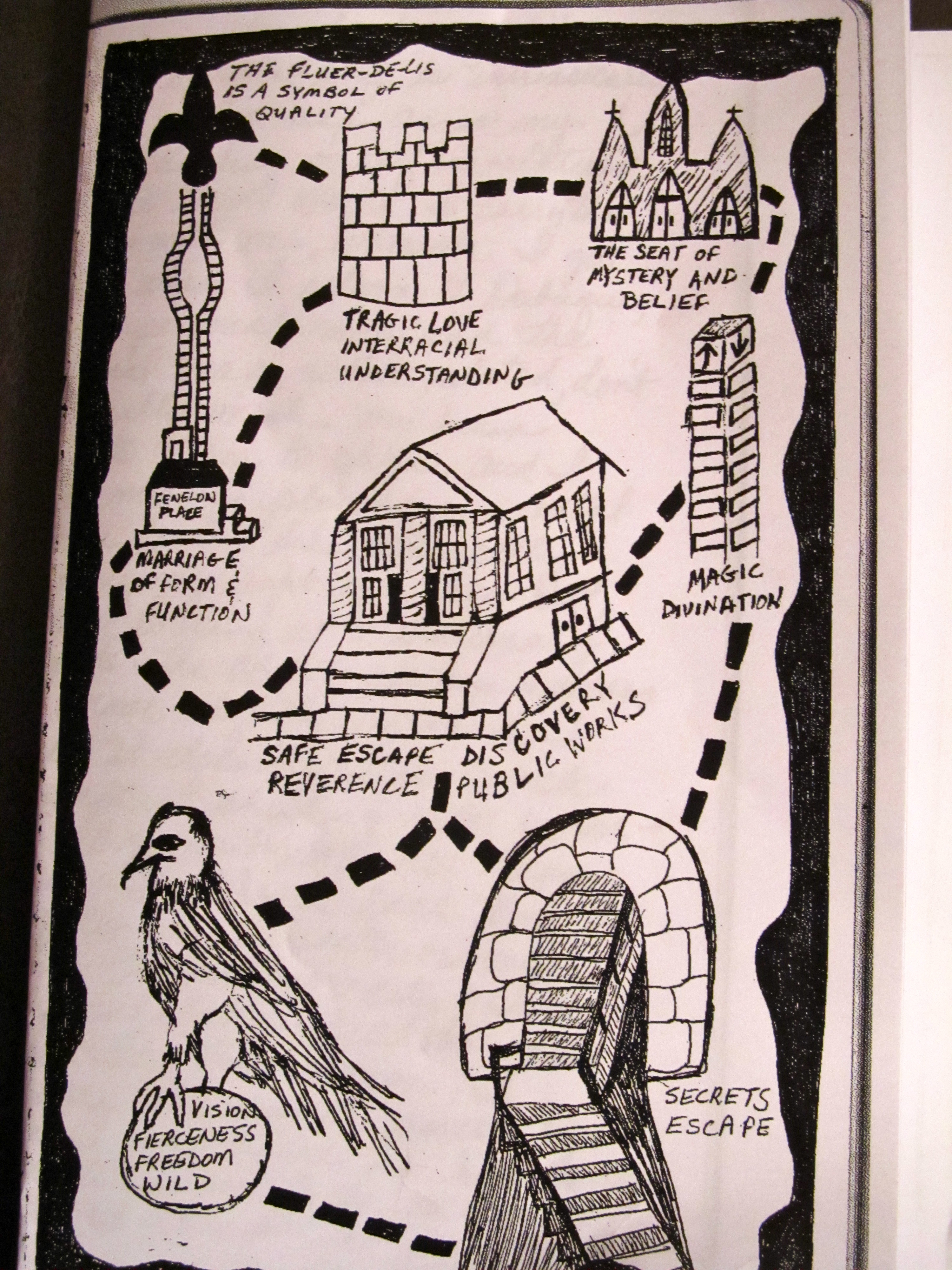
I think, “Like a memory castle, there is a map of Dubuque that I carry within me that bears only minimal relationship to the actual city’s map.” This map contains my memories and my memories of emotions. Attached to each site on the map are sensations, values, concepts experienced or learned throughout my formative years. My spiritual self is intrinsically tied to this map, as is my understanding of self in relation to the larger world.

The map in my psyche looks something like this:

Each location on the map is both a real place (the Fenelon Place elevator, the bank weather tower, the Carnegie-Stout Public Library) and an icon for the meanings I have associated with it (examples listed on the map above).

I carry this map with me, wherever I go. But when I return to Dubuque, my personal map and the actual map, while related, don’t actually match. My brain wants them to align, and I find myself playing a mental game much like alternately closing my right eye, then left, while looking at a stationary object. The object always appears to move slightly, although I know it doesn’t really. This quick perceptual shifting never works – the alignment will not happen. I have to choose each time to be in the exterior city or in the interior city – I can’t fully inhabit both at the same time.

For this reason, I treasure the small pieces of time I am alone in Dubuque. These turn out to be moments when I can sit in an actual physical location and touch the wealth of internal information I’ve stored in its metaphorical twin. Its a bit of a deep moment — like sitting in the coffee shop that used to be Theresa Delaney’s living room. Whatever keeps blowing the door open may be the wind or a ghost — but I can’t help thinking it might also be my other self (the self who has continued to inhabit my internal Dubuque long after the external self moved away) coming to join me for an Americano, extra-hot.

(Note: this post, and the map drawing it contains, are adapted from a journal entry I wrote several years ago)

…Changing the Dream (part 2 of 2)

“The arc of the moral universe is long, but it bends toward justice.”

–MLK Jr.


When I was in graduate school, we used a visualization activity called “The Perfect Future Day Fantasy”, in which we were to imagine ourselves waking up on a “perfect” weekday 10 years into our future. I specifically remember processing this activity with a group of fellow students, when one friend said that, in his perfect day, he was presiding over negotiations to reunify Germany. We all laughed at him, saying “As if…that will never happen.” That was 1987. By the end of 1990, German reunification was a reality.

In the “Awakening the Dreamer, Changing the Dream” symposium, the module which discusses “What is possible for the future”, asks us to shift our perspective from what is probable to what is possible. We live in a cynical world (did I really just quote Jerry McGuire?!). A world in which many of us look at the enormous issues confronting us and decide they are so over-arching, so all-encompassing, that we can do nothing…and we therefore continue in our comfortable dream world.

And yet. Apartheid ended. Change is sweeping through the Middle East. Millions of people the world over are participating in organizations and movements to make justice, sustainability, spiritual fulfillment real in the world in new and creative ways. Just a few who have inspired me: Emmanuel Jal, Curt Ellis and Food Corps, Annie Leonard, and so many others. Each of these individuals has taken their unique talents and skills and employed them in service to justice and creating a different dream for the world. And I am heartened to know there are millions of others, whose names and faces I may never know, but whose voices are represented by an activist in the symposium video module who says, “We didn’t believe we could change anything, but we did it anyway.”

Inspiration is important. It needs to translate into action in order for me to be part of co-creating a new dream for our world (a universal Perfect Future Day Fantasy!). But what can I do? I’ve thought about this long and hard in the week since attending the symposium. First, I can talk – that’s something I’m good at! – and write about what is in my heart. Second, I can start with the environments I am already a part of. For example, on Thursday, the symposium attendees from my university met for lunch to discuss an action plan to bring the symposium, and active outgrowths from it, to our campus community. I can evaluate the corporations with which I do business, and make a conscious effort to support those who use a “triple bottom line – people, planet, profit”. Because food and hunger are issues which are already important to me, I can recommit myself to work on these with my time, talents, and treasure.

It would be overwhelming if we looked at all that needs to be done and thought that we, personally, needed to do it all. Heck, even thinking that we need to do something big, make one grand gesture, is an overwhelming idea. What I am discovering, though, is that each of us has within us the ability to make a difference. If we stop thinking it needs to be a difference that the whole world will see and recognize, and instead think of it as a difference that changes our hearts and touches at least one other, it becomes much less daunting. Do I really think that will change where the earth is headed? You bet I do. And I am far from alone in that:

“It is a moral universe despite all appearances to the contrary.”

–Desmond Tutu

“Never underestimate the power of dreams and the influence of the human spirit.”

–Wilma Rudolph


Conference – Day 3: Innovate

I am a day late posting about Day 3 (Tuesday) of the NASPA Conference. The truth is, Tuesday was so full of content that when I left the final session at 4:30 p.m. I just couldn’t process it. In fact, I had been in back to back sessions all day, with no break or sustenance  (even the water bubblers at the convention center were empty), so the first order of  business was a large bottle of water, followed by a brisk walk through the Walnut & Chestnut shopping district. Then, a burger and fries at the Hard Rock, and coma – on the bed in my room by 7:00 p.m.

The sessions I attended Tuesday ranged from the politics of advocacy, to legal issues, to creative listening, to using technology both in direct work with students and in connecting with other professionals in student affairs. While I found something of interest (and ideas to return to my campus with) in every session, the most mind-blowing sessions were the technology ones. Hands down.

The fact that the tech sessions were actually called “Un-sessions” leant them an air of informality that I really appreciated. Also, unlike most professional settings, you were not sneered at for having your smart phone in your hands and using it! I think the assumption was that you were tweeting session content, and the Microsoft-sponsored technology room was equipped with projectors and screens so that a running twitter feed could be displayed while the “un-session” leaders both shared their prepared thoughts and ideas, and responded to the real-time tweets.

Twitter was ubiquitous at the conference, and I found it almost humorous to watch. One young star and proponent of technology in our work with students received an almost rock-star response – every gem he shared with the group was tweeted and retweeted so many times it was comical to follow his session via tweets (I finally learned exactly how to use hash tags!). Beyond the “kids with new toys” quality of these sessions, there was real information – on resources for professional development (blogs, on-line communities, live twitter chats, etc.); on creating transformative moments for students using new technologies; on how to begin a dialogue via twitter or Facebook then use it to develop IRL/face-to-face relationships with, between and among students and staff on our campuses.

I know that I was not the only person soaking things in like a sponge. I may be coming late to the technology party, but I’m catching up fast. One person tweeted that she was sick of all the technology sessions and wanted to know what had happened to the usual conference fare. Well, here’s my thought about those day-to-day issues, such as budgets and supervision and conduct and _________ (fill in the blank): they will always be with us. And they will always make up the agenda for regional conferences or state professional gatherings. But for those professionals, like me, whose resources only allow irregular opportunities to attend national conferences, the NASPA Conference 2011 was exactly what it should have been. Challenging. Forward looking. Energizing. And exhausting! My one regret? My flight left too early and I was unable to see the final keynote speaker, Robert Kennedy, Jr. That would have been the cherry on top of a very rich experience.

Conference – Day 1: Inspiration

I am currently in Philadelphia, attending the annual conference of the National Association of Student Personnel Administrators (NASPA). The theme of this year’s conference, stemming from our location in this city of our nation’s birth, is “Educating for Lives of Purpose”. I have to admit that, more than twenty years into my professional career in Student Affairs, I can be a bit cynical about meaningful titles and conferences which suggest there might be things seasoned professionals can learn from the programs being offered. Tonight’s opening session, though, may have set the tone for a transformative experience I wasn’t anticipating.

The opening session of professional conferences can be…well, boring. You hear from numerous speakers who congratulate themselves and thank everyone under the sun, give “updates” and “housekeeping notes”. And when that is done, your keynote address is from someone who might be marginally entertaining but, let’s face it, rarely actually knows anything about student affairs. Not tonight.

We began with the theme song to Rocky, which as anyone who reads my blog knows, has personal significance for me beyond the movie. The conference chair gave a gracious welcome, which was succinct and minimalist (as these things go). The NASPA President, Elizabeth Griego, from University of the Pacific, gave a stirring speech on the theme, “We are the people we have been waiting for”. She called us to personally creative leadership, lives and work of purpose, and to ask ourselves whether what we are doing is clear, focused, intentional, and systematic enough to bring about real transformation in the lives of our students and in the communities our institutions are part of.

The featured presenter for the evening was Donna Shalala, President of The University of Miami (and well-remembered as the Secretary of Health and Human Services for eight years under President Clinton). President Shalala made a few brief remarks about her career. She was engaging to listen to, and it is clear that she not only understands the student affairs profession, but sees it as essential to the work of colleges and universities.

President Shalala’s remarks were, however, brief. The majority of her session was devoted to a panel (which she moderated) of recent college graduates who are engaging in lives of purpose through community service: the Peace Corps, Teach for America, City Year, and the Clinton Global Initiative University. These young people were amazing – articulate, thoughtful, bright. And they were challenged, supported, and mentored by student affairs colleagues at each of their respective institutions. As a young woman named Sajena Erazo said, “I pour myself into my students to make them better than I was at their age. And I realize that is what you did for me when I was a student.”

Before the panel, as a way of introducing the panelists and the organizations they are working with, we watched a video. I wrote down one set of words which flashed by on the screen: raise money, raise hope, raise the bar. And while I don’t do a lot of fundraising associated with my career (except for a current pledge drive raising money throughout Lent for Kids Against Hunger), I do believe in the very real possibility of both raising hope and raising the bar in my work. And I am ready to ask myself, as President Griego suggested, “What does it mean to me to live with purpose?” Hopefully, the rest of the conference will also inspire me to ask myself this difficult question. To challenge myself to be the person I have been waiting for.

Respectful Dissent

This morning I was inspired by remarks made by Dr. Maryanne Stevens, President of the College of St. Mary in Omaha, Nebraska. Dr. Stevens’ comments were the final remarks on a weekend retreat exploring the theme of what it means to be a Mercy college or university (for more information on Mercy institutions of higher education, please check out the Conference for Mercy Higher Education website. I believe Dr. Stevens’ remarks will eventually be posted there.)

I cannot do justice to Dr. Stevens’ remarks by attempting to paraphrase them here. However, I do want to share my thoughts regarding one concept introduced this morning: respectful dissent. Respectful dissent, according to Dr. Stevens, involves first listening with an open heart and mind. Then, we must turn inward and reflect upon what we have heard, before determining our response. Only after deep reflection, if we feel called to dissent, by virtue of our membership in a community we would look for ways to do so respectfully. Within the context of Dr. Stevens’ remarks, the community under discussion was the Catholic Church. She was able to offer several examples of respectful dissent within that faith community.

As I’ve thought about this concept throughout the day, I see that it has application for many areas of my life, including but not limited to my rocky relationship with Catholicism. In the workplace, as we struggle to define our roles and to intentionally create policies and programs which reflect our mission and values. In our civic and political engagements, as we strive to resolve difficult and contentious differences in our visions for the society in which we live. In our families, where we hope to create safe and trusting environments which feed our souls and allow us a safe place to land if we fall in life.

We live in a world which appears to have accepted wholeheartedly an adversarial model of disagreement, with a concomitant style of discourse which espouses confrontation and disrespect for those with differing views. We spend our energy shouting each other down, or worse shooting each other down. Respectful dissent would differ in that the process would include dialogue: both deep listening and deep speaking (from the center of ourselves, rather than from the surface, our egos). Its end goal would be lasting and transformative change, as opposed to declaring the loudest voice “the winner” and disenfranchising “the loser”.

 Are there situations in which it would be inappropriate, or not be applicable, to engage in respectful dissent? I don’t know, however, I am doubtful that those who dissent from men like Moammar Gadhafi would be successfully able to take this approach. On a more personal level, do I know what it would look like if I attempted to bring it as a personal response into my daily life? Not really. But I suspect that if I am able to engage more often in respectful dissent, it will result in fewer embarrassing reflections on my hot-headed over-reactions, as well as the need for fewer apologies for steamrolling over other’s opinions. And I think I would like those changes quite a lot.

The Songs Stuck in My Head

For the past week or so, there have been two songs in my head which refuse to leave. More specifically, there have been two lines, one from each song, which keep playing on a loop in my brain and I can’t seem to shake them. The fact that I had not heard either song in at least 25 years (possibly longer) made me that much more curious to understand: why these lines? why now?

Both songs are by Christian recording artists I listened to in my youth. The first by Keith Green (written by his wife Melody), Make My Life a Prayer to You.  The line that keeps playing over and over is, “…oh its so hard to see, when my eyes are on me.” The second is an even bigger memory stretch, by an artist named Honeytree, from a song called, I Am Your Servant: “…when you are lonely, you’re the only one to blame.”

Sometimes when song lyrics float to the surface of my thoughts and refuse to leave, it is because they are catchy and I happen to love the song at that moment. Sometimes, the song is connected to a specific memory that I’ve been playing over in my head. But sometimes, like in this instance, I believe the lyrics are a message I am meant to decipher then use in some manner. Deciphering whether the source of that message is my own heart or subconscious, or whether it is the result of Divine intervention, doesn’t seem to matter as much as parsing the message.

It doesn’t take a rocket scientist to look at these two lines, put them together and come up with the idea that I need to focus attention outward, toward others. And it certainly makes sense, as much navel-gazing as I’ve been doing recently. It also feels like a call to trust both what my heart and my friends have been telling me: that I have something to offer to others that can make a difference in their lives and I need to stop holding back out of fear or misguided feelings of unworthiness.

On another level, though, I can’t help but notice that both songs are calls to live a Christian life: one of faith, prayer, and service. I have always striven to live by Christian ideals, though I have not always been what could objectively be considered a practicing Christian. Is this a call to deepen my faith life?

Here’s what I believe today, thanks to a wonderful and illuminating conversation with my friend, Wendy, yesterday. If life is a series of dots, as Steve Job says, which we have to trust will connect in a coherent manner even though we cannot see the connections as we move forward, I am in the process of stepping onto the next dot – I don’t know exactly where I’m going, but I’m ready to trust that I am being led where I need to go. In my daily, active life, as well as in the life of my spirit.

It didn’t take me long to find video of Keith Green on YouTube. Eventually, I found the Honeytree song, but I had to pay $.99 to download it in order to hear the entire song. I had forgotten some (though clearly not all) of the lyrics. The final stanza includes the lines, below, which seem like a perfect way to end this reflection:

I am a servant, getting ready for my part.

There’s been a change, a rearrangement of my heart.

At last I’m learning, there’s no returning once I start,

to live’s a privilege, to love is such an art…

These Remain

I am a person who sees synchronicities and connections. (As the narrator in one of George MacDonald’s fantasies says, “I was constantly seeing, and on the outlook to see, strange analogies…between physical and metaphysical facts…between physical hypotheses and suggestions glimmering out of the metaphysical dreams into which I was in the habit of falling…Of my mental peculiarities there is no occasion to say more.”)  Sometimes, these strange connections are only in my own mind, but at other times they are quite apparent to others. I once asked a friend if these odd coincidences happened to her. She replied, “Sometimes. But not as often as they do to you.”

Anyway, all of that is a rambling introduction to a coincidence which occurred today. Saturday morning, and I was doing anything to delay heading to the gym. So I engaged in my favorite tactic: I checked out my Gmail inbox. There was a new post from a blog I follow (and have mentioned before) Spiritual Travels. Today’s post describes her thoughts about the apostle Paul, while visiting Ephesus. She concludes the post imagining Paul in his modest home in Ephesus, writing his first letter to the Corinthians, which contains his oft-quoted verses on love. (See them here)  Like many, I have always loved these verses. I like hearing them read at weddings, though I believe what Paul referred to was so much bigger than the love between two people — that everything we do must be animated by love to be worthwhile, that love is more than an emotion, it is a high standard to which we should aspire.

Being reminded of that high standard – love which is faithful and kind, doesn’t boast, never fails – was a wonderful beginning to the day. When I did leave for the gym, I appreciated the beauty of the day, and found myself remembering to be authentic as I interacted with those around me. After a challenging workout, followed by a much-needed shower, I headed out for coffee and lunch. (Yes, the need for caffeine outpaced my need for food by that point in the day!)

Sitting at a table, bathed in warm sunshine pouring through the window, I enjoyed my coffee while reading A Hidden Wholeness: The Journey Toward an Undivided Life by Parker Palmer (I know, I quote him a lot. But he speaks to me in a way few writers have.)  In this section, he is talking about metaphor as a way of inviting diverse people into deep conversation, using the seasons as a metaphor to bring forth spiritual insight.  He says (emphasis mine):

“…As spring’s wonders arise from winter’s hardships, we are invited to reflect on the many “both – ands” we must hold to live life fully and well — and to become more confident that as creatures embedded in nature, we know in our bones how to hold them.

The deeper our faith, the more doubt we must endure; the deeper our hope, the more prone we are to despair; the deeper our love, the more pain its loss will bring: these are a few of the paradoxes we must hold as human beings. If we refuse to hold them in hopes of living without doubt, despair, and pain, we also find ourselves living without faith, hope and love. But in the spring we are reminded that human nature, like nature herself, can hold opposites together as paradoxes, resulting in a more capacious and generous life.”

I sat at my table, the sun warming my back, and looked around at all the people enjoying a Saturday afternoon break at Panera Bread. Undoubtedly, each of them privately struggles, whether with doubt, despair or pain. And yet, in that moment, most were talking and laughing with friends and loved ones. And that is when the synchronicity of the day came around, full circle. As I thought to myself:  “And now these three remain: faith, hope and love. But the greatest of these is love.”