…make hot chocolate

Browsing through a book called, Lean Forward Into Your Life by Mary Anne Radmacher, I came across a story she tells of a minister who was giving a children’s sermon. The minister used the line, “When life hands you lemons, make lemonade.” However, one little boy who didn’t care for lemonade insisted, during the sermon, that the line be changed to “When life hands you lemons, make hot chocolate.”

Radmacher follows the story with this:

“So from the most difficult of circumstances, we can build something of our own choice. Just because a thing is handed to me does not mean it must be grasped by my hand.

This, friends, is a revelation. And it bears thinking about as we run through our overwhelming lives at breakneck speed. We don’t have to accept everything that comes our way, just because it came. And if we do grasp ahold, we still get to shape our response or what we choose to do with it.

Which brings me to my friend, Layne, who has yet another take on the ‘when life hands you lemons’ line. She gave a presentation at a national conference this fall entitled, “When Life Hands You Lemons: Make Souffles, Tarts, and Meringues”. Another great concept: we are allowed to use our creativity. Just because the old saw says to make lemonade doesn’t mean we are required to make only lemonade. Habit, custom, group think be damned!

Choice and creativity. So often I forget that these are in my tool kit when something onerous, unwanted, seemingly unavoidable comes my way in life. I didn’t make a New Year’s Resolution this year. I think I may have just found one! (After all, who says you can only make one in January?!)

Word Girl Meets Visual World – Finale

A person who forgoes the use of his symbolic skills is never really free.
Mihaly CsikszentmihalyiFlow: The Psychology of Optimal Experience, 1990

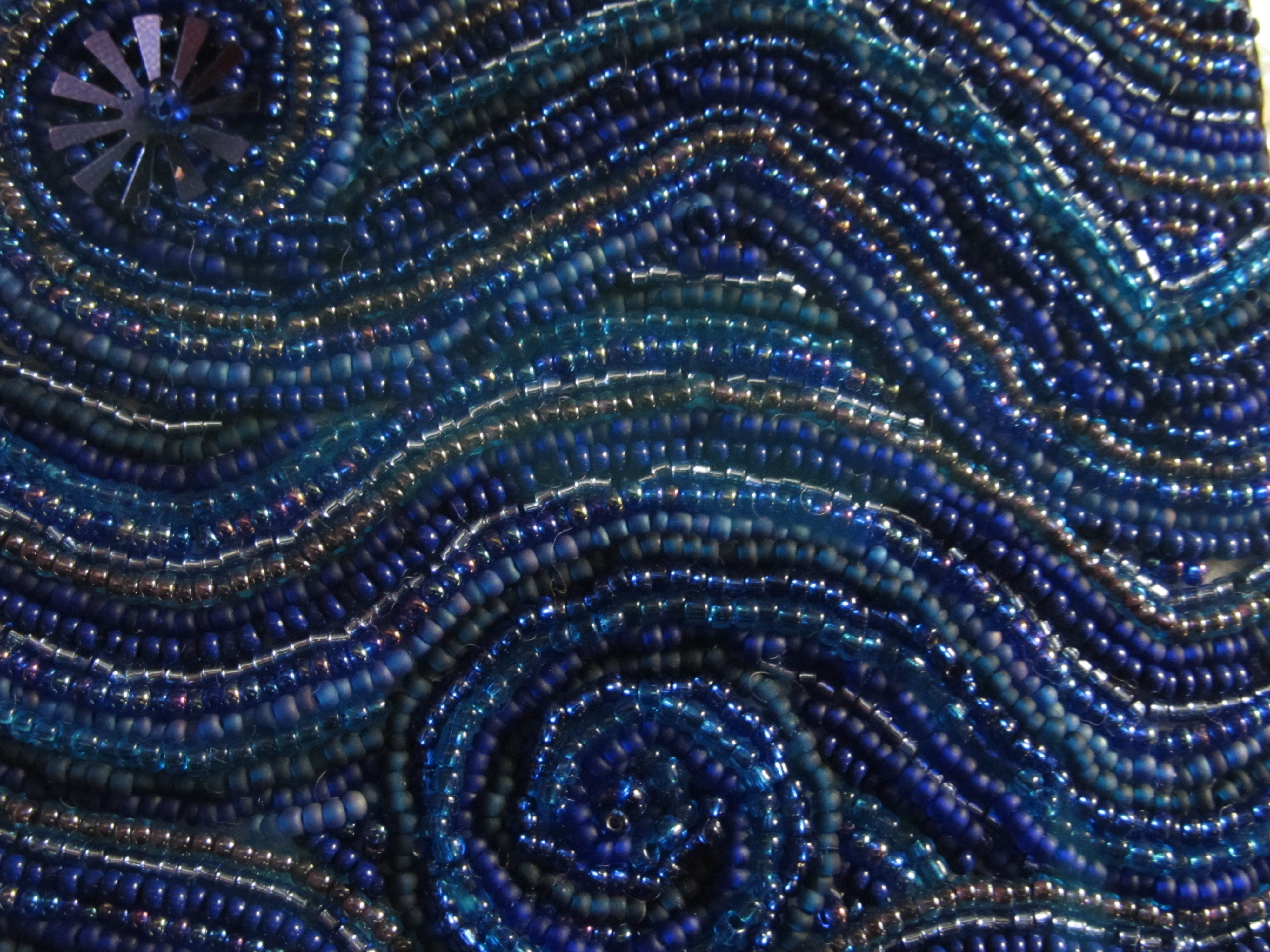
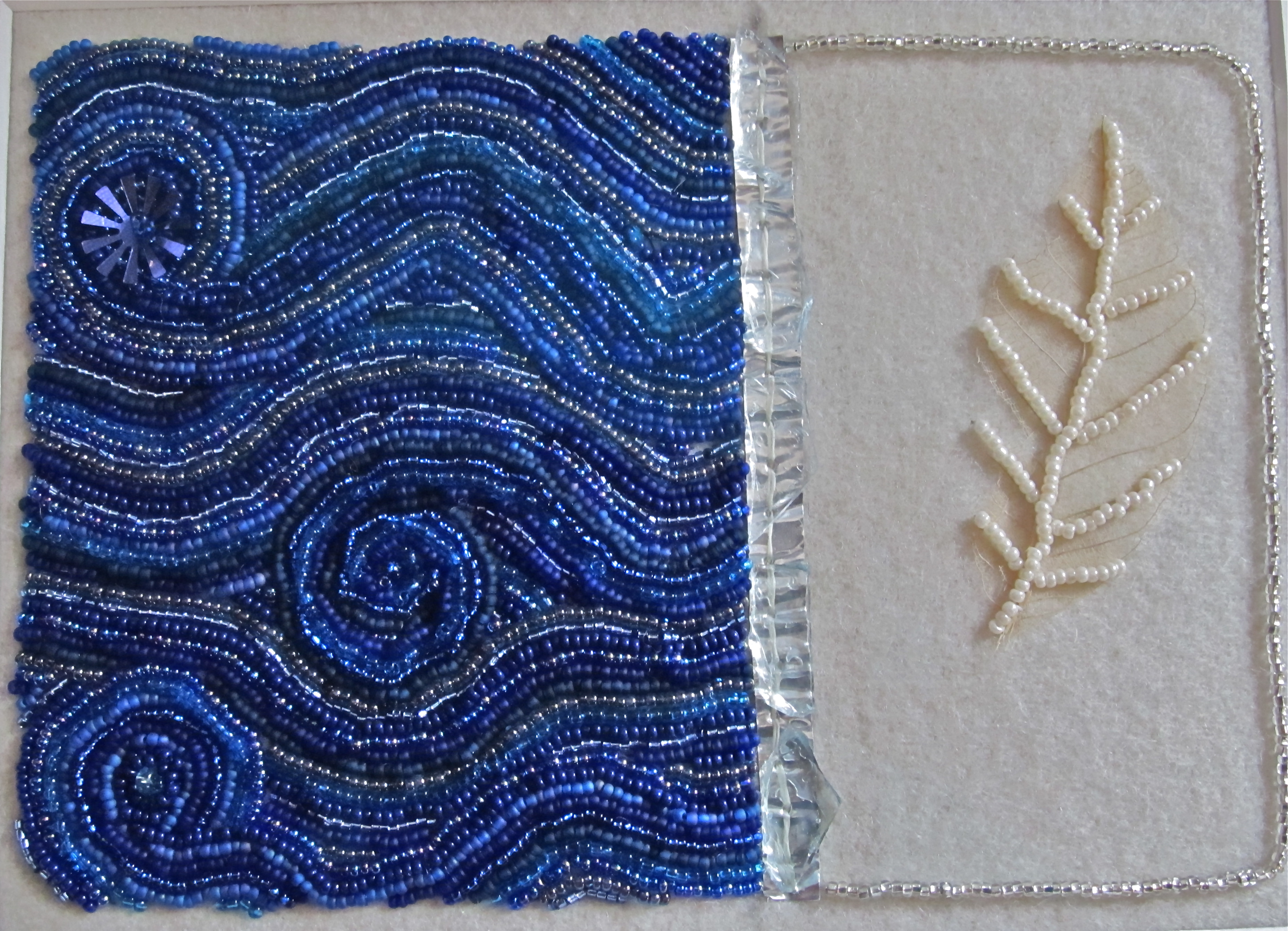
For my final attempt to fulfill the “Winter Silence” challenge, I decided to return to a medium and technique with which I was already familiar – bead applique.  Now, if you have difficulty imagining me sitting, quietly, for hours on end wielding a needle and thread, you’re probably not alone.  But you’ve probably never seen me around beads.  “Winter Silence” took many hours, and in the week leading up to Art Day I beaded until my fingers bled (from sticking myself with the beading needle when I was so tired I could barely keep my eyes open).

Winter Silence: Third and final piece

While the photos don’t fully capture the final piece (which is framed, making it difficult for a novice like me to photograph), I loved the final product.  Why?  First, because it conveyed the theme without words.  Second, because it does so without being directly representational.  Third, because I envisioned this scene in my mind and the end result is not too different from the original conception.

Imagine show and tell on the second Art Day…each person unveiling their attempt(s) to create something within specific parameters, using a specific set of objects.  Each person brought completely different projects to the table. Stephanie’s son commented that hers looked less like “Winter Silence” than like “Winter Slaps You in the Face”, but I loved seeing them all individually, and their diversity as a set.

We have now had five Art Days.  Each day, each project, has been different.  Each of us is developing a small collection of challenge pieces.  One Art Day was devoted entirely to stained glass projects, Paula’s forte.  The most recent saw us all arrive with so many supplies that they took multiple trips from car to house to get everything into the work room.  We still laugh a lot, and talk, but there is a lot more actual work getting done, too.

So, why have I taken three posts to share the story of Art Day and my recent efforts to explore a more visual form of expression?  On one level, it is a way of honoring the experience and the wonderful women with whom I have shared it.  On another level, though, I want to share an experience I am growing from.  Like many people, I suspect, I am reluctant to try new things unless there is a certain level of success guaranteed. I avoid situations in which I feel or look foolish.  Which, for most of us, is what happens when we try something we’ve never really done before.

Art Day has helped me keep at it, learn how to play without undue emphasis on the end result, to compare and contrast my work with someone else’s without a need for ranking the results. I am learning to communicate in actual images rather than verbal imagery. And the sheer fun and concentrated effort required to create is truly a joyful discovery.  Art, and as Mihaly Csikszentmihalyi says in Flow: The Psychology of Optimal Experience, a joyful life “is an individual creation that cannot be copied from a recipe.”  In other words, living life is an art: our time, energy, activity and emotion are the media we have to work with. And in order to live fully, we have to stop waiting for only those things we can do perfectly from the start.  Risking being an amateur or a failure or a fool…that’s how we work our way through to the joy.

Love vs Power?

In the words of Martin Luther King Jr.:

“…Now a lot of us are preachers, and all of us have our moral convictions and concerns, and so often have problems with power. There is nothing wrong with power if power is used correctly. You see, what happened is that some of our philosophers got off base. And one of the great problems of history is that the concepts of love and power have usually been contrasted as opposites – polar opposites, so that love is identified with a resignation of power, and power with a denial of love.

It was this misinterpretation that caused Nietzsche, who was a philosopher of the will to power, to reject the Christian concept of love. It was this same misinterpretation which induced Christian theologians to reject the Nietzschean philosophy of the will to power in the name of the Christian idea of love. Now, we’ve got to get this thing right. What is needed is a realization that power without love is reckless and abusive, and love without power is sentimental and anemic. Power at its best is love implementing the demands of justice, and justice at its best is power correcting everything that stands against love. And this is what we must see as we move on. What has happened is that we have had it wrong and confused in our own country, and this has led Negro Americans in the past to seek their goals through power devoid of love and conscience…

…And I say to you, I have also decided to stick to love. For I know that love is ultimately the only answer to mankind’s problems. And I’m going to talk about it everywhere I go. I know it isn’t popular to talk about it in some circles today. I’m not talking about emotional bosh when I talk about love, I’m talking about a strong, demanding love. And I have seen too much hate. I’ve seen too much hate on the faces of sheriffs in the South. I’ve seen hate on the faces of too many Klansmen and too many White Citizens Councilors in the South to want to hate myself, because every time I see it, I know that it does something to their faces and their personalities and I say to myself that hate is too great a burden to bear. I have decided to love. If you are seeking the highest good, I think you can find it through love. And the beautiful thing is that we are moving against wrong when we do it, because John was right, God is love. He who hates does not know God, but he who has love has the key that unlocks the door to the meaning of ultimate reality…”

Southern Christian Leadership Conference
Atlanta, Georgia
16 August 1967

Where does creativity come from?

I am reading Creativity: Where the Divine and the Human Meet by Matthew Fox.  The book is provocative, as is its author. (Fox, a proponent of Creation Spirituality, was censured by the Vatican, officially “silenced”, and dismissed from the Dominican order)  To illustrate, the title of Chapter 5 asks the question:  “Is original sin the refusal to create, and is redemption the liberation of creativity?” I haven’t gotten as far as Chapter 5 yet, but I am interested to read Fox’s answer.

Back in Chapter 3 (“Where does creativity come from?”) which I read earlier today, the following quote struck me:

“Artists need an inner life just like everyone else.  They also need an outer life, that is to say, a cosmology, an awareness of how we got here and what “here” constitutes in its holy vastness and its unimaginable diversity and creativity.”

As I thought about this concept, two artists whose work has had a significant impact on me came to mind.  The first is Faith Ringgold, whose story quilts offered an entirely new idea of art and the artist’s role to me when I viewed them for the first time in the late 1980s.  The second is my cousin, Stephanie Failmezger.  Stephanie has created a medium she calls “bead mosaic”, which is unique and which she often uses to express her cosmology.  Her latest piece, made up of 24 3-inch beaded quilt squares promises to bring together her influences (such as Mexican art) and the profound spiritual vision underpinning her artistic vision.  While Stephanie and I don’t share the same cosmology, the appeal of her work is that this subtext is expressed so eloquently that her pieces can, literally, be read on many levels.  They speak to the heart even while the mind is grappling with the technique used.

While I don’t have any hard and fast answers to the question asked in the title of this entry, I do believe that it is worth asking not only where creativity comes from, but who is the one doing the creating?  These are questions I am trying to answer for myself.

(I encourage you to check out Stephanie’s work at the following link http://www.facebook.com/pages/SRF-Creative-Studio/113765095304197 )

Learning to Hear

“The first duty of love, is to listen.”  — Paul Tillich

In September 2002, Heather Whetstone, who had been the first deaf Miss America, had cochlear implant surgery which allowed her to hear again.  When they turned the device on, she had to begin the complicated process of learning to hear, something she hadn’t done since she was a small child.

I remember watching her being interviewed on television the very next day, day two of being a hearing person.  She described little sounds she was able to identify.  She said she was in the bathroom and heard the sounds of putting on makeup and spraying her hair.  Then, she turned the water on.  She said, “And it was the most beautiful sound.  It reminded me of my hero Helen Keller.  She felt the water and understood that it had a name.  My joy was like that.”

I want to remember to find the joy in small things — waking refreshed in the morning, good nutritious food, a body that is healthy and works in all its parts. I want to linger on the goodness in my day instead of focus and obsess on the petty annoyances and frustrations.  I want to practice seeing the beauty in people who cross my path rather than picking out their flaws.

I also want to refresh my skills in the art of listening.  The past couple of weeks a parade of young people needing love and guidance have marched through my office. They have frustrated me, they have fought my efforts to assist them, they have worked hard to keep me at arm’s length.  I don’t blame them for that — I’m an administrator sticking my nose into their business, into the parts of their lives they would prefer no one even notice.  But I need to remember to hear what lies beneath the surface.   Sue Patton Thoele says, “Deep listening is miraculous for both listener and speaker.  When someone receives us with open-hearted, non-judging, intensely interested listening our spirits expand.”  I think we all want this, for ourselves and others!

If, as Paul Tillich says, the first duty of love is to listen, then I must try to do my duty. Listen closely enough to shut out the distractions and ambient noise so I can focus on what is important.  In other words, listen with my ears to what is being spoken, but hear with my heart what is being said.

The H Word

“The way I figure it, Heaven and Hell are right here on Earth.  Heaven is living in your hopes and Hell is living in your fears.  It’s up to each individual which one he chooses.”  Jelly paused.  “I told that to the Chink once and he said, ‘Every fear is part hope and every hope is part fear — quit dividing things up and taking sides.”

–Tom Robbins, Even Cowgirls Get the Blues

This week, I’ve been thinking a lot about hope.  First, I read a reflection titled “Fragile Frightful Hope” ( http://wp.me/p3KXs-wK ) in which Randy Greenwald suggests that many of us take shelter in the idea of ourselves as realists in order to avoid the fear inherent in allowing ourselves to hope.  Then, on Tuesday, I attended the annual fundraising banquet for the House of Hope, (http://www.houseofhopecr.org/) an organization offering hope to many women in this community.

The story of the House of Hope is one that highlights the relationship between fear and hope.  Melody Graham, its founder, was working with a woman who needed help, but the kind and intensity of help necessary just weren’t available via local social services.  The first time I heard Melody describe what happened, she said, “And as I was thinking about what this woman needed, I heard a voice ask, ‘Why don’t you open a house for women?'” Each step of the way to establishing the House of Hope was an exercise in facing self-doubt and fear — I mean, its scary to buy a house with no money.  It’s difficult to convince other people to invest in your inspiration.  Melody faced each of these fears, because her hope was stronger.

Melody has been an inspiration to me (and countless others) for years now.  We are amazed by what she manages to create, along with a strong group of friends and allies she has recruited along the way.  I’ve also listened closely as Melody says, “All I did was keep taking the next step.”  Hope leads us forward, if we have the courage to risk doing so without advance knowledge of the outcomes.  And really, the fear is all about outcomes — about being let down, hurt, broken.  We will never know the outcome when we take that first step. Or the next.

At this point in my life, I am not directly engaged in the work of changing my community or creating new structures to support those in need.  But I am engaged in the personal work of transforming a fearful life into one of hope. One next step after another.  Which brings me to the Tom Robbins quote, above.  I have loved this quote for decades, because I believe the wise Chink makes an important point.  When we are sheltering in the cave of Fear, it is easy to delude ourselves into thinking that our only “out” is to leave the cave completely behind.  Stepping out into the pure sunshine of Hope.  But my experience of reality is not that — instead, hope and fear become inextricably mixed.  Sometimes, when I experience that weird flutter in my gut, I can’t even tell for certain which of the two caused it.

This week, today, I living in a place of hope and fear.  I am both afraid I will and afraid I won’t acheive or receive in my life some things I am hoping for.  It doesn’t really matter what these things are — what matters is that I am choosing to hope after a long period of not hoping.  And some of what I’ve hoped for has come to fruition in wonderful ways.  Does it feel less fearful, therefore, to choose hope? Not on your life!  But the quality of the fear is different.  It is a lighter, less depressing fear:   a what if I risk it and it doesn’t happen? instead of a no way can I take that risk!  Sometimes, I can still plunge without warning into the “NO” of pure fear.  But then I realize I can see a little light beginning to glow on the horizon.  Fragile, frightful, hope returns.  And I take another step.

Angel Cards

I have a deck of “angel cards” in my office.  Each little card contains one word and a drawing of angels doing something or holding something associated with that word.  The cards sit in a beautiful abalone shell, a gift from my friend Wendy.

Here’s how they are used:  you draw a card and think about what that word is saying to you at the time you select it.  Sometimes, it feels like you’ve drawn a random word that might mean anything.  At other times, it is uncanny how you draw just the necessary word for your current mental or emotional state.  For example, one day I needed to run errands across town with a very limited amount of time between meetings at the office.  I was stopped both going and returning by midday trains, among other time-sucking annoyances.  On the way back, once the lengthy train had finally crossed the road, I was stuck in traffic behind a school bus.  I was feeling harried, impatient.  Road rage was overtaking me just as I spied an alternate route via a side street where I could get out of traffic and go the speed limit.  Unfortunately, the school bus, at the last second, entered the turn lane in front of me.  And it continued on my alternate route, running a leisurely 15 mph.  I couldn’t pass it, and I followed it right into the parking lot at work.

Frustrated, blood pressure elevated to risky levels, I stormed into my office and ranted a high-drama version of my cross-town trip to a coworker, ending with the school bus.  My colleague suggested, kindly, that I take a few deep breaths and draw an angel card.  I took her advice. The word I drew took the wind completely out of my sails — RELEASE.  But the truly unbelievable piece was that the little drawing on the card was of an angel waving goodbye to, you guessed it, a school bus! Direct message sent and received!

I tell this story to illustrate why I pay particular attention to these angel cards.  It isn’t that there is magic in them.  But, as with many things that allow us to touch our less conscious mind (journal writing is another example) we sometimes surprise ourselves by going to the thing we most need to hear or think about at that moment.  And if Providence is also moving to assist – via our guardian angels – then that is a gift worthy of attention.

Over the past several weeks, I have drawn two words out of the abalone shell repeatedly: BIRTH, EXPECTANCY. First, I can assure you these words are not to be taken literally. Even so, they are powerful words.  I’ve learned to listen when powerful words come my way with such insistence.

What is trying to come into being in my life? I don’t know, but I am excited and just a little trepidatious.  Change, that wonderful, terrible “C” word, fills me with anticipation and fear.  I think I am learning to not only accept change, but to embrace it.  The fear is born of the knowledge that change always requires something from us — if only the internal readiness to go where we will end up anyway.  Friday, after several weeks of pondering BIRTH, I drew a card and discovered that two were stuck together — TRANSFORMATION and TRUST.  Alrighty then. I will try to trust myself, my guardian angels, and Providence.  Something big is on the horizon, though I can’t quite make it out yet.

The Question

Have you ever had one of those minor interactions with someone that was truly not intended to be more than a brief conversation or comment but which, unbeknownst to that individual, sent shock waves through you or made you reevaluate yourself?  I had one such moment a few days ago.  I was one of the committee members hosting a reception at work.  Many of those present had noted, and commented on, the fact that our male colleagues had congregated at one table while our female colleagues gathered at another.  As the event was winding down, I happened to be seated at the table with women, and a faculty friend said, “I suppose I should wander over to the other side.”  I responded that, as usual, I began the event at the table with the men.  My friend asked me what I meant, so I said that, in social situations, I typically begin by joining the predominantly male group.  And then she asked me the question which has been tickling the back of my mind ever since, “Why? Don’t you like women?”

I was nonplussed by the question, but I took it as I believe it was intended: a quick, curiosity-provoked question from one friend (who happens to have a research interest in female friendships) to another (who happens to occasionally make sweeping and broad generalizations).  And my quick answer was, “Of course! I love women!”

In the intervening days, I have caught my mind wandering back to the question, as well as to my initial comment that I find it easier to join groups of men in social settings.  Why is that?  And what does it say about me?  Do I have an underlying issue with women?  Have I bought into the cultural bias that women are just grown up mean girls?  When did I start talking about “mean girls” as if I actually accept this concept?

Here’s what I’ve decided about those questions.  First, I gravitate toward groups of men because their conversations are generally easy to enter into, especially if I don’t know the individuals in the group.  They are talking about things, about stuff they do, about events that have recently taken place.  They are not talking about their feelings, or wondering what someone meant when they said, “Don’t you like women?”  I am not saying that men don’t do these things.  They just don’t usually do them aloud at work receptions.  It is easy to sit on the outskirts of these discussions, occasionally ask a question, or find a moment to tell about the time you tried whatever activity is the subject.

In similar situations, groups of women speak differently — especially in groups where the women are already acquainted with one another.  At this particular event, both groups were speaking about their research interests.  The men discussed topics, instruments, research methods.  The women did, as well, but their conversation was also shot through with comments about how and why this particular research was meaningful to them.  They discussed the circumstances which made finding time for research difficult, or what resonated with them about someone else’s topic.  Very different conversations — each interesting, each meaningful, equally valid.  I just need a little time to warm up to the more self-revelatory discussions.

As you know if you are a reader of this blog, I have written about the wonderful gifts that my male friends and family members bring to my life, the incredible lessons I have learned by observing and interacting with them.  However, today, I am thinking about the amazing women in my life who perform death-defying or life-affirming acts with incredible grace:

  • My mother, who gave birth to 6 kids in 9 years and gave us her undivided attention for two decades.
  • My sister Chris, who nursed her husband, Dave, through stage IV cancer in the 90s, and has fought her own breast cancer in the 2000s.
  • My friend Wendy, emergency room nurse extraordinaire, whose husband says he loves that she sees things she wants to change in herself – and then she changes them (unlike most of us who just talk about changing).
  • My friend Sue who calls her knee replacement surgery and the enforced time off work this summer the “best vacation of her life”.
  • Tricia, who channels her grief from the loss of her son, Nate, into loving work with the SIDS Foundation and as a peer partner for families experiencing the sudden death of a child.
  • Carol, who met and fell in love with Zul, a Malaysian man, in Dubuque, Iowa in the 80s.  Dubuque didn’t get it, but Carol married him anyway.  And a couple of years ago, they adopted the lovely and vivacious Rumela, whom Carol met in an orphanage in India.

These are just a few of the women who inspire me — I could write whole articles about each.  Others, too, or about my sisters Anne and Gwen who make me want to choose courageous paths in my own life.  As I reflect on the question that sparked this reverie, I believe it is good for me to be shocked out of my comfortable perceptions sometimes, and I thank my friend and colleague for giving me reason to pause and reflect.  Perhaps what I’ve written reveals a sexist bias on my part, perhaps it shows that I believe there are culturally ingrained and/or deeply embedded gender differences.  I feel fairly certain, though, that it also reveals that I do, in fact, like women.  More than that, I celebrate their presence in my life.
JOY

…Though I try

to hide it I burn with joy like a bonfire

on a mountain, and tomorrow

and the next day make me shudder

equally with hope and fear.

— “Arriving” by Marge Piercy

When I was in high school, I joined an ecumenical youth group which had a tremendous impact on my life, my beliefs, and my worldview.  At one point, we adopted a practice of signing notes, cards, etc. with the acronym J.O.Y. — which, in youth group parlance stood for the phrase “Jesus, Others, You”.  If we committed ourselves to J.O.Y. (in that order) we would experience joy in our lives.

In describing my own path, I have no desire to offend anyone else’s beliefs.  Putting God and others ahead of self may be both appropriate and right.  However, when I regularly attempted this I rarely experienced joy.  In fact, until recently joy had pretty much fallen off my radar as something I hoped to experience — it was just too far off the grid of normal, daily life.

So here is what I believe now.  Human beings are meant to experience joy.  My mother was wrong (sorry, Mom!) when she told us “life isn’t about being happy”.  I don’t mean we should expect to feel giddy every moment of every day.  There will be trials, tribulations, burnt toast and stubbed toes.  Cancer and poverty aren’t going away any time soon.  But we were created to feel that deep down satisfaction that comes from being truly happy.  In order to get there, you may sometimes have to put your priorities in a different order:  oyj or yoj or jyo — or even include completely different letters in your personal joy acronym.

One day, not too long ago, I was having a really cruddy time of it.  Nothing was going right, I had experienced a big disappointment, it was raining.  For most of my life, a day like that would occasion a feeling of “why do I always have it so bad?”.   But this time it was different:  I was having a cruddy day.  But I was happy.  How could that be?

In looking at that experience, what I discovered is that one thing had changed — I had shifted my priorities in order to develop a “right relationship” with myself.  I can remember talking with a friend about how all the self-focus felt incredibly self-ish to me.  She told me that, by working on my own issues and healing past wounds, I was bringing something good to the world, not just to myself.  I wasn’t sure at the time, but now I can see she was right.

Which brings me to the poem excerpt at the beginning of this entry.  Sometimes, we try to hide the joy we feel because it can be uncomfortable to stand out so starkly from our surroundings.  Sometimes, we are afraid that it makes us a target for others who wish to stamp out our fire, and there are certainly people out there who might try.  But it is also true that  it adds to the measure of our days to interact with people who exude joy. We are energized and inspired by them.  And maybe, when it is you (or me) burning like a bonfire of joy, we will be lighting the way for someone else.  This is the hope part of the equation.

Jump On Life Today!

Several years ago, after attending another boring but educational lecture, I had an idea.  What if we sponsored a breakfast speakers series that would be inspirational in nature — people could come for breakfast and leave ready to try new things, step outside their comfort zones.  I even had a name for the series, JOLT (Jump on Life Today).  I shared the idea with some colleagues, to lukewarm response.  So, I dropped the idea.

Flash forward to earlier this academic year, when I brought out the JOLT idea and shared it with my friend Tricia, our campus counseling center director, and Layne, an amazing young professional in my department.  They met, without me I might add, and decided that it was time this idea became a reality.  The three of us collaborated, brainstormed, and began the series in February.  Yesterday, we held our third JOLT event and it was amazing!

Our speaker, Dr. Deann Fitzgerald (check out her website http://www.docfitzgerald.com) blew us away.  Dr. Fitzgerald and her team have changed lives in a big way both here in Cedar Rapids, and in Kenya (their latest project will bring clean water to 32,000 people).  She talked about failures (“they’re all outcomes…you just like some outcomes better than others”) and she talked about inspiration and passion being things that you have to go looking for…they don’t just appear.  They come when you take a step forward — in any direction — and decide to take another step.  She also says this is the way each person can change the world:  one step at a time.

After Dr. Fitzgerald finished speaking, she gave her email address and encouraged everyone to write if they had questions, ideas, or wanted to create change in the world.  I listened to people saying they want to go on medical mission trips, that they were moved and inspired to act by being in Dr. Fitzgerald’s presence…and that is when it hit me that JOLT was serving as a vehicle for inspiration — just what I imagined it could be when I first had the idea.

One thing that stands out for me today as I have spent some time reflecting on this experience is that I let naysayers prevent me from jumping on life, from taking a step forward in a direction I was inspired to go.  Thank God for Tricia and Layne, who talked back to the negative voices (those of my colleagues, and those in my head which suggested that others knew better than I).  They gave me a true gift when they joined hands with me to take that first step.  I am thinking it is about time for me to trust my own inspiration and creative energy.  Next time, I take the step forward on my own.