A RAGBRAI Story – Part 2

(When we left the story at the end of Part I, the Mustangs were living it up at the beer tent in Homestead, Amanas: sweat-drenched but smiling, and just a little cocky about being “almost done” with the day’s ride)

And so the Mustangs mounted up and began what can arguably be called the most important part of the experience. Tricia and I decided to ride together, and this was the pivotal decision of the day for me. The ride from Homestead to Oxford, a 5.8 mile stretch, was a little hilly, but do-able. Tricia and I commented on the beautiful scenery. It must not have been too difficult a ride if we were still noticing something other than our burning quads and gasping lungs.

As we pulled into Oxford, the party was in full swing. It certainly appeared that many riders were already celebrating the completion of a successful ride. I was flagging, but surrounded by that happy, upbeat atmosphere, I felt reasonably confident I would finish. I not only wanted to finish the 75 miles, I also wanted to be able to say I rode every foot of it. I understood that there is no shame in walking up difficult hills, and that many riders do so. But I wanted to stay on my bike.

Within minutes of leaving Oxford for the last (17.7 mile) leg of the ride, I was questioning my determination. The ride from that point forward was one long, steep hill after another. After another. After another. As we approached the crest of another hill, I could hear the riders in front of me cursing, as they caught sight of yet another hill in front of them. Groaning and cursing. But I also heard a paraplegic rider pedaling with his arms, saying to another cyclist, “We’re gonna do it!”. An older gentleman, passing me by and saying, “That’s it, take your time!”. I heard Tricia, waiting for me at the top of the hill saying, “You’re doing great!”

Hill after bloody hill. I thought I was in hell. A rider passed me, carrying a passenger who was playing the guitar. An ADULT passenger, whose only contribution to the effort was music!  A guy in a cape rode by, as did a bride and groom whose helmets were embellished to look like a top hat and veil. Ok, maybe not hell exactly. More like rural Iowa on an acid trip.

Hill. After. Bloody. Hill. Partners and team members were practically pulling each other up the hills with their words of encouragement. One young girl apologized, “I’m sorry, I have no legs.” But her teammates wouldn’t hear of her stopping, and I saw her three hills later, still riding.  Solo riders were cared for, as well, though. One woman, stopped at the side of the road tinkering with her bike was asked multiple times, “Do you have what you need?”  Strangers looked on us with compassion, including a lovely family with hoses who sat at the crest of a particularly difficult hill. I begged them to spray me with the cool water. At several consecutive driveways, families were shouting, “You’re almost there! Only six miles to go!” I’ll never be able to thank any of them for helping me get through.

Riding up those hills, mostly I was just thinking, “Keep pedaling. Keep pedaling. Keep pedaling.” But it was impossible not to marvel at the people around me who were pushing through. Every shape, size, fitness level. Every age. Bike riding is adaptable to all kinds of ability levels, and people with more to overcome than weight and an inactive past were continuing on. Riders whose whole purpose was other-centered (raising money for HIV-AIDS, for a cure for Diabetes or Breast Cancer) were pushing themselves up and down those hills, too. It reminded me that the zeitgeist of RAGBRAI is part rolling folk festival and part pilgrimage. And in this reminder was the realization that I was participating in the kind of experience that, most of my life, I would only have watched from the sidelines. This wave of committed, possibly crazy, humanity helped to carry me forward when I began thinking I couldn’t keep going.

And then, unbelievably, we crested and in front of us was Melrose Avenue! I couldn’t believe it – Iowa City, about to turn the corner into Coralville, our destination. There was jubilance all around us. Waiting for the State Patrol to give us the right of way, another rider’s radio was blaring Vanilla Ice – and Tricia and I broke into spontaneous dancing astride our bikes. Someone in the crowd yelled, “You go girls!”. The State Patrol officer danced with us.

We turned into a lovely downhill run, the road lined with welcome signs from the colleges and universities with officially registered teams. And then, in the midst of celebration, the final test. One more long-ass hill. I almost cried. Other riders were giving up, dismounting in larger numbers than at any other point on the ride. If Tricia hadn’t been there, I might have been one of them. It took every last reserve to ride that hill. And it was slow going. But Tricia and I rode it together, and when I pulled ahead as we coasted down the other side, I waited for her to catch up. She called, “You don’t have to wait”, but I told her, “The hell I don’t! There’s no way I’m crossing the finish line without you.” How could I, when her encouragement and friendship had just pulled me through the last 17 miles?

The finish line was designed to look like the arched entrances to Kinnick Stadium, home of the Iowa Hawkeyes, with the road painted like a football field. Layne and Kristen, the most awesome and patient road crew ever, were waiting and watching. When they caught sight of us, they jumped up and yelled and cheered, Layne filming us coming in.

I’d like to say that I was overcome with joy, but the truth is, I was exhausted, overwhelmed, dehydrated, hungry and I hadn’t peed in nine hours. I was incapable of joy in that moment. We stopped, and waited for Layne to join us with directions for where we were meeting up with the team. When she arrived, she pointed up the hill in front of us and said, “Go up there to the second stop sign and turn right.” I looked in that direction, and to my shame, burst into tears of frustration. I said, “I cannot ride up another f-ing hill. In fact, I can’t get back on my bike.” Layne hugged me and said, “Its ok. We’ll walk together, and I’ll push your bike.”

I owe a debt of gratitude to a huge community who made my RAGBRAI experience a day I will never forget: The people of Iowa who opened their homes, hometowns, and hearts to the massive river of riders. The cyclists, themselves, who were compassionate comrades on the quest to achieve personal goals. My fellow Mustang riders (especially my girls: Sarah, Colette, Wendy, and Tricia) without whom I would surely have failed – whose love and support held me up throughout the long day. Layne (and her parents for the loan of their truck) and Kristen, the road crew who loved us enough to spend a day waiting, cheering, manoevering through traffic and congestion. They didn’t have the payoff of endorphin highs or self-congratulations at the end – just thankless jobs and a long, sweaty day. The Lange Family, who hosted a reception/party for all the Mustang riders in Coralville, welcoming stinky sweaty strangers into their lovely home.

Each person in a long list vital to the success of the whole. Vital to my success.

The community story is not a story I was expecting, because until I was there, it wouldn’t have seemed possible. There is a lot of hype and mythology surrounding RAGBRAI. Turns out, a lot of it is true. But the magic of it, in my opinion, comes down to love.

I know, some of you just groaned, reading that! Here she goes again, you’re thinking, reading too much into every little experience. I’ll accept that criticism. But I will also say that I am no Pollyanna – ask Tricia, who saw me at my absolute snarliest at the end, after successfully completing the day. Ask Layne, who saw me tensely coiled at 5:20 a.m. when I was worried about the derailers on our bikes being  smashed as we loaded the truck. No Pollyanna visible in those moments, I assure you.

However, throughout the ride, there were moments when I was able to be outside my own fear and self-doubt enough to really see the events and people around me. Those moments were emotional – and more true than the fears. At one point in the day, a rider towing a boom box passed Tricia and I, blasting Martina McBride’s “Love’s The Only House”, one of my all-time favorites. That day, I swear, love was a big enough house to shelter all 10,000 bicyclists.
50 About 50: Caring Less and Caring More

Today is a good day to post two of the 50 About 50 lists I started last week. As you will recall, these posts are leading up to my 50th birthday on Thursday, July 28. Because of the double list, today’s post runs a bit long. I hope you enjoy it anyway. As always, please feel free to respond with comments or your own items for the lists!

10 Things I Find Myself Caring Less About

1. What Others Think

Its a little strange to immediately contradict myself, but I DO care what others think. I will always be interested in how people think, why they’ve reached the conclusions they have. I am happy to reflect on the ways their thinking might illuminate mine. That said, in my younger years I tended to be unduly influenced by others. My own thoughts were like feathers easily blown in a new direction by another’s, more forcefully, declaimed idea. Now, I find I am able to continue in my own direction while remaining open to course corrections based on new information.

2. What Others Think About Me

Finally, I have reached the point in life where I am no longer incapacitated by concerns about what others think about me. Do I care? Yes, sometimes about some things. Mostly, though, I am happy to be the person I am.

3. So-called “Rules”

For most of my life, I have been an inveterate rule-follower. Breaking a rule, even one which might arguably exist only inside my own head,  just felt wrong. Often, even contemplating breaking the rule would induce hyperventilation. Social conventions and mores (such as waiting for an explicit invitation, saying the polite if untrue thing, etc.) still have a certain hold on me. More and more, though, I find that part of living and maturing is learning when to break out – and break a few rules.

4. Weeds, among other “unsightly” things

People say not to compare apples to oranges, because they are two different things.  Well, I was listening to a scientist on NPR one day, who said we needed to change that idiom. At the cellular level, he said, apples and oranges are the same thing! Weeds, flowers, hostas…at the cellular level aren’t they really all the same? I put my energy into the things that matter to me. I don’t waste a lot of energy on the “weeds” in life (or my flower beds) anymore.

5. Cognitive Structure

Things need to make sense, have order, structure, be inherently fair. Or so I once thought. I’m (mostly) through with trying to tidy up all of my beliefs, my thoughts, my emotions into a neat package. The world is wide and full of wondrous things. Its not my brain’s job to rearrange the furniture of the universe. See, accept, wonder, be in awe –  this may be enough responsibility for one human brain.

6. Being in Fashion

Fashions come and go. What looks good on me mostly remains the same.

7. Noise

Dear Mom: on this point, as on so many others, I concede that you were right all along. Sometimes I go whole days without voluntarily creating extra noise (radio, Pandora, television, etc.) in my house. Sometimes, silence is too precious to squander.

8. Television

Like most of America, I enjoyed The Voice when it began airing this spring. But I could miss it if something better – a social event, a good book, a workout, or a quiet summer evening – came along. I refuse to miss more life because “my show” is on television.

9. Body Hair

I don’t understand the current obsession with hairlessness. Yes, I pluck the stray black wires that periodically grow out of my chin. I have my hair stylist wax both my eyebrows and upper lip. But if I forget these things, I don’t run screaming from the mirror yelling words like, “Gross!”  Body hair is just body hair – it IS nature, not an affront to nature.

10. What Ifs/Fear-Based Scenarios

I’d like to say I’m over these completely, but that would be a lie. However, I no longer frighten myself at night wondering what I would do if a rapist crashed through my window in the wee hours. I don’t tell myself a lot of scary stories that begin with the words, “What if…”, just as I am about to embark on a new activity or adventure. What I’ve discovered is that these thoughts act like a prophylactic, preventing a life pregnant with possibilities. In order to live fully, I’ve needed to cut way back on scaring myself with stories of doom.

10 Things I Find Myself Caring More About

1. Beauty

The experience of beauty opens the heart: to perception, clarity, healing. The human heart craves beauty, though we don’t often credit it as a need. In a poem published in 1911, James Oppenheim wrote of women seeking justice, crying out for bread but also for roses – and it is such an appropriate juxtaposition. The staff of life (bread) and the stuff of life (beauty=roses).

2. Health and Vigor

Things you take for granted in your youth, for $200, Alex!

3. Other People’s Children

My nephews, neices, godchildren and the many other children who feel like my neices and nephews. But also, the young adults I have had the pleasure to know and work with in my career in Student Affairs. When I was a young adult myself, I thought I would be “the fun aunt”, that I would have a lot of good advice to impart to my students. Time has shown that the reverse is true – other people’s children have enriched my life, have taught me so many lessons about life, love, and the importance of not taking the teachable moment too far. Thank you to the parents for sharing their children’s lives with me. And to the OPCs themselves: each of you remains in my heart.

4. Animals (and other species)

I am not a pet person. But I am learning to love and appreciate what animals and other species bring to the world around us, and I am learning to care deeply about their continued existence on our planet.

5. Wisdom

I used to pray for wisdom, as a teen. I always felt so stupid, I thought that if I was gifted with wisdom, I would suddenly feel more confident. What I am discovering as I age is that wisdom isn’t about feeling self-confident. It is about caring enough to self-reflect as a means of continuing to develop and grow into the person I was meant to be.

6. Trying New Things

They say you can’t teach an old dog new tricks. Well, that’s only true if the dog doesn’t want to do anything new. And I DO!

7. Honesty/Truth

Its probably not a good thing to admit, in writing, that I am a really good liar. Further, if I am being truly honest, I must admit that I have lied purposefully and often, and not only to myself. But here’s the rub: every time I deny the truth, or “pretty it up” in some way, I deny my own self. This cuts to the heart of why honesty is a virtue and so closely aligned with the concept of integrity. No integrated whole can wantonly deny its own parts. The older I get, the more life experience I accummulate, the more important honesty becomes as a personal value.

8. Compassion/Mercy

I am, and have always been, a really good reader. I can put myself square into a character’s psyche and emotional make-up with little effort. I used to think this was a sign that I excelled at compassion and empathy. Really, that was just fiction. True compassion, true mercy, requires a willingness to enter fully, as myself, into another person’s messy life.  I am just learning the depth of character true compassion requires. I hope, someday, to embody it myself.

9. Unconditional Love

“Human beings, like plants, grow in the soil of acceptance, not in the atmosphere of rejection” said John Powell, in his book titled Unconditional Love. I read the book my freshman year of college, as did many of my friends, and we bandied around the concept quite a lot. I can remember saying to people (wince), “I love you. Unconditionally.”  What a crock! At 19, I hadn’t the vaguest clue what that meant, and no pop-psych book was going to enlighten me. I had to learn what it means the old fashioned way – by torturing myself and others, by saying hurtful things and tearfully rescinding them, by seeing the worst in myself or another and then – joyfully – discovering that I still felt love. This loving unconditionally is no easy thing. I believe it is worth the effort to practice, though, in the hope of someday being really and truly good at it.

10. This Moment

I not only care more about this one, I am in love with this one! I used to live in the past or the future, anywhere but the here and now. When and how that changed is the story I’ve been telling in this blog. One of the best things about my life now is that I am living it right here, in this moment – and I am so grateful for the present.

Breaking: Apart or Open?

Have you ever looked at the first card in the tarot deck, The Fool? In many decks, The Fool is setting forth on a journey. He has packed lightly, a small bundle slung over his shoulder. He looks ahead, not down at the path which, to onlookers, appears to be a precarious one. A dog nips at his heels (or in some drawings, his bum) but he appears unconcerned. In fact, he sets forth with a face full of joy and hope, blithely unaware of the dangers that await wherever he is headed. The Fool appears foolish, indeed.

What an apt image for us as we set out into our lives – especially as we set off into the uncharted lands of relationship. We rarely see what is before us, even when there are markers in place (I once dated someone who told me on our first date that his favorite song was “Love the One You’re With”. Perhaps I should have read that marker.) But often, there are no easy-to-read road signs. I don’t know about you, but I am cautious by nature, and it is rare for me to put my feet to a path I can’t see the end of. So, I have ventured out into the territory of love relationships timidly, afraid of the unknown future ahead and of the possibility of experiencing emotional pain.

Which brings me to the topic of this post: broken hearts. Despite my caution, my heart has indeed been broken a time or two. No one, I think, really experiences life without heartbreak. In the throes of real emotional pain, I have wondered, “What am I supposed to do with this? With this broken thing that was my heart, with these feelings that have nowhere to go now that they have no one to be invested in?”

In one such moment recently, I read the following paragraph, and it gave me some much-needed perspective:

“But there are at least two ways to understand what it means to have our hearts broken. One is to imagine the heart broken into shards and scattered about — a feeling most of us know, and a fate we would like to avoid. The other is to imagine the heart broken open into new capacity — a process that is not without pain but one that many of us would welcome.” (Parker Palmer, from A Hidden Wholeness)

When I read this, it immediately reminded me that I have, in fact, experienced my heart being “broken open into new capacity”. One such experience was a trip I took to Ireland a few years ago. I had never travelled overseas, and had dreamed of visiting Ireland – then got the opportunity to travel with a group from the university. I fell in love with Ireland, and with the person I became on that trip — a person who lived as fully as possible in every minute, who didn’t leave a drop or a crumb behind. It was amazing. When we boarded the plane to return to the States, I put my jacket over my head and cried for two hours.  But the experience of leaving that perfect moment broke my heart open. A love of travel and an image of myself as fully alive were the new capacities born of that experience.

When our hearts break due to relationships not working, not going where we want them to, ending, it is difficult to accept. To then, on top of learning to live with the brokenness, expect or hope for something new and good to be born of it almost defies us. It feels beyond our reach, and yet…perhaps it isn’t. Perhaps we’re meant to learn that looking like a fool isn’t the end of the world. Perhaps we’re meant to discover that hearts are resilient muscles — and like all muscles, they get stronger the more you use them. And perhaps the capacity that will be born is the ability to love without reservation, because you begin to understand that the journey itself (rather than its end) is what makes it worthwhile to do so.

And so you, The Fool, journey on. You feel your feelings, especially the ones that hurt. You look for the good, for the things you may have learned or discovered in yourself. You flex your heart muscle and find that it still works. And eventually, as a Missy Higgins song puts it, “you’ll wake to find, you’re a little unbroken.”

Conference – Day 2: Activism

I began the day with an early morning trek to the Philadelphia Museum of Art. It was too early to enter the museum and see the exhibits, but that is not what I was there for, anyway. Like millions of others over the years, I visited the museum to see the Rocky steps. You know, the ones Rocky tackled as part of his training for the big fight in the original Rocky film. One of the reasons that movie has inspired so many is the whole idea of one regular guy taking on a corrupt system and, through application of hard work and heart, overcoming the odds that are stacked so high against him.

Turns out, this was a fitting way to begin the second day at the NASPA Conference. The morning’s featured speaker was Emmanuel Jal, whose autobiography War Child tells the story of his turbulent youth in Sudan, where he witnessed many atrocities, at the age of eight became a child soldier, then a refugee and one of the “lost boys” of Sudan. But Jal’s path was destined to cross that of Emma McCune who saved him (along with 149 other Sudanese children). Jal now works for peace and to better the lives of those in his home country living in poverty. His goal is to change the world. I know he managed to take a bunch of college administrators and turn us into dancing fools this morning, so maybe he will succeed.

The afternoon featured speakers were Ian Cheney and Curt Ellis, the documentary filmmakers who brought us King Corn the story of how hidden corn in our diets has literally changed us. They also took on a project of farming out of the bed of an old pickup, leading to their high-profile Truck Farm.  Advocates for sustainable practices in food production, they have also started an activism project modeled on Americorps, called Food Corps. Their aim is to send young adults into communities to teach about whole foods, grow school gardens, and get communities really thinking about the startling effects of our current food consumption patterns in the United States. This is a public health crisis (1 in 3 children is on track to develop Type II Diabetes), it is a social justice concern (our poorest communities have the least access to fresh foods), and it touches everyone. After the session, I spoke briefly with Curt Ellis, who is spearheading the activism side of their ventures. He indicated that Iowa (my home state) is one of the first 10 states to which Food Corps workers will be sent. We spoke about some of the challenges in Iowa of speaking directly and truthfully to farmers and to powerful business interests about these concerns. He said he’s met with higher level management at businesses such as Cargill (to name one major industry in my community) – and he believes that by and large they want the same things he does, among them food that makes people healthy rather than sick. The ten states they’re starting Food Corps in were selected because they already have statewide organizations which will support Food Corps’ mission and purpose. In Iowa, there are a couple of campuses with strong Americorps programs, and they will also be working with the National Center for Appropriate Technology.

In addition to the two featured presentations, I went to two additional sessions. One of these also fit todays theme. The presenters, from Marquette University, discussed the development of a social justice living-learning community based on the life and work of Dorothy Day, founder of the Catholic Worker Movement. Dorothy Day, an activist whose example has inspired many to enter fully into lives of those who have little.

In all, I walked away from today’s formal events ready to take action in both my work and my own life. Inspiration is a great thing, but today’s speakers reminded me that without action, great ideas remain just that. As Emmanuel Jal, Ian Cheney, and Curt Ellis know, inspiration must lead to action in order to spark real change.  And this brings me back to Rocky. As we all know, sometimes the road to change is difficult and requires hard work. We love what Rocky stands for because he succeeded through sheer perseverance. Emmanuel Jal fasted for over 600 days to raise money to build a school in Africa because he promised the children he would do it. I don’t know about you, but I definitely call that perseverance! I’m happy to have both the fictional hero and a real life one to learn my lessons from. And the lesson I learned today is that it isn’t really a question of CAN I do it (am I good enough, strong enough, talented enough to change the world). Its more a question of WILL I do it? And the only way to answer yes to that question is…to get busy!

The Songs Stuck in My Head

For the past week or so, there have been two songs in my head which refuse to leave. More specifically, there have been two lines, one from each song, which keep playing on a loop in my brain and I can’t seem to shake them. The fact that I had not heard either song in at least 25 years (possibly longer) made me that much more curious to understand: why these lines? why now?

Both songs are by Christian recording artists I listened to in my youth. The first by Keith Green (written by his wife Melody), Make My Life a Prayer to You.  The line that keeps playing over and over is, “…oh its so hard to see, when my eyes are on me.” The second is an even bigger memory stretch, by an artist named Honeytree, from a song called, I Am Your Servant: “…when you are lonely, you’re the only one to blame.”

Sometimes when song lyrics float to the surface of my thoughts and refuse to leave, it is because they are catchy and I happen to love the song at that moment. Sometimes, the song is connected to a specific memory that I’ve been playing over in my head. But sometimes, like in this instance, I believe the lyrics are a message I am meant to decipher then use in some manner. Deciphering whether the source of that message is my own heart or subconscious, or whether it is the result of Divine intervention, doesn’t seem to matter as much as parsing the message.

It doesn’t take a rocket scientist to look at these two lines, put them together and come up with the idea that I need to focus attention outward, toward others. And it certainly makes sense, as much navel-gazing as I’ve been doing recently. It also feels like a call to trust both what my heart and my friends have been telling me: that I have something to offer to others that can make a difference in their lives and I need to stop holding back out of fear or misguided feelings of unworthiness.

On another level, though, I can’t help but notice that both songs are calls to live a Christian life: one of faith, prayer, and service. I have always striven to live by Christian ideals, though I have not always been what could objectively be considered a practicing Christian. Is this a call to deepen my faith life?

Here’s what I believe today, thanks to a wonderful and illuminating conversation with my friend, Wendy, yesterday. If life is a series of dots, as Steve Job says, which we have to trust will connect in a coherent manner even though we cannot see the connections as we move forward, I am in the process of stepping onto the next dot – I don’t know exactly where I’m going, but I’m ready to trust that I am being led where I need to go. In my daily, active life, as well as in the life of my spirit.

It didn’t take me long to find video of Keith Green on YouTube. Eventually, I found the Honeytree song, but I had to pay $.99 to download it in order to hear the entire song. I had forgotten some (though clearly not all) of the lyrics. The final stanza includes the lines, below, which seem like a perfect way to end this reflection:

I am a servant, getting ready for my part.

There’s been a change, a rearrangement of my heart.

At last I’m learning, there’s no returning once I start,

to live’s a privilege, to love is such an art…

Living the Questions

Be patient toward all that is unsolved in your heart and try to love the questions themselves…Live the questions now. Perhaps you will then gradually, without noticing it, live along some distant day into the answer.

–Ranier Maria Rile

Letters to a Young Poet


Be patient toward all that is unsolved within your heart. Yeah, right.

Because patience is something we are all busy cultivating, in this culture of instant gratification. Because patience is something we humans are so good at right from the start – ever been around a young child who wants something? Yes, patience is a virtue we only possess if we actively seek and practice it, because we are not (most of us) born patient.

Lacking patience, how does one live within the questions long enough for the inner self to discern, then make known, the answers? It is not easy. Have you ever had an itch that would not go away, despite extreme bodily contortions to reach and scratch it? Living with the internal itchiness of unresolved questions can be truly uncomfortable. I’ve been given the advice to trust my gut, which is fine if your gut is a trustworthy ally. Mine tends to be a trickster, responding from fear but pretending otherwise. (And then prompting me to eat because food will make me feel better.)

Rilke’s suggestion that, gradually, without realizing it, we might live into the answers someday isn’t particularly comforting. I mean, how are we supposed to move forward without answers?  Steve Jobs, in his 2005 commencement address at Stanford, uses the image of connecting the dots. That each decision, each step we take, is a dot. He goes on to say that the dots cannot ever be connected moving forward, they can only be connected looking backward, in retrospect. We have to keep choosing and trust that the dots will connect.

My tricksy gut tells me he’s right. Cultivate the patience to wait for the answers to make themselves known, while trusting that the choices I make in the meantime will connect in a coherent way someday. Remaining where I am because I am afraid to move forward without all the answers, may seem safe. But the truth is, I’m just stuck. To get unstuck, I need to cultivate my inner Wile E. Coyote (from the Roadrunner cartoons). I need to be willing to keep moving forward right off the edge of the canyon into the unknown. Now, Wile E. always looks down, and in doing so loses his faith that he can make it to the other side, causing him to plummet to the canyon floor. That’s where the trust part comes in: take a step and keep going, trusting that I’ll get to the next dot. Because I will. Even when Wile E. Coyote falls, he gets back up and tries again in the next episode.


When the Pendulum Swings

When I was younger, in high school and college, I was very deeply involved in religious activities. Several times a year, I went on weekend retreats, which were invariably peak experiences. People who hardly knew one another would open the contents of their hearts, bond quickly and intensely, and share a high well beyond any experienced in normal, daily life. Returning to normalcy post-retreat was always difficult. People returned to their daily selves, and the shared experience grew less powerful as a touchpoint with one another. As the retreat ended, you told yourself things had changed, that you had changed. But the truth was, your old self and habits nearly always reasserted themselves.

I remember Pastor Ross addressing this: faith isn’t a feeling, he said. When the feeling of the retreat passes, you discover that faith is a verb. Something you actively do, not something you passively feel.

It has now been many years since I’ve been on that kind of retreat, or experienced exactly that kind of high. However, for just over a year now, I have been on a journey which has led to similar feelings: happiness, joy, a sense of purpose, renewed (or just new) relationships. My life has had a quality of incipience, every day on the cusp of a new experience or revelation. It has been amazing. I have gushed about it. I have sworn that everything is different now, things have changed, I have changed.

And all of that is true. However, no peak experience, no emotional high lasts forever. And when that feeling goes away, when the pendulum begins to swing on the downward arc, what does one do? More to the point, what should I do?

Option #1: Chase the High

A friend recently invited me to join her at a movie premiere in New York. The movie, directed by Robert Redford, stars several actors I enjoy. I loved that she asked, but for a variety of reasons needed to decline the offer. Several people told me I was crazy; in fact, one person said she wished she had my life because she would live it better than me. Well, that’s possible, I suppose. However, I am still me. I will still make decisions, for good or ill, based on my own values and gut feelings. I will never be the type of person who drops everything else in my life to jump at unusual experiences just to be able to say, “See what I did?!” So, chasing the high isn’t really an option suited to my temperament.

Option #2: Wallow.

As the pendulum drops from its apex, its easy to allow your emotional self to plummet into sadness and depression. Truthfully, there have been many times when this proved to be my modus operandi. In the current case, the things that have changed the most in my life are internal. The outward trappings have remained essentially the same. And now I am faced with the same life choices and decisions that have always awaited my attention: What should I be doing with my life? I have learned to be honest with myself, which felt really good at first, but which can be a bit depressing. For example, I pretended for decades that I didn’t have feelings like other people. Now, I’ve admitted to myself that I do and some of them are angry or disappointed or sad. Part of me wants to roll around in those denied emotions for a while, just feeling them. Luckily, my emotional health is more robust than it once was, and I can’t see the point in wallowing. So, Option #2 is a no go.

Option #3: Remember that to BE has always been a verb.

I’ve (briefly) studied two foreign languages in my life, and while I don’t remember much of either, I do remember that to be was the first verb we learned to conjugate in both of them.  So this option suggests that, regardless of what I am feeling, I can keep breathing, keep moving forward. I can keep living in the present, living as this new self I’ve worked so hard to become. And I can have faith – an active choice, not just a momentary feeling – in my ability to continue creating a meaningful life.

In summary: Option 1: too hard; Option 2: too soft.  Option 3…just right! Now that I’ve chosen an attitude, I just have to figure out the right action plan to go with it. And that will be both the hard and the rewarding part. I don’t know what will come next. But I do know that the pendulum will eventually hit its nadir and begin another upward climb!

Flash Back Friday

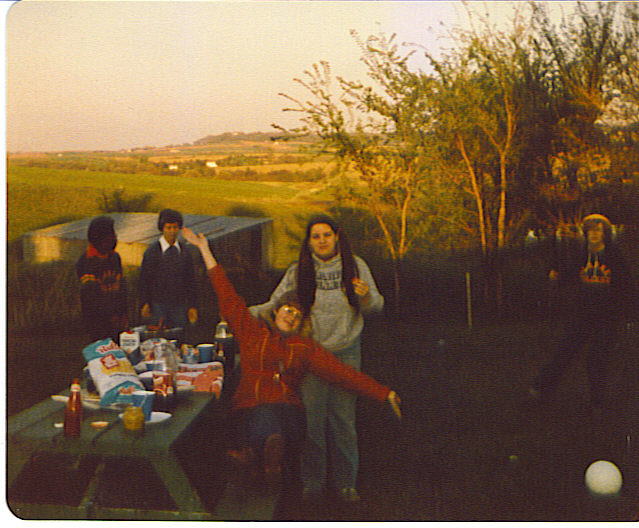
April 1980: celebrating the last days of my freshman year in college.  LaDonna (seated), me with the long pigtails, left to right in back Myrlene, Jane, Lynne.  Picnic as Jane’s house in Key West, IA.  I have not stayed in touch with any of these women, though two joined religious orders (and I believe LaDonna is at Clarke University, our alma mater). I have no idea who snapped the photo.  Sorry, friend!

Taboo No More

Sunday night, my friend Wendy and I went on a whirlwind Christmas shopping expedition.  As we finished two intense hours and were heading home, Wendy asked if I would mind stopping briefly at K-Mart.  She said she gets many stocking stuffers and gag gifts there each year, but often forgets to go there until she’s been everywhere else first. I don’t frequent K-Mart regularly myself, but I didn’t mind stopping.

As we wandered down one of the wide “center” aisles, filled with special gift items, I happened to see a gift box of Tabu — the scent I wore and loved throughout college.  The gift box came with a spray bottle of cologne, a small purse-sized bottle and a tube of scented lotion for the amazing price tag of…wait for it…$9.90.

Me:  I didn’t even know they still made this stuff!  I wore this all the way through college.  I used to love it!

Wendy:  Then you have to buy it, an early Christmas present for yourself!  Come on, you can’t beat the price!

Me:  It probably stinks.  I would guess that what I liked at 19 isn’t the same as what I like thirty years later!

Wendy:  No, you’ll probably still love it!  Come one, you have to get it.

And so I left K-Mart, the proud owner of the Tabu gift set.  And guess what?  I have been wearing it ever since, and…I smell goooood.  I smell like carnations, and spice, and a little powder in addition to young, hopeful, and idealistic.  I thought my tastes had taken me into more sophisticated sensory territory back in graduate school when I discovered Perry Ellis perfume.  But I guess I have always been a Tabu girl masquerading as a designer scent profile!

This has led me to wonder what other “childish” likes or pursuits I’ve given up in the name of maturity but should reconsider now.  As you know, I’ve already gone back to biking as a favorite pastime, and a couple of years ago I discovered that I still enjoy roller skating.  But what else did I decide, prematurely, I was too sophisticated, too sua-vee, too plain OLD for?  Here is a partial list I’d like to check out now, and see how they fare:

  • Strawberry soda pop.  Sickeningly sweet or deliciously decadent?
  • Yarn crafts: macrame, God’s-eyes, crochet squares that somehow never got sewn into an afghan.
  • Cheesy made-for-television Christmas movies.  OK, who am I kidding, I never gave these up!  ABC Family’s 25 Days of Christmas and FaLaLaLa Lifetime fight for my viewership nightly every December.
  • Driving around the countryside on hot summer nights, windows down, music blaring (will it be the same if the music isn’t playing on an 8-track tape?).
  • “Russian” Tea.  An instant tea and Tang concoction.  Hmmmm…
  • Bonfire, guitars and folk singing on the “beach” (using the term loosely for a sandbar along the Mississippi River).

As is the case for most people, I think, I was in a hurry to grow up — or at least to appear grown up to the rest of the world.  “When I was a child, I talked like a child, I thought like a child, I reasoned like a child. When I became a man, I put childish ways behind me” (1 Corinthians) was a credo I took seriously.  I never wanted people to think of me as childish, so I was quick to monitor my choices for what they communicated about my level of maturity.  This bible verse talks about taking up adult responsibilities and mature thought processes, definitely important for all.  However, as in all things, a balance is called for.   “And he said: ‘I tell you the truth, unless you change and become like little children, you will never enter the kingdom of heaven’ ” says Matthew 18:3.  The balance between these two good admonitions is what I am seeking in my life now.

When I was in college, there were numerous silly things we did to amuse ourselves.  Last summer, I had a small reunion with several friends, and we resurrected our “snapping turtle” skills (see photo, below).  I can’t tell you (because I’ve never known) how this started or why, but we laughed so hard attempting the snapping turtle faces, 25+ years out of practice, that I realized it is time to stop worrying about appearing childish or foolish – and to start reveling in it!  Sincere enjoyment in the moment is childlike, not childish, and hits that lovely balance I’m seeking.

Now, how about it?  Anyone for a strawberry soda – my treat!