…make hot chocolate

Browsing through a book called, Lean Forward Into Your Life by Mary Anne Radmacher, I came across a story she tells of a minister who was giving a children’s sermon. The minister used the line, “When life hands you lemons, make lemonade.” However, one little boy who didn’t care for lemonade insisted, during the sermon, that the line be changed to “When life hands you lemons, make hot chocolate.”

Radmacher follows the story with this:

“So from the most difficult of circumstances, we can build something of our own choice. Just because a thing is handed to me does not mean it must be grasped by my hand.

This, friends, is a revelation. And it bears thinking about as we run through our overwhelming lives at breakneck speed. We don’t have to accept everything that comes our way, just because it came. And if we do grasp ahold, we still get to shape our response or what we choose to do with it.

Which brings me to my friend, Layne, who has yet another take on the ‘when life hands you lemons’ line. She gave a presentation at a national conference this fall entitled, “When Life Hands You Lemons: Make Souffles, Tarts, and Meringues”. Another great concept: we are allowed to use our creativity. Just because the old saw says to make lemonade doesn’t mean we are required to make only lemonade. Habit, custom, group think be damned!

Choice and creativity. So often I forget that these are in my tool kit when something onerous, unwanted, seemingly unavoidable comes my way in life. I didn’t make a New Year’s Resolution this year. I think I may have just found one! (After all, who says you can only make one in January?!)

Apple-Parsnip Soup

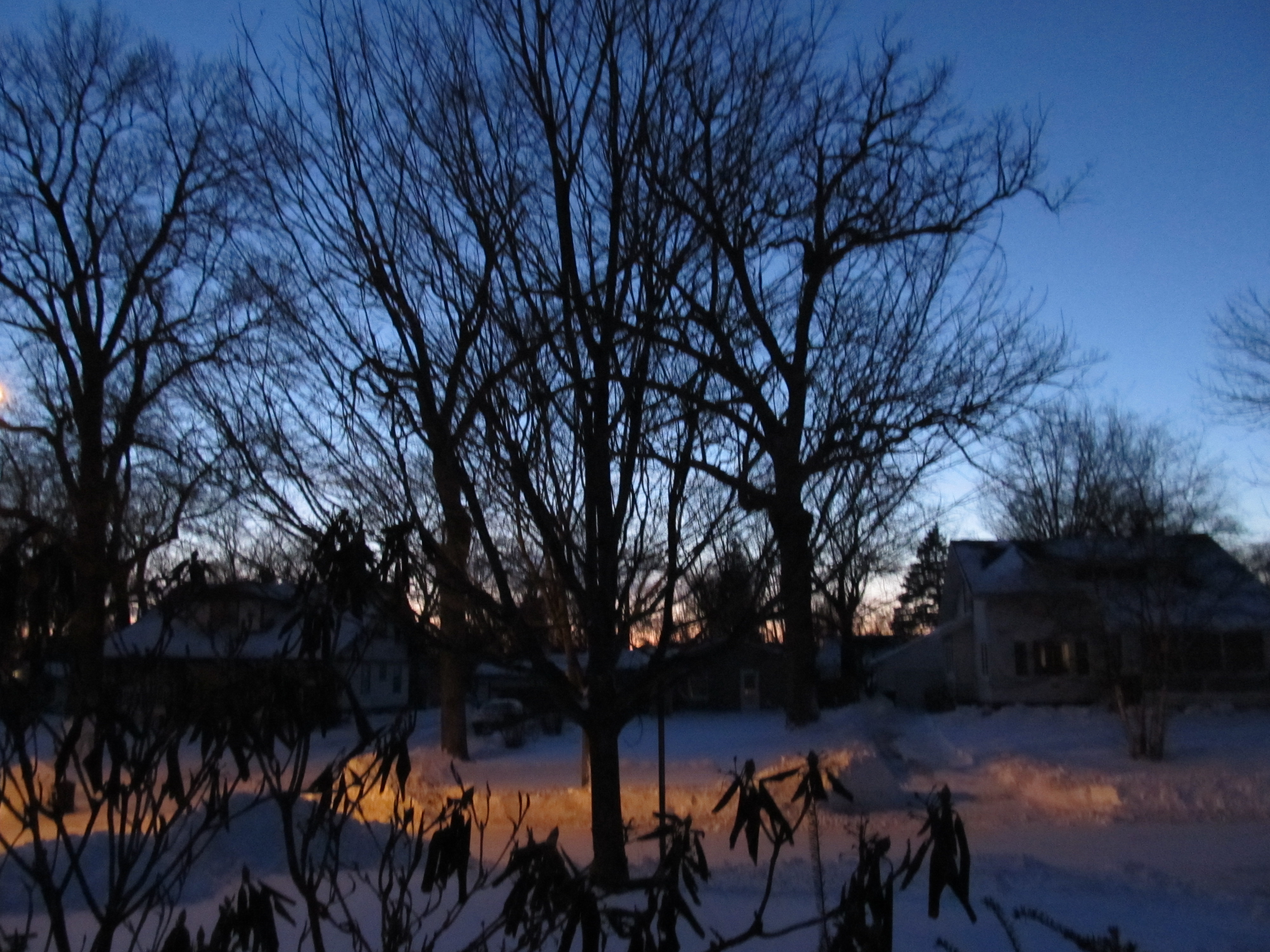
Imagine, if you will, the day after a major blizzard. You have spent just over four hours with your trusty shovel, clearing 13 inches of snow including drifts reaching almost three feet high. The sun sets in a blaze of color, as the temperature is plummeting to an overnight low of -12 degrees.

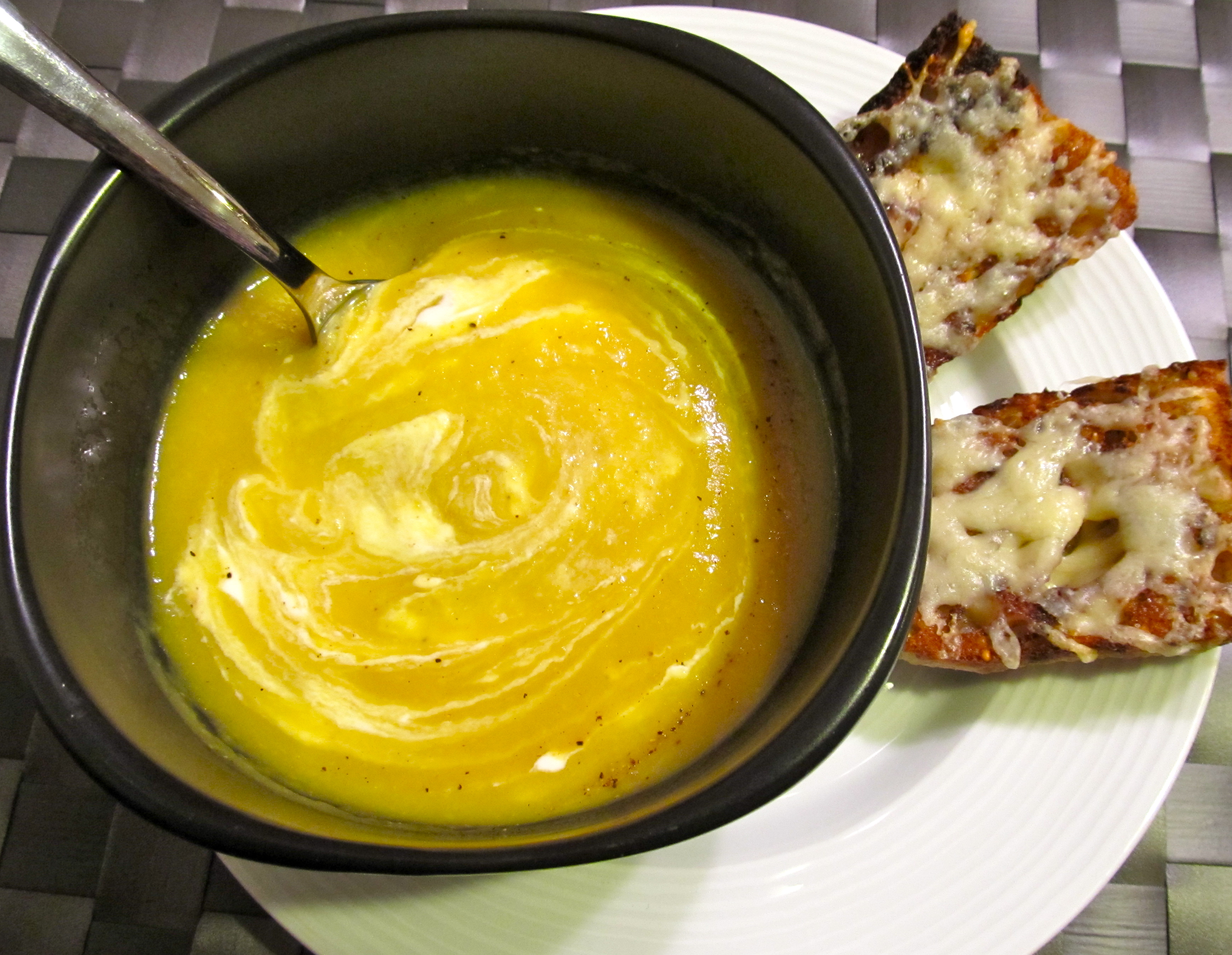
You go inside, unpeel sweaty layers of clothing, and grasp a cup of hot tea to warm your frozen fingers. Suddenly, you remember it is parsnip week at your house! Warm apple-parsnip soup, made in the midst of the blizzard, is only minutes away from filling your empty stomach with velvety goodness. Bliss!

This soup is so good, I braved the worst of the blizzard on Tuesday night to deliver a container to my friend Layne (she lives about 300 yards away). We agree that a little more heat might improve the soup, but it is wonderful made faithfully to the recipe, too (which can be found on the recipes tab, above). I have one serving left, which I plan to savor after a little snow shoeing later today!

Flash Back Friday

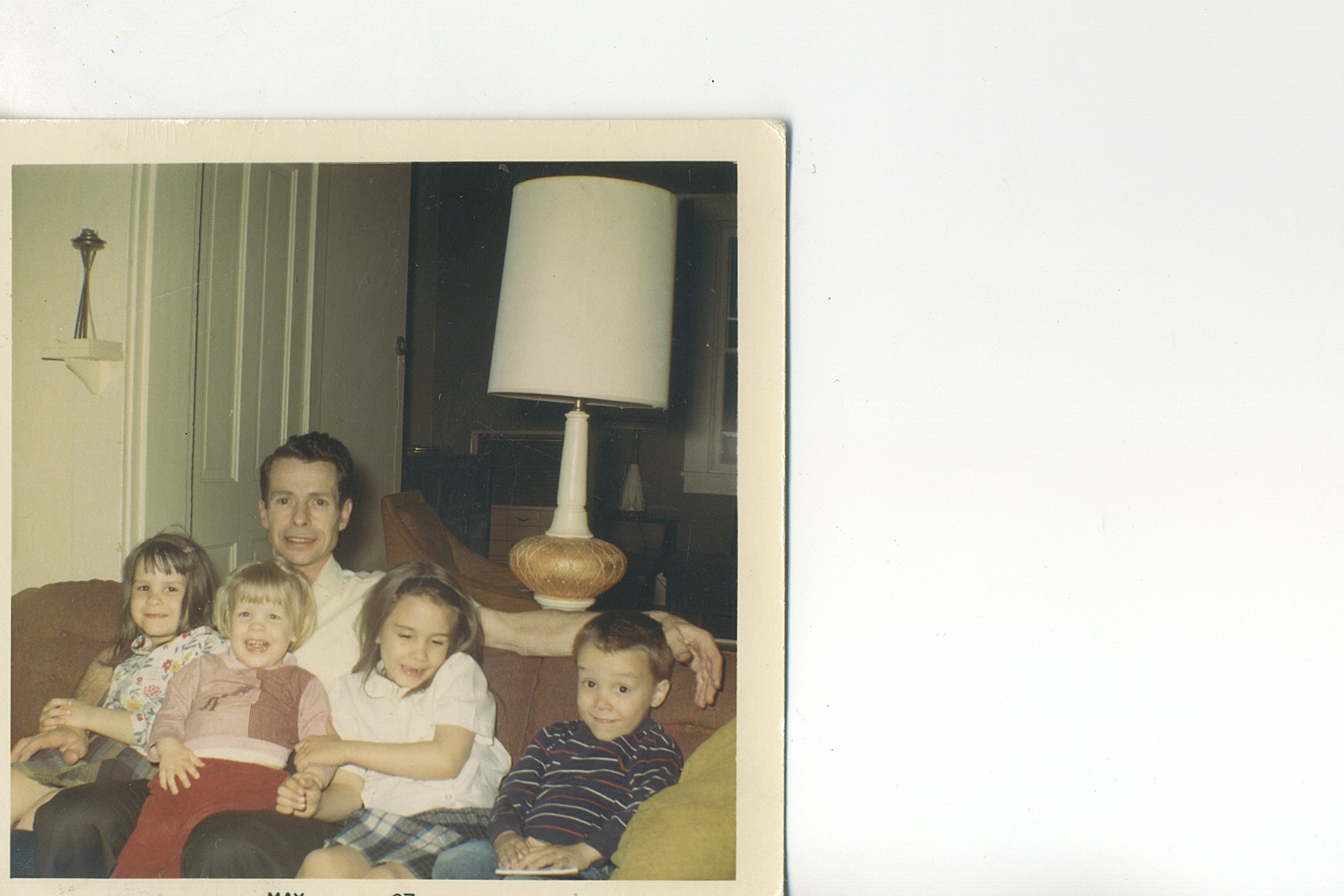
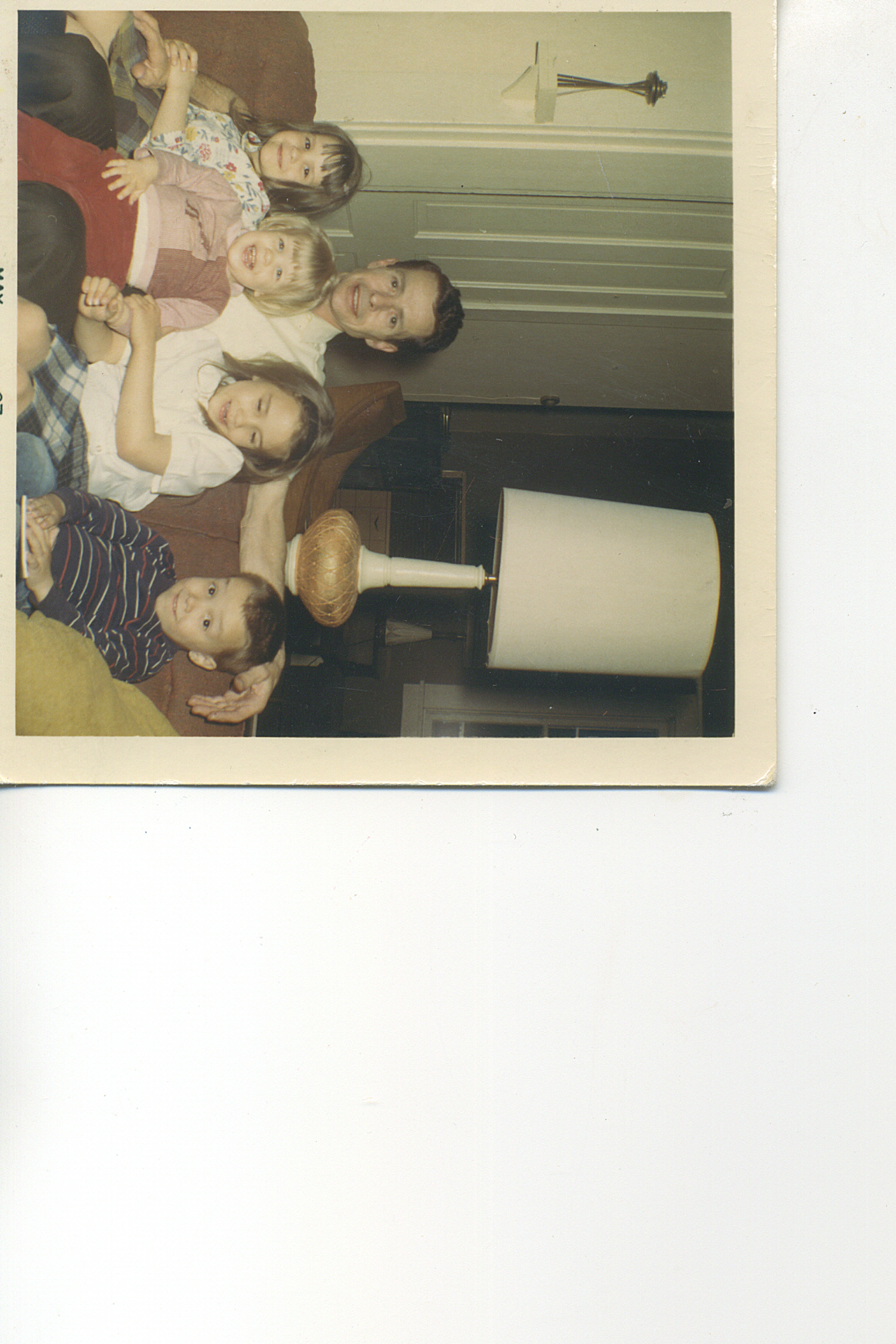
Since I wrote about my grandfathers in my Wednesday post (The Odd and Unusual: My Grandfathers) I thought it would be fun to post a photo of my Grandpa Postel today.  The children, from left to right are: me, Gwen, Chris and Jeff. The photo is dated May, 1967. Chris is dressed in the uniform we both wore during our years at St. Raphael’s Cathedral Grade School. If you look at my attire, you will see that my early fashion sense left plenty of room for growth!

How to Love People: A Misanthropes Guide to Relationships

First off, I used the word misanthrope because it is a great word.  I don’t really qualify as one, but it also serves the purpose of letting you know right off the bat that I’m no relationship expert!  I once read an article in which a woman said, “I love mankind. Individual people annoy the hell out of me.” That’s fairly representational of my feelings, or at least of my natural, introverted inclinations. However, inclinations change. At least mine have, and I’d like to share some things I’ve learned about loving others which (now that I know them) have changed my life. Really. They’ve changed my life.

I am not required to tell others what I really think about them, their choices, their actions. Once, I was with a friend who was telling me that he and his wife were thinking about having a child.  His wife was really pushing for it, but he wasn’t sure. He shared his reasons for being unsure, and I told him they were, essentially, stupid.  He responded, “You know, some friends would just listen and empathize.”  This particular friend, at that particular moment, needed someone to hear what he was feeling, not someone to argue against him.  The trick, and the art of being a good friend, is learning the difference between these times, and those moments when what your friend is looking for is someone to help them face a hard truth.  Parker Palmer suggests (in Let Your Life Speak) that we must “avoid the unconscious violence we do when we try to save each other”, that we must learn to “hold another life without dishonoring its mystery”. In other words, sometimes just being quietly yet fully present to another is enough.

I am not required to tell others everything feel. I used to avoid telling anyone what I felt, and that included myself. In order to open my life to more and healthier relationships, I’ve had to learn to acknowledge my emotions and, yes, to express them. Finding that sweet spot, you know the one where you allow others to know your heart without knocking their feet out from under them like a riptide, is terribly difficult. Frankly, I still suck at it. Sometimes, I don’t share my feelings when or how it is most appropriate (usually because I am arguing with myself about whether I should), then I blurt them out at moments when others are completely unprepared. Sharing honestly without hurting or knocking others down – practicing this skill is key to mastering it!

Being RIGHT is overrated. Let’s face it, we all love being right. We love being in the right. Sometimes, this is important. But not as often as we think, especially in relationships. I’m a middle child, and early in life was known for over-using the phrase, “That’s not fair!” I would go to great lengths to prove I was right. And when I did, it was almost always a hollow victory. It turned out I was either the only one who cared OR my need to be right had taken the spontaneous fun out of the moment. Now, when my entire family gets together, I enjoy staying out of the fray. Let others fight for control, for the decision-making power, or for the sheer delight of fighting to be right. The gift of this approach is that I get to stay in peaceful connectedness with all my loved ones. I just wish I had known this at 18. I would so have avoided that unfortunate kick-fight with my 19-year-old sister one morning before going to college classes together!

I am capable of loving people whom I know to be flawed. One day, I was hanging with a friend whom I just love. I mean, this friend is really special, wonderful, funny, loving, kind, beautiful inside and out. And then, something was said by this person that completely shocked me. It revealed a weakness in my friend’s character. The kind of weakness that, in the past, I might have considered a “fatal flaw”, in that it could have killed our friendship. And that’s when it hit me that I could choose to extend my love and friendship anyway. That I could see someone’s weaknesses and flaws clearly and still love them. That blindness to these traits is not a requirement of love.  In some cases, I am actually learning to love the flaws. No, really! Being in relationships intimate enough that I actually know these things and see them as an endearing part of the whole package is a gift beyond measure. It is a gift I hope to learn to extend to myself, as well.

When in doubt, choose the most loving course of action. This suggestion, while akin to “being right is overrated”, takes the concept a step further. There are often times in relationships when we don’t know the right thing to do. Should I go over there? Or give her space? Say something? Or hold my tongue? Take a stand/give an ultimatum? In my experience, the right path can proceed forward from whichever step I take, as long as that step is taken with a loving heart. Importantly, my action needs to express love for the other, and for myself. And that tends to be the hard part. It is easier to step into the role of martyr (“See how I sacrifice for you?”) or that of the self-righteous (“I don’t deserve/need this!”) than it is to carefully navigate a loving response.  Yes, there may be times that the most loving response is to walk away. But, by and large, the great beauties of relationship develop when we work through these tough issues and come out stronger on the other side.

I don’t think there’s anything new or earth-shaking in this guide. I am an imperfect practitioner of each point. But I’m learning how important each one is to deepening relationship. I also don’t think its any coincidence that each one refers to maintaining a balance between self and other in relationships. I no longer think it is possible to have loving relationships with others if I don’t have one with myself.

One last thought: being a misanthrope (allowing minor things about others to annoy me) was a defense mechanism that kept people at arm’s length. If I could be blunt or dismissive or right, I didn’t have to risk letting people close enough that I could be hurt. Recently, I was talking to my friend Tricia, who is a mental-health counselor. I said, “I cry a lot more often than I used to.” And her response was, “Thinking about the person you used to be, and how your life has changed, would you really want to go back? Isn’t crying, even if it is a little every day, a small price to pay?” And, of course, she’s right.

The Odd and Unusual: My Grandfathers

A few years ago my friend Wendy told me that a well-known psychic, host of a nationally syndicated radio show, was planning to be in the area for a week and was taking appointments.  We were both curious to check it out, and set up appointments at the AmericInn in Coralville.  I had no idea what to expect, but the psychic turned out to be not the least bit intimidating. We had just settled in to the appointment when she asked, “Is your grandfather still with us?” I must have looked at her dumbly, because she rephrased her question. “Has your grandfather passed?” I quickly indicated that yes, both of my grandfathers had ‘passed’.

B., the psychic, then said, “Well, one of them is in the room with us right now. I don’t know which one, but he says you love the odd and unusual. That you take after him in this, so maybe that helps you know which one it is.”  Clearly, B. had never met either of my grandfathers this side of the veil, or she would have known that wasn’t much of a clue. My mother claims it must have been my dad’s father who showed up, since he once visited a psychic during his corporeal life. By contrast, her father, she claims, “wouldn’t be caught dead at a séance”.

However, my Grandpa Postel was definitely into the odd and unusual. When my grandmother died, our family moved into their home, and Grandpa moved into an apartment in the basement. He decorated the apartment with items from the Lillian Vernon catalogue: dogs with jewel eyes and bobbing heads, a fake parrot, a psychedelic lamp and various items from the “Surprise Grab-bag” offer. He worked at the Dubuque packing house, stamping meat. His closest work companions were the rabbis hired to certify the kosher meats, and often at the dinner table he shared stories about them. This seemed exotic to me, given that we lived in a town that was more than 90% Catholic at the time. No one else I knew had ever met a Jewish person. Grandpa had a drawer full of treats in his kitchen…if you consider Smith Brother’s cough drops a treat (which he did. Also, grape jelly by the spoonful.) In the summer, he and his friends would sit in the sun on lawn chairs in the neighbor’s yard, drinking beer. I would always hang out with them, the only kid among the old folks, listening to their stories and drinking the warm dregs left in their bottles.

Grandpa Joe was another kettle of fish altogether. He wore a crew cut, had green tattoos all over his arms from his years in the Navy, and tended to swear up a storm. He lived in Texas, then Florida, and his visits always occasioned at least mild panic in our house. He liked good food, and was an excellent cook. He taught my mother, his daughter-in-law, how to bake bread and she taught me – albeit via telephone many years later. Joe was a bourbon and water man (which I tasted at each visit and hated every time). He also handcrafted model steam engines – miniature working versions the craftsmanship of which, at the time, I didn’t comprehend. Now, though, I am in awe of what I remember of his work. He had an international following of collectors. Late in his life, he wrote down some interesting recollections from the Depression, including his time riding the rails and staying in the “jungles” with other men looking for work.

Ed and Joe. You couldn’t find more normal or unassuming names, yet the men who possessed them were out-of-the-ordinary in many ways. They were so unlike one another, that I am lucky no teacher assigned a descriptive essay on “Grandfathers”. Mine would have been full of contradictory adjectives. And yet, I loved them both and like to think that I carry a few of their traits – other than the whole liquor thing (surprisingly, I have become a whiskey drinker…in moderation, of course).

Grandpa Postel, Ed, died when I was in 7th grade, in the early 1970s. It was a sad and difficult time for all of us. I will never forget standing outside my junior high school in Hastings, Minnesota, on that cold, gray day, waiting for my dad. Or, after the funeral, talking with Grandpa’s brother Merle, who started to cry and didn’t even care that saliva was running from his mouth in a stream to the floor.

Flash forward a couple of decades. Friday, October 13 (I never remember which year because it was overshadowed by Friday the 13th). I was sitting at my desk in my current job when the phone rang. It was my parents, calling to tell me that Grandpa Joe had died (in his mid-80s,he put a gun in his mouth and pulled the trigger). My brother, Jeff, and I drove to Dubuque that evening to be with my folks. The four of us reminisced, and drank a toast – bourbon of course – to the old man.

The week before Grandpa Joe died, I had a dream. I remember I told my friends about the dream, at lunch the next day, because it had been such a powerful one.  In the dream, my family was gathering across a green lawn toward a table laden with food. We were all dressed in white, and the furniture and linens were white also.  The table sat under a massive tree, with sheltering branches that provided cool shade under the hot sun. There were peacocks wandering on the lawn as we took seats at the table, drinking iced tea and lemonade and chatting the way families do. Suddenly, from out of some bushes off to the side, there wandered a bird with striking plumage. Its body was white, but it had a giant tail fan all in shades of reds and oranges. It was beautiful. I asked, “What is that?” And someone answered, “It’s a quetzalcoatl. They’re fire-eating birds.” Suddenly, I felt that something unusual was taking place, and I turned to my dream-mother and asked, “What’s really going on here?” She said, “We’re visiting your grandfathers. Grandpa Postel is this sheltering tree, and Grandpa Joe is the quetzalcoatl. Both of them are here with us.”

The night of Grandpa Joe’s death that dream was with me on the dark drive home. And now, every time I think of either Joe or Ed, the memory of that dream returns to me, still powerful. And I am comforted to know two things: that my grandfathers are watching over us, and that in my love for the odd and unusual I carry them with me, always in my heart.
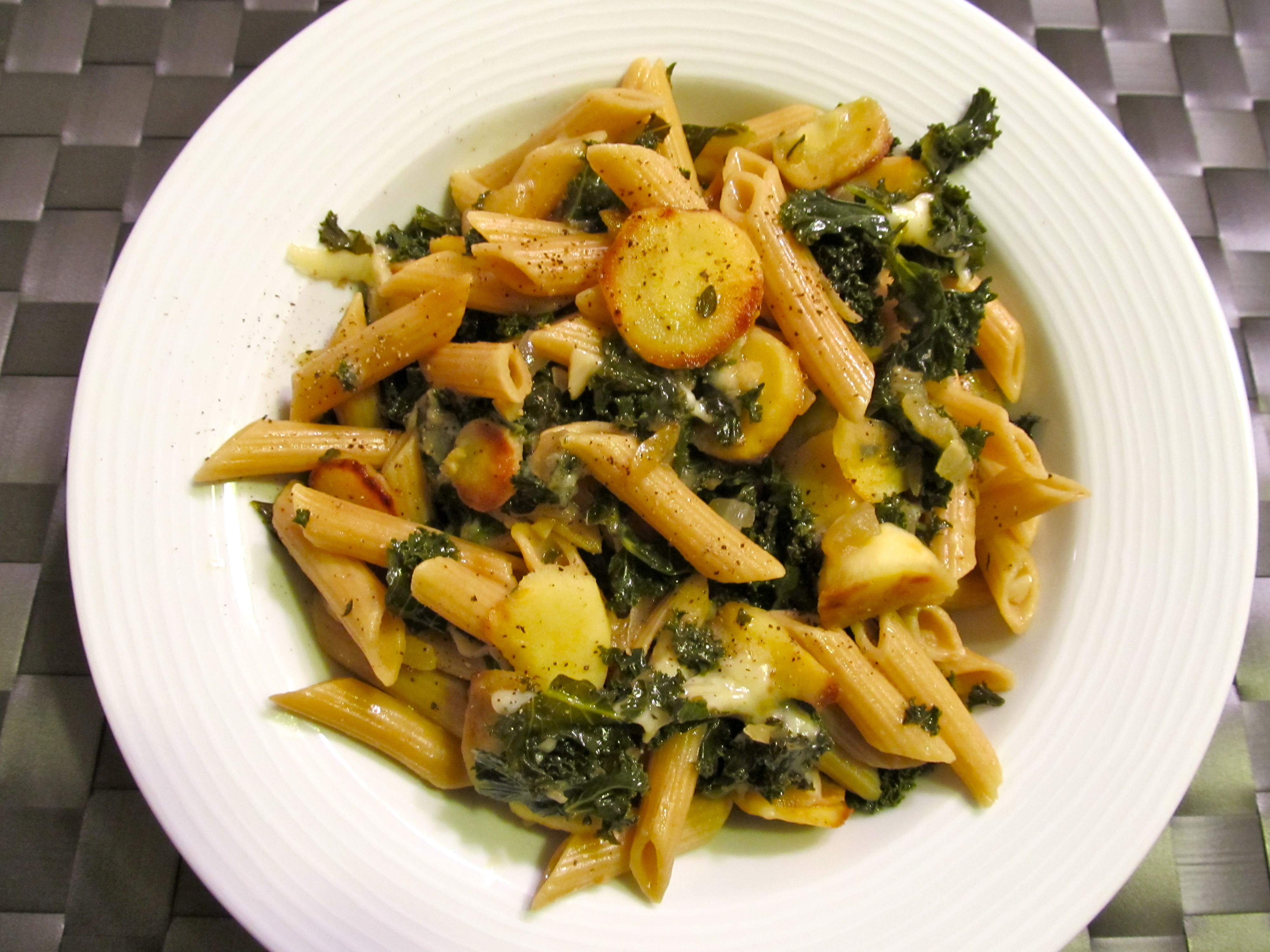
Pasta with (Black) Kale, Caramelized Onions, and Parsnips

The thing about living in Cedar Rapids, Iowa is that there are three choices for grocery shopping and they are all supermarkets (and the three includes WalMart and Target). No Whole Foods. No Trader Joe’s. No local cooperative (unless you drive to Iowa City). Therefore, like many things readily available in other markets, there is no black kale to be had in this town, unless one grows it oneself. Luckily, this recipe is delicious with regular kale!

This is parsnip week at my house, so there will be parsnip and apple soup later in the week. I had never cooked with parsnips as a featured item before making this pasta. I discovered that, like carrots, cooking brings out their sweetness. I also learned that they should cook somewhat longer than the recipe suggests, unless you want them to be crunchy rather than crisp.  If you use this recipe, I recommend not skimping on the seasonings or it tends to be on the bland side. As always, find the full recipe on the recipe tab, above.

Dear Diary: A Response and Reflection

On his blog, “Somber and Dull”*, my friend Randy Greenwald has posted two articles on diaries/journal keeping.  In the second entry, Randy shares thoughts on whether personal diaries or journals can be considered accurate portrayals of the lives of their authors, given the pressures of writing for posterity or self-improvement.  He finishes with this reflection, “My own journal keeping occurs early, early in the morning, when sometimes my soul is as dark as the sky is outside. It’s not necessarily an accurate description of my whole view of life!”

In the past couple of weeks, I have been reading random diary or journal entries I’ve written over the past 30+ years, with the intent of sharing some along with my “Flashback Friday” photos. As I’ve read them, I’ve been struck by several thoughts. Most prevalent is the wish that I had written more detailed content.  Many entries are quite descriptive of my emotional response to specific events, but leave out any facts about the events themselves. At 15 or 25, I apparently believed that the daily occurrences that shook my world were all memorable enough that I would only need access to the momentary emotional condition to bring them back. I clearly had not reckoned with the effects of age and immoderate alcohol consumption in my late adolescence on long-term memory!

Second, as I have looked through the assorted spiral notebooks, bound blank books, and record keeping folios in which my journals are written, I have been struck by the repetitive nature of many of my reflections. It is humbling to realize how the particular challenges of my personality in relationship to the world have been ongoing and relatively unmediated by age, experience, wisdom. In her book, The Work of Craft: An Inquiry Into the Nature of Crafts and Craftsmanship, Carla Needleman says that she used to labor under the illusion that, once she learned something, it was hers forever. But that now she sees that the things worth knowing are difficult to grasp, and must be learned over and over again. (Sorry, I can’t put my hands not the exact quotation, so I’m paraphrasing from memory here.) My journals prove Needleman’s conclusion, by showing that I cycle through the same life issues, relearning the same insights. I like to think of it as an upward spiral, because I do inch along to greater understanding each time. But it is an incremental improvement.

The third thing I’ve discovered in rereading these notes is that I have no difficulty telling the difference between when I was writing from my heart and when I was striking a pose for the benefit of some “future reader”.  I have actually laughed aloud while reading some of my more pretentious entries.

Perhaps the most surprising thing I’ve stumbled upon while reading my journals, though, has been the compassion I feel for my younger, less mature, self. Life happens, and we do our best to stay a step ahead of the tidal wave. Sometimes, we manage pretty well. But at other times, we stumble and get wet as the wave rushes past. I had no clue how to stay out of the water. Writing in my journals has been one way I’ve tried to learn from my missteps. I have often said that I know when I haven’t been writing in my journal because I feel untethered. That the time to reflect is as necessary to my life as taking the time to eat…well, ok, maybe as necessary as taking the time to exercise. I can go days, even weeks, making excuses. But I don’t really feel well without it.

At this point in my life, I find my need to reflect in prose is greater than ever. I write this blog, and keep two journals: one for normal daily reflections, and one in which I write about a specific set of life issues with which I am wrestling. Like my friend, Randy, my tone changes to reflect the moment in which I am writing, and individual entries cannot always be trusted as a true reflection. However, taken as a whole, the disparate parts tell a coherent story of one woman’s life: mine.

*Check out Somber and Dull if you’re interested in a thoughtful, well-reasoned and well-read Christian perspective. The blog’s name is meant to be humorous, and does not reflect the site’s content!

Word Girl Meets Visual World – Finale

A person who forgoes the use of his symbolic skills is never really free.
Mihaly CsikszentmihalyiFlow: The Psychology of Optimal Experience, 1990

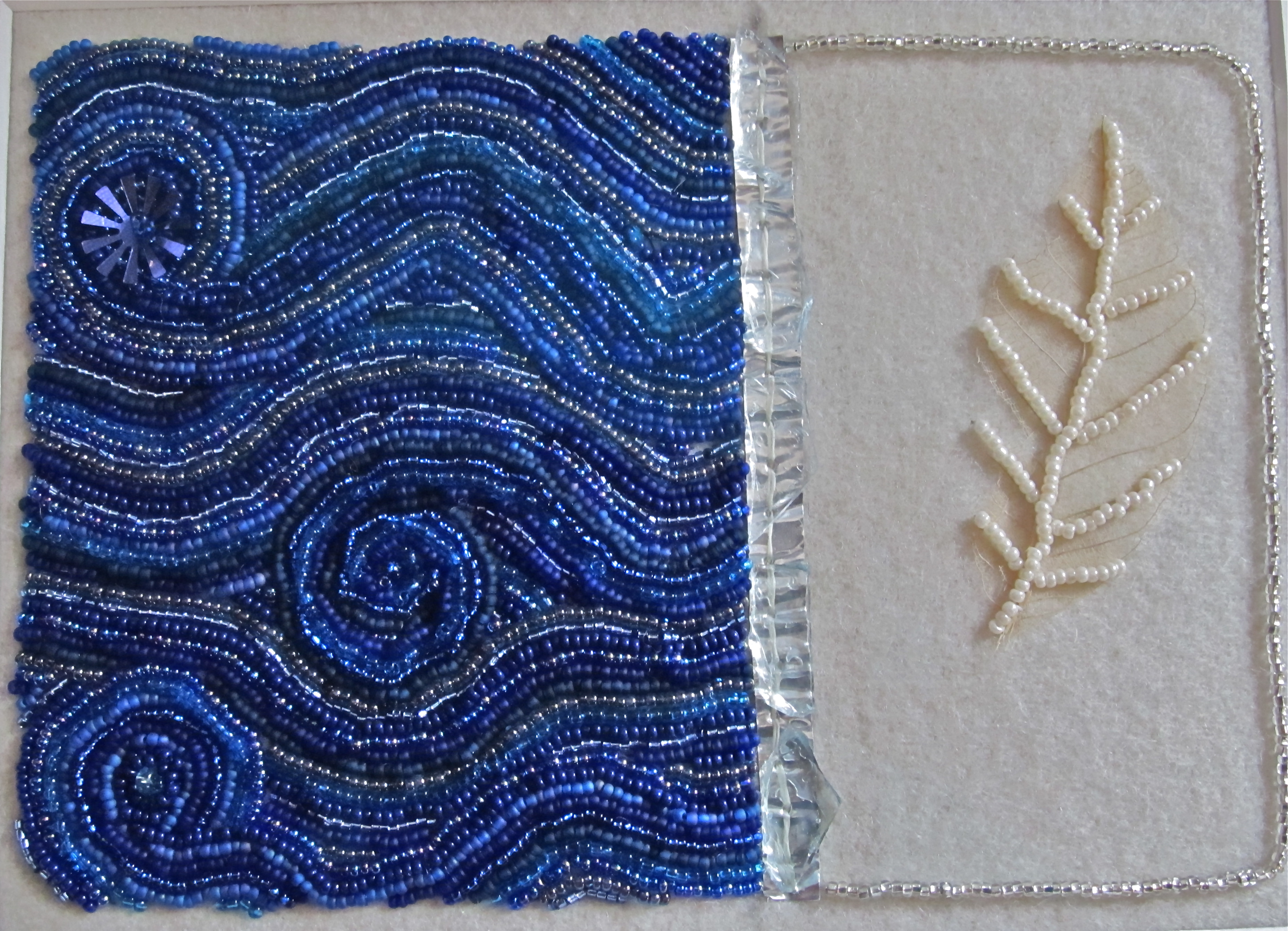
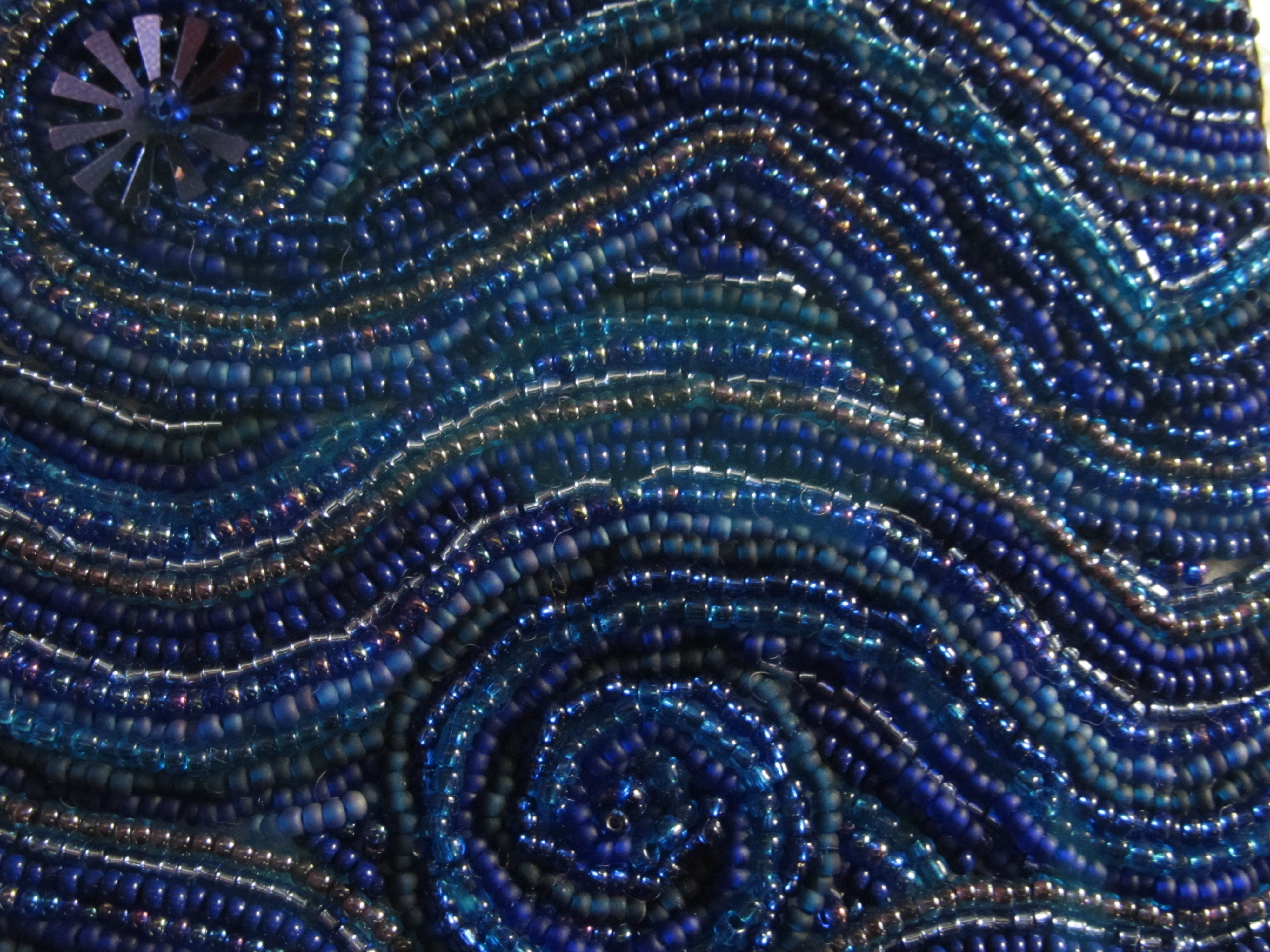
For my final attempt to fulfill the “Winter Silence” challenge, I decided to return to a medium and technique with which I was already familiar – bead applique.  Now, if you have difficulty imagining me sitting, quietly, for hours on end wielding a needle and thread, you’re probably not alone.  But you’ve probably never seen me around beads.  “Winter Silence” took many hours, and in the week leading up to Art Day I beaded until my fingers bled (from sticking myself with the beading needle when I was so tired I could barely keep my eyes open).

Winter Silence: Third and final piece

While the photos don’t fully capture the final piece (which is framed, making it difficult for a novice like me to photograph), I loved the final product.  Why?  First, because it conveyed the theme without words.  Second, because it does so without being directly representational.  Third, because I envisioned this scene in my mind and the end result is not too different from the original conception.

Imagine show and tell on the second Art Day…each person unveiling their attempt(s) to create something within specific parameters, using a specific set of objects.  Each person brought completely different projects to the table. Stephanie’s son commented that hers looked less like “Winter Silence” than like “Winter Slaps You in the Face”, but I loved seeing them all individually, and their diversity as a set.

We have now had five Art Days.  Each day, each project, has been different.  Each of us is developing a small collection of challenge pieces.  One Art Day was devoted entirely to stained glass projects, Paula’s forte.  The most recent saw us all arrive with so many supplies that they took multiple trips from car to house to get everything into the work room.  We still laugh a lot, and talk, but there is a lot more actual work getting done, too.

So, why have I taken three posts to share the story of Art Day and my recent efforts to explore a more visual form of expression?  On one level, it is a way of honoring the experience and the wonderful women with whom I have shared it.  On another level, though, I want to share an experience I am growing from.  Like many people, I suspect, I am reluctant to try new things unless there is a certain level of success guaranteed. I avoid situations in which I feel or look foolish.  Which, for most of us, is what happens when we try something we’ve never really done before.

Art Day has helped me keep at it, learn how to play without undue emphasis on the end result, to compare and contrast my work with someone else’s without a need for ranking the results. I am learning to communicate in actual images rather than verbal imagery. And the sheer fun and concentrated effort required to create is truly a joyful discovery.  Art, and as Mihaly Csikszentmihalyi says in Flow: The Psychology of Optimal Experience, a joyful life “is an individual creation that cannot be copied from a recipe.”  In other words, living life is an art: our time, energy, activity and emotion are the media we have to work with. And in order to live fully, we have to stop waiting for only those things we can do perfectly from the start.  Risking being an amateur or a failure or a fool…that’s how we work our way through to the joy.