Throw Open the Gates

Image

I don’t just mean physically; I mean emotionally, spiritually, intellectually. I don’t want to be afraid of bright colors, or new sounds, or big love, or risky decisions, or strange experiences, or weird endeavors, or sudden changes, even failure.                              —Elizabeth Gilbert, Big Magic


I have this friend, B., whose approach to life is always full-tilt. He’s an artist, a musician, a bad-ass trickster on both his bikes and his skateboard. I often cringe at the ways he pushes himself physically, at the photos of scrapes and casts that show up on Facebook. But I usually can’t help being distracted from these sights by the huge goofy grin on his face.

Like the rest of us, B. has fears – I just don’t know what they are.

Whatever gifts he is exploring, whatever he is creating, B. doesn’t hold back – all of it is put out into the world, shared with others. We’ve never discussed whether he gets sweaty palms before he uploads his work to a music-sharing app, or if he stays awake at night fretting over how his family or friends might react to his lyrics, his latest artwork – or if his fear of physical pain ever gives him pause before attempting a new jump or trick on his bike. The key point is that, whatever fears he may experience, they don’t stop him.

Unlike B., many of us hold back, keeping all that beauty and energy locked up inside. For some, that holding back has been instinctual and strong – they’ve never broken through it to let their gifts and talents out into the world. For others, the holding back is a retreat: they’ve stepped out there and been roundly criticized, belittled, “put back in their place”.

Maybe you, like me, have experienced both.

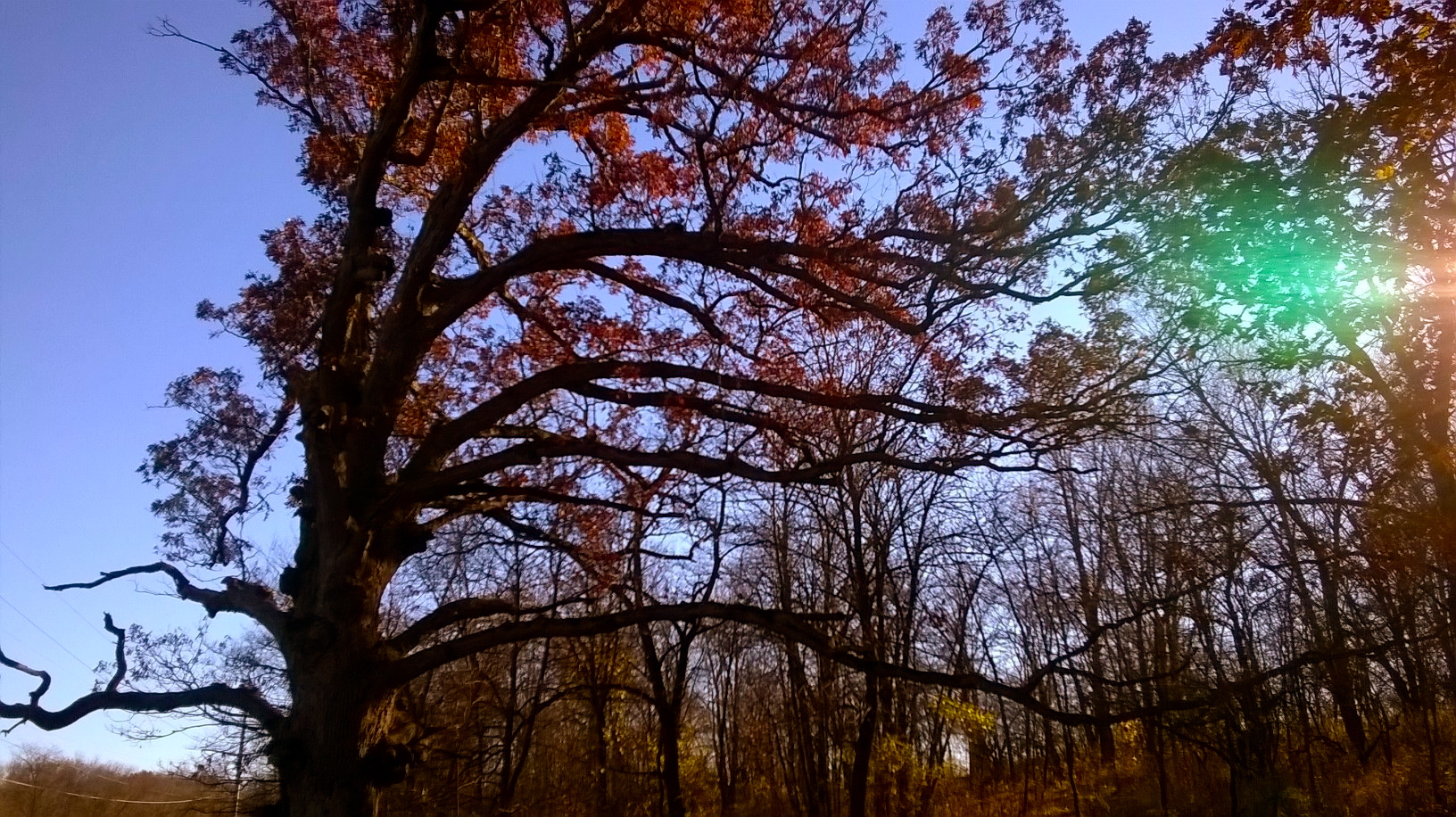
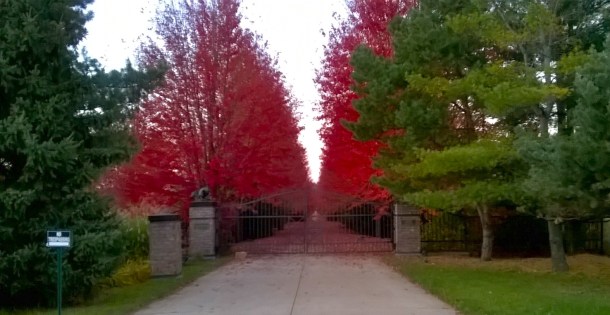
When I took the photo, above, I remember feeling judgmental toward whomever had fenced in that glorious riot of color, assuming that it was about keeping the “riffraff” out. But as I’ve been thinking about it, I realize that it could as easily be an image of keeping something in, rather than of keeping something out. It could easily be an image of what it looks like to hold back our giftedness – an image of what the world needs but isn’t able to experience because of our fears.

“Vocation is the place where our deep gladness meets the world’s deep need,” says Frederick Buechner, writer and theologian. Is our holding back the very thing that prevents us from discovering our own deep gladness? Our vocations? And how have we beggared the world by refusing to meet it’s deep need with the gift of ourselves?

I ask you, what “big magic” (to borrow the words of Elizabeth Gilbert) would happen if we opened the gates and freely shared that beauty with the world? If we took down our psychic “no trespassing” signs and just shared ourselves – our humor, our talents, our love – with someone, anyone or everyone, besides ourselves? True, we might experience pain or brokenness. But we might notice it less because of the huge, goofy grins on our faces!


Demarcations

Image

Demarcation: the action of fixing the boundary or limits of something.

When I worked on a college campus, I was responsible for addressing problematic student behaviors. Often, a student’s behavior violated generally accepted community standards while not directly violating a rule (for example, we didn’t technically have a rule against turning your residence hall floor into an indoor slip-n-slide, but we did consider it to be non-compliant with community standards). When this happened, there were always people quick to suggest writing a new policy or adding the specific behavior to an existing policy. I learned quickly that giving in to the pressure to spell everything out in this way would have meant having the longest and most convoluted code of student conduct ever. Not only that, though. It would have meant attempting to box students in with rules, to prevent them from freely experiencing choices and their consequences. Every interaction we had, then, would have been about rules, about proof of guilt or innocence – rather than about what it means to be a community, about the common good, and how members of a community are expected to regulate their own behaviors toward that good. As an educator, I tried to make the judicial process about the life of the community.

I tried to do that in the microcosm of the residence halls on one small college campus because I believe that is how we are called to live as citizens of our civil communities and as members of the wider human community.

I look around me these days and see so much that is troubling…

…In this election season, candidates are freely applying the most heinous comparisons, to Nazi Germany for example, to actions or decisions with which they disagree. They liberally pepper their speeches with made-up “facts”. Donald Trump, whose rhetoric consists mostly of calling other people names (stupid, boring, ugly, loser) and making self-aggrandizing statements (“I have one of the highest IQs”, “I’m rich”) is hailed as a straight-talking response to political correctness.

…In today’s climate, if I speak out against police brutality and racial profiling, I am told I am contributing to lawlessness and anarchy, to police deaths. If I speak out against the negative rhetoric and tactics of protesters or those who use the protests as a cover for illegal activity, I am called a racist.

…Refugees from conflict and war seek peace and safety while many of our countries cower in fear of terrorists or erect razor-wire to stave-off perceived scarcity, using dehumanizing tactics to make these choices appear reasonable.

…Don’t even get me started on what happens if one speaks compassionately about either side in the Israeli/Palestinian conflict. Or abortion. Or any one of a host of other divisive issues.

We are so busy making up ways to demarcate who is with us and who is against us that there is no room left for the voices of those who believe that both #blacklivesmatter and #policelivesmatter – for those who believe that all lives matter but who respect the truth that at this point in our history hash tagging that is disrespectful to those whose life experiences have been discrimination and marginalization.

I personally don’t use the term “political correctness” because it is most often used as a bludgeon to attack people on the left who stand for sensitivity to others. But while there is no one-size-fits-all term for the left to use, they still manage to find a variety of harsh and hurtful words to bludgeon those on the right whose views differ from theirs. And because of all this bludgeoning in our rhetoric, no real dialogue takes place. One political candidate went so far as to suggest last week that his party’s candidates should not be expected to participate in debates moderated by persons who had never been members of that political party. So, rather than seeking dialogue, we are going to lay down another line of demarcation – in politics, we only speak to those who already agree with us?

Where in all of this, I wonder, is the common good? Once we’ve marked our territories, outlined our many divisions and subdivisions, where is there ground identified as neutral territory? Where is the ground on which people of good will but differing perspectives can meet?

Again, I find myself thinking about the situations I worked with in university student life. One of the biggest challenges was mediating roommate disputes. Here’s how it typically went down: one student would come to see me, sharing the atrocious, cruel, thoughtless things their roommate had done to them. The student would often cry, hands shaking, telling me of how deeply hurt they were. My heart would go out to that student, my sense of justice would be engaged, I would want to take on the role of advocate for him or her. Then I would bring in the roommate and hear a different story, varying in particulars, yet resulting in another deeply hurt individual. When I brought these two hurting souls together, each firmly entrenched in the belief that their roommate was an evil, horrible, thoughtless person, my first effort was to get them to share their feelings. Often, once they opened up about feeling hurt or disregarded or disrespected, tears, hugs and apologies followed. The two would then want to leave my office, feeling better and assuming that we were done. But what followed next was the more difficult part – actually going back to the root causes of their differences and looking for new ways to address them in the future. Looking for ways to get both of them thinking about the common good in terms of their room, their interpersonal relationship, and within the larger context of their residential community. Without that second piece, the two would soon be back, crying over the same issues as before – often after having turned their residential floor into a Civil War re-enactment, sides enlisted, battle flags planted.

I was thinking of all of this the other day, as I walked the land at Prairiewoods. When I saw the tree, photographed above, I noted how it stands in a place of demarcation between the prairie and the woods. The tree appears to have its own leanings, its branches clearly reaching towards the woods, with only one or two stunted arms stretching toward the prairie. Yet, while I couldn’t get it all in one photograph on my cell phone, the trees roots were visible as well – and they were strong and vital, reaching in all directions. Woodlands and prairies are quite visually different from one another, yet each is a vital ecosystem with equally good characteristics to recommend it. I couldn’t imagine declaring, “The woods must suffer so the prairie can thrive” or “I stand with the woods against the prairie.” I couldn’t imagine choosing one and turning my back forever on the other – no matter whether one “agreed” more directly with my heart.

The wisdom of creation is the wisdom of communion. It is the wisdom of interconnection, interplay, collaboration and cooperation. It is the wisdom of the common good. In my life, I need to strive to be more like that tree: I have my leanings, of course – my values, beliefs, ethics, my politics. But I also have roots that push outward, that explore the territory beyond all demarcations. I have the gift of a voice that can be raised in dialogue and questioning, of ears that can do greater things than hear – they can actually listen. 

I have a heart whose natural state is open.

What’s more, I believe we are each endowed with these gifts. I believe that we are entrusted by the Universe to make the most of these gifts in service to the common good. They say desperate times call for desperate measures – so I’m calling us all to these measures:

  • talk to people you don’t have to;
  • attend another party’s political forum and meet the human beings there;
  • read a book with a title you disagree with or a magazine that you feel has idealogical leanings away from yours;
  • step into new territories and discomfort zones.

Let’s act as if we haven’t been infected by our current cultural need to demarcate every line and label one side “us” and the other side “them”. Let’s use our voices to ask questions and express compassion; use our ears to hear AND to listen. Let’s allow our hearts to stay open. And, as may be likely, if our hearts are closed, let’s allow them to break open again – for our common good.


Spooky Action From A Distance…Two Truths and a Lie

“In a landmark study, scientists at Delft University of Technology in the Netherlands reported that they had conducted an experiment that they say proved one of the most fundamental claims of quantum theory — that objects separated by great distance can instantaneously affect each other’s behavior.

The finding is another blow to one of the bedrock principles of standard physics known as ‘locality,’ which states that an object is directly influenced only by its immediate surroundings. The Delft study, published Wednesday in the journal Nature, lends further credence to an idea that Einstein famously rejected. He said quantum theory necessitated ‘spooky action at a distance,’ and he refused to accept the notion that the universe could behave in such a strange and apparently random fashion.”

— John Markoff, “Sorry, Einstein. Quantum Study Suggests ‘Spooky Action’ Is Real“, New York Times, October 21, 2015

The article quoted above came to my attention during a social gathering in the basement of a convent in Wisconsin one night last week. (I know, it seems like there might be something funny to say about that, especially if you’ve never known any nuns personally. But trust me, many sisters are quite social.) It was another two days before I had the opportunity to read the article myself. As Markoff states, this study is the best evidence yet for “the existence of an odd world formed by a fabric of subatomic particles, where matter does not take form until it is observed and time runs backward as well as forward.” It gave me goosebumps!

And not just because of the study’s many scientific implications. For nearly 48 hours, I had been thinking about this concept of spooky action at a distance, allowing my imagination to run wild. So imagine how I reacted upon learning that the lead scientist on the team conducting the experiments is named Hanson – the exact same last name as mine! Weird coincidence, eh?

And that’s when I stopped giving the entire concept much serious thought, because: Halloween. In late October, it is not really possible to think about something Einstein, everyone’s favorite genius, called “spooky” without thinking about spooks and other things that go bump in the night. In that moment, the (likely ill-conceived) idea for today’s Halloween post was born:

Two Truths and A Lie: Spooky Action Version

What follows are three stories about spooky occurrences (with apologies to serious scientists everywhere). Two of them I swear are totally true, and faithfully reported. The third is partly made up. You decide which is which, because I’ll never tell! (Not in this post, anyway)

Story #1: Amber Light

In the early 1990s, my parents purchased a house at auction. The home had been built and lived in by one family, the last member of whom, Amber, had recently moved into a nursing home. My parents never met her. Over the first few years of living in the house, strange things sometimes happened: doors slammed for no apparent reason; my parents would wake up in the night to discover every light on the first floor of the house turned on (despite having been shut off when my folks went to bed). They joked that George, father of Amber and builder of the house, was less than ecstatic about the renovations they were making. The parentals weren’t particularly bothered by the occasional oddities they experienced. However, none of these incidents prepared them for what happened one winter night, years after they had moved into the house.

That night, both of my parents were awakened from deep sleep at exactly the same moment, bolting upright in bed in unison. Their hearts were pounding, adrenalin coursing through their bodies.

Dad: What woke you up?

Mom: You tell me what woke you up first!

Dad: I saw a blinding light right above us, right above the bed. It was there briefly, only a few seconds, then disappeared.

Mom: I saw it too!

They were both nonplussed by the incident, and slept fitfully the remainder of the night. In full daylight the following morning, they were still a bit freaked out, unlike any of the other times unusual things had happened in the house. After discussing the incident, they formulated a theory of what had happened. My dad got online and began searching for information to confirm their theory. Eventually, he found it: Amber, the previous occupant of the house, had passed away in the night. They concluded that Amber paid one final visit to the house that had been her lifelong home.

Story #2: Cecilia’s Curse

A few years ago, I was visiting my parents in New Mexico. In a local paper, I happened to see a notice for ghost tours being conducted in Albuquerque’s Old Town and insisted that my parents accompany me on one such tour. It was a beautiful evening in Old Town, and Dad was surprised to see just how many people had turned out for the haunted tour. It was a great experience – we learned all kinds of new things about Old Town and Alubuquerque’s history. Toward the end of the tour, we arrived at the Our Lady of Guadalupe Chapel. In all my previous visits to Old Town, I’d never seen this chapel, and I was immediately enchanted. (see video of chapel)

Once the entire tour group was inside the main chapel, I noticed someone out of the corner of my eye, way off to the side, away from the group. However, I didn’t really pay much mind to her because our tour guide, who was very engaging, had begun to tell the group about various hauntings that had been reported by chapel visitors in the past. He asked if anyone in the room was named Cecilia – and my parents and I started laughing because that is the name I took for my confirmation. The guide noticed our laughter, and called us out to share. I explained my connection with Cecilia. He began to tell a story about an incident shortly after the chapel had been built. It involved someone named Cecilia or whose patron saint was Cecilia (I don’t remember which) dying mysteriously in the chapel. Ever since, women who are connected with Cecilia often see a particular ghost. After seeing the ghost, the person visited would experience something extraordinary – either good or evil.

The whole room kept looking at me as he spoke, and I was uncomfortable with the scrutiny. I began to look around the room, and my attention was caught by the figure I had seen previously. The center of the chapel was open – faithful who had attended services there in the heyday of Old Town mostly stood – but along the side of the room were niches with wooden pews in them, so that prayerful visitors had a place to sit down. I looked to my right, and saw a woman in old fashioned dress sitting in one of the niches. She was looking directly at me, and after inadvertently meeting her eyes I quickly looked away, as I usually do when I catch a stranger staring at me in a public place.

As we left the chapel, I asked my parents, “Did you see that woman sitting on the right side of the chapel? She was staring at me and freaking me out!”

My parents looked at me blankly. “Which woman?”, they asked, looking around at the members of our group.

“She wasn’t with our group,” I said. “She was in the chapel when we got there.”

“I was the first person in the chapel after our guide,” my Dad said. “There was no one in there ahead of us, the room was empty.” We laughed, and began joking about how I had seen the apparition – now I needed to expect something momentous to occur. I was a little creeped out, but joined in the good-natured joking.

On the way home, we stopped for gas. As he often does, my father returned to the car with several lottery scratch tickets. “Here you go,” he said. “I got you a ticket – it’s the least I could do since you treated us to the haunted tour!” Unbelievably, when I scratched the ticket, I had won $3,000! Apprently, the ghost was feeling benevolent that night!

Story #3: A Little Night Music

In June of 1978, my family moved from Ohio back to Iowa. For the first couple of weeks, we stayed in a hotel, waiting for the previous owners of our new house to finish moving out. When we were finally able to inhabit our new home, a good deal of work needed to be done including adding bedrooms in the basement. For the time being, my two brothers were sharing a room upstairs, while my sisters and I (three of us) were in another room. My parents had the master bedroom.

On our very first night in the house, I woke around 2:00 a.m. to the sound of unearthly music – very similar to Native American flute music – flowing through the house. No one in our family played such an instrument, and the music was very…present…is the best word I can use to describe it. I laid on my mattress on the floor, unsure what to do but terrified of the eerie music. Suddenly, someone grabbed my foot – and I jumped about a yard off the mattress!

It was my sister, Gwen. She whispered, “Do you hear that?”

“Hear what?”, I asked.

“You know what!,” she whispered back furiously. “That music!”

Honestly, unless you heard it, you cannot understand just how freaked out Gwen and I were. We decided we couldn’t possibly leave our room to investigate, but we also couldn’t just lay there and listen to the sound of that music in our house. On the count of three, we screamed for my dad. The music immediately stopped, but we were committed to having an adult check into it. It took several attempts to scream him awake, but eventually Dad came running into our room.

We explained what had happened, which, granted, sounded silly to him. He claimed he had been awake and hadn’t heard a thing. But we knew he had been sleeping because of the difficulty we had getting his attention. He grudgingly walked through the upstairs of the house, then opened the basement door and shouted, “If you’re in our basement playing a flute, cut it out!”

We were told to go back to bed and forget about it. My parents believed the sound was simply air moving through the a/c ducts. And they stuck to that story forever, despite the fact that in the years we lived there I never again heard that same sound. But it stuck with me, and it always frightened me when I thought of it. It had not felt welcoming.

Many years later, I was living in Cedar Rapids and working professionally in college administration. I happened to pick up a book by a man who was attempting to come to terms with his Greek Orthodox religious upbringing, which was full of mystical stories and superstitious beliefs. Only, as he delved more deeply, he discovered that mystical events tend to happen in real life, not just in his mother’s stories. He recounted the following experience of visiting a deserted chapel in the countryside of Italy (this is my retelling because I no longer own the book):

The chapel was known for being particularly lovely though in ruins. The author and his friends had gotten lost on the way there. When they arrived in the town, after dark, they were told that the chapel had recently been boarded up to keep local vandals at bey. Disappointed, they drove to the chapel anyway, and decided to attempt to get inside. At the back of the building, they discovered that someone had been there ahead of them, breaking open an entrance just large enough to squeeze through. Once inside the chapel, it was evident that very recent visitors had been up to no good – spray painted graffiti was still dripping and many items inside the chapel were smashed; litter was strewn throughout. Suddenly, low flute music was heard. It’s sound was menacing. The group stood together, discussing this sudden development, and the music got louder, building to a crescendo. Suddenly, items began flying at them from around the chapel – pieces of litter, small rocks, etc. – as if a strong wind were blowing inside the building. The author and his friends fled.

I shivered in my cozy little cottage in Cedar Rapids, Iowa. His description of the flute music was eerily familiar to me – I recognized it immediately. I understood the small groups’ fear upon hearing it. And I wondered what might have happened if, all those years ago, my sister and I hadn’t started screaming.

###############################

So, which stories are true and which embellished? Feel free to guess! If you know the truth, though, don’t give it away to everyone! And, remember that when it comes to spooky actions (to paraphrase Hamlet): there are more things in heaven and earth than are dreamt of in your science, Einstein!

HAPPY HALLOWEEN!
What the Snake Is Teaching

One recent afternoon I was at my desk when our office supervisor came to my door.

“Sorry to bother you,” she said, “but there’s a snake in the hallway. I really don’t like snakes.”

I should mention that my place of employment is an ecospirituality center located on seventy acres of prairie and woodland, where all creatures are treated with care. Ross Perot once said: “When you see a snake, you kill it. You don’t appoint a committee on snakes.” Where I work, we don’t kill the snake – but our snake committee is ad hoc and made up of whomever we can find who is willing to handle the critter.

So, I followed my colleague down the hall, where we found the small snake nestled behind a recycling bin. I’m not afraid of snakes, per se, but I prefer to know what variety I’m dealing with before I reach down and pick one up. This little guy didn’t look familiar to me. So we called in a third accomplice to help us remove the approximately 10-inch snake.

Tools were gathered: a dustpan and a flyswatter. The reptilian interloper was ushered into the dustpan, the flyswatter engaged in an attempt to keep him there as we carried him through the center. But the agitated snake just wouldn’t stay safely put, and kept wriggling off the dustpan and onto the carpet only to be scooped up again. Eventually, he was half carried, half shooed out the front door. He encountered a doorstop embedded in the cement front porch and promptly reared up and struck at it with his fangs before sidewinding his way into the grass.

Poor little guy! He couldn’t tell we were trying to help him, he only knew that something outside his control was happening, and he was working desperately to regain control of the situation. His reptilian brain flooded his body with “fight or flight” messages, with fear. To no avail he tried fleeing from us, and fighting with the doorstop. Had he been able to relax and allow us to move him he would have experienced less trauma.

I started thinking about how like that little snake I am.

I thought about the many times I have found myself somewhere physically or psychically unfamiliar, and responded from my own reptilian brain. The first time I drove alone from Iowa to New Mexico so visit family, I remember being afraid to leave my hotel room in a small Colorado cow-town after dark – and ended up going without dinner. The next morning, driving (hungry) through open expanses of landscape, very few other vehicles on the road and no towns in sight, I had an anxiety attack of epic proportions. When the trip ended safely and without mishap, I regretted my inability to relax and enjoy the drive, passing instead of stopping at the new sights I saw from the safety of my locked vehicle.

Or the many times my fear of unknown outcomes held me back rather than stepping forward. Why didn’t I engage with that awesome nonprofit I discovered? Or go for another graduate degree, this time in library science (I mean, really, I might have been an awesome librarian)? How many events did I skip because I couldn’t imagine the discomfort of those first ten or fifteen minutes after walking in alone?

Yes, little snake, I was totally picking up what you were laying down!

There is a major difference between myself and a reptile though – my brain is capable of contradicting the rush of fight or flight adrenaline. I have evidence, in the form of experience, that tells me I don’t have to strike out or run away.

A few years ago, I had occasion to travel to Philadelphia for a conference. In order to get a great airfare, I needed to travel early, so I had almost two full days to explore the city by myself before the conference began. Remembering past experiences, I was prepared: I brought lots of reading material and work I could do from the safety of my luxury hotel room in the city center. But in the cab from the airport, I found myself eagerly drinking in the sights of the city, and made a resolution that I would not spend my time cowering in my room. I dropped my luggage in the room, and set out walking. Those two days entering into the energy of the city, walking to every famous landmark in town, eating in cafes I discovered down side streets…they were amazing. I have a treasure trove of photos and memories to remind me that, when I relax and allow new experiences, amazing things can happen.

When I moved to Minneapolis, I practiced stepping outside my comfort zone almost daily. I pushed back against my inner reptile with consistency and intention. I met so many amazing people – the kind of people you look up to and are inspired by, and the kind you can laugh with and share your secret soul with. And while the days were not always easy, not a single fear proved to have the power my brain wanted to give it. Every hurdle, every obstacle, was climbed over, sidestepped, punched through (often with the help of friends) – and not one would have been worth the loss of running away.

Even though I know better, I still have to wrestle with that little snake in my brain that wants me to be ruled by fear whenever I am not in control or am facing something new. Seeing that live representation of my internal struggle playing out on the dustpan and carpet that afternoon helped me realize something else. Not only do I have experience to teach me that I can work through the fight or flight urge instead of giving in to it. That little frightened snake helped me see that the part of myself that urges the fear is a tiny little wriggling thing. I could as easily step on it and squash it as listen to it.

As I said, however, here we treat things with care. That includes ourselves – every part, even the wriggly scared reptile parts. What the snake is teaching me is to stop fighting that fearful part of myself and, instead, teach it to relax and allow. Relax into the knowledge gained through a lifetime of experience that fear and loss of control are false prophets of doom. Allow experiences and people, especially new and unexpected ones, to grace my days and enrich my life. Just because I don’t know what comes next is no reason to run away or get poised for defensive action. Just because I feel that fear doesn’t mean I have to berate myself, either. It IS a part of me, and it isn’t going to sidewind itself out of my brain.

Thank you for teaching me such important lessons, little snake!


And then there was Jen

Image 1

In my early childhood, back when there were only three children (instead of the eventual six) in my family, my parents made a photo album for me (as they did for each of their first three kids). It was grandly entitled “And Then There Was Jen”. From my baby announcement through the first pages, it carried a movie theme: roughly “Jen is the best sequel ever”!

I used to love paging through the album, looking at the pictures of myself and my family, reading the humorous captions written in my father’s handwriting. But in my awkward early-teen phase (which lasted about a decade) I began to resent that the album stopped cold around my fourth birthday. Over half of the pages of the scrapbook-style album were empty. Not only that, what struggling middle child (I was definitely in the middle, between the first child and the first boy) wants the movie of their life to be a sequel? Who wants to forever play second-fiddle to the premier event?!

So one day I decided that I would fix it. I laboriously lettered onto one of the empty pages of the album the title: “The Real Me!”. I intended to fill the rest of the pages with photos I selected, and my own commentary. No more of my dad’s supposedly funny comments about dirigibles (here’s how I explained this running gag to childhood friends: “My dad is weird”). However, as I’ve mentioned before, I tend to be easily distracted. I was called away from my project before getting further than the title page. Despite my intention to return to it, I never did.

One day, months or a year later, my sister, brother and I sat down to look at our albums in consecutive order. We paged through Chris’ photo album, snickering at funny pictures and my dad’s cartoon captions. By the time we moved on to mine, we were totally disposed to laugh at the dirigible jokes and were having a great time. Then Chris turned the page and staring up at us was my forgotten title, “The Real Me”. I was immediately mortified. I had intended to keep this a secret, only I had overachieved on that goal by completely forgetting it myself. Too late, I watched as my sister turned the page and discovered…nothing.

“The Real Me” was blank.

Sensitive middle-child that I was, I had totally set myself up for the teasing that followed. Even I eventually saw the humor in it, but that moment when my siblings first discovered my handiwork totally stands out in my memory as a classic example of self-induced mortification.

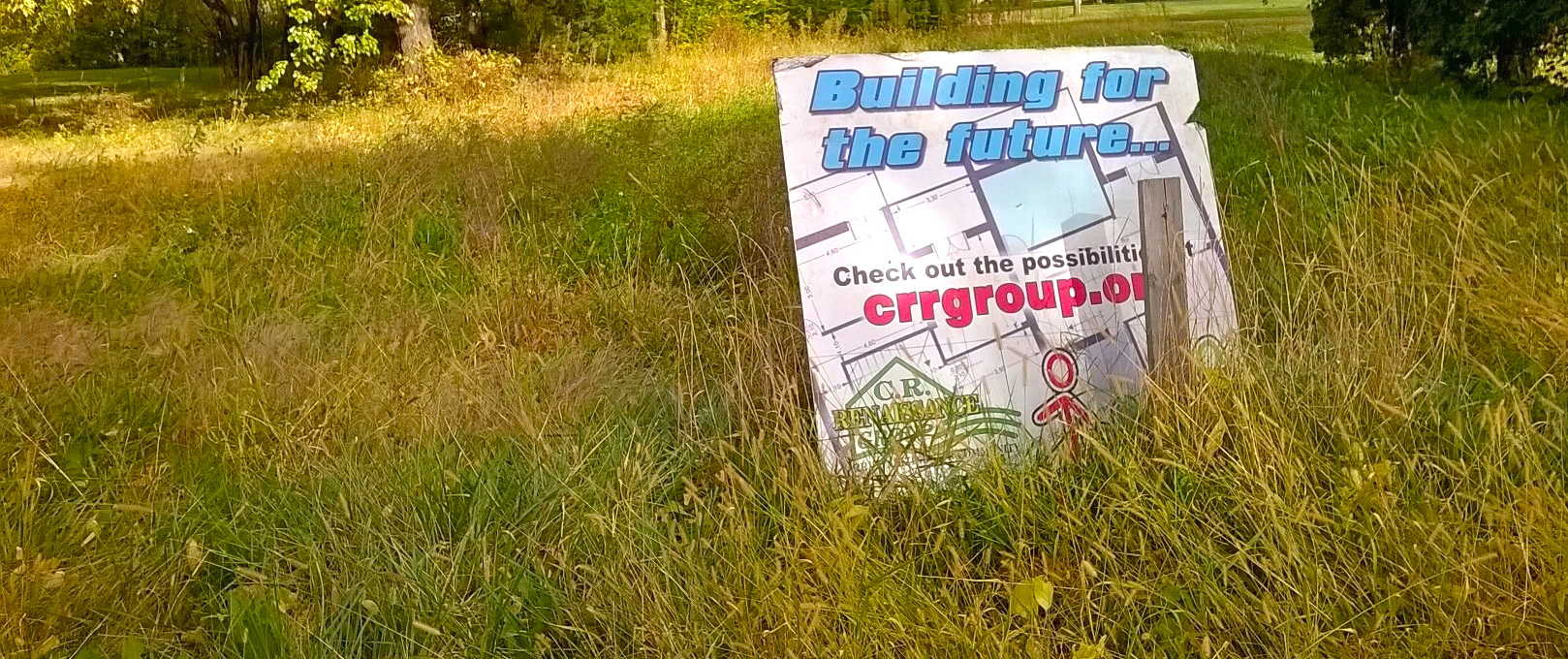
All of this came back to me when I took a walk one afternoon this week and saw a dilapidated sign deteriorating in an overgrown and weedy field, surrounded by acres of empty lots. It read: “Building for the Future”.

The neighborhood where I saw the sign, and where I now live, was inundated by a flood in 2008. It was a natural disaster of epic proportions – at the time the second-costliest natural disaster in the country’s history. Once, there were homes and streets and people here. There are telltale signs of this past – streets that weirdly wander into grassy spaces and stop, house-shaped depressions in the ground still visible despite several years’ growth of grass and weeds. The empty lots represent both what has been lost to the past, but also what may be possible for the future. I wasn’t sure how I felt – sad for what was lost or intrigued about what could be.

As I walked, I began to feel as if I was walking in myself – a kind of visceral knowing-with-my-body rather than with my head. The landscape of memory is only visible if you know what you are looking for -we may be able to piece together why there are dirigible jokes, or what made them funny. But in truth, that is all gone, the moment has passed. These empty lots are just empty lots, even if you lived and laughed and loved here once.

When we are in a time of change or transition, the landscape of the present appears unfinished, blank, in many ways. The real me? Who knows? Here in the transitional moment, what we see depends to a large extent on what we choose. We can choose to invest emotion in what once was or we can look around and see the landscape of potential. As the sign says, we can “check out the possibilities”.

Here’s the tricky part. Without sustained intention to grow something more, we get stuck in a wasteland of empty, overgrown fields. Without dedicated attention we have a title page followed by…nothing.

For me, the walk through this neighborhood was a wake-up call. I have allowed myself to dwell for too long in the transition. My colleague, Rodney, called it “grief resistance”. Despite feeling called toward change and new horizons, called toward risk and vulnerability, there has been grief – the inevitable leaving behind that happens with forward movement. And I have allowed that grief to linger to the point of wandering off the path I meant to be on. This inattention to my life’s intent has had real, negative, effects: I’ve gained weight, lost energy for things I love (like riding my bike), obsessed anxiously about things over which I have no control. I’ve been saying no to events, to people, to opportunities when a yes was called for. And, if I am honest, my rare yeses have been a bit lackluster, too.

As I walked, I felt oddly lost, though I knew exactly where my feet were planted. In the days since, I’ve begun to think of that walk as a path of demarcation between the time I spent hanging out in an empty field and the time I’ll spend building something here, in this space I’m now occupying. I’m resetting my intentions, and I know I’ll return to them again and again. The real me is not a series of blank pages, no matter what you might find in my childhood photo album. It is about time I started living that way again.


Risk = Disruption

The path to exponential growth always includes – disruption – a letting go and a taking hold.             –from Disrupt Yourself, by Whitney Johnson


The other night I wanted something lighthearted to listen to while doing my dishes. I went online and found a Rolling Stones list of the 20 best comedy podcasts. #14 on the list was a podcast called RiskThe basic premise of Risk: people telling stories they never thought they’d share. It sounded interesting, so I clicked on it.

The first story I heard was told by a man who began with the moment he decided to kill his mother. The second story? A guy who shared a recovered memory of his mother taking him to a rebirthing practitioner. By the third story (a woman whose experience of loss was overwhelming) I was wondering exactly why this had been considered a comedy podcast. The stories were raw and powerful. Yes, they were told with humor, but I wouldn’t call them comedic.

Maybe that’s just me. (Admittedly, it might also have been the episode I listened to.)

The interesting thing is I had been feeling anxious and depressed. The previous night, like many in recent months, I had fallen asleep alright only to waken at 2:00 a.m. and find further sleep impossible. On my way home from work, I had been texting with a friend about how rarely these days I days I feel as if I am inhabiting my own life. She suggested maybe it was time to see a doctor. She wrote, “I didn’t mean medication only! That’s not the only reason to visit a doc. I’m sure they do other doctorly things. Of which I have no clue what.” That made me laugh AND I actually felt it, which is what led me to seek comedy for some relief that evening.

Risk didn’t make me laugh, but listening was therapeutic anyway. First, the stories were masterfully told. Second, while I personally had not experienced any of the events described, my empathy was activated as I felt along with these storytellers – my heart and my intellect, disengaged from my own stuff in order to engage with their sorrows, anger, love. When that occurred, in a strange way it brought me back to my center – it reminded me of who I am and how I came to be in this current place, this exact moment in time. It reminded me that there’s an arc to my own story, and I’m still in the middle of it.

This led me to think more about the idea of risk. The podcast is aptly named, because sharing oneself at that deep level so publicly carries risk, makes one vulnerable in an immediate and visceral way. When I first started writing this blog, I experienced that kind of risk very directly, both in the stories I shared of my own emotional journey and every time I uploaded a photo of myself standing on an easy to read scale. In my experience, others resonate with that kind of story telling. They respond with support and gratitude, because it touches them and, sometimes, speaks for them in ways they don’t feel able to for themselves.

For me, writing the blog, telling my story, became a way of practicing taking risks. I had spent a lifetime being extremely risk-averse, so I definitely needed the practice! But there was still a distance between myself and that risk – I posted the blog entry from the privacy of my cozy little cottage on Elmhurst Drive, then went about my day. I wasn’t face-to-face with that risk – it went out through the ether and I waited for feedback to let me know whether it had been a good risk or not.

What it was leading to, what I was practicing for, was learning to take risks in real life. Big risks that involve my whole self, my daily being in the world – risks where what is on the line is everything. It is often the case that test-runs just aren’t rigorous enough to truly prepare a person. The vulnerability of putting your thoughts and feelings out there is real, but putting your livelihood, your basic needs, your whole heart on the line is risk of an entirely different magnitude.

Only now, two and a half years into choosing to take such risks in my life, am I understanding that the disruption – to my world view, to my self knowledge, to my emotional composure  – that accompanies choosing that order of risk doesn’t settle overnight.

In her new book, Disrupt Yourself, Whitney Johnson talks about the need for disruption in the business climate as a way to spur innovation, both in your business and your career. But there are definitely applications beyond the business world. She writes about the slow beginning of change, but suggests that there will come a tipping-point, when progress happens more quickly:

“Self-disruption will force you up steep foothills of new information, relationships, and systems. The looming mountain may seem insurmountable, but the S-curve helps us understand that if we keep working at it, we can reach that inflection point where our understanding and competence will suddenly shoot upward…”

…and…

“…With learning, our progress doesn’t follow a straight line. It is exponential and expands by multiples. Instead of learning a fixed number of facts and figures each day, what we learn is proportional to what we’ve already learned. We needn’t merely plod along, moving one up and one over on the graph of existence…we can explode into our own mastery.”

In this sense, risk=disruption. When we take risks, we need to expect disruption. Whether that disruption lasts moments, days, or years it is uncomfortable at best, extremely painful at worst. But it is part of a well-lived life’s trajectory. The storytellers on the Risk podcast clearly exemplified the piece I sometimes lose sight of; namely, that every experience (especially, perhaps, the gut wrenching ones) leads to growth. You can’t see how it works when you are in the midst of it – it is only after you’ve passed through the disruption that you can look back and connect the dots. It is only after you’ve reached the top of the mountain (or the S-curve) that you can truly look back and see how far you came.

Until then, keep your face toward the climb. And if it helps, let someone else’s story remind you that it will all – eventually – be worth it in growth dividends. It will be worth it when you find yourself that much closer to the person you are called to be, to the life you are meant to be living.


I Think About You

Myka H-L; Rachel S.; Hallie and Atalie B.; Zoe H.; Emma, Ada, and Carys F.; Abby, Katie and Dani D.; Abby and Maria K.; Kate and Anne A. 

After work tonight, I stopped by the D. family’s house. Homecoming at the local high school is this week, culminating in the Homecoming Dance on Saturday night. All three of the girls are going – senior Abby, sophomore Katie, and freshman Dani. I’ll be out of town Saturday, so I got to preview their dresses tonight. Dani in royal blue and rhinestones; Katie a stunner in black; Abby adorable in the navy blue – even as she repeatedly sassed her mom (and got away with it because of her smile and the twinkle in her eyes).

On Facebook, my great-niece Ada’s mom posted the following conversation with her (Ada is four, Carys is one):

“But Carys wrote it!”
“…Carys did not write ADA on the door.”

On Instagram, Zoe smiles straight at me, cuddling with her grandpa Pappas in a booth at a Chicago diner. In a text my goddaughter Kate can barely contain her excitement as she gets her first pedicure.

Myka is studying for her doctorate in England; Rachel is enlivening a theater company’s shows. Hallie is saving the world from her dorm room at UNM; her sister Atalie is singing and dramatizing her way to accolades. Abby K. is running marathons while her baby sister Maria is busy trying to act like a much older kid. Anne is starting to use understandable words, though she still (adorably) barks at people.

These fifteen young women and girls are my nieces and great nieces, my goddaughters and the children of my heart. I could tell you things that make each of them unique, and sweet and extraordinary – even little Carys, whom I haven’t technically met yet. Their smiles, stories, tears, laughter and hugs enrich my life. Just knowing they are in the world brings me joy.

Which is why, when another study came out recently saying as many as one in four college women will experience unwanted sexual contact/sexual assault, it broke my heart. The odds are against my girls.

I don’t know why I should expect that they will somehow be safe, simply because they are my loved ones. After all, American girls and women are in good company. Worldwide, women experience violence at staggering rates, often at the hands of those they know. (Some statistics from UN Women can be found at the end of this piece.)

Unfortunately, violence – the kind that is reportable and quantifiable (whether it is either ever reported or accurately quantified) isn’t even the whole story. As I watch the news, I am astounded that in 2015 a candidate for president of the United States can, with almost complete impunity, demean a professional woman as having “blood coming out of her wherever” because he didn’t like the hard questions she asked. Or make fun of a female opponent’s face, suggesting she isn’t good-looking enough to be elected.

Earlier this year, I was appalled as I watched a news story unfold in Minneapolis. Lisa Bender, the city council woman from my own ward – an incredible advocate for those who are often voiceless in local politics, a cancer survivor, and a mother whose example of political activism to her daughters is (in my opinion) truly admirable – was the victim of a horrific social media harassment campaign. It happened because she voted in a manner contrary to the wishes of the celebrity host of an HGTV show. The celebrity posted her displeasure over the councilwoman’s vote. The onslaught of hatred this unleashed was immediate – not only calling Ms. Bender demeaning names (bitch, piece of shit, waste of human flesh), but also calling for, most particularly, sexual violence against her.

And then I think about examples from my own life. The times I’ve been called a “fat bitch” (and worse) for doing my job or just for being in a public place. Or when addressing college students’ behavior, being ushered into a dorm room with a giant television playing porno movies in an attempt to humiliate me. The times strange men have almost angrily told me to smile or offered to “put a smile on my face”. About the times I’ve been told in the workplace, by men and women both, that my being smart intimidates my male colleagues or superiors, or that I need to “play the game” better, “stroke his ego” more. About the many times I’ve been told to stop talking like a “feminazi” when all I’ve asked is to be treated with equal dignity and respect.

Violence against women takes many forms: physical, psychological, emotional. Anyone who thinks we’ve progressed past discrimination based on gender isn’t paying much attention. If you’re a man reading this, pleases refrain from commenting #notallmen. Because we are all part of this culture – it IS all men, and it IS, unfortunately, all women too. Until we all radically reconsider the ways we contribute to the culture of violence against women – even if we contribute to it by remaining silent, by not calling it what it is – it will not change.

To my nephews, great-nephews, godsons, and male children of my heart:  I could tell the world things that make each of you unique, and sweet and extraordinary – even little Ezra, whom I haven’t technically met yet. Your smiles, stories, tears, laughter and hugs enrich my life. Just knowing you are in the world brings me joy.

Which is why I have hope that things can change. That, together, we can create a less violent world for all our women and girls, for all our people.

“I Think About You”

Every time I see a woman on a billboard sign
I think about you
Saying “drink this beer and you’ll be mine”
I think about you
When an actress on a movie screen
Plays Lolita in some old man’s dreams
It doesn’t matter who she is
I think about you

When I see a pretty woman walking down the street
I think about you
Men look her up and down like she’s some kind of treat
I think about you
She wouldn’t dare talk to a stranger
always has to be aware of the danger
it doesn’t matter who she is
I think about

[Chorus:]
You: eight years old
big blue eyes and a heart of gold
when I look at this world, I think about
You and I can’t help but see
that every woman used to be
Somebody’s little girl, I think about you

Everytime I hear people say it’s never gonna change
I think about you
Like it’s some kind fo joke, some kind of game
I think about you
When I see a woman on the news
who didn’t ask to be abandoned or abused
it doesn’t matter who she is
I think about

[Chorus]

When I look at this world I think about you

–Colin Raye

__________________________________________________________

  • 35 per cent of women worldwide have experienced either physical and/or sexual intimate partner violence or non-partner sexual violence.
  • It is estimated that of all women killed in 2012, almost half were killed by intimate partners or family members.
  • Worldwide, more than 700 million women alive today were married as children (below 18 years of age). More than one in three—or some 250 million—were married before 15.
  • Around 120 million girls worldwide (slightly more than 1 in 10) have experienced forced intercourse or other forced sexual acts at some point in their lives
  • More than 133 million girls and women have experienced some form of female genital mutilation (FGM) in the 29 countries in Africa and the Middle East where the harmful practice is most common.
  • Trafficking ensnares millions of women and girls in modern-day slavery. Women and girls represent 55 per cent of the estimated 20.9 million victims of forced labour worldwide, and…
  • …98 per cent of the estimated 4.5 million forced into sexual exploitation.
  • In the United States, 83 per cent of girls in grades 8 through 11 (aged 12 to 16)have experienced some form of sexual harassment in public schools.

(http://www.unwomen.org/en/what-we-do/ending-violence-against-women/facts-and-figures)

The Voice of the Beholder (Allowing other voices to help shape our personal narratives)

“Who does the telling shapes the story. Recall the classic Japanese movie, Roshamon and the principle it demonstrates. A man is murdered and a woman is raped, and four people tell what happened. Each person’s version is “true”, yet each version tells a different story. It matters who does the telling.”                –Jean Shinoda Bolen, M.D., from Crossing to Avalon

One evening a couple of weeks ago, I went to a cross country meet. I went to support my friend, Ryan, who coaches the team at the university where I used to work. I was happy to cheer for the college’s current student-athletes and a couple of faculty friends who were running. However, at this annual event there is always an alumni contingent running – and I was mostly there for them.

Chatting with friends and former colleagues, I got two different versions of how things are going at the university these days – either everything is great or the whole place is about to implode. In other words, when it comes to this particular institution’s story, it clearly matters who is doing the telling.

During the women’s race, which was first, I stood with the husbands and children of my former students (some of the husbands were also alums). We talked about their jobs and family lives; I listened as they teased one another and revived old team jokes. But when the women appeared in that last stretch to the finish line, all attention became focused immediately on finding and cheering for those we knew. One by one, the women crossed the finish line, and their families went to congratulate them on competing and completing the race. Eventually, most of the runners had finished; the stragglers, separated by wide margins, were clearly pushing their limits to keep running.

The other spectators had mostly drifted off to congratulate the finishers, but I remained with one husband and his happy, smiling baby girl, waiting for the last alumna runner to come into view.

I had watched on Facebook as former athletes replied to the race event page, good-naturedly goading one another into signing up. Or self-deprecatingly agreeing to run, with apologies for being out of shape or unprepared. I had seen the post when this young mother had capitulated and added her name to list of those running. From her ambivalent “What the heck, I’m in,” I knew she was not at all certain it was a good idea. But she showed up. And she ran.

When she eventually came into sight on the long, straight stretch to the finish line, this is what I saw: a woman pushing herself to finish what she started, even though every breath and every step hurt. She was red-faced, sweat-drenched and yes, I could still see the signs that she’d given birth a few months ago. I thought she was amazing. Awe-inspiring, in fact. When she came up to us, I congratulated her. I told her she’d done a fantastic job, that I was impressed – every word of which was true.

Her first words were, “I shouldn’t have done this.”

We enter many events in our lives with trepidation, with fear. We feel unsure of ourselves; sometimes we’re conflicted about whether we’re doing the right thing. We feel ourselves stumble, we’re aware of every mistake or misstep. And when we share the story of those moments, we are focused on the many ways we fell short. How we just missed the mark. But for those who witnessed us at these times, during these difficult events in our lives, the version we tell may sound completely foreign.

In observing us, others see the ways we have overcome the things that hold us (and often them) back. They see our strengths, our gifts set loose to grace the world around us. They are able to respond to these things from a place of pure appreciation, pure celebration, in a way we may never be free to when sharing the story ourselves.

It may well be true that my young friend “shouldn’t” have run that day. But the beauty I saw in her effort, determination, follow-through and sheer grit was also completely true. If she can hear that truth, and hold the tension between her version and mine as both/and, rather than dismissing one as a fiction, she might learn something about herself that would be good for her to know. For one, that she can be inspiring to others without being perfect.

Over the years, I’ve written numerous times about voice – learning to use mine, the ways our culture tries to silence our voices (especially if we are women, people of color, poor). I’ve said it is vitally important that we honor our own voices. I stand by all of that. But have you ever noticed that, in our own version of events, we often tell the story from the perspective of our insecurities? Shaded by self questioning instead of celebration? So I want to argue that there is also a time for letting someone else tell our story. And in listening to that story, allow that their version of events may hold truths about us that are worth hearing.

Don’t misunderstand me: I believe it is vitally important that we be allowed to shape our own stories, to craft a personal narrative that tells our own deeply complex, inevitably flawed, yet also beautiful and grace-filled truths to ourselves – and then shares them with the world. We can sometimes get stuck in the negative narratives we tell ourselves about who we are, about the life experiences that shaped us and, in so doing, wounded us. We can get stuck in a version of our story that keeps us in that wounded state. Moving from a crippling narrative into an empowering one is incredibly hard. It is also paradoxically simple (not easy). Simply, we craft a different narrative. One that works for us by allowing that our presence and our giftedness are real and substantive. And they contribute value to our world, despite lacking perfection. Despite being messy or sometimes difficult to speak and hear.

In closing, I’d like to share another story – the fact that it also is a story about running is purely coincidental. In July, my friend Molly ran her first 5k. Afterwards, she told me it was hard but she was really glad she had done it, and that her daughter, Kate, was present to see it. Molly hoped that Kate would take some important lessons from this: that women can take on the challenge to be physically strong; that it is a good thing to push yourself beyond what you thought you could do; that it is important to finish, even when it is difficult.

When I saw Kate for the first time after the race, she ran over for me to pick her up and said, “Jen, did you know mom and Aunt Alissa ran in a race in Door County?”

“Really?!”, I asked.

“Yes! And guess what, Jen!,” Kate crowed. “Mom won!”

My eyes met Molly’s over Kate’s head. Both of us were smiling, though Molly’s smile was also a bit of a cringe. I know she wanted to correct Kate’s impression, tell her that she hadn’t won the race. But I silently willed her not to. Kate was at the race, after all, and had seen everything she needed to see. Her four-year-old mind came to exactly the right conclusion – her mom was a winner. And Molly, like most mothers battling their parenting demons, needed to hear that. I hope she allows Kate’s version to inform the story she tells herself.

Yes, it matters who does the telling. But if, when crafting your story of yourself, your personal narrative, you find yourself stuck on the things that are wrong, flawed or wounded perhaps you can look to the people who love and admire you to contribute some positive perspective without dismissing them. Yes, their vision of you may be biased for the good, but yours is likely biased toward the negative. Together, they may flesh out a more realistic version of you! And I promise you – though the story will be different, it will still be true.

Intense Clarity

“There’s nothing quite as intense as the moment of clarity,

when you suddenly see what’s really possible for you.  — Christine Kane

Once, many years ago, I was driving down  Highway 30 at a good clip (about 75 mph). The road had just changed from two lanes to four lanes, divided by an emerald green grass median. I was in the right-hand lane, passing another vehicle on a curve, boxed in by cars both in front of and behind mine. And that’s when it happened: I saw a wooden palette fly off a truck taking the same curve from the opposite direction. As the palette cartwheeled across the median, I could see the line of it’s trajectory as if it was a lighted runway leading directly to me. Because of the cars on every side, I couldn’t speed up, slow down or move out of the way. Time slowed and stretched exactly like a film on slow-mo, the palette’s roll appearing gracefully choreographed. I followed my mind through each step of reasoning leading to the realization that there was nothing I could do to stop the impending collision, and I still had time enough to wonder, “So, this is it? This is how I die?”

News flash – it wasn’t. Curiously, there was no fear in that split second after the possibility that “this is it” occurred to me. But there was a certain clarity of mind that suggested I relax into the moment. What else was there for me to do? To my utter amazement, the palette smashed into my Saturn, then slid under it. There was no crash, though I slowed down, not really understanding how I was still on the road. The other cars surrounding mine didn’t hesitate though they couldn’t have failed to see the impact as wood splintered and flew in every direction. They disappeared down the highway as I finally found a hole and pulled onto the shoulder. There was significant damage to the car – both driver’s side tires were bent out at crazy angles. I had ample time, during my two hour wait for a tow truck, to wonder about that odd moment of clarity.

Since that experience, I have had other, similar, moments – in the midst of sudden unexpected events, that still moment of pause. These haven’t all been events when I thought I might be facing death. But each was a moment when I suspected that what was happening right that second might be the catalyst for a complete sea change in my life. The event that turned my life, or the community or even the world to a new course. A new path. And in the middle of each event, that still moment of clarity in which my conscious self stepped out of the slipstream of time to ask, “Is this it?” When that happens, any tension, anxiety or fear I feel dissipates. I am aware that I am aware.

Looking back, I can see that sometimes the moment was a significant or historic one and sometimes not. On the morning of September 11, 2001 when I watched in real time as the second plane crashed into the twin towers was definitely significant (and a moment I shared with millions). But whether each event changed my life’s trajectory, causing my own cartwheel through existence to appear graceful – or not – seems almost anticlimactic to the experience of that brief clarity and cessation of fear. Whether I remember what preceded or led to that moment, I remember those moments. Standing on the path through the national monument at Pecos, New Mexico staring into a raven’s eyes. Pausing on the hill above Cedar Rapids and seeing the downtown in complete darkness during the flood of 2008. On my bike in the woods, hugging a tree I had nearly careened into headfirst. In each mental picture is the memory of that curious calm, suffused with a clear mental light.

The past couple of weeks have been a time of frenzied activity and a certain amount of anxiety. My sleep patterns have been disrupted by worry-induced insomnia. My ability to stay centered emotionally and mentally through long, demanding days has been tested. And in the midst of that, another of those moments of awareness: late on a hot and humid afternoon, standing on a path leading through restored tall-grass prairie. Later, as I thought about it, I realized that I am notoriously bad at predicting, while in the experience itself, whether a moment is a pivotal one or not. I have generally assumed that having that moment of clarity is a sign of the importance of the moment as a turning point; but I have been proved wrong way more often than right. What if I’ve been thinking about this backwards? What if instead of predictive those moments are redirective?

What if the point of that clarity is to remind me that attempting to see the future is, well, futile? Or to remind me that I am more effective when I am centered – not when I’m trying to control circumstances outside my scope of influence? What if that still, uncluttered moment is my reminder that relaxing in this very present here and now, waiting patiently for the unfolding of whatever is to come, is the actual way forward. It isn’t that this moment is important and pivotal, it is that each moment is. I am aware that I’m aware. And that is enough for right now.


Learning factions

The school year has had a rolling start this month; some students began classes weeks ago and others just started today. My friend’s daughter, Abby, started seventh grade a couple of weeks ago. After school on the second or third day, my friend noticed that Abby was pensive, maybe a little down, and asked if something was bothering her. In a voice tinged with desperation, Abby responded, “Mom, I don’t have a faction!”

When my friend repeated the story to me later, I was grateful I’d read the Y.A. bestseller, “Divergent”, so I was able to immediately grasp the problem. (The story of “Divergent” takes place in a futuristic society divided into five factions. As teens approach adulthood, each chooses the faction with which he or she feels most aligned. The heroine, Tris, discovers that she is divergent – meaning she has no true faction.) In Divergent, Tris feels like an outsider, never quite fitting in. My young friend, Abby, feels the same.

Believe me, I can totally identify with Abby. As a freshman in high school, I remember feeling factionless. I had a few friends, but they were from several different social groups and tended to identify most strongly with those groups, of which I was not a member. Many Friday nights I attended football games with a group of girls I never really saw, otherwise. The people I ate lunch with at school weren’t the same people I had sleepovers with on the weekends. Most of the time, this was fine. But whenever numbers were an issue, I was the odd man out – I got cut from the roster. Which left me high and dry, feeling “out” at those exact times when a freshman really needs to feel “in”.

The summer between my first and second years of high school, my siblings and I joined an inter church youth group (ICY). On a hot Tuesday night in July, we met about thirty other high school kids and four college-aged leaders at the Lutheran church. For an hour or so, we played some kick-ass volleyball on the church lawn. The game was relaxed, inclusive, fun. There was no cutthroat competition – though there was plenty of humorous braggadocio. After the game, we adjourned inside the church. In the sanctuary, everyone pulled up a piece of floor and the guitars came out. We sang a few songs, said some prayers, then began a style of interaction based on what our leaders called “Serendipity”. With our eyes closed, we mingled in the group until the leader told us to join hands with another person, eyes still closed. My partner was Dave*, one of the college guys leading the group. Each of us was given a paper plate and a crayon, and asked to make a nameplate for our partner. In addition to our partners’ names, we needed to answer four questions about the other person – putting an answer in each “corner” of the round plate. I don’t remember all of the questions, but I’ve never forgotten that, in the upper left-hand corner we were supposed to answer the question, “If your partner were a color, what color would they be?” Dave, making a nameplate for me, wrote “yellow”. I was shocked…and delighted. I’d been expecting gray, black, brown – no one had ever described me as yellow before! The whole evening was fun, but more important, I felt welcomed and included in a way that was so outside the norm of my usual, angst-y, teen interactions.

On the way home, I basked in the glow of every positive thing that had happened that evening. Later, when I went to bed, I lay there replaying it all in my head. And as the bright energy faded, giving way to sleep, I knew one thing: I had, indeed, found my faction.

From that point on, my high school experience was different. I had my ICY peeps in my corner, and I was loving life. Retreats, hay rides, late night guitars and bonfires. We met on Tuesday nights and Thursday mornings before school, cementing our connectedness with intentional yet fun activities. Interestingly, even engaged with my faction, I managed to maintain a few friendships outside the group. We liked each other for the sake of our shared interests and our individual personality quirks, without the need to be joined at the hip with one another – that’s what our factions were for! As far as I was concerned, it was the best of both worlds. I didn’t give much thought to the times that friends told me I was the only one in my group who would talk to them, or who was nice to them. I chalked it up to simple misunderstanding.

Junior year flew, full of adventures – from blowing up my chemistry lab to searching for the ever-elusive albino farm in the neighboring township to having my first jamocha shake at Arby’s. Then life happened and mucked things up.

The summer preceding my senior year, my family moved from Ohio to Iowa. I was devastated. At my new school, the senior class alone outnumbered the entire population of my previous high school. Back to being factionless, I had no clue where to sit, who to talk to, or how to address the rising panic I felt walking into the absolutely packed cafeteria. I had no one.

But here’s the interesting thing. Watching the other kids with their groups, I realized some important truths about factions. These are the things I want to say now to Abby, my young friend feeling so “out there” without her own crew.

First, factions always think they’re open to others, but they rarely are. For example, most of the students at my new school were decent people. Very few were actively cruel or hurtful. But most of them were also not actively kind. Or welcoming. Suddenly, I remembered my “outsider” friends commenting on the exclusionary vibe they got from my ICY friends. At my new school, the kids who were generous and open? The outsiders, like me.

I learned that having a faction can make you less compassionate – because compassion requires a reaching out beyond yourself, beyond your normal circles. When you have a faction, you don’t have to think about what it feels like to eat alone in a crowded lunchroom filled to bursting with other kids having fun – you’re too busy laughing for it to cross your mind. You don’t have to “reframe” to make yourself feel good about another Friday night at home with your parents when you’d rather be with friends…if you had any. Since you don’t have to do these things, you forget there are other kids who do. You literally forget to have compassion for them.

Another truth people don’t really explain ahead of time? Factions maintain their strength by a certain level of uniformity. Gryffindor is brave, Hufflepuff is loyal. ICY loved Jesus, volleyball and guitar sing-alongs. When you have a faction, you get lazy about needing to maintain effort to develop and keep friendships. The group all shows up and, voila! Shared experiences and assumed similarities of thought and emotion. Group membership becomes a shortcut to friendship – but like a lot of shortcuts, its doesn’t lead where you expect it to. Sometimes, you end up spending time with people you don’t really connect with. Or worse, you find yourself looking past behaviors you don’t endorse,  out of loyalty to the group – even when this makes you uncomfortable.

It also surprised me to learn, after moving, that the strength of my faction didn’t make me strong. When I moved to a new city, I had to find strength within myself, not in the group. (Although it did help to know, when I felt alone, that there were people somewhere who loved me.) Interestingly, what helped me move ahead were the friendships I had maintained outside my faction. I still knew how to be friends with a diverse set of individuals who weren’t friends with one another. I remembered that sometimes what was truest and most valuable about someone was protected, and had to be coaxed out with regard and attention. I remembered that there were no shortcuts to developing relationships. True friendship takes time, effort, patience.

In life, I want to tell my dear Abby, you will find yourself part of many groups. They’ll come together in a variety of ways, around a plethora of shared experiences – and they will often bring you joy. As an adult, I’ve discovered that the best kinds of “factions” are created by the synergy that develops when individually strong friendships coalesce together into groups that embrace rather than try to usurp those connections. Because it is the individual relationships you nurture and develop over time that will fill out the depth and quality of your life.

Dearest Abby, I would say. Maintain your openness to people who engage your compassion; to those who invite and invoke your individuality in return. Try not to leave your integrity at the threshold of your latest faction, no matter how tempting it is to gloss over troubling choices made by others or within in your group.

And whatever you do, lovely Abby, never discount the real gift of a lone friend in favor of the dream of belonging to a “faction”. Group hugs are never as satisfying as the embrace of one dearly loved friend.

****************************************************************************

*Note: I thought you might be interested to know that my partner, Dave, from my first ICY youth group experience, is none other than my beloved brother-in-law Dave Finnegan. 39 years later still in my life but now in the faction known as “family”!

Some day I may write a post specifically about the spiritual and religious formation I experienced through my involvement with ICY, but for the purposes of this post, it serves mostly as context for the joyful experience of finding my “posse”.