Catching Sight: The Four A’s of Healthy Stewardship

I went out for a peaceful walk during my lunch break the other day. The air on that late summer day was oppressively humid and still. Not really thinking about anything in particular, I was just walking to clear my head. I passed the gated front of the fenced-in fruit orchard and turned right along the fence. The grassy path along the wire fenceline led invitingly into the woods.

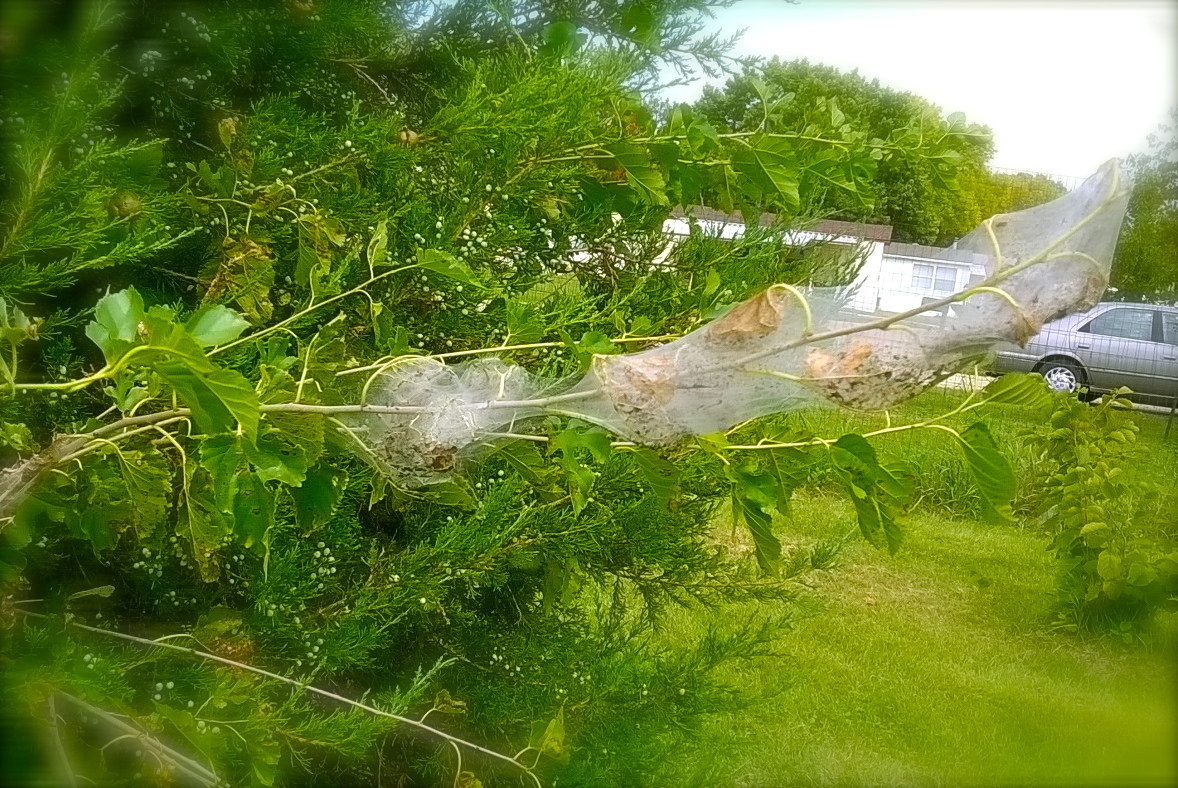
I had decided to head in that direction, when something in the orchard caught my eye, just on the edge of my vision. I turned to look, and saw this:
 

Image

I thought it was a little creepy looking, but I mentally shrugged it off and kept walking. Several steps later, I stopped and turned back. It occurred to me that this might not be a great thing to see in a fruit orchard. It also seemed, since the trees had previously been harvested, that it might be a while before anyone else visited the orchard. I thought, “If I don’t look into this possible problem, who will?” So instead of continuing my walk, I went back around to the gated entrance and approached the web.

Up close, it was even ickier to look at than it had been from a distance. And on a leaf just below the huge web, I noticed a mass of wriggly wormy-looking caterpillars, and the first film of a new web. I was definitely uncomfortable standing that close, but I wanted to take a photo to show to our outdoor staff so they could identify whether this was a problem (beyond the obvious issue of being unsightly). As I stepped in closer to get a clear shot, a breeze suddenly blew up, wafting the branch full of insects into my hair. Ugh – I shudder just remembering that sensation! I was completely grossed out.

As it turns out, what I happened across on my walk were most likely fall webworms, which in their adult state become a species of moth. They may not be particularly harmful to trees, though they do denude the branch inside the “tent” web of leaves. An infestation may completely denude affected trees, though, which may be harmful.*

So, other than the fact that we all enjoy sharing stories about things that gross us out, why am I telling you this?

Lately, I’ve been struggling to get (and keep) my act together. I am dimly aware of issues in my life which need to be addressed, but each time I catch sight of them in my mind’s eye, I just keep walking. Like Scarlett O’Hara or Clarice the doe, I conjure up a vague “tomorrow” when I will think about it, or make it happen. What this looks like is binge-watching television series on my Amazon Prime account. It looks like having another pistachio-chocolate chip muffin at Coffeesmith’s. It looks like my body waking each day achy from lack of exercise and my mind fuzzy from too-little sleep.

After work that day, I immediately showered (a whole afternoon thinking about those creepy-crawlies in my hair demanded that), then boiled water for a cup of tea. Standing in my kitchen, looking into the tea steeping in my cup, I caught sight of one of the things I had been avoiding looking at straight-on: my upwardly mobile weight. I am thirty pounds heavier than I was this time last year. I’ve known this was happening, but I’ve refused to train a direct gaze on it. My friends have not mentioned it. No one has taken me to task for it. In that moment, the reality truly hit me: if I don’t get ahold of this, no one will. After all, it is my job to manage my life and my health – on one else’s.

I quieted my mind as I stared into my tea. A picture began to form in my mind of what my life had been like at 350+ pounds. I forced myself to imagine being there again: how would I feel physically? The first sensation I recalled was the difficulty I had breathing. Followed by the halting process of going up and down stairs, carefully, one foot then the second foot on every step rather than the graceful flow of one foot, one step. How would I feel emotionally if I kept heading in that direction? Hopefully, I’ve dealt with much of the shame from the past – would it recur? Would new shame take it’s place?

With an infestation of fall webworms, addressing the issue before it gets out of control is the best management technique. Occasionally, lawn and garden pests or weeds are ignored until the gardener’s only recourse is to till the whole mess under and begin again. But most gardeners learn to respond as soon as signs of the problem appear. Pay attention. Take action. Assess the results. Adjust the behavior. And begin the cycle again.

Attend. Act. Assess. Adjust. The four a’s of healthy stewardship, whether what you are tending is a garden, a corporation, or a life; whether the concern is weight control, or money management, or communication. In life, it is so important not to ignore the things you notice out of the corner of your eye – to not move on as if you are Sergeant Schultz fromHogan’s Heroes reruns, perennially telling yourself, “I know nothing.” Pay attention. Engage in action. Assess the outcomes. Adjust the behaviors. Begin again, spiraling ever more closely to your desired results. More closely to your desired self.


*I am not a horticulturalist, entymologist, or a gardener of any stripe. Therefore, take my description with a grain of salt, and consult an actual expert if you are concerned about webworms!


Wise and Intelligent

Now and then, it happens that I come upon a phrase that sticks with me. I find my thoughts returning to that phrase, again and again. Like a puzzle piece, it clicks into place bringing disparate ideas and experiences together in a new way.  Earlier this week, I happened to read a selection from Deuteronomy (4:6-8) in which Moses exhorts his people to live by the statutes he has taught them, and thus the world would see that ‘This great nation is truly a wise and intelligent people.

Full disclosure: I don’t know much about scripture, particularly the Old Testament (nor, in all honestly, do I regularly read it). With that in mind, I don’t wish to talk about the scriptural context or meaning of this passage. Instead, speaking as a lover of words and their nuanced meanings, what caught my attention was this:

Wise and intelligent.

Hold the phone! They’re not the same thing?

Ok, so I actually do know that these words have different meanings. But, like most people, I get a little lazy with my language. The danger in doing so is that, when you start allowing one word to connote the same as another in your conversation, you start to mistake one for the other.

In our modern culture, we have a problem with conflation of concepts. (I’ve written about this before – for example, conflating celebrity with authority. ) So it is no surprise, really, that we tend to assume that intelligence equals wisdom. How many times have we heard someone say, “Smarter people than me say/have agreed/decide…”? Maybe they are smarter than me, but does it automatically follow that they are wiser? On the cultural or societal level, valuing intelligent above wise – or assuming they are equivalent – can lead to huge errors in judgment or into rough ethical waters. But what does it mean at the personal level? For my life?

In my professional life, much of which has been spent on college campuses, this has been a big thing. The mind reigns supreme in that environment. The highest compliments, and often the most respect, accrue to those seen as the most intelligent. Conversely, I’ve often heard a colleague lower his or her voice and say, with mock kindness, “I’m sure she’s very nice. I’m just not certain she’s very smart.”  If we stop to ponder, though, we can all cite examples of highly intelligent people making unwise choices or decisions – as well as people whose intellectual prowess may not be lauded who make excellent decisions.

For those of us in leadership roles, it is vital that we make the distinction between intelligent and wise, although we often fail to do so. We are invested in our own self-image (and the world’s perception of us) as intelligent. We get used to thinking of ourselves as smart. Because of this, we begin to think of our first perceptions, our quick and ready solutions, as wise. But sometimes, as the British would put it, we’re too smart by half. Our hubris leads us astray, into equating expedient with right. Into thinking that we are wise, and that those around us are less so. The result of this type of flawed thinking can be disastrous to our organizations or institutions, prematurely cutting of discourse and collaboration. In the worst cases, it can lead to a betrayal of our mission.

In my personal life, not making appropriate distinctions between wisdom and intelligence has sometimes caused me to cast my allegiance with smart people of questionable character. It has sometimes led me to assume wisdom where, perhaps, only persuasive rhetoric actually existed. More important, it has occasionally caused me to devalue others – assuming myself as superior in intelligence to that individual and, therefore, wise enough to listen only to my own voice. It is humbling to admit the truth of that – I have been dismissive of others all the while believing myself to be wise.

So, what does it look like to be both wise and intelligent? How does one become both? Is there a link or some kind of causal relationship – are we born intelligent and made wise? In his book, The Road to Character, David Brooks cites the philosopher, Montaigne: “We can be knowledgeable with other men’s knowledge, but we can’t be wise with other men’s wisdom.” Brooks continues: “That’s because wisdom isn’t a body of information. It’s the moral quality of knowing what you don’t know and figuring out a way to handle your ignorance, uncertainty, and limitation.”

Figuring out a way to handle my ignorance, uncertainty and limitation? That sounds hard. It sounds like a task which requires a lifetime of reflection, introspection, of self-interrogation. If I think about it that way, wisdom becomes a life path, not a quality which can be applied to me or anyone else. To be truly wise, we must be ever on that journey. Luckily, Brooks asserts that “No person can achieve self-mastery on his or her own. Individual will, reason, compassion, and character are not strong enough to consistently defeat selfishness, pride, greed, and self-deception. Everybody needs redemptive assistance from outside – from family friends, ancestors, rules, traditions, institutions, exemplars, and, for believers, God. We all need people to tell us when we are wrong, to advise us on how to do right, and to encourage, support, arouse, cooperate and inspire us along the way.”

If we are smart, we will surround ourselves with others who offer such “redemptive assistance” to us. If we wish to be wise, we will actually listen at the deep level of our souls to the lessons they offer to teach us by their presence in our lives.

In so doing, we may actually manage to be both wise and intelligent.

I’m With Stupid


There we were, gathered around the granite-topped island in Molly’s kitchen: four women at the end of a long day. We each had stories to share, requiring listening ears and commentary from our girls. We were all very aware that my four year old goddaughter, Kate, was happily ensconced on a tall chair at one end of the counter and adjusted our language accordingly. Or so we thought until Colette was interrupted, mid-sentence, by a reprimand. “Colette!,” Kate chided. “That’s a bad word!”

Playing back Colette’s sentence in my mind, I couldn’t even find a bad word. All eyes turned toward Kate, who could tell from our blank faces that we weren’t sure which word was the “bad one”. She half whispered, “Stupid. It’s a bad word.”

Oh, yeah. THAT bad word! The toddler equivalent of an extremely nasty epithet. Colette dutifully apologized, and our conversation continued. If any of us doubted that Kate was listening intently to our adult chatter – jobs, co-workers, family issues – we were quickly disabused of that notion as she regularly corrected our use of that “bad” word.

Stupid. I was struck by several thoughts as our conversation continued. First, that most of us were consciously watching our language selection, self-censoring what we considered expletives and replacing them with more acceptable alternatives. Second, it was disconcerting how frequently the word we settled on as a replacement was “stupid”. The stupid meeting. The stupid guy. The stupid idea. Finally, I arrived at the realization of something that all parents and preschool teachers already know: allowed unchecked, use of the word “stupid” (and variations such as stupidhead), will proliferate at an alarming rate. It is arguably the first, and for many one of the most potent, put-downs we learn.

Almost immediately upon learning the word stupid, and discovering its value as an insult, we are taught that it is impolite and inappropriate to apply the word to others. That’s how powerful the word is: parents and educators work diligently to keep us from using it as a weapon with which to bludgeon others. Unfortunately, we are rarely taught not to apply it to ourselves.

As I thought about Kate’s adamant correction of our conversation, it called to mind the many ways fear of the word stupid – and my willingness to use it against myself – have negatively impacted my life. Not wanting to appear stupid has kept me from asking questions, from trying new things, from approaching people I admire for guidance and/or mentorship. It has prevented me from putting my work out into the arena (in the Teddy Roosevelt sense), kept me from daring greatly (in the Brene Brown sense). Fear of “stupid” has kept me playing small.

This fear of being seen as stupid has kept my mouth shut when I should have spoken. In some cases, it has  been misinterpreted by others as quiet strength, as understanding rather than confusion. It would be a lie to say I hadn’t encouraged that sort of misunderstanding in order to preserve the illusion (possibly only existing in my own head) that I knew or grasped more than I did. Anything to prevent them seeing my stupid!

The more I’ve thought about it, the more I’ve come to agree that children should be taught that to call someone or something stupid is inappropriate. And being a grown-up doesn’t suddenly make it alright. So I’m going to work on striking it, as much as possible, from my vocabulary. If the conversation at Molly’s is any indication, that won’t be easy for me!

Equally important, we should also be taught not turn that weapon on ourselves, either. We (I) need to stop fearing it will be used against me, and I need to stop hurting myself by using it as a self-accusation. “Stupid” is another trigger to exploit our vulnerabilities and reinforce the notion that we must be perfect before we venture to put ourselves, thoughts, skills or talents out into the world.

I try to imagine what my life might be had I been less afraid of “stupid”: had I been willing to give voice to my questions, to publicly proclaim my ideas, to publish (or even submit) my written work for review and critique. The world may or may not have been a different place because of it. But I’m fairly certain that I would be a different person had I not been avoiding “stupid” at all costs.

“When we spend our lives waiting until we’re perfect or bulletproof before we walk into the arena, we ultimately sacrifice relationships and opportunities that may not be recoverable, we squander our precious time, and we turn our backs on our gifts, those unique contributions that only we can make. Perfect and bulletproof are seductive, but they don’t exist in the human experience.” 

― Brené Brown, Daring Greatly: How the Courage to Be Vulnerable Transforms the Way We Live, Love, Parent, and Lead


Finite Math

At 5:15 a.m. my neighbor begins making breakfast. A strange trick of acoustics in this building means that, in my upstairs bedroom, I hear every rattle and bang in their downstairs kitchen. I roll over and attempt a return to slumber.

Some days, that works. Some days I stretch my sleep-sore muscles and fall gracefully, gratefully back asleep. But not today. Today, I stretch and wonder about that heaviness in my leg – is it a sign? Should I see the doctor? From there, the worries and anxieties held at bay while I sleep come marching forward, a neurotic, necrotic parade.

Knowing sleep will not return at this point, I get up. In my kitchen, I begin the morning ritual of making my double shot Americano. Add hot water and the finely ground espresso becomes the rich loamy soil in which I will plant a new day. Whether it will be a good day, productive and interactive – or not- is often determined in this moment.

My friend Wendy has spent the last seventeen years telling her children that they have a choice – if you don’t like how you feel in this moment, choose to feel differently. Happiness isn’t a destination, its a choice you make in every moment of action or reaction. I watch her girls, all teenagers now, and see them apply this choice. It is like the sun emerging from clouds, that moment.

This morning, as I sip my coffee, it feels like a herculean task, that reframing of mindset. I’m not sure I’m up to it. I turn on my computer, and find Parker Palmer’s weekly “On Being” blog post, this week called “Poetry as Sacrament: Disentangling from the Darkness”, in which he meditates beautifully on Mary Oliver’s poem “Landscape”:

Every morning I walk like this around
the pond, thinking: if the doors of my heart
ever close, I am as good as dead.

Every morning, so far, I’m alive.

So far, I think (using the calculator function on my phone) that is 19,726 mornings. I google the question, “How many decisions per day?” and read:

According to multiple sources on the Internet, the average amount of remotely conscious decisions an adult makes each day equals about 35,000.

690,410,000 decisions and counting. My first thought is “No wonder I don’t want to decide where to have dinner or what book to read for book club.” I think of texting my younger friends and letting them know they haven’t used theirs up yet, so from now on they must choose – my decider is worn out from overuse.

My next thought, “How many of those ‘remotely conscious decisions’ were good ones? How many were ‘the right’ ones?” No function on my smartphone could ever calculate that number. This I know: it falls somewhere between 1 and 690,410,000.

That’s as far as math will take me; there’s no point in attempting to calculate the incalculable. There’s no point in lingering over that parade of worries that began its march through my head while I was still in bed this morning. Of the approximately 35,000 decisions I will make today, some will be good ones. Some will not. Mistakes will happen. Anxiety in advance and obsessive second-guessing afterwards won’t change that reality.

Like Wendy’s girls, I have a choice. I can hold the doors of my heart open so that my choices can be made from the place of infinite things (like mission, like compassion, like gratitude). Or I can close those doors, out of worry or indecision or just plain inattention, and be “as good as dead”, rendering my choices lifeless as well.

When I think of it this way I say: let my inevitable mistakes be life-affirming ones; let my errors of judgment emerge from seeing the best in others; let me work to stay centered enough that my infinite humanity, rather than my finite ego, decides. Choose; then move on.

19,726 mornings. And every morning, so far, I am alive.


Bellyflops vs Swan Dives: Splash over Depth

Three things I’ve read this week have really got me thinking: the first is a story, believe it or not, about Madonna; the second is the transcript of a speech about justice; and the third is an article about why we Americans deserve Donald Trump as a candidate in the presidential race. The premise of each is similar; namely, that we tend to substitute the easy thing or the splashy thing for the right thing – and then hail the one as if it were the other.

In a piece published in The New York Times titled “Growing Older with Madonna”, Jancee Dunn reminds us that Madonna is known as the queen of reinvention. Certainly, she has tried many styles and set many trends. In her mid-50s now, she looks great. But her latest video feels somehow not right – she struts around, falling down “drunk” with her skin-tight dress riding up to reveal her underwear, declaring that she’s going to party all night and kiss who she wants and no one is going to stop her. Really? I remember that attitude from when I was 19, but then I grew up. The article asks a probing question about Madonna as an artist: “Yes, she is constantly reinventing herself, but is she evolving?”

The next instance of a sort of cultural “mistaken identity” or transposition of concepts comes from Anand Giridharadas’ address to the Aspen Institute’s Action Forum. “The Thriving World, The Wilting World, and You” . In it, Giridharadas discusses the difficulties of questioning the status quo when “…This community was formed by stalwarts of American capitalism; today we sit in spaces named after Pepsi (as in the beverage) and Koch (as in the brothers); our discussion of Martin Luther King and Omelas is sponsored by folks like Accenture, David Rubenstein…” He goes on to say that as they seek solutions to the great disparities in the world, they never quite manage to address the root causes. He calls it the “Aspen Consensus”, in which “the winners of our age must be challenged to do more good. But never, ever tell them to do less harm.” As a result, they are (in his words), trying “to market the idea of generosity as a substitute for the idea of justice.”

The third, a Frank Bruni op-ed from The New York Times, discusses the confusion we’ve created between politics and entertainment, stating “…of this I’m certain: We now utterly conflate entertainment and politics, routinely confuse celebrity with authority and regularly lose sight of the difference between a cult of personality and a claim to leadership.”

Reinvention instead of evolution; generosity instead of justice; celebrity instead of authority, personality instead of leadership. If these various journalists are correct, we as a culture are routinely replacing values and ethics which require maturity, depth of conviction, and the courage of character with things that have a similar appearance, but which never take us below the surface into the realm of thoughtful and right action.

In some ways, the two photos (below) encapsulate this idea. The first photo is of someone engaging in a belly flop. At the pool, belly flops are an easy way to garner attention. They are loud, splashy; they require that people pay attention – even if only to avoid getting wet. Anyone with the desire to garner attention can pull off a belly flop. When well-executed, onlookers are delighted.

In many respects, the second photo looks much the same as the first. However, the second photo is of a swan dive. The swan dive begins with the same wholehearted, arms-spread-wide posture. However, at the last moment, the swimmer pikes and actually dives into the water. Swan dives result in a clean entry to the water, very little noise, almost no splash. They require practice, skill, an urge toward perfection of form. One can perform a swan dive in a crowded aquatic center with very little notice, especially at first. When well-executed, onlookers need to actually be paying attention to notice. However, when paying attention, onlookers are often wowed.

Another difference between the belly flop and the swan dive is that many of us, witnessing the two, firmly believe that we might be able to pull off the belly flop ourselves. But we don’t think we are capable of the swan dive.

Which brings me back to the ideas discussed in the articles I’ve referenced above. Reinvention is relatively easy. Many of us change things about ourselves, re-order the ephemera of our lives with some regularity. If we stop to think of evolution, of truly and deeply becoming the person we are capable (even meant) to be, we grow immediately wary. Or weary. We don’t really think of ourselves as having the fortitude to work that hard on our own growth and development. Often, we rely on life events to propel us in new directions, rather than being willing to undertake self-improvement or self-empowerment, or our own transformation. Yet we are spiritually called to this, I believe. We feel an inner pull toward evolutionary change, but we are unsure or overwhelmed by the prospect of how to proceed. And we – out of laziness, or fear, or unwillingness to upset the apple cart of our lives – settle for cosmetic change.

Generosity in place of justice is another easy substitution for most of us. And the difficult thing here is that generosity is, in itself, a good thing. I would never argue against it. All too often, though, we stop at generosity when what our communities and our world require is justice. We tell ourselves justice is the province of extraordinary souls – the Ghandis, Mother Theresas, MLKs of this world. We feel this way because justice requires deep change. It requires a willingness to root out the systemic causes of injustice. It calls us to act in ways, and with regard to issues, that are complex and difficult to sort out. We could be wrong. We could be facing much more powerful people and forces than ourselves. Most discomfiting of all, we may need to live with ambiguity and uncertainty and still stand our ground. Generosity feels so good. Justice is often just plain uncomfortable.

Finally, we engage in the fascination of celebrity. It is fun to follow the lives of the rich and famous. But somewhere along the line, we have confused noteworthy with newsworthy when it comes to the well-known. More disturbing is the idea permeating our culture that, somehow, celebrity status serves as shorthand for deserving, smart, accomplished, and admirable. Somehow we allow ourselves to think that those whose personalities loom large in our media are also more knowing and more creative. Have better ideas. Are more thoughtful. Here’s the thing: just because someone has a forum doesn’t mean they actually know anything – nor does it mean that they are right-er (smarter, better, or more deserving) than the rest of us. But we’ve been led to believe (and allowed ourselves to accept) otherwise. So Chloe Kardashian’s butt sets our agenda, diverts our attention from the starving butts, the homeless butts, the butts without clean water – the millions of persons suffering from lack, systemic inequalities, racism. We sate our interest in the wider world, the world outside ourselves, with celebrity brand junk food. We fall for the splash and not the depth.

Why am I going on and on about this? Especially when the writers of the articles I’ve cited have made their points more eloquently (and more succinctly) than I? Because each of them touched on a slightly different facet of what I see as endemic in 21st century American culture – the willingness to settle for the big splash because we lack the will, perhaps the self-discipline, to reach for the swan dive. To work toward the fulfillment of our own potential as well as toward the creation of a world in which all people can potentialize. I, personally, need to work at maintaining a focus on right instead of easy, on deep instead of the kind of broad that comes from the “squirrel? squirrel?” distractibility of modern life. I feel that longing for the clean dive that takes me well below the surface, and I believe I am not alone in that.

Yesterday, I heard a quote on the radio as I drove (and because I was driving couldn’t jot down who said it), that we are the first generation to feel the effects of climate change, and the last generation who can do something about it. It terrifies me to think that we are a generation belly flopping our way to oblivion. More than that, it saddens me to think how we continue to squander the miracle, the absolute gift, of life in this incredible, amazing, generative Universe. So I am going to work hard to evolve, to leaven my generosity with action for justice, and to call forth my own leadership skills instead of letting those with larger personalities hold the field. I’m going to practice diving for depth.


Incipience: The Mystery of Becoming

Last week, I arrived back at work from a lunchtime errand to discover surfaces everywhere topped with clear plastic take-out containers. In each container was a bunch of milkweed leaves and a caterpillar. Accompanying each was a handout, introducing the creature inside as an incipient butterfly. I’ve never watched a caterpillar turn into a butterfly, so I was fascinated to have this opportunity placed in front of me.

The first thing I learned is that caterpillars poop a lot. Seriously, they were productive little things. For a day or so, I watched them eat away at the milkweed, filling their containers with caterpillar “mulch”. Then I got used to their presence, busy with other things, and didn’t notice when a change took place. Suddenly, there were no caterpillars, just bright green pods hanging from the tops of each plastic container – they had become chrysalises while I wasn’t looking.

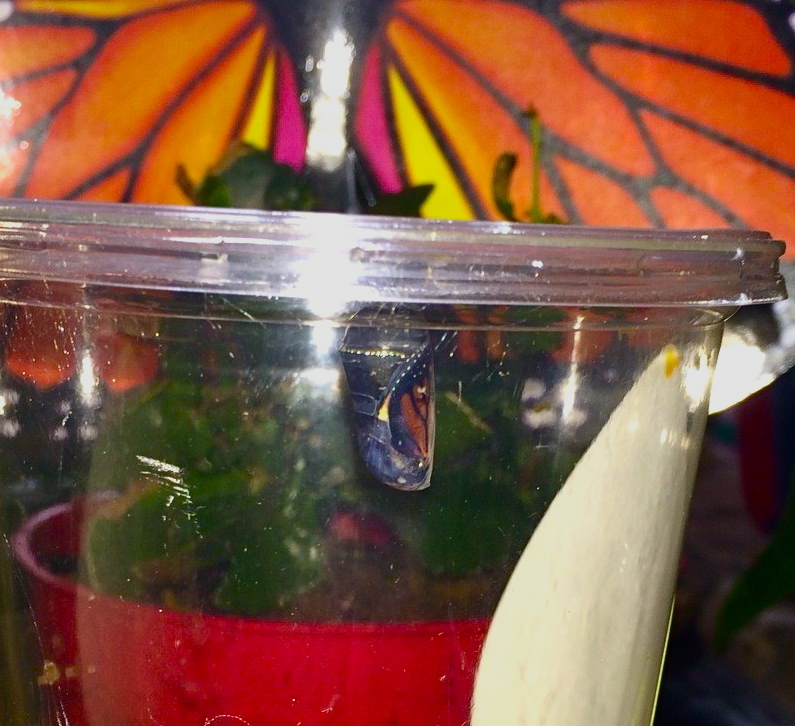
Each chrysalis started out bright green with a small line of metallic-looking gold dots across it (which I will come back to later). By this point, I was determined not to miss the remaining steps of caterpillar-to-butterfly transformation. I checked on them throughout the days, finally noticing that their color was changing. At first, it appeared that the chrysalis was turning black, but over time (and upon closer inspection) I began to see the colors of the butterfly emerge within the clear casing of the chrysalis.

Image

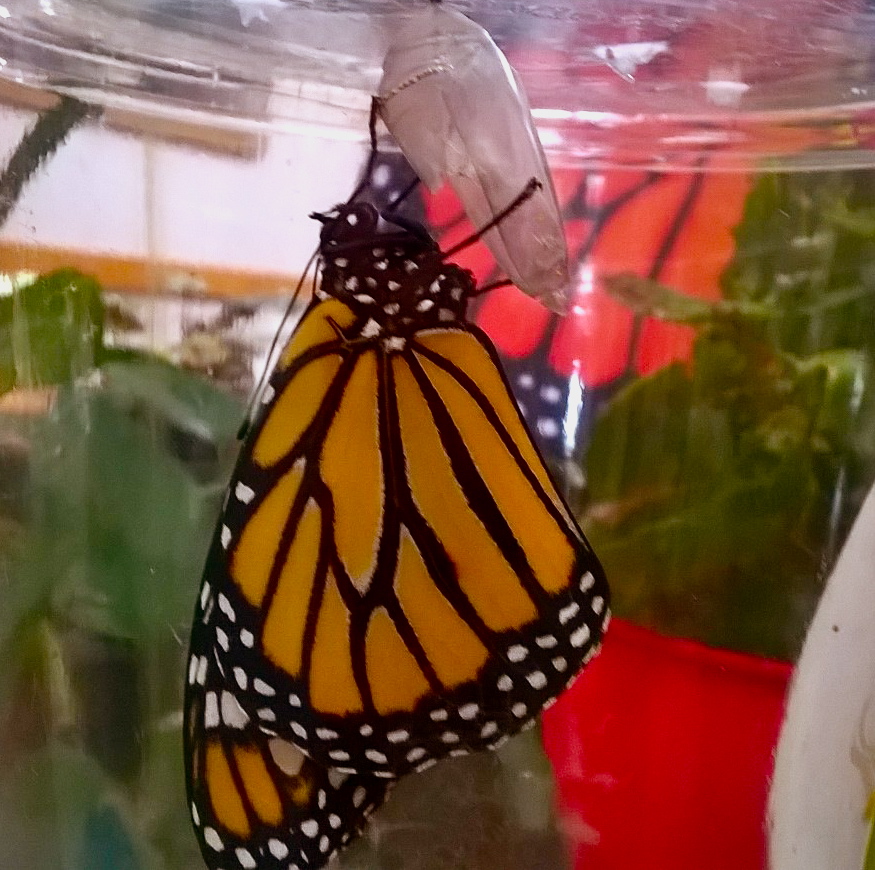
And then, not too much longer and this happened:

Image 1


Many people have rhapsodized about the transformation of caterpillars to butterflies. It is an image that has been used as metaphor many times, and watching the process is endlessly fascinating. I can’t even begin to speak about it as beautifully as so many others already have. But what I loved about watching this transformation was knowing that the seeds of evolution were inside the wriggly caterpillar all along.

Science tells us that there is no structural commonality between caterpillars and butterflies. The caterpillar literally dissolves into a kind of genetic goop inside the chrysalis. Cells which had remained dormant within the caterpillar, poetically called “imaginal” cells, take over:

These little groups of cells that start developing very early in the caterpillar’s life but then they stall, and so they’re just in there waiting, and they don’t start growing until the very end of the 5th instar (the last caterpillar stage). —Journey North: Monarch Butterfly

What emerges is something completely different. But those imaginal cells? They were there from the beginning. From this I take two lessons for myself:

  • Within each of us resides the seeds of what we can become – and we can literally change our form (transform) from within.
  • What we have the potential to be is radically different from who we already are.

Remember that line of metallic dots on the green chrysalis? (If you look closely at the photos above, you can see the dots in both.) They intrigued me, so I did a little research and discovered this: they are a mystery. Science has not yet explained them. I take great pleasure in knowing this. We can transform our lives, our very sense of who we are – that potential, that incipience, exists within us. But there’s mystery in us, too. The beautiful, shining mystery of creation that defies human understanding.

This past week, everyone who stopped to look at, discuss, celebrate, and set free our butterflies noted not only the incredible biology of the process, but also the deep mystery. And we all shared, if briefly, in the joy of transformation. I can’t hold on to those moments, but I want very much to remember them. Especially at those times when I begin to feel, “This is it. I am finished becoming. I’m set now in this form, in this way of being in the world and in my own body, heart, soul.”  Because those moments are the ones when I need my own imagination (my imaginal cells, if you will) to kick in. That is when I need to remember the joy – and the beauty – that is activated with the conscious choice to change and grow.

“If the point of life is the same as the point of a story, the point of life is character transformation. If I got any comfort as I set out on my first story, it was that in nearly every story, the protagonist is transformed…If the character doesn’t change, the story hasn’t happened yet. And if story is derived from real life, if story is just condensed version of life then life itself may be designed to change us so that we evolve from one kind of person to another.”  — Donald Miller, A Million Miles in a Thousand Years: What I Learned While Editing My Life


You are not an imposter. Your inner voice is a jerk.

“It was a little embarrassing to be reading a self-help writer and thinking, This guy gets me. But it was in this moment, lying in bed late at night, that I first realized that the voice in my head – the running commentary that had dominated my field of consciousness since I could remember – was kind of an asshole.”

— Dan Harris, from 10% Happier


The other day I had the great fun of spending time with an old friend. We first met in graduate school, and had been so simpatico that we decided “friends” was too tame a word for us. “Colleague” was too passionless, too professional. So, although we were in fact friends and colleagues, we took to calling each other “Comrades”. We were united in our…you know, whatever it was we felt so deeply about back in 1987.

Anyway, my comrade and I were not in touch for many years. Recently reconnected, it has been a joy to write (actually, to get mail because she is much better about sending things than me), to Facebook message, and now and then to be in one another’s presence. And I was finally able, last weekend, to visit her space: see her house and gardens, visit her favorite places in the college town she calls home. And to tour her office.

Now, you need to know that this friend of mine is kind of an overachiever. Ok, not really an overachiever – she is talented, brilliant, and capable of everything she has achieved. And she is a capital-A Achiever. In her office are photos of her with Presidents (yes, of the USA), members of the Cabinet and Administration (again, yes, of the USA); there are framed commendations, tons of awards, photos of her with many people whose lives she has touched through her work.

I was impressed. But not in the way one is sometimes impressed with celebrity or suffused with hero-worship for someone whose activism we admire. I was impressed by the natural feeling that these things were as they were meant to be – that my friend has simply inhabited the life that called to her. That sounds easy, like I’m suggesting that it came easily to her. Au contraire! Knowing what I know about this woman’s path, I understand that it took hurculean effort at times, that it took sacrifice and intention. I love that she was both proud and humble as I lingered over these mementos of her accomplishments.

As we left her office, I said, “I’m a little disappointed. Back in grad school we were all certain you’d DO something with your life.” Just a little humor cliche to help glide over a moment of genuine emotion.

Since returning to my daily life, I’ve been thinking about the ginormous job my friend has, and the grace with which, it seems to me, she skillfully weaves so many disparate threads. I think it is amazing and inspiring – but there’s also a voice in my head that won’t stop comparing me to her and ridiculing me for not being as capable. It tells me that any day now I’ll be found out in my own work as the incompetent, ineffectual, poseur I truly am.

As journalist Dan Harris says in the quote above, the voice in my head is kind of an asshole.

I’ve had a lot of experience with this voice – a lifetime of experience, in fact. It never shuts up. Sometimes, but not that often, it chatters benignly about strange or unrelated things: how much it would suck to be Ferris Bueller’s sister; why so many crappy books become bestsellers (yes, Fifty Shades of Gray, I’m talking about you); why do we itch? But mostly that always yammering voice is telling me I should be afraid, that I suck, that things may be good now but they’re about to change for the worse.

Since my childhood, I have known I was sensitive. More accurately, too sensitive. At least that is generally the language I heard from my family, from friends, from people who had just said something unkind or unfairly critical: “Oh, Jen, you’re too sensitive.” In order to combat that diagnosis, I’ve spent a lot of energy over the years pretending that I’m impervious. Acting nonchalant when I’ve felt hurt or fearful. Anything to avoid the appearance of being overly-sensitive.

But the voice in my head knows better. That voice knows I’m easily wounded, often frightened, sometimes paralyzed by self-doubt. Knowledge is power, so that voice uses what it knows and goes for the jugular. Especially when I contemplate taking risks or making life choices which involve new areas of endeavor.

It picks moments when I’ve relaxed a little to double-down. Admiring my “comrade” took me outside my own head in order to appreciate her accomplishments. So that voice came back harsher than ever, seizing that moment when I was vulnerable to comparison.

Luckily, I’ve got a greater understanding of how to respond than I once did. Natural health practitioner and author, Mely Brown writes:

Impostor syndrome isn’t exclusive to highly sensitive people. Many conscientious and high achieving people fall victim to this nagging fear. But the simmering discomfort about being found out is often constant for a sensitive person.

Why wouldn’t it be, considering you’ve spent a lifetime of feeling different from others and trying to fit in?… But even if you grew up displaying your sensitivity with pride, it’s unlikely you escaped the cultural pressure motivating you to disguise your real self to fit the norms.

…If you’re constantly thinking about who you should be but aren’t, and what you should be doing but can’t, understand that valuing your achievements and signature strengths allows you to show yourself as you truly are, more comfortably — even when you’re the odd one out.

Each of us has a voice that keeps a running commentary going in our heads – not just people who self-identify as sensitive. One thing we can do, as Ms. Brown so clearly states, is to value our own strengths. This means being willing to look for and admit our own strengths, rather than fearing that we’ll get too big for our britches if we identify and own them.

Another tactic I’ve learned to use is to question the veracity of that voice. The reality is, that just cuz the voice says it and it hurts doesn’t mean it is true. Lots of things that hurt us hurt because they aren’t true. And yes, sometimes the truth hurts, too. But you’ve got to spend some time questioning your inner tormenter, rather than accepting what it says whole cloth. I’ve discovered that if I stop and question a specific barb it hurls at me, mostly it melts away like an ineffectual schoolyard bully who’s been stood up to. Every now and then, I’ll even say to myself, “Stop talking to me like that. I don’t deserve it.”

Finally, and most efficiently, I’ve learned to not listen. Just because you can’t help hearing it (the voice IS inside your head, after all) doesn’t mean you have to listen to it. I am not a meditator or yogi, but I do appreciate the benefits of mindfulness: allowing the voice to run on, noticing it, but not putting energy towards it. Thinking of the stream of consciousness as just another babbling brook, providing background noise that you are in no way required to pay direct attention to is an awesome technique to master. I wouldn’t say I’m an expert yet, but I am getting better at it all the time. Often, I don’t notice how much I’m listening/giving credence to that inner mean girl until I’m feeling enough anxiety that a panic attack is imminent. But when I feel that heightened physiological affect, I usually catch on that I haven’t been practicing good mental hygiene/mindfulness.

For me, employing some of these proactive responses to that inner critic allows me to move forward rather than remain in stasis. It also allows me to enjoy others’ accomplishments without somehow feeling diminished myself. My comrade deserves to be appreciated and admired for her strengths and accomplishments. As do I. As do you. We are not impostors – we are human beings with gifts, talents, strengths and imperfections. We may be sensitive, but we don’t need to let that define or incapacitate us.

Numb and numb-er…


True…but I’d prefer to feel happy.

A few years back I was going through a period of change in my life, including allowing myself for the first time in many years to truly feel my emotions. One day as I struggled with all those feelings, my dear friend and extraordinary counselor, Tricia, handed me a tissue for my tears. Then she asked, “Would you rather feel this way, or go back to not feeling at all?”

Considering that I was crying and snotting all over myself in the middle of a work day, the idea of emotional numbness had some appeal. But I couldn’t honestly wish for it back. Even on the worst of days I felt more alive as an emotionally open person than I ever had while keeping my emotions impenetrably walled-off.

That emotional wall has been on my mind frequently as I work my way through the current transitions in my life. The final few months before I accepted a new job (entailing a return to my former hometown) were not particularly happy ones. In fact, in the six weeks prior to receiving the job offer, there wasn’t a single tear-free day. Which made it all the more strange when the tears stopped.

No crying is a good thing, right? Except that big, emotionally impactful things were happening: saying goodbye to friends I love, leaving a city I love, saying hello to friends I love and have missed, moving into a beautiful, spacious new apartment, beginning a job…all “big ticket” emotional items.

One evening I was moving around my apartment putting things away, slowly making choices about where items belong now that I have multiple rooms in which to keep them. I suddenly experienced a strong sense of disorientation. How did I get here? Whose life was this, anyway?

Because, I reasoned, if this were my life, I would feel something.

That’s when I realized that I’d fallen easily into my old habit of coping with feelings by shutting them away. And actually, it can be a useful coping mechanism when you are in the midst of huge transitions calling for management of many details. After all, it is difficult to get through a lengthy to-do list if you are stopping every few minutes to blow your nose and wipe your eyes.

The problem is that I forget to get back to feeling things once the immediate frenetic work is done. I forget that, in order to manage my difficult emotions this way, I also have to shut away the ones I want to feel – like love and happiness, like contentment and inner peace. I don’t even realize that I’m wandering around in a numbed and foggy state, emotionally flat and unresponsive. I don’t contact the friends I miss, I don’t make an effort to enjoy those who are nearby. Keeping myself closed off from my emotions effectively renders the work of moving, the effort required to change my life, meaningless.

I share this for several reasons.

First, I know I am not alone in finding ways to numb myself in order to keep my emotions at bay when they threaten to overwhelm me. Whether it is with substances (alcohol, drugs, peanut M&Ms), with isolation, by binge-watching “Full House” episodes or by obsessively taking Facebook quizzes, the end result is the same – unfulfilled days leading to an empty life. I am not alone in needing reminders to cut that crap out.

Second, it is a cliché to say that awareness is the first step toward change. But it is also true. I have to realize that I’m indulging in a coping mechanism that is past its usefulness – I’m beyond the frenetic phase of my move and into the long, slow part of the transition. I have both the time and leisure to attend to my emotional life again – it will actually make the transition more successful if I open my heart and see what’s going on in there! If what I’m saying rings true for you, isn’t it time to stop protecting yourself and start risking emotion again? Me too.

Third, I need my life to be about something. Something bigger than myself. In large part, that is what this transition and new job are all about. The effort and energy required to avoid emotional engagement prevent that by keeping my attention unfocused and dis-engaged. So I ask myself, do I really care if my taste in classical music is hipster or not? Is that pistachio muffin really worth trading my ability to laugh or to cry? Tomorrow, next week or next year, will I look back at this time and be proud of what I’ve accomplished? Will being able to recite Uncle Jessie’s lines from memory be a big enough contribution to this world? Would it be, is it, enough for you?

If your answer is no, then let’s agree to help each other out. We won’t intentionally numb ourselves with whatever our “numbing agent of choice” might be – and to keep ourselves honest, we’ll tell someone we trust what that is. We’ll treat each and every fledgeling emotion as valid and nurture it, in ourselves and in others. We won’t judge emotions as good or bad – we’ll just let them speak for themselves. And finally, let’s not judge others for being emotional beings, even when they/we are sloppy-emotional. It’s immensely human of us.

Eventually, we may grow to not only feel but to appreciate every emotion for the richness it adds to our understanding and experience. And when that happens, like good parents, let’s just keep it to ourselves that happiness is our favorite!

I Disagree. And that’s ok…

A paraphrased conversation from a spring meeting of the Rider Writer’s Group:

A: (reading from her essay) “If you believe (this), you’re wrong…”

(She continued until she had read the entire essay. Several comments were then made in response to the essay)

Me: I admire how you point-blank called the reader out – “You’re wrong!” I almost never say anything that direct, even if I feel really strongly about it.

P: Why not?!

Me: I’m not sure. I don’t want to create bad feelings or alienate people. But I also don’t want to get into a verbal war over comments on my blog. (I then gave an example of an unpublished piece that takes a stand on a polarizing topic.)

M: Well, I think you should go for it. You can always turn comments off if it gets too bad.

P: Yeah! Just go for it!

A: Besides, it’s okay for people to disagree.

Wait! What?! It’s okay for people to disagree? Why didn’t anyone ever tell me this?

Now, I’m not talking about conversational debate. I grew up surrounded by and participating in family debates (mostly over morning coffee) about everything from the relative merits of a particular restaurant, to politics and educational policy, to “what is art?” While some of these topics may have been things that we cared about, they weren’t actually very personal. In this kind of debate, my faith, energy, and soul aren’t really invested. Instead, the verbosity is more about having a wide-ranging conversation, taking a position for the fun of having to defend it or capitulate to a better-articulated argument.

Real, substantive, disagreement is much more difficult to navigate. First, for many of us, disagreement equals conflict and, therefore, must be avoided at all costs. More than that, though, we avoid deep disagreement because it makes us feel vulnerable. When I clearly state what I believe from the core of who I am, I risk rejection. Sometimes, in the heat of argument, that rejection feels like annihilation.

The paradox inherent in this dilemma is clearly stated by Parker Palmer:

“Instead of telling our valuable stories, we seek safety in abstractions, speaking to each other about our opinions, ideas, and beliefs rather than about our lives. Academic culture blesses this practice by insisting that the more abstract our speech, the more likely we are to touch the universal truths that unite us. But what happens is exactly the reverse: as our discourse becomes more abstract, the less connected we feel. There is less sense of community among intellectuals than in the most ‘primitive’ society of storytellers.” Parker Palmer

In today’s world, as we navigate the major issues of our time: climate change, economic disparity, discrimination and inequality, US women’s domination of world soccer (ok, just checking that you’re paying attention) it is more vital than ever that we practice the moral courage of speaking truth. This doesn’t only mean sharing divergent opinions, it means learning to confront our own fear of vulnerability to say what is in our hearts – regardless of whether others will agree. We can’t let fear of conflict prevent us from talking about the very real decisions with which we are faced as a community.

And speaking of community: until we find a way to include disparate voices in one conversation, we will never create true community. Instead, we will continue to create closed circles of like-minded individuals who agree with each other in ever louder voices in an attempt to drown-out the voices of the closed-circle groups living near us.

I could go on haranguing on this topic in an abstract way, but then I’m guilty of the very thing I’m arguing against. So how am I practicing the moral courage of truth in my own life? Well, in some ways I’m not. For example, I haven’t published that blog piece on a polarizing topic I spoke of with my writer’s group. In other ways, I’m working on it. First, I’m listening to myself speak – noting when I take refuge in abstractions or, worse, untruths. This is a very humbling thing to do, as I discover just how often I slide over or glide around inconvenient or uncomfortable truths. Second, I’m evaluating situations and people in which and with whom it is less daunting to speak my truth. As in so many things that take courage in life, starting with lesser risks builds strength for greater risk-taking. Third, I’m evaluating those areas that need my voice and practicing speaking my truth there, even if I know others will disagree. Even if I know that speaking will reveal fundamentally divergent views between myself and people I love or respect. Because my friend and fellow writer A. is correct: it’s ok for people to disagree.

Not only is it ok, it is actually possible to continue to love and respect those with whom we disagree. In fact, one could argue that true love and respect are only possible between those who have learned to speak divergent truths AND continue in relationship with one another. When one of my loved ones came out as lesbian to a family member, she indicated her fear that it might harm the relationship. The reply she received was, “Maybe now we can really have a relationship.” Because truth is essential to creating “right relationship”, whether between individuals or within communities. In fact, real community only thrives in environments that learn to hold a diversity of views without erupting into discord and interpersonal violence. I know no other way to create this than one person, one courageous truth, one relationship at a time.


Circles and Spirals

“And the world cannot be discovered by a journey of miles, no matter how long, but only by a spiritual journey, a journey of one inch, very arduous and humbling and joyful, by which we arrive at the ground at our own feet, and learn to be at home.”

                                                                          –Wendell Berry


In years past when I trained Resident Assistants in preparation for the arrival of first year students in the fall, I would ask them to create a visual model of a welcoming, inclusive community. Invariably, the group would form a circle, holding hands with one another. It provided a wonderful opportunity for discussion, as the model they’d just created was, in fact, closed to new people. The group discussion that followed was always rich and insightful, culminating in some very creative group formations representing community.

In many ways, the image of a closed circle has never really appealed to me as a metaphor. If some circular pattern or concept was needed, I’ve always preferred a spiral because it speaks of ongoing movement, of a future; it can spin upward to represent growth or downward to represent depth. A spiral allows for the concept of coming full circle, without that being an end-point. Yep, I’m all about the spiral.

Except that this week my life has been all about the circle.

Everyone has issues with people in their lives that, for one reason or another, just don’t go well. Contact with that person(s) ends, but messily, with unresolved turmoil or emotion. Moving back to a community in which I lived and interacted for seventeen years meant that I was returning to the vicinity of several such situations and what I perceived as “problematic people” from my past.

I didn’t intend to actively avoid these individuals, but I suspect I’m not that different from others in that I (passively) hoped to not run into them. I’m not proud of that cowardly impulse, but I think it’s a normal, human one. Most of us are cowards when it comes to conflict and discomfort in social interactions. However, as with so many things associated with moving and my new position, it appears that there is a plan other than my own at work in my life. This became apparent as one after another of my so-called “problematic people” walked through the door this week.

What I discovered through these encounters is invaluable. First, I learned that allowing myself to think of individuals as problems stripped them of their humanity. Instead, I had come to see them as one might view characters in an uncomfortable drama – broadly drawn to represent one value, rather than as multi-dimensional beings. Second, casting them in the drama which was held over week-after-week inside my own head meant that neither they nor I were allowed to grow beyond the initial messy turmoil (whatever that was). Third, dramas feed on emotional avoidance – so that the longer these situations remained unresolved, the larger they grew in my reckoning. Over time, interpersonal icky-ness came to be equated in my thinking with insurmountable impediments to forgiveness and healing.

Of course, that was not true. In each case, our encounters were initially awkward – I hadn’t expected them and they had not been prepared for me. But after the first few moments, each of these people I had previously defined as “problems” proved to be generous, good-humored, open, receptive. And I like to think that I mirrored those qualities. By the time we parted company, I no longer feared seeing them again. More important, the arc of negative energy associated with each person was finally closed. Brought full circle.

So this week I’m learning to appreciate the closed circumference of the circle. It doesn’t mean I am done with these individuals – who knows whether we will cross paths again or play a part in one another’s lives at some future point. Completing the circle doesn’t close off the person, it puts a stop to the energy drain of the unresolved drama. It can, in fact, make further connection, even some spiraling together, possible.

Which brings me back to idea that there is a plan other than my own visibly at work in my life. Had I made a plan for this, I certainly wouldn’t have placed several such encounters in close proximity, time-wise. I’d have decided each needed both space and careful engineering. Most likely, I’d have obsessed to the point where authentic connection or response wasn’t possible due to the anxiety and stage-fright I’d have felt. But here’s the thing: these unclosed circles were holding me back from doing the work I feel called to do. They weighed on my confidence, authenticity, full engagement in the present. Now I can leave them where they belong – in the past.

And my “problem people”? They can, once again, be fully human as opposed to one-dimensional characters in my mental melodrama. Their names are off my marquee. I can get back to work, less burdened and distracted, on my spirals.

And for that I am truly, profoundly grateful to The Planner.