The Sunday Roast: Guest Post by Susan Stork

When Sue and I met, in graduate school at The University of Iowa, we kept trying to figure out how we knew one another. Eventually, we came to accept that while we had never met before, we were clearly meant to know one another in this life. We have been friends and professional colleagues for 26 years now, and the things we could share about each other…well, I’ll leave it at that! Trust is a huge part of this enduring friendship! I am truly excited to introduce you to my friend, Susan Stork!

Growing up, I didn’t have much confidence in myself or my body.  The reasons are immaterial at this point, but suffice it to say that I was awkward, and seemed only to reinforce that when I tried to do things that others did very naturally.  As a result, I tried to avoid doing anything remotely challenging – like throwing a ball, doing a sommersault, playing dodgeball or dancing.  It’s a wonder I ever learned to ride a bike!

Once when I was 8 or 9 years old I was rollerskating on the sidewalk in front of our house when I hit a crack where the sidewalk had heaved up.  I hit the pavement so hard it knocked the wind out of me.  My dad saw it happen and ran over to pick me up.  I can still remember the panic of being breathless and the shame I felt about not having seen the sidewalk crack.   That lack of confidence only increased throughout my childhood.  I was the uncoordinated kid who was picked last for team games at recess, and while I learned to swim, I was anything but smooth in the water.  At school dances I don’t know which I feared most – not being asked to dance or being asked to dance!

There were brief hints of the physical gifts I would later discover I possessed.  After high school graduation, I took a trip to Rocky Mountain National Park with a friend and climbed Long’s Peak.  We started in the dark of early morning (so we could be down before afternoon thunderstorms were a risk) with little more than some advice from hikers we’d met the day before, a flashlight and some water.  We didn’t “summit” – altitude sickness leveled us “flatlanders” – but before we turned around we knew we had done something physically challenging in getting to around 13,000 feet in elevation.  The peak is 14-something.  Not bad for a couple of out-of-shape Midwestern girls whose only prep for the trip had been hours of dreaming during breaks in band practice our final semester of school!  What we lacked in skill, we made up for in endurance.

Miraculously, I had learned to ski in high school P.E. class at our local ski hill, and it was skiing that provided the enticement to go to college in Montana. I loved the active, outdoorsy, and athletic vibe in my environment. Maybe I hoped some of the athleticism would rub off on me…?  I became a good skier during those years, but surprisingly, that didn’t bolster my confidence in my body.  I continued to think of myself as clumsy, soft and weak.

A few years later while in graduate school, my advisor asked me to be on the staff at a summer leadership camp.  Her confidence in my academic and social skills was encouraging, but I was worried about embarrassing myself if I had to do anything too physical.  When I arrived at the camp, I was asked to fill in for a last-minute staff resignation to team-teach a group of about 40 high school freshmen and sophomores for the two-week session.

One of the lessons on teamwork was to be conducted on the camp’s challenge course or ropes course.  This activity presents small groups of people with controlled physical challenges at a series of stations, each with a different goal and many potential solutions.  The learning comes as group members identify potential solutions to the “problem”, recognize and utilize each other’s strengths and weaknesses, and encourage each other to trust that the group will respectfully support each individual’s effort and contribution to the task, regardless of the nature of that effort.

Ropes course day was anticipated by campers and staff with both trepidation and excitement. I was so nervous I was unable to eat breakfast that morning.  A lifetime of angst, shame, and fear about my body and its shortcomings was about to be laid bare to a group of kids, a co-teacher and the ropes course staff.  I considered not going, but only briefly.  I felt obligated as a leader to demonstrate my faith in the power of teams, so I went.  What I learned about teams and about myself that day altered my confidence in ways from which I am still reaping the benefits.

I don’t remember much about that morning, except the station that required us all to cross an imaginary river full of piranhas using nothing more than a series of tires hung by ropes and suspended from a cable.  The first step was to launch yourself from a platform on a knotted swinging rope, and grasp the first tire.  I immediately slipped off the rope and into the “river”.  The entire team goes back to the beginning when one person falls off the course.  But somehow, my team supported me emotionally, got me back on that platform, and when I launched the second time, one of my teammates was there to hoist me up by the back of my pants onto my tire, while another person held his tire steady.

I don’t remember getting across the “river”, but I do remember talking about what that support had felt like as we de-briefed.  For the remainder of camp, whenever I was free, I was at the ropes course helping other groups through their adventures and encouraging the kids in whose eyes I recognized that familiar mix of fear and shame.  By the end of the week I had shimmied through a web of ropes, balanced on a log see-saw, climbed telephone poles and fallen backwards off a platform into the arms of a bunch of kids below.  On purpose.  More than once.

Now let me assure you, I was not a latent athlete waiting to come alive.  I was, and still am, kind of awkward at a lot of physical things.  I still hate dancing.  I still have a rotten throw.  I’m still not coordinated well for things like team sports.  But I am strong and I don’t quit.  I rarely back away from a physical task.  I can push wheelbarrows loaded with rock, carry heavy boxes and furniture up flights of stairs, grow things, stack hay bales and step safely from a dock into a boat.  I can assemble IKEA furniture, kayak two miles across a lake and back again, climb up and down a ladder all day to paint, nail shingles to a roof, and dig out old tree roots.  I like to ride my bike.  I like to train with weights.  I am proud of what I can do with this body.

I will not likely run a marathon, or dance gracefully, or golf.  But that’s ok because I can help the marathon runner unpack boxes and be completely settled in her new home in one day.  I can plant and grow a flowering landscape that the ballroom dancer with a brown thumb needs only to water to enjoy.  And I can skillfully drive a cart so the golfer can play 18 holes despite painful arthritis.  Yes, I am proud of this body.

My ropes course experience happened 26 years ago.   In the years since, I have led countless groups of students through challenge course activities in the name of teambuilding.  I am always conscious that on that day, in that group, there is someone who feels about his or her body the way I did about mine.   And I hope to catch his or her eye at some point and silently, confidently, offer the strength in my body to help them swing to that tire and grasp the power, as yet undiscovered, in her own body and mind.
Words That Changed My Life: Hubris

For much of my early life, I was not particularly self-aware. Self-conscious? Absolutely. But I had not yet learned to see myself, my actions, my interactions with others from an analytical perspective. I simply could not stand outside myself and review with honesty my actions, motivations, or emotions. As a result, I was often taken by surprise, both by my own choices and by the reactions of others toward me.

My junior year in college, I took a Greek Mythology course as an elective. The course was taught by a nun who had spent most of her career teaching in grade school. We were horrified, on the first day of class, to be told we must respond in unison to her questions. We were also given worksheets and made to place them in exact order in our notebooks at the exact same moment, so that the noise of opening our required 3-ring binders (then snapping them shut) would take place all at once – no stragglers allowed. We were required to turn in the binders weekly. Misplaced worksheets resulted in deducted points. We began the semester hating that we were being treated like children. After all, we were confident and competent adults.

Through the course of the semester, though, my classmates and I grew to love Sister’s techniques. First, we decided to have fun with the novelty of returning to our third grade classroom structure. Then, the sheer amount of information we were actually learning – and retaining – became fun in a different way.

One concept that has stuck with me from that course is the idea of hubris. “The word was used to refer to the emotions in Greek tragic heroes that led them to ignore warnings from the gods and thus invite catastrophe. It is considered a form of hamartia or tragic flaw that stems from overbearing pride and lack of piety.” (eNotes: Guide to Literary Terms) Hubris: on one level I kept the word in my arsenal because I love words, and this is a good one to pull out in arguments and essays.

On another, deeper, level the idea that overbearing pride could be a tragic flaw was working on me. How would I know if I suffered from this? I mean, does anyone with this problem know they have it? Or are they all so arrogantly sure of themselves that they would never recognize their own puffed-up sense of self? The more I thought about it, the more relief I felt. After all, I was the opposite of self-confident – I was fearful in every way. And I was sure that everyone could see my inadequacy, despite my efforts to cover it up.

Pride, as they say, cometh before a fall. I reached a point in my life when it occurred to me that I had been allowing my life to happen to me, rather than actively living it. Of course, this realization came about as the result of pain and unhappiness that finally became too great to ignore. I think for most of us, these emotional growth spurts are often the result of difficulties, challenges, sadness rather than of happy times. The rawness of our emotions can cleanse away the lethargy and inertia of daily life, and we see ourselves more clearly.

What I saw in myself was an unbending pride that approached the level of tragic flaw. My pride didn’t stem from arrogance and overblown confidence. Mine stemmed from that very sense of inadequacy rooted deep in my psyche. My pride did everything it could to hide my unworthiness. I never wanted anyone to know I was clueless in a new situation, so my pride prevented me from asking questions. I never wanted to appear as stupid as I felt, so my pride kept me from venturing opinions or seeking out mentors and teachers. I certainly didn’t want anyone to feel sorry for me, so my pride prevented me from reaching out honestly and letting my friends know I was in pain, or lonely.

In Greek mythology, the story of Icarus is often used to describe the concept of hubris:

The main story told about Icarus is his attempt to escape from Crete by means of wings that his father constructed from feathers and wax. He ignored instructions not to fly too close to the sun, and the melting wax caused him to fall into the sea where he drowned. The myth shares thematic similarities with that of Phaëton — both are usually taken as tragic examples of hubris or failed ambition — and is often depicted in art. (Wikipedia)
 

Presented with hubris in the context of my mistaken pride, which prevented me from fully engaging with others in my life, or with that of Icarus, I now see the second manifestation as preferable. At least Icarus’ pride led him to strive for something greater with his life – rather than using pride to keep life small and crabbed into a safe little box. I can’t say with utter assurance that I have mastered my tragic flaw. But I can say that, finally, I am self-aware enough to be able to see my choices and behaviors in light of how they either are filling my life or depleting my life – and then to take corrective action. Sometimes, I am even able to reflect on possible choices and take the best path first. And that, friends, is worth suffering a blow to one’s pride.

When Breaking News Breaks Your Heart

“Let the highest truths and values guide everything you do.”
–Quaker admonition
 

Working in higher education means that when national news revolves around campus scandal, we will be even more absorbed in the story than we might otherwise have been. No one talked too much about Herman Cain at work today. Everyone had something to say about Joe Paterno. It is considered a kind of professional courtesy not to jump into the public fray too quickly, pointing fingers at other institutions. When a student dies of alcohol poisoning, when a campus sexual assault turns out to have been mishandled, when a college is fined by the Department of Education for a policy that doesn’t quite meet the federal guideline, we can find ourselves thinking, “I could be that (insert campus title) standing in front of the camera.” And we refrain from public posturing. This story is something entirely different.

I’m guessing we’ve all been paying attention – if not, just google Paterno and you’ll begin to learn the horrifying details. A lot of words have been used to describe what took place between a coach and the vulnerable children he was supposedly mentoring. More have been used to discuss the criminal lack of judgment displayed by members of the Penn State administration. I don’t have any that wouldn’t seem cliche at this point. Instead, I want to talk about the ease with which we can stray from the very values that give our lives meaning.

These coaches were famous for their values. For teaching them, for speaking them, for living them. For mentoring young people to become adults of strong character. By all accounts, these were the hallmark of their careers. I can’t speak to the values of the university officials also involved in these events, but I have spent my life working with higher education administrators. The values of our shared roles and professions as educators can be expressed in a myriad of ways, but at the core are generally recognizable: lifelong learning, development of well-rounded citizens and whole persons, the common good, to name a few.

How, then, does anyone stray so far from their professed values that they could be complicit in creating the culture of cover-up and self-protection so evident as the facts of this case have become known? I suspect the usual culprits: fear, money, cowardice, hubris, and plain old poor judgement. I would also like to suggest that our unwillingness as a society to engage in self-reflection, to practice quiet, to ask ourselves the hard questions, played a role here as well. When everyone becomes caught up in our “brand” or our image, as opposed to who our actions say that we are, abuses of power happen. When fear causes us to lose the values at our center, we often find ourselves pushed into behaviors we wouldn’t normally condone. Finally, I sometimes wonder if we place anywhere near enough value on the idea of vocation – what am I called to do with my life as opposed to how will I make money?

I don’t know about you, but in my job I am faced almost daily with situations big and small about which I am asked to decide the right course of action. I can never be 100% certain that the decision I come to, the action I take, is the most ethical, most right. However, what I can do is ask questions, get input from others I trust, then take the time to consult my own inner voice. If I ask, it will tell me if cowardice or conviction is behind my choice. Most important, I can never allow myself to forget that I am charged with a sacred trust as an educator. Sacred isn’t a word used very often, I’m afraid, in cultures like the one that developed at Penn State.

What has happened has happened. Nothing any of us, or the pundits, or even the courts say or do can change that now. The choices were made, from the heartbreaking violation of trust between Sandusky and his young victims, to the heartbreakingly apathetic (or cynical or criminally negligent – take your pick) response from those who could have done something about it. The only thing I can do in the aftermath of this horrifying chain of events is look within. I can reaffirm that I need to do the right thing, not the easy thing. I can take the extra minutes to search my soul before choosing an irrevocable course. I can practice speaking the truth when doing so is less risky, so that I am ready to do it when it feels like my job or more might be on the line.

Finally, I can remind myself regularly that my work isn’t just about collecting a paycheck or having a positive reputation. It isn’t about politics or creating plausible deniability. It isn’t about protecting my company’s reputation or brand or revenue stream above the people whose lives are impacted by what I do. My work is a sacred vocation, and what I value should be crystal clear from how I behave within that work.

“Before you tell your life what you intend to do with it, listen for what it intends to do with you. Before you tell your life what truths and values you have decided to live up to, let your life tell you what truths you embody, what values you represent.”
–Parker Palmer

Preparing for Winter

In the epic fantasy series A Song of Ice and Fire, which begins with Game of Thrones, the northern Stark clan has a saying: winter is coming. In the series, summers can be short or decades-long. But the Starks know that winter will surely follow, no matter the duration of milder weather. Their mantra, “Winter is coming”, serves as a sobering reminder to be prepared.

Here in the midwest, a rash of perfect weather has brought the happy realization that fall is almost upon us. Deep blue skies, fresh apples, pumpkin spice lattes at Starbucks…early autumn is celebrated for many reasons. But this year, and not only because I have just started reading the George R.R. Martin series, I can’t help but say softly to myself, “Winter is coming.”  And I am feeling ambivalent about it.

Last Thanksgiving, I spent the long weekend in Minneapolis with my friend Mike. An ice storm was coming, so I left earlier than anticipated and arrived in the city only 30 minutes before the storm. Mike’s studio apartment, in an old home in a neighborhood that has seen better days, was without heat. We kept warm wearing layers and blankets, leaving the gas oven lit with the door open. And I cooked, the first night making a pot of chicken noodle soup.

On Friday, Mike worked. I prepared dinner in the crockpot, then I wrapped myself up in a soft, knit infinity scarf (a beautiful shade of teal). I put on my new winter activity boots, and hiked a couple of blocks to the nearest coffeeshop. It was packed with Somali men, and I only stood out a little as I sat in the back reading a book of essays about winter. The cold, the snow, the steamy coffeeshop resounding with animated discussions in a language I didn’t speak- these all converged into a sensory experience I can’t describe. That moment, though, planted a romantic’s view of winter in my psyche which held on for most of the season. I couldn’t get enough of ice crystals and deep cold and shoveling.

That was then. This is now. Perhaps my current ambivalence about winter comes from having just had the second almost-perfect summer of my adult life. I used to think that summer in Iowa was the best recruitment tool other states could use to lure people away from here. Now, I’ve discovered that weighing less and doing more actually counteracts the effects of corn-sweat-induced humidity. Summer in Iowa isn’t so bad.

Maybe I am on the fence about winter because I can’t even remember what I own in the line of closed-toe shoes. Or is it that secretly, I am afraid I’ve lost that romanticism that carried me through last winter? The sense that each day contained an incipience, that things were on the cusp of happening. That the cold and hard wind were scouring away extraneous stuff in order to give me a clear path to the life and person I was becoming. I liked feeling that way.

But years and moods pass. If I am unable to recreate the epic fantasy tale in my head and heart that carried me through last winter, how will I keep moving forward? By preparing. I need to use this time to winterize myself – not just my car and my house. Get back into the routine of morning workouts now, before it is so cold I give in to that as an excuse not to leave my bed. Stock up on reading material full of interesting ideas to engage myself on cold, dark December nights. Plan and execute the annual clearing of my craft room, so I can access the materials to create. Reacquaint myself with the many delicious, hearty soup recipes I’ve collected over the years. And remind myself of this simple truth: a life fully lived requires more than hunkering down in a warm corner and hoping the season passes over. It requires choosing to act, to laugh, to love and to seize the moment we’re given – rather than pine for the one we’re not.

Recently, I have learned to love summer. All my life, I’ve eagerly awaited fall. I have (and I will) enjoy them as fully as possible each year. But winter is coming, and I plan to be ready for it.

Acquired Tastes

The other night, I joined friends for Indian take-out. The selections included two kinds each of lamb and chicken curry, sag paneer, samosas and two flavors of naan. I had some of each curry over savory rice, plus a samosa and the garlic naan. A couple of the dishes were quite spicy, but the flavors were rich and layered. I loved all of it.

Later, as I drove home, I remembered the first time I tried Indian cuisine. I hated it. What were those pungent smells and earthy flavors? None of it tasted right, all of it was unfamiliar. These thoughts brought to mind other items I disliked at first blush, but grew to like (or in some cases love): country music, bald dudes, the smell of Quaker Oats. Below are a few other acquired tastes that may need a little explanation:

  • Bike shorts: All of my adult life I have joined friends in making fun of people who wear bike shorts. Especially if they are wearing matching jerseys (or, like the couple I saw on Saturday, BOTH wearing the same matching shorts/jerseys outfits). “Really?”, I’ve thought. “You need to wear a diaper in skin-tight spandex in order to ride a bike?”  With the purchase of my first pair of biking shorts this summer, I have had to take it all back. I may still be less than comfortable with the skin-tight spandex, but I am loving the diaper part. Comfortable doesn’t begin to describe it – those shorts have literally saved my butt.
  • Squats and lunges: A number of years ago, when I still weighed close to 350 pounds, my friend Ryan designed a workout routine for me. He included lots of these moves, and I told him I couldn’t do them. He said I could. We went round and round on it, but the truth is, I nearly fell over when I tried a lunge and I thought I looked like a weirdo when I attempted a squat. I gave them one chance, and refused to consider them again. Once I joined Sisters’ Gym, the fitness classes almost always included squats and lunges. I did them as gingerly as possible, and complained frequently about how they hurt my knees. However, this summer I have turned a corner – all the bike riding has strengthened my knees, increased my physical confidence, and allowed me to see that squats and lunges just add to my body’s strength. I don’t wait until my trainer’s back is turned to fudge on them anymore.
  • Top 40 Radio: To be fair, this is a re-acquired taste. I loved it as a teen. I despised it throughout my 40s. Last year, I was exposed to it while riding in a van with Mike and his teenaged sons. I had to listen, because the volume was cranked. I distinctly remember hearing “Magic” by B.O.B. and thinking, “Wow, I’ve never heard this before, but I can already sing along!” When it came time to update the workout songs on my iPod, I turned to the ever-popular popular music for songs which might be inane (Brittney or Ke$ha) but have a good beat (Flo Rida or Usher).
  • Power bars and sports drinks: Back in the days when I was always looking for the most delectable snackfoods, I thought these were terrible. The bars were sticky and tasted like sawdust, while the beverages were sweet with a strange aftertaste. Also, when you never break a sweat, they seem dumb. Now I know better. Early morning physical activity benefits from food intake, but I just can’t do breakfast sometimes. And long bike rides during severe heat advisories are just safer when electrolytes are replenished. I have come to appreciate (yes, even like) these items. 
  • Movement: There was a point in my life when I avoided things that required extra movement, or really any movement. My mother often commented on my strange talent for finding a way to complete household chores while seated. Sometimes, I was actually jealous of the people on motorized chairs in the grocery store – why did they get to ride while I walked? When friends needed help moving or completing work projects in their homes, I usually volunteered to bring food rather than engage in the labor. Now, some days I feel lazy. But most days, I need to fit in some kind of physical activity, even if the day is a long one, in order to feel truly well. It turns out, I like moving. A lot.

I didn’t include any people on my list. However, experience has taught me that first impressions should not be allowed to determine the course of relationships. I have a number of treasured friends whose personalities or styles were an acquired taste for me – and I am certain that the same is true for them with regard to me. I know all about the research on first impressions, their tenacity and the lightening speed with which they are made. But I also know that first impressions can strike deceptively far from the truth. The important thing, whether I’m talking people or curry, is to keep an open mind. Like most important life lessons I’ve learned, this one bears repeating. Luckily, the opportunities for having it reinforced are many!

50 about 50: Books

“This is the way
you have spoken to me, the way – startled –
I find I have heard you. When I need
it, a book or a slip of paper
appears in my hand…
 
…Your spirits relax, —
now she is looking, you say to each
other, now she begins to see.                                                             
 
 –Denise Levertov

Reading has been one of the great pleasures of my life – also, one of the most important means for personal growth. The simple truth is, I am who I am today partly because of the books I’ve read. In how they’ve touched me at the right moment, how I’ve been open to them when I needed to learn something, books have enriched my life immeasurably.

I have read widely and constantly. In second grade, I got in trouble for reading (a novel) in class. In junior high, my mother nearly flat-lined when she discovered me reading Jacqueline Susann’s  Once Is Not Enough. In high school, I read every Barbara Cartland regency romance I could find, as well as all of Thomas Hardy. When people comment about the strange, esoteric bits of trivia in my brain, I often secretly laugh – because I know what low-brow piece of literature I gleaned that tidbit from!

It would be impossible to make a list either of my favorite books or of all the authors whose ideas or themes have instructed me. Instead, today’s list is of books which have become integrated into my own psyche in some important way. I’ve cheated (a little) because there are more than ten books in this list. I could easily have expanded the list far beyond these ten items – it makes me sad, for example, that there are no John Irvings, no poetry, none of my beloved “books that became movies starring Shirley Temple” on the list. Someday perhaps I’ll write a definitive list of the best books I’ve read. Today is not that day! (PS – the list is in chronological order)

1. The Five Little Peppers and How They Grew by Margaret Sidney

I believe I’ve shared this before, but The Five Little Peppers taught me what reading is for. I learned to read with phonics and the Dick and Jane readers. “Run, Dick, Run.”, does not inspire one to develop a life-long love of reading. Story can, though. And this was the first true, long, emotionally satisfying story I ever read. The rest is, as they say, history!

2. Trixie Belden Series by  Julie Campbell Tatham et. al. /Madeline L’Engle’s Books

Trixie Belden and Vicky Austen showed me two young women struggling with a variety of difficult issues: annoying brothers, shady characters with nefarious intent, mysteries and logic puzzles, the death of loved ones, crushes on boys. I loved that both girls worked hard and thought hard about what it meant to be her best self. I never minded that Trixie used exclamations such as, “Gleeps!” She and her friends the Bob-Whites of the Glen, as well as L’Engle’s characters, helped me maintain a moral grounding at times when it could easily have crumbled away.

3. Pride and Prejudice by Jane Austen

For many years, this was the only novel I read more than once. And by more than once, I mean 20+ times. Admittedly, on one level it could be read as a longer romance novel, and that is probably why I read it the first few times. Gradually, though, I began to appreciate its finer qualities. It has been many years now that I have considered it one of the finest novels ever written. If you have read it without laughing out loud, you have missed just how clever Jane Austen is as an observer and commenter on personalities and social mores. She is witty and on point, without straying into mean and snarky (most of the time) – definitely qualities I aspire to in myself.

4. Lord of the Rings Trilogy by J.R.R. Tolkein

A word that is currently so overused as to make it practically meaningless – EPIC – is the best word to describe both these books and their impact on the trajectory of my reading life. For one, I have remained a true fan of the fantasy genre. In addition:  history, linguistics, folklore, metaphor – my appreciation for each has grown significantly as a result of these books. More importantly, the idea that even the humblest of hobbits has a role to play in the great and dramatic events of the world, has informed my worldview and cemented my temperament as idealist.

5. The Grapes of Wrath by John Steinbeck

The structure of this novel hooked me: the Joads’ story interspersed with chapters describing the injustices (such as produce being allowed to rot rather than feed people) occurring in that turbulent time. My parents were politically involved and aware in the 60’s and 70’s, and while I soaked up that ambience during my childhood, until I read The Grapes of Wrath, I hadn’t understood how powerfully the written word could move me in service to a just cause.

6. Man’s Search for Meaning by Viktor Frankl

“Everything can be taken from a man or a woman but one thing: the last of human freedoms to choose one’s attitude in any given set of circumstances, to choose one’s own way.”  Viktor Frankl

The first time I read this memoir, I was young and more inspired by the fact of his survival in the death camps than I was by how Frankl survived. As I have matured, I have worked hard to remember the truth quoted above. Unhappy at work? Bored with your life? Feel like someone is oppressing you? Use your freedom to choose – beginning with how you respond to the person(s) or events involved. I gravitate toward people in my life who intuitively understand and model how to do this.

7. Earthrise: A Personal Responsibility by David Thatcher

I was spending a leisurely morning in the 1990s browsing at my favorite shops on the pedestrian mall in Iowa City. At The Vortex, I lingered in the books section, flipping through whatever caught my eye. Underneath a pile of New Age magazines, I spied a thin, quite worn-looking little book. It appeared to have been read by many, though this was not a used book store. It was so strange, nestled among the many shiny new items – and we all know I cannot resist something strange or unusual. So I sat down to read it on the padded little bench in the store. And literally felt my mind and my worldview expanding as I read. I’ve never met anyone else who has read this book. For a long time, I almost believed only my copy existed, I almost believed it was magically produced just for me to find at that exact moment in my life when I would be most open to it. Basic premise: the human capacity for affecting our world is exponentially greater at the individual level than any of us typically realize, and it is time for us to take responsibility for what we create.

8. Yellow Raft in Blue Water by Michael Dorris/Animal Dreams by Barbara Kingsolver

I read these two novels back-to-back. They were both beautiful and powerful stories, widely different from one another in subject and tone. What struck me, though, was a similar central concept: that perception is reality. In Yellow Raft, the story is told through the perspectives of several generations of women in the same family. Each perceives the events through her own lens, and each responds accordingly. The reader develops a very full picture of what happened, while each character must make choices based on her own, limited, knowledge. In Animal Dreams, a woman returns to her childhood community, having left in late adolescence feeling outcast and incapable of being accepted by those around her. Returning, she discovers that children don’t see or understand very much – in part, because their parents and the other adults around them provide shelter from the more difficult to comprehend things in life. The view she constructed of her family, community, and self was based on this incomplete understanding – and incredibly flawed. Together, these two novels have helped me develop a more sanguine approach to familial relationships – yes, we shared experiences, but there are sound reasons for our differing responses and/or feelings about them. What an eye-opening thought – someone else’s perception of reality, while different than mine, can be equally valid.

9. Desert Pilgrim by Mary Swander

I shared the story of the powerful retreat experience that helped change the course of my life previously in this blog, here. This book was the basis for the retreat, written by the author who served as our retreat leader. One of the many things I loved about Desert Pilgrim, was the strange synchronicity between Swander’s life and mine – the people, communities, places we both know and love. Other than the retreat, our paths had never crossed. But our lives share some quirky people and experiences. As a result of the book, the retreat, and a few other connections in my life, I have adopted San Rafael as my patron saint (along with St. Cecilia, whose name I took at confirmation). While I won’t attempt to articulate what this has meant to me (because it would make this post unbelievably long), suffice it to say that I take hope and comfort from this.

10. Let Your Life Speak by Parker Palmer

This book was rain on my parched soul, and came to me at a moment of great need. If you are ever at a crisis point regarding your vocation or life purpose, this book is a wonderful companion – especially (though not only) if you have been working in higher education.

Well. It turns out that I am incapable of “short and pithy” when sharing books I love. I hope you’ve enjoyed reading this post and learning about some of the books that have shaped me. I am particularly interested in hearing about those that have touched you – please share!

Internal Landscapes, Part 2: Maps of Meaning

I am sitting in a coffee shop in my hometown of Dubuque one frigid January Saturday. Outside, the wind howls and the temps have dipped to -30. Inside, I look around at this shop I have never entered, but which is in a room familiar to me all the same. It used to be Theresa Delaney’s living room, when we were in grade school at St. Raphael’s. The entire neighborhood in which my friends and classmates lived has been turned into boutiques and shops of one kind or another. As I sit there, thinking about how surreal it is, the front door keeps opening of its own accord.

The barrista comes from behind the counter to slam it shut each time. The third time he says, “You probably think its the weather, but trust me, we have ghosts. This happens no matter what kind of weather we’re having.” As he returns to his post, I find myself wondering, “Are these ghosts anyone that I know?”

I start thinking about this small midwestern city, my hometown, and about how so many things about it are familiar to me despite the long years in which I have only visited. Much of the city is imprinted on my soul. Thinking about it, though, I realize that what I carry within me isn’t so much the actual city, as it is my version of it.

I remember learning about “memory castles” used by great thinkers back in the days before the printing press or Moleskine notebooks were invented. In their minds, these intellectuals (mostly members of religious orders) would build a castle with many rooms and specific features. Each thing they wished to remember, they would carefully place in a specific location or superimpose on one of the castle’s features. This allowed them, once proficient at the technique, to remember and retrieve huge storehouses of information.

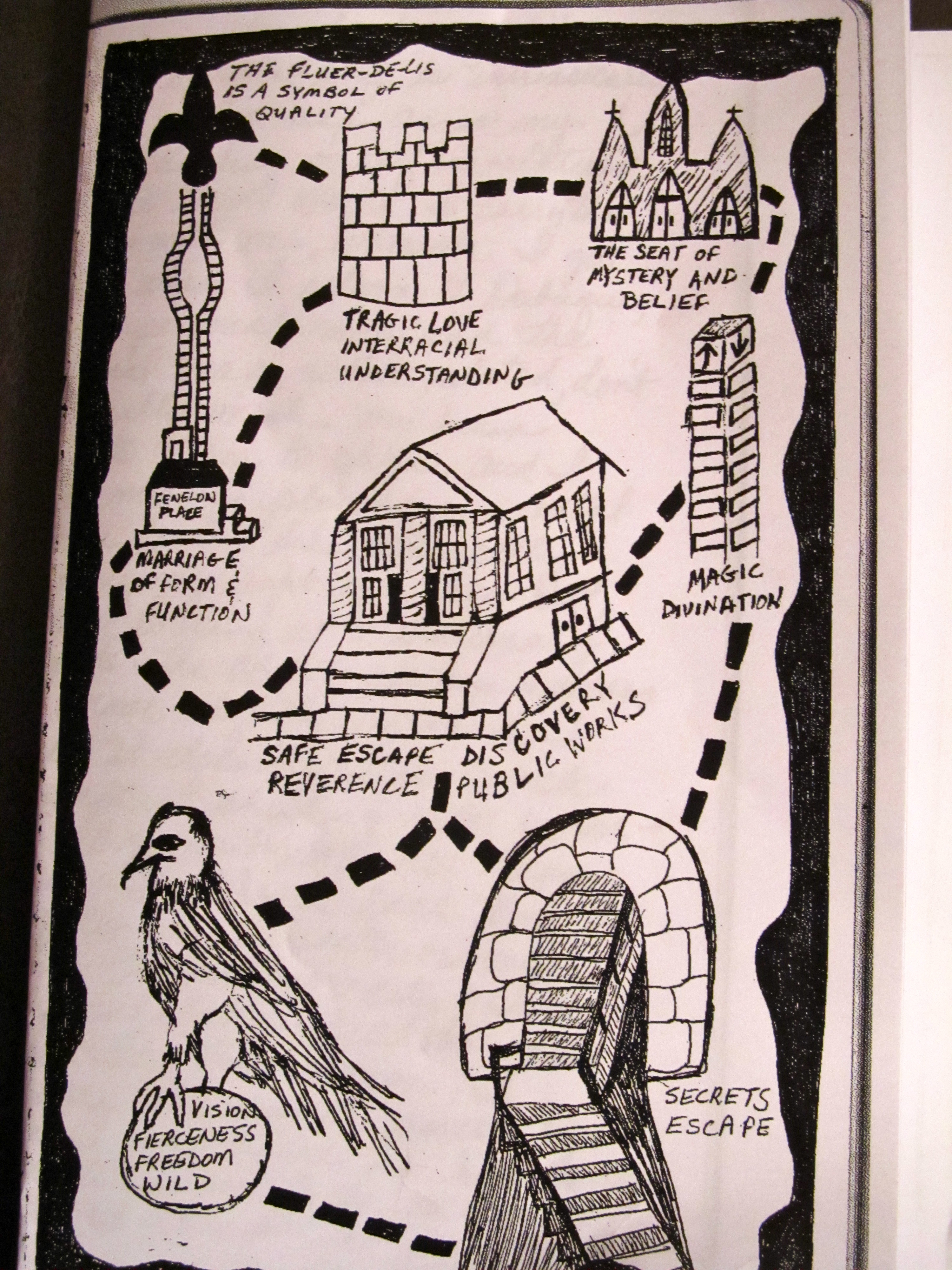
I think, “Like a memory castle, there is a map of Dubuque that I carry within me that bears only minimal relationship to the actual city’s map.” This map contains my memories and my memories of emotions. Attached to each site on the map are sensations, values, concepts experienced or learned throughout my formative years. My spiritual self is intrinsically tied to this map, as is my understanding of self in relation to the larger world.

The map in my psyche looks something like this:

Each location on the map is both a real place (the Fenelon Place elevator, the bank weather tower, the Carnegie-Stout Public Library) and an icon for the meanings I have associated with it (examples listed on the map above).

I carry this map with me, wherever I go. But when I return to Dubuque, my personal map and the actual map, while related, don’t actually match. My brain wants them to align, and I find myself playing a mental game much like alternately closing my right eye, then left, while looking at a stationary object. The object always appears to move slightly, although I know it doesn’t really. This quick perceptual shifting never works – the alignment will not happen. I have to choose each time to be in the exterior city or in the interior city – I can’t fully inhabit both at the same time.

For this reason, I treasure the small pieces of time I am alone in Dubuque. These turn out to be moments when I can sit in an actual physical location and touch the wealth of internal information I’ve stored in its metaphorical twin. Its a bit of a deep moment — like sitting in the coffee shop that used to be Theresa Delaney’s living room. Whatever keeps blowing the door open may be the wind or a ghost — but I can’t help thinking it might also be my other self (the self who has continued to inhabit my internal Dubuque long after the external self moved away) coming to join me for an Americano, extra-hot.

(Note: this post, and the map drawing it contains, are adapted from a journal entry I wrote several years ago)

When the Pendulum Swings

When I was younger, in high school and college, I was very deeply involved in religious activities. Several times a year, I went on weekend retreats, which were invariably peak experiences. People who hardly knew one another would open the contents of their hearts, bond quickly and intensely, and share a high well beyond any experienced in normal, daily life. Returning to normalcy post-retreat was always difficult. People returned to their daily selves, and the shared experience grew less powerful as a touchpoint with one another. As the retreat ended, you told yourself things had changed, that you had changed. But the truth was, your old self and habits nearly always reasserted themselves.

I remember Pastor Ross addressing this: faith isn’t a feeling, he said. When the feeling of the retreat passes, you discover that faith is a verb. Something you actively do, not something you passively feel.

It has now been many years since I’ve been on that kind of retreat, or experienced exactly that kind of high. However, for just over a year now, I have been on a journey which has led to similar feelings: happiness, joy, a sense of purpose, renewed (or just new) relationships. My life has had a quality of incipience, every day on the cusp of a new experience or revelation. It has been amazing. I have gushed about it. I have sworn that everything is different now, things have changed, I have changed.

And all of that is true. However, no peak experience, no emotional high lasts forever. And when that feeling goes away, when the pendulum begins to swing on the downward arc, what does one do? More to the point, what should I do?

Option #1: Chase the High

A friend recently invited me to join her at a movie premiere in New York. The movie, directed by Robert Redford, stars several actors I enjoy. I loved that she asked, but for a variety of reasons needed to decline the offer. Several people told me I was crazy; in fact, one person said she wished she had my life because she would live it better than me. Well, that’s possible, I suppose. However, I am still me. I will still make decisions, for good or ill, based on my own values and gut feelings. I will never be the type of person who drops everything else in my life to jump at unusual experiences just to be able to say, “See what I did?!” So, chasing the high isn’t really an option suited to my temperament.

Option #2: Wallow.

As the pendulum drops from its apex, its easy to allow your emotional self to plummet into sadness and depression. Truthfully, there have been many times when this proved to be my modus operandi. In the current case, the things that have changed the most in my life are internal. The outward trappings have remained essentially the same. And now I am faced with the same life choices and decisions that have always awaited my attention: What should I be doing with my life? I have learned to be honest with myself, which felt really good at first, but which can be a bit depressing. For example, I pretended for decades that I didn’t have feelings like other people. Now, I’ve admitted to myself that I do and some of them are angry or disappointed or sad. Part of me wants to roll around in those denied emotions for a while, just feeling them. Luckily, my emotional health is more robust than it once was, and I can’t see the point in wallowing. So, Option #2 is a no go.

Option #3: Remember that to BE has always been a verb.

I’ve (briefly) studied two foreign languages in my life, and while I don’t remember much of either, I do remember that to be was the first verb we learned to conjugate in both of them.  So this option suggests that, regardless of what I am feeling, I can keep breathing, keep moving forward. I can keep living in the present, living as this new self I’ve worked so hard to become. And I can have faith – an active choice, not just a momentary feeling – in my ability to continue creating a meaningful life.

In summary: Option 1: too hard; Option 2: too soft.  Option 3…just right! Now that I’ve chosen an attitude, I just have to figure out the right action plan to go with it. And that will be both the hard and the rewarding part. I don’t know what will come next. But I do know that the pendulum will eventually hit its nadir and begin another upward climb!

Let’s Call It “Experience”

“Experience is what you get when you didn’t get what you wanted.”

— Randy Pausch, The Last Lecture

When I was a kid, I wanted an Easy Bake Oven.  Think about it: a toy in which a lightbulb provides the heat source to bake all kinds of delectable confections and a kid obsessed with delicious goodies.  Why wouldn’t the two be destined for one another?  But, I never got one.  Turns out, I wasn’t alone in my disappointment.  The other day I was talking with friends, and someone said, in the stilted tones of a disgruntled 10-year-old,  “I never got one either. My mom thought they were stupid.”  My own mother’s sentiments exactly.

The Christmas orgy of gift-giving affords many opportunities to think about what to do, or what it means, when you don’t get what you want.  Disappointment in the gifts received is only the tip of that iceberg.  We hang so many hopes and expectations on the holiday — we want someone to stick a bow on us and say, “You’re my present this year” like in the coffee commercial.  We want that moment when we are completely aware that our life is rich and full of meaning (resulting in our buddy Clarence getting his wings).  We want to sing in four-part harmony about the white Christmas of our dreams while wearing gorgeous red-velvet dresses…ok, maybe that one is just me!  You get the picture, though.

I, personally, have been lucky in two ways.  First, growing up in a family with six children and a limited income, I had many opportunities to learn that I might not get everything I wanted.  I learned many coping mechanisms for this, from swallowing my disappointment with a 2000 calorie chaser of fudge to learning to be happy with what I did have.  Admittedly, some mechanisms were more helpful than others.

The second way in which I have been lucky is that, in the past year or so, I’ve gotten more than I ever expected on so many levels. I won a cruise, for crying out loud, not to mention healing relationships and recovering self-esteem along with some pretty amazing bike rides.  And I’ve been learning healthier coping mechanisms too.

Which, it turns out I’ve needed recently.  I got so accustomed to getting whatever it seemed I wanted, that I started to forget that life doesn’t work that way 100% of the time.  And BLAM! I ran smack up against it: not getting something I really wanted. Had this been something material, like an iPhone or a Nook, I think I would have taken it in stride.  But in the realm of emotional desires, I’ve discovered it can be much harder to find a way to manage extreme disappointment.  Here’s how I’m proceeding:

1.  I remind myself of the Randy Pausch quote, above.  Experience, as he refers to it, is just another name for living life as fully as possible.  And that is, deep down, what I truly want.

2.  I remind myself to be grateful for all I do have.  The list is long, and astounds me when I really think about it.

3.  I surround myself with people who make me laugh, to balance the private moments when, sometimes, I cry.

4.  I take action in other aspects of my life in order to feel positive momentum:  craft room clean, check; menu planned for the week, check; Tupperware organized, check. (If you know me, you’d better be laughing at this last one – when have I EVER been the kind of person who has orderly Tupperware?)

In these ways, even the awful feeling of not getting your heart’s desire can be transformed. Not what you expected, but not at all shabby.  And you’re able to remember that gifts come in their own time.  I believe that hope and patience are excellent qualities to cultivate because they contribute to resilience in the face of disappointment. And because, despite what you feel today, you can never know what the future holds.

Which brings me back to the Easy Bake Oven.  I received a Christmas gift on which there was a tag which read, “From Santa:  Sorry!  I’m a few years late with this. ENJOY!”  I’m sure you know what was waiting under the wrapping paper. Sometimes, if not always, you do get the things you want. Maybe in a slightly delayed time frame, or from a source you never anticipated.  Being ready for either outcome is, perhaps, what experience is meant to teach us.

As it turns out…

…curbing the violent thoughts which run rampant in my head while driving is extremely difficult.  (In case you didn’t read last week’s entry, I have decided that conquering my violent thoughts is the new frontier.)  On Saturday, I grumbled about another driver in the Barnes and Noble parking lot, realizing only after I verbalized my thoughts that I had a passenger — and she had read my blog entry only that morning.  We looked, startled, at one another then burst into laughter.  Embarrassed laughter, on my part.  Humbling moments, such as this, serve to either convince me that a resolution I have made is hopeless or to recommit to it with greater vigor.  Which direction will I go?!

A few years ago, I read several publications, and watched some interesting films (What the Bleep? and The Secret) on the concept of the “Law of Attraction”.  The basic concept, and I am seriously simplifying here, is that we give off energy that attracts like energy to us.  I have experimented with this concept, and while my experiments have been limited, I have found that it works — to a point.  It’s all about focus: I need to focus on what I DO want, not what I DON’T want, to attract.  Behind the wheel, I am always focused on what I don’t want — a slow driver, or a tourist, or someone who doesn’t use turn signals, in front of me.  My friend, Sara, can vouch for the fact that I seem to be a magnet for unsure and infirm drivers.  This is one of the reasons that I am certain that I will have a better experience when driving if I somehow curb my thinking.

But it goes deeper than wanting a more pleasant driving experience.  Many minds more gifted than mine, from theologians like Pierre Theilhard de Chardin to visionaries like the woman who became known simply as Peace Pilgrim, have written about the need to take a close, hard look at what we allow to exist in our hearts and in our heads.  That these thoughts have real consequences in the world.

Many years ago, I was introduced to one writer who has had a profound impact on my understanding, if not my actual behavior. Etty Hillesum wrote extensive diaries and letters about her spiritual transformation during the period leading up to and culminating in her death in Auschwitz.  She had many offers from admirers and friends to go into hiding, however, she chose to work openly to try to relieve some of the suffering of her people — and to share in their suffering herself when the time came.  Before she was sent to the death camp, she gave her diaries to a friend for safe-keeping, with the instruction to publish them if she died.

In her diaries, which were finally published in the 1980s, Etty speaks eloquently to the point of managing your inner dialogue.  “I see no other solution…than to turn inwards and to root out all the rottenness there. I no longer believe that we can change anything in the world until we have first changed ourselves.  And that seems to me the only lesson to be learned from this war.  That we must look inside ourselves and nowhere else.”  By February, 1942, when Etty wrote this, she had seen enough inhumanity that she could easily have been forgiven for vilifying the Enemy.  But she took another route.  “By our own hatred…our greatest injury is one we inflict upon ourselves…True peace will come only when every individual finds peace within himself; when we have all vanquished and transformed our hatred for our fellow human beings of whatever race–even into love one day.”

You may be thinking it is a far cry from rising to noble heights while living through one of the greatest human atrocities of the modern world to training oneself not to curse at other drivers.  But that’s not really true.  How can I root out and unlearn my own ingrained prejudices if I can’t even curb this petty vitriol?  That is the real question behind my desire to get a grip on my driving problem.  Which takes me back to the question: decide its hopeless or recommit with renewed vigor?  Taking my cue from Etty Hillesum, what other choice is there if I value peace in this world?